

How Many Hours a Week Does a Dog Franchise Owner Actually Work?
Top TLDR: How many hours a week a dog franchise owner works depends entirely on the phase of the business and whether they are operating it personally or through a general manager. Pre-opening and launch typically run 50-plus hours per week. A stabilized, manager-run location can drop to 15 to 25 hours. If you are planning your transition, build your schedule assumptions around the launch phase first.
The most common answer you'll find online is somewhere between 40 and 60 hours a week. That's not wrong, but it's not the full picture either. How many hours a dog franchise owner actually works depends on which phase of the business they're in, whether they're running it themselves or through a manager, and how well the franchise system they chose does or doesn't reduce administrative load. This page breaks all of that down in plain terms.
The Answer Changes Depending on Which Phase You're In
Dog franchise ownership doesn't have a single weekly schedule. It has phases, and each one looks different.
Most prospective franchise owners underestimate how much time the pre-opening period requires. They also underestimate how much the workload shifts after a location is 12 months in and well-staffed. The hours a week question only makes sense when you attach it to a specific phase.
Here's how those phases actually break down.

Phase 1: Pre-Opening (The Most Intensive Period)
Before the doors open, the owner is the business. There's no team running operations yet, no manager handling daily tasks, and no members to take care of. Everything that needs to happen before opening day runs through the owner.
During pre-opening, a Wagbar franchisee works through the build-out process, completes the franchise training program, handles hiring, sets up membership systems, works on local marketing, and coordinates with the franchisor on everything from site readiness to operational procedures.
Wagbar provides a proprietary pre-opening platform called "Opener" that guides franchisees step by step through the launch process. That structure removes a lot of the guesswork, but it doesn't remove the time. The owner still has to show up for every step. Pre-opening for a location that's building out from scratch often runs well beyond standard business hours, particularly in the final weeks before launch.
Wagbar also brings franchisees to Asheville, North Carolina for a one-week intensive training covering dog behavior management, bar operations, staff training methods, and marketing. That week is fully committed. Franchisees who have jobs they haven't yet left often use PTO or work with their employer during this phase.
The honest expectation for pre-opening: 50 to 60-plus hours per week is common, sometimes more depending on how complex the build-out is. This phase is time-limited, but it should not be underestimated.
Phase 2: The Launch Window
Grand opening through the first three to four months is the second phase, and it demands nearly as much time as pre-opening, just in a different form. Now the owner is actually running operations, training staff on the floor, handling the inevitable surprises of a new business, building member relationships from scratch, and troubleshooting anything the systems didn't anticipate.
Wagbar sends a team member to be on-site during the grand opening itself. That support is real and it helps, but the owner is the constant. Staff turn to them for decisions. Members introduce themselves. Vendors need sign-off. The franchisor wants feedback on how opening week went.
An owner-operator during launch is typically working six days, often putting in 50 hours or more. A franchisee who hired a general manager before opening is in a slightly different position, spending a lot of that time training, observing, and reinforcing rather than executing every task personally. But they're still very much present.
This phase is also where the community foundation gets built. At a dog bar specifically, the early members are disproportionately important. They become the word-of-mouth base, the regulars who bring friends, and the people who stick around even when the business has growing pains. Owners who show up during this phase, who know the dogs' names and remember which members have been there from the start, build something harder to replicate than any marketing budget.
Phase 3: A Stabilized Location (What Ongoing Looks Like)
Six to twelve months in, with a trained staff and a growing member base, the weekly hours look very different depending on how the owner structured the business.
For an owner-operator who is on the floor most days: 40 to 50 hours per week is typical. They're running the venue, managing staff, coordinating events, reviewing financials, and handling the relationship with the franchisor. It's a real job, not a passive income stream.
For an owner running through a general manager: the picture shifts considerably. Weekly involvement moves toward reviewing financial reports, checking in with the GM, handling any personnel issues at the management level, and staying current with franchisor updates. Owners in this structure often describe spending 15 to 25 hours per week on the business once it's stable, with heavier involvement during events, staff transitions, or when something operational needs attention.
The off-leash dog bar model at Wagbar has structural features that support the lower end of that range. It operates during set hours with no overnight component. There's no boarding to manage. The membership model creates predictable revenue and predictable traffic patterns. Those characteristics matter when you're trying to delegate operations to a team.
Owner-Operator vs. Manager-Run: The Real Difference in Weekly Hours
The ownership structure question is the single biggest variable in how many hours a dog franchise owner works. Two owners with the same franchise, in similar markets, can have completely different weekly workloads based on how they've organized the business.
An owner-operator who works the floor alongside their team will put in the most hours. They know the most about day-to-day operations, have the deepest member relationships, and have the most direct control over quality. They also have the least personal schedule flexibility.
An owner who runs through a strong general manager handles a different set of tasks. Their time goes into financial oversight, key hiring, community strategy, franchisor communication, and performance management. The total hours are lower, but the work requires different skills. Financial literacy, the ability to read a P&L and ask the right questions, and genuine comfort with managing through someone else rather than doing the work directly.
Several Wagbar franchisees came from backgrounds that map well to the oversight role. AJ Sanborn, the Richmond, Virginia franchisee, spent 20 years in financial services before opening his Wagbar location. Reading performance data and holding teams accountable to metrics is not new territory for someone with that history. Dianna, who brought Wagbar to Phoenix, Arizona, came from IT sales with restaurant industry experience, giving her a solid operational baseline for evaluating how the floor is running even when she's not there.
The dog business models guide covers how different ownership structures perform in the pet industry more broadly, including what makes the experience-based venue model different from service franchises when it comes to delegation.
What Takes Time That Owners Don't Expect
Beyond the obvious operational hours, dog franchise owners consistently report a few time costs that didn't show up clearly in their pre-purchase research.
Community management. A dog bar's success is built on community. Events, member relationships, breed meetups, holiday programming, and local partnerships all require someone's attention. When the owner is the face of the business, much of this falls to them. Even owners running through a GM often stay involved in community-building because it's the part of the business they genuinely enjoy, and because member retention responds to owner visibility.
Staff recruitment and turnover. Hiring well for a dog bar takes time. The right staff profile, someone comfortable around dogs, skilled with customers, and reliable in a physical environment, is more specific than a generic service industry hire. When turnover happens, the owner is the one rebuilding the team. Planning for this time cost upfront is worth it.
Franchisor communication and reporting. Wagbar provides ongoing support through quarterly business reviews, marketing assistance, and operational updates. These are genuinely useful touchpoints. They're also commitments of the owner's time, not the GM's.
Vendor and facility relationships. Equipment maintenance, supply chain logistics, local food truck partnerships, and facility upkeep are recurring owner tasks that don't show up in any single week as especially heavy, but add up across a month.
What Wagbar's System Takes Off Your Plate
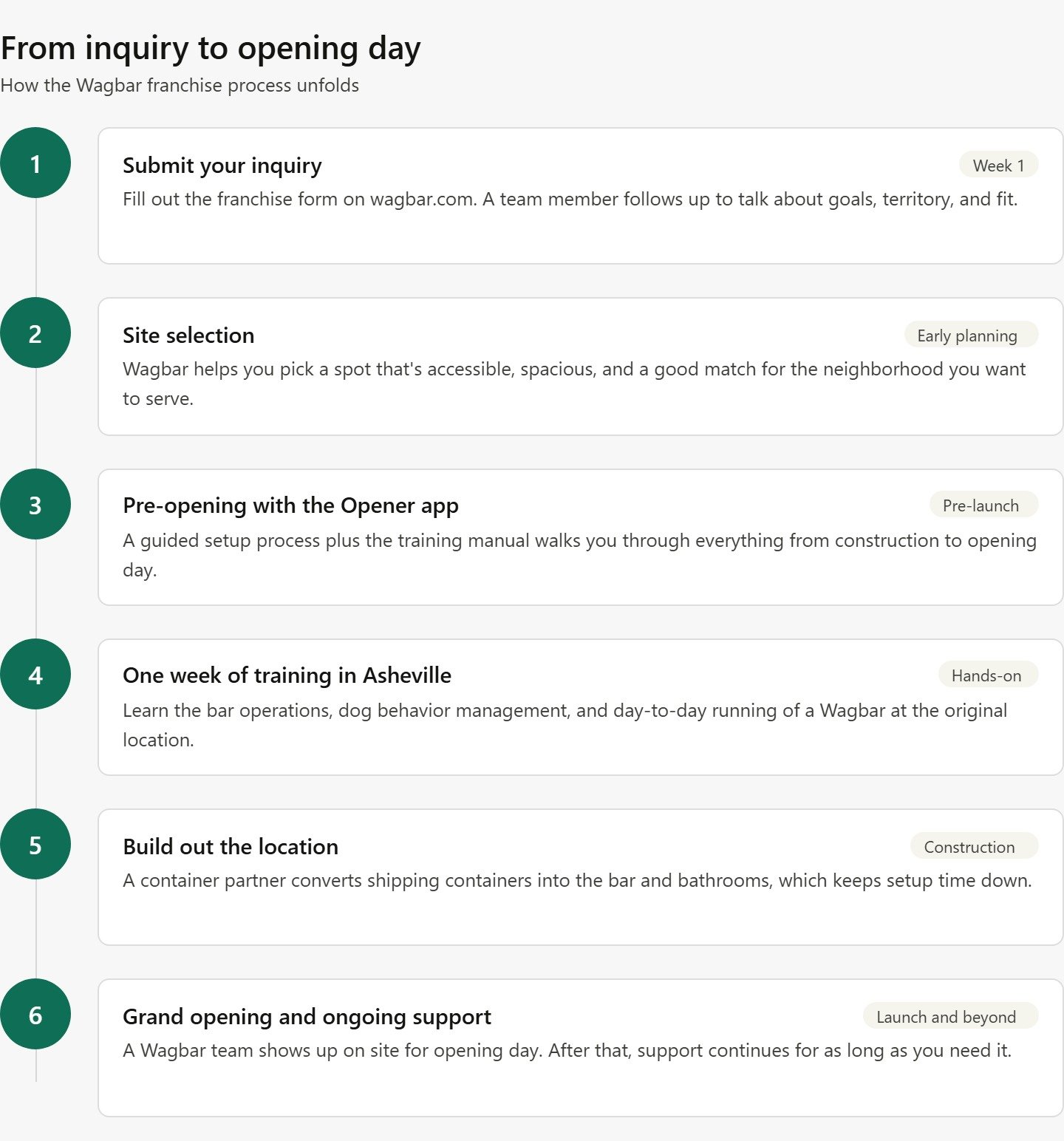
The case for franchising over independent business ownership often comes down to what's already built. For a Wagbar franchisee, several operational layers that an independent business owner builds from scratch are provided through the franchise system.
The operational playbook, staff training curriculum, membership management infrastructure, and brand marketing templates all come with the franchise. The build-out process is simplified by a near-turnkey option using converted shipping containers as the bar and bathroom structures. Ongoing support through quarterly reviews means the owner has a structured accountability channel rather than figuring out what to measure on their own.
None of that eliminates the work of running the business. But it does front-load that work into learning and executing an existing system rather than designing the system first. For first-time business owners, that distinction matters significantly when it comes to how quickly they can reach the stabilized, lower-hour phase of ownership.
The benefits of owning a pet franchise page covers the full scope of what the Wagbar support structure provides, and how it compares to building a similar concept independently.
Frequently Asked Questions
Is a dog franchise considered a passive investment?
Not at the typical ownership scale. A single-unit dog franchise requires real involvement from the owner, particularly during pre-opening and launch. In a manager-operated structure with a stable team, the involvement level drops substantially, but it's still an active investment that requires consistent financial oversight and strategic attention. Multi-unit ownership with experienced GMs at each location can move toward a more passive structure, but that's a longer-term evolution.
Does Wagbar require the franchisee to be on-site full-time?
The specific requirements for franchisee involvement are detailed in the Franchise Disclosure Document. The franchise opportunity overview covers the general structure. For specific questions about on-site requirements, the Wagbar franchising team is the right contact.
Can someone open a Wagbar franchise while still employed full-time?
Pre-opening requires significant time commitment, including a one-week training program in Asheville. Whether someone can manage the build-out and launch phase while keeping a full-time job depends heavily on the job's flexibility and the scope of the build-out. Many franchisees transition out of employment before or during launch. This is a personal planning question worth working through honestly before signing anything.
Does the number of units affect weekly hours?
Yes, but not in a linear way. A second or third unit doesn't double the owner's personal hours if the management structure is already in place. At three or more units, the owner's time shifts heavily toward managing managers and financial oversight rather than individual location operations. Wagbar offers a 50% discount on the franchise fee for franchisees committing to three or more units, making multi-unit growth financially structured into the model.
What's the hardest part of managing time as a dog franchise owner?
The launch phase, consistently. Pre-opening and the first few months of operation require more hours than most owners anticipated, even when they tried to plan for it. Owners who go into that phase expecting it to be their most intensive period, rather than hoping it won't be, tend to manage it with less stress.
How do Wagbar's revenue streams affect how much time the owner puts in?
A diversified revenue model, including memberships, day passes, bar sales, and events, means the owner or GM is managing multiple performance lines, not just one. Events in particular require planning and execution time. The revenue structure for off-leash dog bars explains how those streams work together and what each one demands operationally.
Bottom TLDR: How many hours a week a dog franchise owner works is not a fixed number. It shifts from 50-plus hours during pre-opening and launch to significantly less once the location is stable and a GM is running daily operations. Wagbar's training program, operational playbook, and ongoing franchisor support help shorten the heavy-hour phase. Audit your current weekly capacity before committing and plan for launch to be your most demanding stretch.