
From Corporate to Off-Leash: How Wagbar Franchisees Made the Switch
Top TLDR: Three Wagbar franchisees made the switch from corporate to off-leash dog bar ownership — AJ Sanborn from 20 years in financial services in Richmond, Dianna from IT sales in Phoenix, and Jennifer from a corporate career in Los Angeles. Each brought transferable professional skills and a genuine love of animals to a franchise model built to close the operational gaps. Visit wagbar.com/franchising to start the conversation about available territories.
Most career changes look obvious in hindsight. The person who left accounting to open a bakery, the engineer who became a teacher — once they're on the other side, the path makes sense. But from where they were standing before they moved? It rarely felt obvious at all.
The Wagbar franchisees who came from corporate careers describe something similar. They had real careers, real track records, real reasons to stay. What shifted, for each of them, was less about the job and more about what the job couldn't give them. What comes through in their stories — consistently, across different industries and different cities — is that the move wasn't impulsive. It was deliberate, and it was grounded in something they actually cared about.
This page profiles three of those owners: AJ Sanborn in Richmond, Virginia; Dianna in Phoenix, Arizona; and Jennifer in the Los Angeles area. Their backgrounds are different. What drew them to the same business is worth understanding if you're asking similar questions about your own next move.
AJ Sanborn, Richmond, Virginia: Two Decades in Financial Services
AJ Sanborn spent 20 years in the financial services industry before he started looking for what came next. That's a long time to build expertise, professional relationships, and a way of thinking about risk and return. It's also a long time to figure out what a career can and can't give you.
When AJ began exploring his options, one of them was opening a traditional bar. He knew the hospitality side had appeal — the social environment, the regulars, the sense of being at the center of something communal. But a traditional bar didn't fully account for the other thing that mattered to him: animals.
Finding Wagbar closed that gap. The combination of an off-leash dog park and a bar wasn't just an interesting business concept. For AJ, it connected two things that had previously been separate — his interest in running a social, community-centered space, and his genuine love for animals.

What AJ brought from financial services is exactly what running a pet franchise opportunity requires in ways that aren't always obvious from the outside. Two decades of evaluating financial risk means he understood investment analysis, cash flow modeling, and how to read a deal soberly rather than emotionally. Those skills don't disappear when you change industries. They just get applied in a different context — one where the daily work happens to involve dogs.
AJ and his fiancée share their home with Bibi, a fluffy white dog, and were anticipating the arrival of a Bernese Mountain Dog when he joined the Wagbar network. The Richmond market — a city with a strong professional community, active social scene, and growing dog owner population — fit the demographic profile that tends to support a Wagbar location well.
The part of this transition that tends to catch analytically trained people off guard isn't the business side. It's the pace and physicality of the work. Running an off-leash dog park and bar is active, present, and people-facing in a way that financial services rarely is. The days are less structured, the problems are more immediate, and the feedback loop from customers is constant and direct. For people who've spent careers behind a desk, that shift is both energizing and disorienting in the early months.
Dianna, Phoenix, Arizona: IT Sales Meets Restaurant DNA
Dianna's path to Wagbar runs through two professional worlds that don't often overlap: IT sales and the restaurant industry. After years in IT sales — a career built on understanding customer needs, managing complex sales cycles, and hitting targets — she was looking for a business that would bring those skills together with something she cared about on a deeper level.
The restaurant background is what makes her story particularly interesting in the context of a franchise like Wagbar. Running a dog bar is operationally closer to running a small restaurant or bar than most people realize. There's inventory management, staff scheduling, a licensed bar to run, customer-facing service standards, and the challenge of creating an environment where people want to come back. Someone who already knows what good hospitality operations look like has a meaningful head start.
What Dianna wanted, in her own words, was a business that felt like community building rather than traditional business. Wagbar's model — built around recurring memberships, regulars who know each other, events that bring the local dog owner community together — is specifically designed to produce that kind of environment. It isn't incidental. It's the product.
Phoenix, Arizona is a strong market for the Wagbar concept. High population density, strong dog ownership rates, a social culture that thrives in outdoor settings — it checks the demographic boxes that Wagbar looks for when evaluating territories. For more on how Wagbar evaluates markets, the best cities for dog franchise success resource covers the specific factors that matter.
The transition from IT sales to franchise owner surfaces a challenge that's worth naming directly: the loss of the institutional support structure. In a large company, you have HR, legal, finance, marketing, and IT all working in the background. As a franchise owner, you're the person who has to coordinate all of those functions, even when Wagbar's support system is handling significant pieces of it. People who come from corporate environments often underestimate how much mental energy that requires until they're doing it.
The flip side is accountability. Dianna's success at Phoenix is directly connected to her own decisions and effort in a way that a sales quota at a large company never quite captures. That direct link between work and outcome is something franchisees from corporate backgrounds consistently identify as one of the most significant differences — and, ultimately, one of the most rewarding ones.
Jennifer, Los Angeles, California: Corporate Career, Lifelong Animal Lover
Jennifer's story is perhaps the most direct line between who she's always been and what she's doing now. As a child, she wanted to be a veterinarian or a marine biologist. Animals were a consistent thread through her life even as her career took a different path. A long corporate career brought professional success, skills, and resources. What it didn't do was connect her work to the thing she'd cared about since she was young.
The decision to open a Wagbar in the Los Angeles area wasn't a pivot away from her corporate background so much as a return to something she'd always valued. She opened the location with her husband's support and brought three dogs to the enterprise. For Jennifer, the Wagbar concept represents something specific: not just a business but a place where she can be genuinely useful to the community she's building around it — a space that creates connection, not just commerce.
The Los Angeles market is one of the more complex environments in which to open any business — regulatory, logistical, and competitive factors all run at a higher degree of difficulty than most other U.S. markets. The fact that the Wagbar franchise system provides site selection guidance, a streamlined build-out solution using converted shipping containers, and pre-opening operational support through the "Opener" app matters more in a market like LA than it might in a smaller city. The system is designed to remove the complexity that would otherwise fall entirely on a first-time business owner's shoulders.
What corporate backgrounds tend to prepare people well for in this context is project management under ambiguity — understanding how to move a complex initiative forward when not every variable is controlled. Opening a new Wagbar location has a lot of that quality. The training and support structure establishes the framework, but the owner is the one navigating local specifics, building the team, and doing the community outreach that turns a new location into a neighborhood fixture.
For Jennifer, the work aligned with what she'd always wanted: to be around animals, to build something that mattered to people, and to use the professional skills she'd developed to create something real in her own community. The dog business franchise models guide covers the broader landscape of how different pet business concepts compare if you're still evaluating your options.
What These Three Stories Have in Common
The obvious thread is that all three came from professional careers with transferable skills and chose Wagbar because it connected that professional foundation to something they genuinely cared about. But there are a few less obvious patterns worth noting.
None of them had direct pet industry experience. AJ came from financial services. Dianna from IT sales and restaurants. Jennifer from a corporate career. Wagbar's training program is designed specifically for this kind of owner — someone who brings strong business instincts and needs to build the pet-specific operational knowledge. The benefits of owning a pet franchise page covers what that support system includes in detail.
All three were making deliberate moves, not escaping bad situations. There's a meaningful difference between leaving something and moving toward something. People who franchise primarily to escape a job they dislike often find that the stress of ownership is harder to manage than the job they left. People who move toward something they actually want to build tend to perform differently when things get hard, which they do for virtually every new franchise owner at some point.
The markets are each genuinely strong for the concept. Richmond, Phoenix, and Los Angeles each offer the population density, dog ownership rates, social culture, and disposable income that support a Wagbar location. These weren't random choices — they reflect the kind of market selection thinking that the complete guide to market demographics for dog franchise success walks through systematically.
The investment required serious preparation. Wagbar's total estimated initial investment ranges from $470,300 to $1,145,900, with a $50,000 initial franchise fee. These are not decisions made casually. Each of these owners arrived at the process with the financial standing to make the investment seriously, which is part of what makes their transitions sustainable rather than precarious. Full financial details are provided through the Franchise Disclosure Document to qualified candidates.
What the Transition Actually Costs
None of this is framed here as easy. The switch from a structured corporate or sales career to owning an off-leash dog park and bar involves real adjustment, and being honest about that is more useful than glossing over it.
The first year of a new franchise location is demanding in ways that are hard to fully anticipate. You are building a member base from zero, figuring out what works in your specific market, managing staff through their own learning curves, and handling the kinds of problems that don't come with instruction manuals. The franchise system removes a significant amount of the startup complexity — the build-out infrastructure, the operational training, the playbook for how a successful Wagbar runs — but it doesn't remove the effort of being a first-year business owner.
What it does provide is structure, support, and a model that has already worked in other markets. For people coming from corporate careers who are used to operating within defined systems, that combination is often more reassuring than starting from scratch would be. There's something to build on. There are people to call.
The dog franchise opportunity page is a useful starting point for comparing how Wagbar's model sits within the broader pet franchise landscape. And if you've read these three profiles and recognize something of yourself in them, the most direct next step is visiting wagbar.com/franchising to start a conversation about available territories and what the inquiry process involves.
Frequently Asked Questions
Do Wagbar franchisees need a background in the pet industry?

No. The current Wagbar franchise network includes owners from financial services, technology sales, corporate management, and other professional backgrounds. Wagbar's training program is built to equip owners with the operational skills specific to running an off-leash dog park and bar, including dog behavior management and bar operations, regardless of prior pet industry experience.
What professional backgrounds tend to translate well to Wagbar franchise ownership?
Finance and analysis backgrounds are useful for cash flow management, investment evaluation, and financial planning. Sales backgrounds translate into member relationship building, community outreach, and local marketing. Operations and project management experience maps directly onto staff management, events programming, and the build-out process. Hospitality backgrounds provide a meaningful head start on bar operations and customer experience standards.
What does the Wagbar training program include for new franchisees?
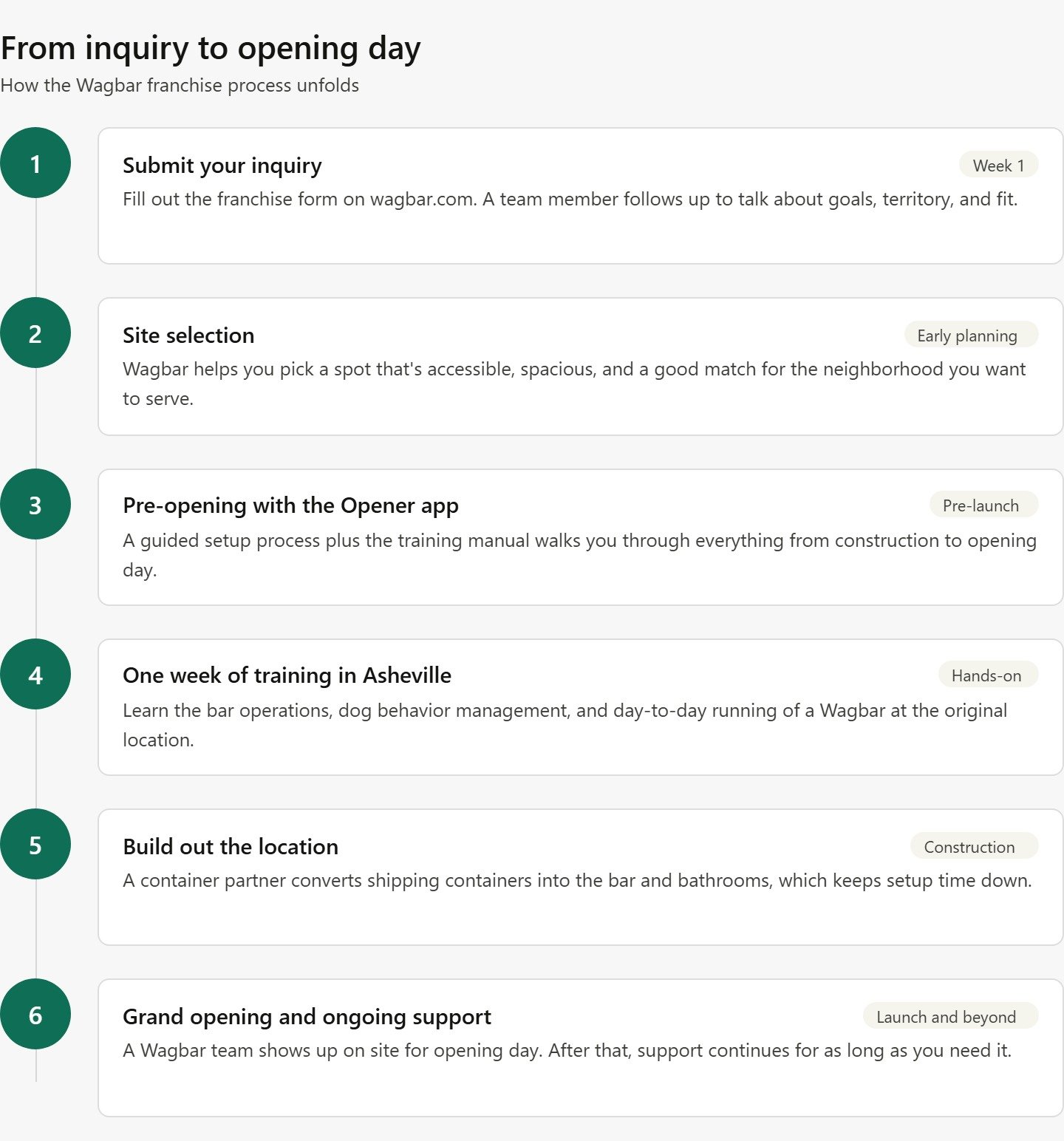
Training begins with the proprietary "Opener" app, which guides franchisees through site selection and pre-opening setup. It continues with an intensive week on location at Wagbar's Asheville, North Carolina headquarters covering dog behavior management, bar operations, staff training, and marketing. A Wagbar team member is present for the grand opening, and ongoing support continues through quarterly business reviews and operational guidance.
What is the investment required to open a Wagbar franchise?
The total estimated initial investment ranges from $470,300 to $1,145,900. The initial franchise fee is $50,000. Ongoing fees include a 6% royalty on adjusted gross sales and a 1% marketing fund contribution. Franchisees who commit to three or more units receive a 50% discount on the franchise fee for additional locations. Full financial details are provided through the Franchise Disclosure Document.
How does the franchise system help corporate-background owners manage the transition?
Wagbar provides a build-out solution using converted shipping containers that simplifies the physical setup of the bar and bathroom infrastructure, a structured training program for operational skills, site selection guidance, and ongoing support after opening. For owners coming from corporate environments who are accustomed to operating within established systems, the franchise model provides the structure that makes the transition from employee to owner significantly more manageable than starting from scratch.
Bottom TLDR:The corporate-to-off-leash switch that Wagbar franchisees made in Richmond, Phoenix, and Los Angeles followed a consistent pattern: deliberate career transitions grounded in real professional skills, strong local markets, and a franchise system designed to handle the pet-specific operational knowledge they didn't yet have. If their experience reflects what you're weighing, review available territories at wagbar.com/franchising.
Investment figures are informational only and subject to change. Refer to the Franchise Disclosure Document for complete and current financial details. This content does not constitute an offer to sell a franchise.