

Franchise Business for Sale in Tampa, FL: Year-Round Dog Bar Operations in the Bay Area
Top TLDR: A franchise business for sale in Tampa, FL offers something most Wagbar markets cannot: an outdoor dog bar that operates at full capacity every month of the year. Tampa's subtropical climate sits in USDA hardiness zones 9b and 10a, with hard freezes occurring only a few times in 75 years. With a metro population of 3.04 million and employment growing 4.14% annually, Tampa Bay is built for year-round revenue. Start at wagbar.com/franchising.
Most off-leash dog bar franchises operate in four-season markets. They build their membership base knowing that January in Asheville or February in Richmond will compress outdoor activity, shift customer behavior, and create seasonal variability in revenue. Ownership in those markets means planning around a peak season rather than operating at consistent capacity.
Tampa doesn't have that problem.
Hard freezes in the Tampa Bay area are so rare they've occurred only a few times in the last 75 years, according to Wikipedia's climate documentation of the region. Highs range between 65 and 95 degrees Fahrenheit year-round. The USDA designates the area in hardiness zones 9b and 10a — plant classifications reserved for subtropical and near-tropical climates where frost is an anomaly rather than a seasonal certainty. For an outdoor dog park and bar franchise, that translates directly to revenue: 365 operational days instead of the compressed peak season that governs most Wagbar markets.
This is the core argument for a franchise business for sale in Tampa, FL. The climate removes a risk variable that every investor in a northern market has to budget around.
Tampa Bay's Scale Creates Multi-Location Territory
The Tampa-St. Petersburg-Clearwater metropolitan statistical area reached a population of 3.04 million in 2025, growing 1.03% from the prior year, according to Macrotrends data. The broader Tampa Bay region — encompassing eight counties including Hillsborough, Pinellas, Pasco, Hernando, Manatee, Polk, Sarasota, and Citrus — is home to nearly 5 million people, according to the Tampa Bay Partnership's 2025 Regional Competitiveness Report. That report notes that Tampa Bay welcomed over 740,000 new residents since 2010, a 17.5% increase, and is projected to grow at nearly twice the national rate over the next five years.
The Tampa-St. Pete-Clearwater MSA ranks as the 18th-largest metropolitan area in the United States. That scale means a franchise investor is not evaluating a single city but a regional market with multiple distinct communities that could each support their own Wagbar location without meaningful geographic overlap.
Tampa city itself has a population of approximately 401,618 with a median household income of $75,475 and a median age of 35.9 years, according to 2024 U.S. Census ACS data compiled by Cubit Planning. Employment grew 4.14% year-over-year from 2023 to 2024, with the largest employment sectors concentrated in healthcare, professional and technical services, and finance. The city's population is young and growing, with 32.3% of residents between 25 and 44.

The suburban communities surrounding Tampa add significant demographic range. South Tampa's Hyde Park and Palma Ceia neighborhoods carry household incomes well above city averages, with a walkable urban character and strong outdoor lifestyle culture. The Westchase, Carrollwood, and Citrus Park corridors to the northwest represent established suburban family communities with high homeownership rates and dog-owning households that match Wagbar's membership profile. St. Petersburg across the bay has its own distinct character — a creative, community-oriented city with a growing young professional population and one of Florida's most active craft brewery scenes.
Florida's No-Income-Tax Environment and In-Migration Demographics
Florida has no state income tax. That affects both the franchisee's personal financial picture and the spending behavior of the consumer base they're building a membership business around. Residents who relocated to Tampa from higher-cost, higher-tax states — a significant portion of the region's in-migration wave — often find themselves with meaningfully more disposable income than in their prior locations. That additional discretionary spending capacity flows into experiences, including premium pet experiences.
The in-migration pattern itself matters. Tampa Bay has absorbed a sustained wave of transplants from the Northeast, Midwest, and California, bringing with them the dog-owning habits and lifestyle expectations that drive Wagbar's core customer: younger professionals treating their dogs as primary household members and seeking social venues where that relationship is central to the experience.
This demographic pattern mirrors what drives strong Wagbar markets in Richmond, Charlotte, and the Research Triangle: in-migration of higher-earning, dog-owning younger professionals into a market that already has an outdoor social culture and a craft beverage scene oriented around gathering with friends and dogs.
The off-leash dog bar model performs best in exactly this environment — communities where the customer base is already conditioned to spend weekends at outdoor social venues and where the dog is an assumed participant rather than a special accommodation.
The Year-Round Revenue Advantage in Practical Terms
For a franchise investor, the climate argument is not just about comfort. It's a business model argument.
Wagbar locations generate revenue through three streams: day passes, memberships, and bar sales. The membership model creates recurring income that doesn't require a transaction at every visit. But membership retention depends on customers using the venue consistently. In markets with cold winters, January and February test that retention. Members who stop coming because of weather may not renew. Day pass revenue drops during cold stretches.
Tampa eliminates that calculus. A customer who becomes a Wagbar member in Tampa has no reason to pause their visits in winter. The dog still needs exercise. The weekend routine still holds. The outdoor bar is still comfortable at 70 degrees in January. Revenue modeling in a Tampa location starts from a fundamentally different baseline than in a four-season market.
This is why the H1's framing of "year-round dog bar operations" is not just descriptive. It describes a financial advantage that compounds over time: consistent membership retention, predictable day-pass volume, and a bar revenue pattern that doesn't have a quarterly low point caused by weather.
Wagbar's container bar build-out system, which partners with a vendor to convert shipping containers into fully equipped bars and bathrooms, is well-suited to Tampa's outdoor orientation. The structure provides shade and protection from afternoon rain while keeping the concept outdoors where it belongs. The training and support program equips franchisees to manage the operational nuances of this format regardless of regional climate variation.
Wagbar's Florida Presence
Wagbar has already committed to the Florida market. The Wagbar Orlando, FL location is in development, giving the brand direct operational experience with Florida's regulatory environment, climate management considerations, and regional customer culture. For a prospective Tampa franchisee, that Orlando development serves as a proof-of-concept reference within the same state.

Florida's franchise regulatory environment is relatively straightforward — Florida is not one of the states that imposes additional franchise registration requirements beyond the federal FTC Franchise Rule, which requires a 14-day disclosure period before any agreement is signed. That simplifies the path from inquiry to signed franchise agreement compared to states with registration requirements.
The benefits of owning a pet franchise in a market with year-round operating conditions are practically visible in the revenue model: an owner-operator in Tampa is building the same business as in Charlotte or Dallas, but without the seasonal revenue compression that those markets experience during winter months.
Tampa Submarket Breakdown for Site Selection
Tampa's geography creates distinct submarket pockets, each with a different customer profile. A Wagbar location in Tampa benefits from site selection that matches the concept's specific needs: outdoor space, community-oriented neighborhood culture, and proximity to residential dog-owning households.
South Tampa and Hyde Park represent the highest-income urban submarket in the city. Hyde Park, Palma Ceia, and the Bayshore Boulevard corridor have dense concentrations of young professional homeowners with the income and lifestyle to support premium recurring spending. The neighborhood's walkability and proximity to Bayshore — the world's longest continuous sidewalk, used heavily by dog walkers — makes it a natural site for an off-leash social venue.
Westchase and Carrollwood to the northwest serve an established suburban family market with strong homeownership rates, good school districts, and dog-owning households that have the discretionary income and weekend routines that membership models depend on. Commercial development in these corridors includes the kind of mixed-use outdoor gathering spaces where a Wagbar location integrates naturally.
St. Petersburg across the bay has developed one of Florida's most active independent food, beverage, and arts scenes. The Central Arts District, Grand Central, and Kenwood neighborhoods have a strong community identity and a young professional population that has driven the city's growth as a destination independent of Tampa. A St. Pete location would operate as a distinct market from a Tampa location, serving a separate customer base.
Brandon and Riverview to the east and southeast represent the high-growth suburban corridor with rapidly expanding residential development, strong family demographics, and the dog-owner density that follows suburban growth in warm-weather markets.
Franchise Investment and Entry Requirements

The initial franchise fee is $50,000. Total estimated investment ranges from $470,300 to $1,145,900 depending on site, build-out, and local market factors. The royalty fee is 6% of adjusted gross sales, with 1% directed to the Wagbar marketing fund. For franchisees committing to three or more locations, a 50% multi-unit discount on the franchise fee applies. Given the Tampa Bay region's scale and the distinct community submarkets described above, a multi-location strategy within the broader Bay Area is a realistic investment thesis.*
Revenue comes from day passes, memberships, and bar sales. The revenue model for off-leash dog bars covers how these streams work together, but Tampa's specific advantage is the elimination of seasonal revenue compression that affects the pattern in northern markets.
This information is provided for general reference only and is not an offer to sell a franchise. Investment figures are estimates. Full details are in the Wagbar Franchise Disclosure Document (FDD). Wagbar Franchising LLC, 7 Kent Place, Asheville, NC 28804.
Frequently Asked Questions
Is Wagbar franchising in Tampa, FL?
Tampa is available territory for Wagbar franchise development. Prospective investors can submit an inquiry at wagbar.com/franchising to discuss specific territory availability, qualification requirements, and the evaluation process.
How does Tampa's climate affect franchise operations?
Tampa's subtropical climate means outdoor dog park operations are viable 365 days a year. Hard freezes are extremely rare, with the area classified by the USDA in hardiness zones 9b and 10a. This eliminates the seasonal revenue compression that four-season markets experience in winter, creating a more predictable annual revenue pattern for membership-based businesses.
Is there an existing Wagbar in Florida?
Yes. The Wagbar Orlando, FL location is in development. That commitment gives Wagbar direct experience with Florida's regulatory environment and customer culture. For a Tampa investor, the Orlando development provides a state-level operational reference point.
What is the franchise investment?
The initial franchise fee is $50,000. Total estimated investment ranges from $470,300 to $1,145,900. Royalties are 6% of adjusted gross sales plus 1% to the marketing fund. A 50% multi-unit discount applies at three or more locations.* Full details are in the FDD.
Not an offer to sell a franchise. Offer made only by FDD.
What dog entry requirements apply?
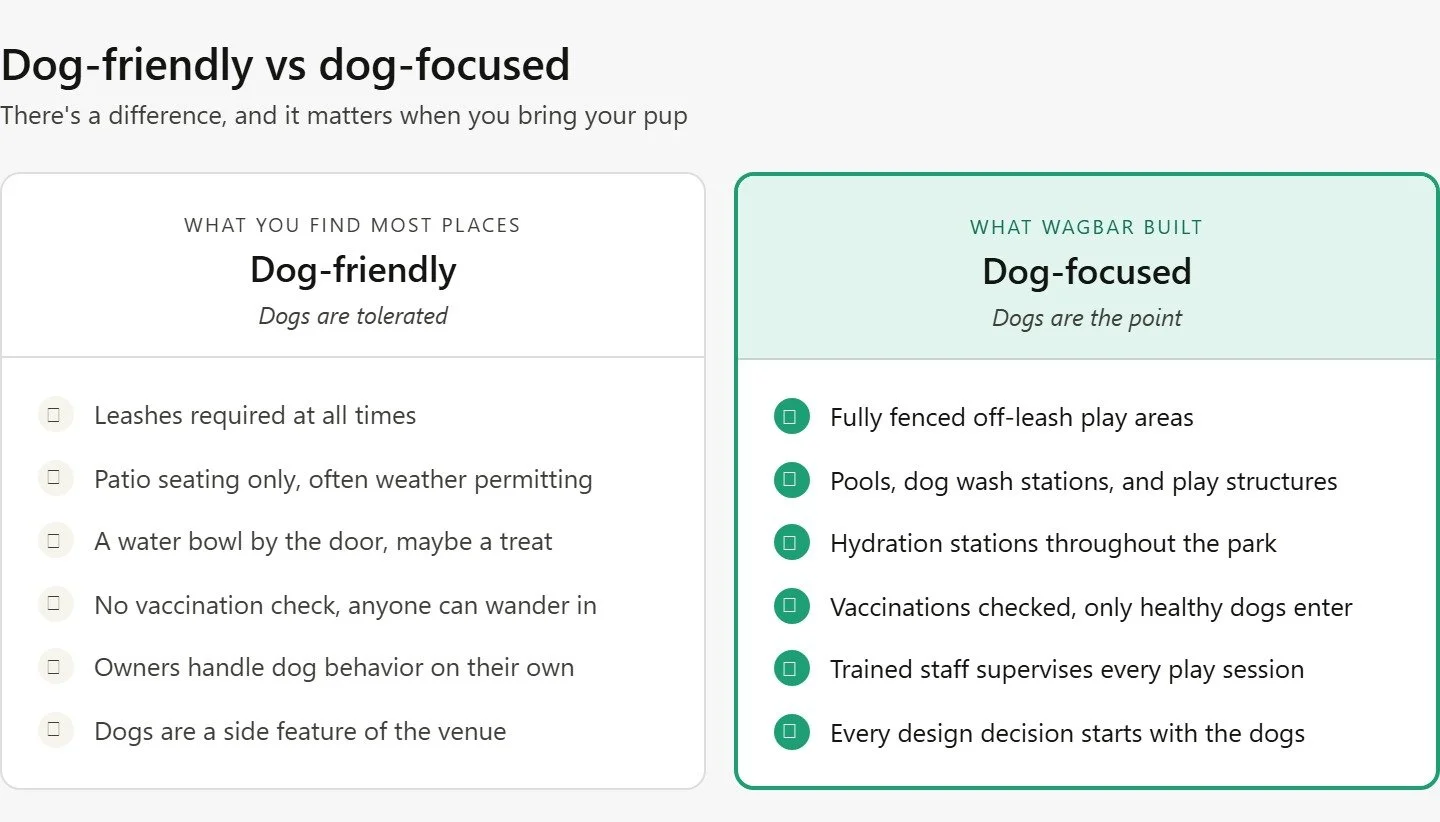
All dogs must be current on rabies, Bordetella, and distemper vaccinations, at least six months old, and spayed or neutered. Human guests 18 and older enter free. These requirements are consistent across all Wagbar locations. Details are at the Wagbar FAQ.
Does the Wagbar container bar system work in Florida's heat?
Yes. The container bar build-out includes shade structures and is designed for outdoor-first operation. The format's open-air configuration suits warm climates well, and shaded covered structures extend comfortable operating hours during Tampa's hottest summer afternoons. The off-leash dog bar design and operations guide covers the operational framework in more detail.
Bottom TLDR: A franchise business for sale in Tampa, FL benefits from year-round dog bar operations that no northern market can match. Tampa's subtropical climate — classified in USDA zones 9b and 10a, with hard freezes occurring only a handful of times in 75 years — removes the seasonal revenue compression that affects four-season markets. The Tampa-St. Pete MSA holds 3.04 million people and is growing. Explore territory availability at wagbar.com/franchising.