

Dog Park Franchise Investment Guide: Costs, Returns, and Financing Options

Top TLDR: A dog park franchise investment like Wagbar requires an initial investment of $470,300 to $1,145,900, including a $50,000 franchise fee, with ongoing royalties of 6% of adjusted gross sales. This dog park franchise investment guide breaks down every major cost, revenue stream, and financing path so you can make a confident decision before signing anything.
The pet industry crossed $147 billion in annual spending in the United States, and that number keeps climbing (American Pet Products Association, 2023). Dog owners aren't cutting back, even when household budgets get tight. That's part of what makes a dog park franchise investment so attractive to entrepreneurs who want a business with real staying power.
But "attractive opportunity" and "smart investment" are two different things. Before you commit to a dog park bar franchise, you need a clear picture of what you're putting in, what you can realistically expect to get back, and how long that's going to take.
This guide covers everything from the initial investment breakdown to exit strategies. No fluff, just the numbers and context you need.
What the Initial Dog Park Franchise Investment Actually Includes
Wagbar's total initial investment runs between $470,300 and $1,145,900. The range is wide because location costs vary significantly across different markets. A site in downtown Charlotte looks very different from a property on the outskirts of Cincinnati.
Here's how that investment breaks down across the major categories:
Franchise Fee: $50,000
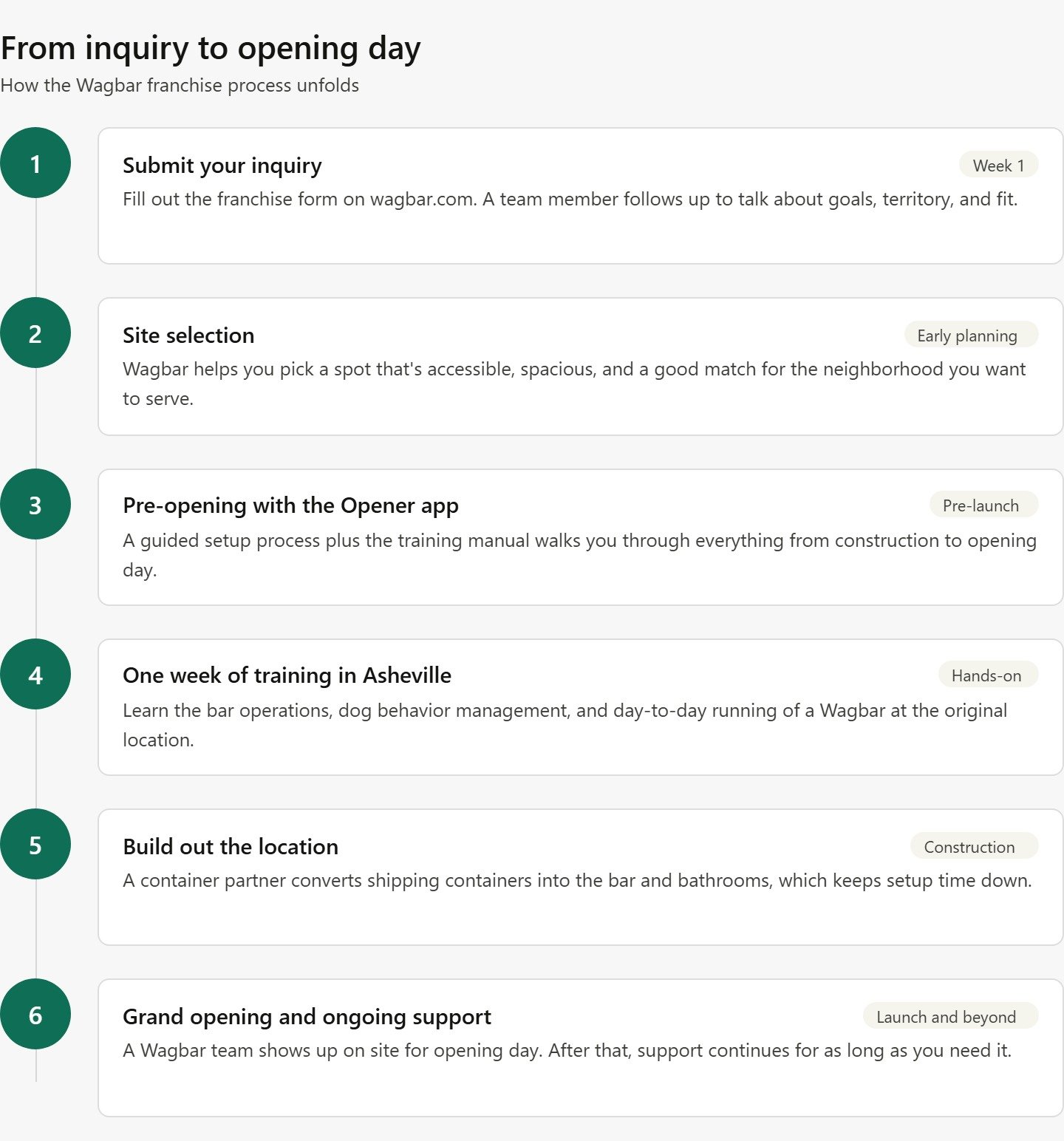
This is your licensing fee, paid upfront. It covers your right to operate under the Wagbar brand, access to the proprietary systems, initial training, and ongoing support. For franchisees opening three or more units, Wagbar offers a 50% multi-unit discount on the franchise fee, which meaningfully changes the math for investors thinking bigger.
Real Estate and Build-Out
This is typically the largest variable in the range. Leasehold improvements, construction, fencing, outdoor spaces, and landscaping all fall here. Wagbar has developed a near-turnkey build-out solution using converted shipping containers as fully equipped bars and bathrooms, which reduces both construction timelines and costs compared to building from scratch.
Equipment and Furnishings
Bar equipment, point-of-sale systems, outdoor furniture, safety fencing, lighting, and climate control infrastructure. For year-round operations in markets with harsh winters, covered or climate-managed spaces add to this line item.
Technology and Software
Wagbar uses a proprietary "Opener" app to guide franchisees through the pre-opening process. This digital infrastructure is built into the investment and doesn't require additional licensing fees on top of the franchise fee.
Working Capital
Standard franchise guidance recommends holding 3-6 months of operating expenses in reserve before opening. For a concept with a ramp-up period, this buffer matters. Undercapitalization is one of the most common reasons new franchise locations struggle in year one.
Initial Marketing and Grand Opening
Your launch matters. The initial marketing budget covers local advertising, social media presence, grand opening events, and community outreach. Wagbar provides marketing support and templates, but local spending is part of your startup equation.
Ongoing Operational Costs
Once you're open, your fixed and variable costs settle into a more predictable pattern. Understanding these ahead of time is how you build a revenue model that actually holds up.
Royalties and Marketing Fund
Wagbar charges 6% of adjusted gross sales as a royalty fee. An additional 1% of adjusted gross sales goes to the Wagbar marketing fund, which supports brand-wide advertising and awareness. Combined, that's 7% off the top of every dollar you bring in. It's a standard structure for the pet franchise industry, and it funds the ongoing brand development that makes your local location more recognizable.
Staffing
Labor is typically the largest ongoing cost category for a Wagbar location. You'll need staff trained in both dog behavior management and bar operations, which is a specific skill combination. Wagbar's one-week intensive training program covers this, but ongoing staffing costs depend heavily on your local labor market and the hours you operate.
Lease and Property
Monthly rent varies by market. Premium urban markets command higher lease rates, but they also come with larger customer pools. Suburban markets may have lower overhead but require stronger marketing to drive traffic consistently.
Food, Beverage, and Supplies
Your cost of goods for bar inventory and any food truck partnerships. Unlike a traditional restaurant, Wagbar keeps food complexity low by working with rotating food truck partners rather than maintaining a full kitchen, which meaningfully reduces this line item and the operational complexity that comes with it.
Insurance
A dog park operation requires specialized insurance coverage. General liability, liquor liability, and property coverage are standard. Your premium will depend on your state, property size, and coverage limits. Work with an insurance broker who has experience in both hospitality and pet-related businesses.
Utilities and Maintenance
Outdoor operations mean weather-exposed infrastructure. Budget for seasonal maintenance, cleaning, fencing upkeep, and higher utility costs in locations where you're running climate control for year-round access.
Revenue Projection Models
A Wagbar location generates revenue from multiple streams, which is one of the reasons the off-leash dog bar model has stronger financial fundamentals than single-revenue businesses.
Membership Revenue
This is your most predictable income. Wagbar offers daily, monthly, annual, and 10-visit punch pass options for dogs (humans enter free). Monthly and annual memberships create recurring revenue that gives your business a stable base regardless of whether foot traffic fluctuates week to week. According to research published in the Harvard Business Review, recurring revenue models command higher valuations than transaction-based models because they demonstrate predictable cash flow.
A location with 200 active annual memberships at a modest average rate generates significant baseline revenue before a single day-pass visitor walks through the gate.
Day Pass Revenue
One-time visitors pay per-visit fees for their dogs. This revenue scales with your traffic, making it more variable but also more sensitive to local marketing efforts, events, and seasonal patterns.
Bar Sales
Beverage sales are your highest-margin revenue stream. Beer, craft cocktails, seltzers, wine, and non-alcoholic options are all part of the menu. Humans enter free, which removes the friction of a cover charge and makes the bar portion feel naturally accessible. The off-leash dog park experience drives dwell time, and longer dwell time drives more bar revenue.
Events and Private Rentals
Breed meetups, trivia nights, live music events, and private rentals all layer additional revenue on top of your base business. These also serve a marketing function, bringing new visitors in for a specific occasion who often convert to regular members.
Projecting Revenue
Because Wagbar's FDD (Franchise Disclosure Document) contains Item 19 financial performance representations, specific revenue figures for existing locations are available to prospective franchisees during the formal discovery process. Contact franchising@wagbar.com for details. What's publicly clear is that locations in high-dog-ownership, socially active markets with strong membership bases create more predictable financial performance than those relying primarily on day-pass traffic.
Cities like Denver, Atlanta, and Charleston demonstrate the demographic profile Wagbar targets: higher-than-average household incomes, strong pet ownership rates, and a culture that supports premium experiences. If you're evaluating a franchise business for sale in Atlanta or a Charleston franchise opportunity, the local market data on dog ownership and discretionary spending should be part of your analysis.
Financing Options and Strategies
Most franchisees don't write a check for the full investment. Here's how people typically finance a dog park franchise investment.
SBA Loans
Small Business Administration loans are the most common financing vehicle for franchise investments. The SBA 7(a) loan program allows qualified borrowers to finance up to $5 million with loan terms up to 25 years for real estate and 10 years for equipment and working capital. Interest rates are typically prime plus a lender spread.
The advantage of SBA financing for franchise concepts is that the SBA maintains a Franchise Registry of pre-approved franchise systems, which can streamline the approval process. Check whether Wagbar appears on the registry when you begin your financing conversations.
Conventional Business Loans
Banks and credit unions offer conventional business loans outside the SBA umbrella. These typically require a stronger personal financial profile and may have shorter terms, but they can move faster than SBA loans for borrowers who qualify.
ROBS (Rollover for Business Startups)
If you have a 401(k) or IRA with significant funds, a ROBS structure allows you to use those retirement funds to capitalize your franchise without early withdrawal penalties or taxes. This is a legitimate and commonly used strategy, but it requires working with a specialist who sets up the structure correctly. Done wrong, it creates serious tax exposure.
Home Equity
Some franchisees tap home equity through a HELOC or cash-out refinance to fund part of the investment. This carries personal risk since your home secures the loan, but the rates are typically lower than unsecured business debt.
Franchisor Financing
Check with Wagbar directly about any in-house financing programs or preferred lender relationships. Some franchisors maintain relationships with lenders familiar with their model, which can simplify the approval process. Contact franchising@wagbar.com early in your discovery process to understand what financing guidance they can offer.
Equipment Financing and Leasing
Not every piece of equipment needs to be purchased outright. Bar equipment, point-of-sale systems, and certain technology infrastructure can sometimes be financed separately through equipment lenders or leased entirely. This keeps more capital available for working capital and marketing, which matter more in year one than owning a tap system outright.
Investor Partnerships
Some franchisees bring in a passive investor to fund a portion of the investment in exchange for an equity stake or preferred return. If you have the operational chops but not the full capital stack, this can bridge the gap. Wagbar will need to approve any ownership structure, so involve them early in these conversations.
Multi-Unit Discount as a Financing Strategy
Wagbar's 50% franchise fee discount for three or more units is worth factoring into your capital planning. If your financial profile supports a multi-unit commitment, the reduced upfront cost on franchise fees can meaningfully lower your total investment across locations. Two franchise fees at full price might equal the same cost as three fees at the discounted rate, making the multi-unit path financially compelling for qualified investors.
Tax Considerations and Benefits
Owning a pet franchise creates genuine tax planning opportunities. These aren't loopholes, they're standard business deductions that apply to any qualified business investment.
Section 179 Deduction
Equipment purchases, including bar equipment, fencing, furniture, and technology infrastructure, may qualify for immediate expensing under Section 179 rather than being depreciated over multiple years. This can significantly reduce your tax liability in year one. The 2023 limit was $1.16 million (IRS Publication 946).
Bonus Depreciation
Bonus depreciation allows additional first-year deductions on qualifying property. The phase-down schedule means this benefit decreases over time, so earlier movers capture more value from it.
Qualified Business Income (QBI) Deduction
Pass-through entities (LLCs, S-corps) may deduct up to 20% of qualified business income under Section 199A, subject to income thresholds and business type rules. A franchise structured as an S-corp or LLC typically qualifies.
Startup Cost Amortization
Business startup costs and organizational costs can be amortized over 15 years, with up to $5,000 of each deductible in year one if total startup costs are under $50,000.
Working with a Franchise-Savvy CPA
The most important tax advice here is to work with an accountant who has direct experience with franchise businesses. The interplay of franchise fees, royalties, startup costs, and entity structure has real tax implications that a generalist CPA may miss.
Note: Tax laws change. Consult a qualified tax professional for advice specific to your situation.
ROI Timelines and Expectations
Franchise investors often ask "when will I break even?" The honest answer is that it depends on your market, your location quality, how aggressively you build membership, and how efficiently you manage labor and overhead.
General Franchise ROI Benchmarks
According to FRANdata, the median time to break even for food and beverage franchise concepts is 2-3 years from opening. Concepts with strong membership revenue components can perform better on this timeline because recurring revenue builds faster than pure transaction-based models.
Year One
Expect a ramp-up period. Marketing takes time to work. Word-of-mouth in the dog community is powerful but slow to build. Year one is typically when franchisees are investing in memberships, building community relationships through events, and refining operations. Community building is the foundation that makes everything else work.
Year Two
Membership base should be growing. Operations are more efficient. Staff turnover stabilizes. Revenue becomes more predictable.
Year Three and Beyond
Mature locations with strong membership bases operate with more predictable cash flow. At this stage, the question shifts from "can I survive?" to "how do I grow?" which may mean considering additional units or deepening community engagement through expanded programming. Some franchisees at this stage also benefit from renegotiating their lease, having demonstrated the location's commercial viability to the landlord.
What Accelerates ROI
Site selection in a high-density dog-owner neighborhood, active community event programming from day one, a strong opening marketing push, and aggressive membership conversion all compress the timeline. Locations in markets like Denver with high rates of outdoor-oriented pet ownership and dense social scenes tend to ramp faster.
What Slows ROI
Undercapitalization, weak opening marketing, passive membership conversion strategy, and poor site selection are the most common causes of extended break-even timelines. Choosing a location based on cheap rent rather than customer density is a frequent and costly mistake. Lower overhead doesn't help if you're not generating enough revenue to cover even the basics.

Revenue Per Square Foot Thinking
One useful frame for evaluating your location's financial potential is revenue per square foot. A dog park bar operates across indoor bar space, outdoor off-leash areas, and any covered transitional zones. Each of those areas has a different revenue-generating capacity. Your indoor bar area drives beverage sales. Your outdoor space drives membership value and dwell time. Understanding that relationship helps you think about layout and capacity decisions that directly affect your financials.
Benchmarking Against Comparable Concepts
The broader off-leash dog bar category is still relatively new, which means public benchmarks are limited. Wagbar's FDD Item 19 is the most relevant data source for prospective franchisees. Review it carefully and speak directly with existing franchisees, which you have the right to do as part of the discovery process. Those conversations will give you a more grounded sense of realistic performance than any general industry statistic.
Risk Management Strategies
Every business carries risk. The question is which risks you can anticipate and mitigate.
Market Risk
Dog ownership is broad, but your catchment area matters. Before signing a lease, analyze dog owner density within a 3-5 mile radius, competing off-leash spaces (public and private), and local household income levels. The best cities for dog franchise success share a common profile: high pet spending per household, limited free alternatives, and a culture that supports premium experiences.
Operational Risk
A dog park is a physically and logistically complex business. Dog safety incidents, staffing turnover, and weather disruption are real operational risks. Wagbar's training program, safety protocols, and ongoing support network address these, but they don't eliminate them. Investing in good staff, maintaining your facility, and enforcing dog safety protocols consistently reduces your exposure significantly.
Regulatory Risk
Liquor licensing, animal facility permits, and local zoning all apply to a dog park bar. Wagbar provides guidance on navigating these, and the comprehensive pet business legal guide covers licensing and compliance essentials. That said, local regulations vary widely, and working with a local attorney familiar with hospitality and animal regulations is worth the investment. The zoning and regulations resource on the Wagbar site is a useful starting point.
Economic Risk
The pet industry is historically recession-resistant. People cut back on their own spending before they cut back on their pets. According to the American Pet Products Association, pet spending grew during the 2008-2009 recession and again during the COVID-19 pandemic period. That doesn't mean a dog park bar is immune to downturns, but the category has a better track record than many discretionary spending categories.
Insurance as a Risk Tool
Adequate insurance coverage is non-negotiable. Beyond general and liquor liability, consider business interruption insurance for extended closures, umbrella coverage, and employment practices liability insurance. Review your policy annually as your revenue grows.
Exit Strategies and Franchise Resale Value
Business plans that only think about getting in are incomplete. How you get out matters just as much.
Selling Your Franchise
Established franchise locations with documented revenue, a strong membership base, and clean operational records are genuinely sellable assets. Buyers are looking for the same things you would look for: proof of concept, community loyalty, and operational systems that don't require the owner's constant presence.
Wagbar must approve any franchise resale, and the buyer must meet the franchisor's qualifications. This protects both the brand and the buyer, but it does mean your pool of potential purchasers must clear franchisor approval.
Factors That Increase Resale Value
Strong recurring membership revenue, documented operating procedures, a tenured staff, and a location with remaining lease term all increase what a buyer will pay. Franchises that look like businesses rather than jobs command higher multiples.
Multi-Unit Value
Operators who build multiple locations have a more attractive exit than single-unit owners. A buyer acquiring a 2-3 unit operation in a market has a fundamentally different conversation than a single-unit buyer. The benefits of owning a pet franchise include scalability, and franchisees who plan for scale from the beginning tend to build more transferable businesses.
Succession Planning
Some franchisees plan to pass the business to a family member or key employee. This requires early planning around ownership structure, training, and franchisor approval of any leadership transition.
Brand Equity
The Wagbar brand continues to expand, with locations developing across the Southeast, Mid-Atlantic, Southwest, and beyond. A growing national brand increases the recognition and marketability of individual franchise locations over time. Buyers in a market where Wagbar is well-known are easier to find than buyers for an unknown concept.
Frequently Asked Questions
What is the minimum investment required to open a Wagbar dog park franchise?
The estimated initial investment range is $470,300 to $1,145,900, with a $50,000 franchise fee included in that total. The actual cost depends heavily on your specific market, property, and build-out requirements.
How much does Wagbar charge in ongoing royalties?
Wagbar charges 6% of adjusted gross sales as a royalty fee, plus 1% of adjusted gross sales contributed to the system marketing fund. Total ongoing fees are 7% of adjusted gross sales.
Is there a discount for opening multiple locations?
Yes. Wagbar offers a 50% discount on the franchise fee for franchisees who commit to opening three or more units.
Can I finance a dog park franchise investment through an SBA loan?
SBA 7(a) loans are one of the most common financing vehicles for franchise investments. Eligibility depends on your personal financial profile, credit history, and the specific lender. A franchise attorney and accountant can help you evaluate the best structure before applying.
How long does it typically take to break even on a franchise investment?
Break-even timelines vary by market, location quality, and revenue execution. Industry benchmarks for food and beverage franchise concepts point to 2-3 years for median performers, with strong membership-driven concepts potentially hitting break-even sooner.
What happens if I want to sell my Wagbar franchise?
Wagbar must approve all franchise resales, and the buyer must meet the franchisor's qualifications. Established locations with documented revenue and a loyal membership base are genuinely marketable assets.
Does Wagbar offer support during the franchise opening process?
Yes. Wagbar sends a team to support grand openings and provides ongoing support beyond the launch period. The proprietary "Opener" app also guides franchisees through the pre-opening phase.
What insurance do I need for a dog park franchise?
At minimum, you'll need general liability, liquor liability, and property insurance. Business interruption coverage and umbrella policies are also worth discussing with a broker experienced in both hospitality and animal-related businesses.
Key Takeaways
A dog park franchise investment with Wagbar means entering a recession-resistant pet industry with a differentiated model, recurring membership revenue, and a franchisor committed to franchisee success. The initial investment range of $470,300 to $1,145,900 reflects the real cost of doing this right, from site selection through grand opening.
The strongest investments are made by people who understand their local market, plan their capital carefully, and commit to building genuine community from day one. The off-leash dog bar concept isn't just a business, it's a place people and their dogs come back to week after week. That loyalty is what makes the financial model work over time.
If you're ready to explore whether a market near you is right for Wagbar, start a conversation at franchising@wagbar.com or visit wagbar.com/franchising.
Bottom TLDR: A dog park franchise investment through Wagbar ranges from $470,300 to $1,145,900, with a $50,000 franchise fee, 6% royalties, and multiple revenue streams including memberships, bar sales, and events. To maximize ROI on your dog park franchise investment, prioritize high-dog-ownership markets, build your membership base aggressively in year one, and maintain adequate working capital reserves through your ramp-up period.