

Dog Park Bar Revenue Model: Where the Money Actually Comes From
Top TLDR: The dog park bar revenue model combines four simultaneous income streams: memberships, day passes, beverage sales, and events. Unlike single-service pet businesses, this model generates revenue from multiple customers at once during every operating hour. To strengthen your dog park bar revenue model, prioritize membership growth in year one so recurring income covers fixed costs before day-pass and beverage sales are factored in.
One question prospective Wagbar franchisees ask more than almost any other is a simple one: how does this actually make money?
The honest answer is that the dog park bar revenue model is structurally different from most small businesses, including most pet businesses. A grooming salon earns money one dog at a time. A pet sitter earns money one visit at a time. Wagbar earns from memberships, day passes, beverages, and events simultaneously during every hour the location is open. The person monitoring the park, checking in members, and serving drinks at the bar is generating revenue from all four streams at once.
That's not a marketing claim. It's the operational reality of why this model has attracted franchisees in markets like Richmond, Knoxville, Phoenix, Charlotte, Myrtle Beach, and Los Angeles. Understanding how each revenue stream works, and how they interact, is the right starting point for anyone seriously evaluating whether this is the right pet business opportunity for their market. The off-leash dog bar concept page covers the foundational design principles, while the pet franchise industry overview provides the broader market context for why this model has grown so quickly.
Revenue Stream 1: Dog Memberships
Memberships are the foundation of the dog park bar revenue model, and the most important stream to grow in the first year of operation. They're also the most structurally valuable because they generate recurring income regardless of day-to-day attendance patterns.
At Wagbar, membership is for dogs only. Human entry is always free for guests 18 and older. Membership options include daily, monthly, annual, and a 10-visit punch pass, giving dog owners flexibility to choose the format that matches their visit frequency. Members don't need to show vaccination records on repeat visits after the initial check, which creates real convenience value alongside the financial savings.

What makes the membership stream financially important goes beyond the subscription revenue itself. A location with a strong active member base starts every month with a significant portion of its fixed costs already covered. Rent, staff, utilities, and royalties don't stop when it rains or when a local event pulls potential visitors away for a weekend. Membership revenue does.
Why annual memberships specifically matter. Annual members pay upfront for a full year of access. That means revenue is captured before the visits even occur. Pre-selling annual memberships during the pre-opening window, before the doors have opened for the first time, is a strategy Wagbar franchisees use to arrive at opening day with revenue already on the books. This is a direct benefit of being part of the Wagbar franchise system, where the pre-opening process, including membership presales, is built into the operational framework.
Realistic membership contribution. In a stabilized location, membership revenue typically represents 30-45% of total revenue. Locations with higher membership penetration rates operate with more predictable cash flow and are less vulnerable to weather, seasonal dips, and competing events. The target isn't just selling memberships. It's building the kind of experience that makes members want to come back two, three, or four times per week.
Revenue Stream 2: Day Passes
Day passes serve guests who haven't committed to a membership yet, visitors from out of town, and first-timers experiencing Wagbar for the first time. They're priced at a premium relative to the per-visit cost of a membership, which serves two purposes: it generates solid revenue on its own, and it creates a natural financial incentive for guests to upgrade to membership if they plan to come back.
Proof of vaccination is required for each day-pass visit, which adds a small friction point compared to the membership experience. That friction is intentional. It reinforces the value of membership, especially for guests who love the concept but haven't yet committed.
Day passes are the most variable revenue stream of the four. They're sensitive to weather, seasonality, and local events. A beautiful Saturday in October and a rainy Tuesday in January are not the same in terms of day-pass volume. This is precisely why memberships matter so much, and why the mix between membership and day-pass revenue is worth tracking closely from the earliest months of operation. For prospective investors comparing this model to other pet businesses, the pet business profitability benchmarks show how revenue volatility plays out differently across pet business types.
Realistic day-pass contribution. In a location with a healthy membership base, day passes typically represent 20-30% of total revenue. In newer locations where the membership base hasn't fully built, this percentage can be higher, but that means the revenue base is more volatile. Growing the membership base is the most effective way to reduce that volatility while also growing total revenue.
Revenue Stream 3: Beverage Sales
Beverage sales are the highest-margin revenue stream in the dog park bar model on a per-dollar basis. Beer, wine, cider, hard seltzer, and non-alcoholic options carry cost-of-goods in the 20-30% range, meaning roughly $0.70-0.80 of every drink dollar goes straight to gross profit before labor and overhead.
Wagbar's drink menu is built around variety. Draft beer and canned options, wine, cider, seltzer, and non-alcoholic beverages cover the full range of what guests want. There's no hard liquor, which keeps the atmosphere relaxed and family-friendly while still giving people a reason to stay, order another round, and make an afternoon out of a visit.
The connection between dwell time and beverage revenue is direct. Guests who stay for two hours buy more drinks than guests who stay for 45 minutes. Anything that extends the visit, a dog having a great social experience, good seating, live music, a food truck with something worth eating, also extends the average beverage tab per visit. This is why the events calendar isn't just a marketing activity. It's a direct driver of beverage revenue.
Realistic beverage contribution. Beverage sales typically represent 30-40% of total revenue at a well-run location. The range depends heavily on average ticket size, which is influenced by menu variety, pricing, and how much programming the location runs. Locations that treat the bar operation as central to the experience, not secondary to the park, consistently outperform on this metric.
For prospective franchisees evaluating the full financial picture, the revenue streams breakdown for off-leash dog bars goes deeper into how these individual percentages interact across different location types and market sizes.
Revenue Stream 4: Events and Private Bookings
Events are the fourth revenue stream, and the most flexible of the four. They include ticketed public programming like breed meetups, trivia nights, live music, and holiday parties, as well as private event rentals for birthday parties, corporate gatherings, and special occasions.
The financial case for events is straightforward. The physical space is already open and staffed. Adding an event doesn't require proportionally more overhead because most of the cost structure is already in place. A trivia night that draws 30 additional guests who each spend $25 on beverages represents roughly $750 in incremental revenue with minimal additional cost. A private birthday party booking generates rental fee revenue plus beverage minimums. Both improve the economics of the day without requiring the location to physically expand.
Events also serve a retention function beyond their direct revenue contribution. Members who come to a breed meetup, a live music evening, or a holiday costume contest are building a social habit and an emotional attachment to the location. They're less likely to let their membership lapse because Wagbar isn't just a place where they take their dog. It's a place where they have friends, where their dog has regulars to play with, and where something is usually happening.
Wagbar has hosted breed-specific meetups for smush-face breeds, poodles and doodles, trivia nights, live music performances, food truck partnerships, and seasonal events. The events calendar is a direct reflection of the community building approach that separates high-performing locations from ones that rely only on passive walk-in traffic.
Realistic events contribution. Events typically represent 5-15% of total revenue. This percentage is smaller than the other three streams, but its impact on retention and member loyalty makes it disproportionately valuable to overall financial performance. Locations that run consistent weekly programming year-round retain members at higher rates and generate more beverage revenue per visitor than locations that treat events as optional extras.
How the Four Streams Interact
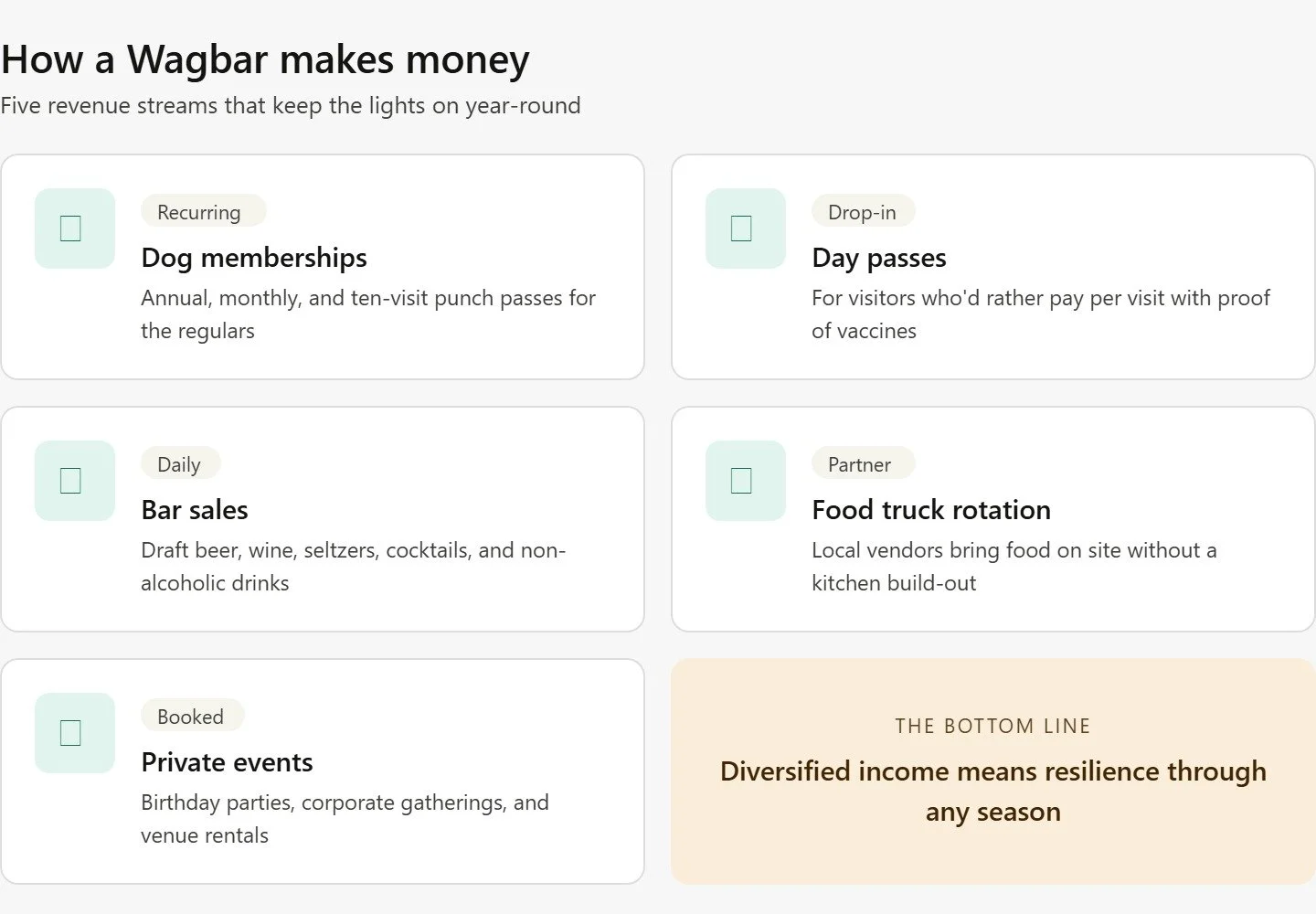
The dog park bar revenue model's real advantage isn't the size of any single stream. It's that all four run simultaneously and reinforce each other.
A new member joins because they came as a day-pass visitor and had a great experience (memberships feed from day passes). That member comes back twice a week, orders drinks on most visits, and attends the monthly trivia night (memberships drive beverage and events revenue). They tell three friends, who become day-pass visitors and eventually members (word of mouth extends the loop).
At the operational level, a single staff member checking memberships at the gate, monitoring the park, and working the bar is effectively serving all four revenue streams at once. That's the labor efficiency that makes the model financially viable in a way that a single-service business can't replicate.
What this means for breakeven. A location aiming for monthly operational breakeven needs its combined revenue from all four streams to exceed monthly fixed costs. Fixed costs typically include rent, staff wages, royalties, utilities, insurance, and supplies. The membership revenue floor is what makes this achievable even in slower months, because it provides baseline income independent of daily weather, attendance, and events volume. Understanding the full breakeven picture is part of what the dog park bar startup cost guide covers for investors in the early evaluation stage.
What Wagbar's Franchise Model Means for Revenue Building
The investment to open a Wagbar franchise, with an initial franchise fee of $50,000 and total estimated investment of $470,300 to $1,145,900, includes more than the physical build-out. It includes the pre-opening membership presale framework, the operational training that teaches franchisees how to grow and retain members, the marketing infrastructure that drives initial awareness, and the ongoing support that helps locations improve their revenue mix over time.
This information is not intended as an offer to sell, or the solicitation of an offer to buy, a franchise. It is for information purposes only. An offer is made only by Franchise Disclosure Document (FDD). Currently, the following states regulate the offer and sale of franchises: California, Hawaii, Illinois, Indiana, Maryland, Michigan, Minnesota, New York, North Dakota, Oregon, Rhode Island, South Dakota, Virginia, Washington, and Wisconsin. If you are a resident of, or wish to acquire a franchise for a Wagbar to be located in one of these states or a country whose laws regulate the offer and sale of franchises, we will not offer you a franchise unless and until we have complied with applicable pre-sale registration and disclosure requirements in your jurisdiction.
Royalties run 6% of adjusted gross sales, with 1% going to the marketing fund. For multi-unit operators committing to three or more locations, Wagbar offers a 50% discount on the franchise fee, making the per-unit economics of portfolio ownership more favorable. The benefits of owning a pet franchise covers how the training and support infrastructure directly supports revenue performance from day one.
Frequently Asked Questions About the Dog Park Bar Revenue Model
What percentage of revenue comes from memberships at a Wagbar location?
Memberships typically represent 30-45% of total revenue at a stabilized location. This percentage is higher in the early months when the membership base is still building, and tends to stabilize as day-pass conversion into memberships occurs and the active member count matures. Annual memberships are particularly valuable because they capture 12 months of revenue upfront.
How do beverage sales compare to membership revenue?
Beverage sales typically represent 30-40% of revenue and carry the highest gross margins of any revenue stream, since cost of goods for beer, wine, and non-alcoholic options runs 20-30%. Beverage performance is closely tied to dwell time, programming frequency, and average ticket size. Locations with active events calendars consistently outperform on beverage revenue.
Are events worth the operational effort?
Yes, both directly and indirectly. Events directly generate beverage revenue by increasing visit volume and dwell time. They indirectly generate revenue by improving member retention. A member who attends regular events has a much lower likelihood of canceling their membership than one who uses the park as a solo routine. The community engagement framework for dog-focused businesses covers how to measure the retention impact of programming.
What makes the dog park bar revenue model different from a regular bar?
A regular bar earns exclusively from beverage sales and depends entirely on foot traffic. The dog park bar model adds membership subscriptions (recurring, attendance-independent revenue) and day passes (access fees separate from what guests drink), creating multiple revenue layers that a conventional bar doesn't have. This results in a more predictable monthly revenue floor.
How does a new Wagbar location build its membership base quickly?

The most effective approach is pre-opening membership presales, which Wagbar's proprietary Opener app supports during the pre-launch window. Locations that arrive at opening day with a base of presold memberships have a financial cushion that reduces stress on the initial months when traffic is still building and the location is working through operational learning curves.
Bottom TLDR
The dog park bar revenue model generates income through four streams simultaneously: memberships (30-45%), day passes (20-30%), beverage sales (30-40%), and events (5-15%). What makes this model financially distinctive is that membership revenue recurs monthly regardless of daily attendance, creating a revenue floor that appointment-only businesses don't have. To maximize dog park bar revenue, focus on annual membership presales before opening and run consistent weekly events to extend dwell time and increase beverage spend.