

Dog Bar Franchise vs. Sports Bar Franchise: Which One Actually Makes More Money?

Top TLDR: A dog bar franchise vs. sports bar franchise comparison shows that sports bars generate higher gross revenue ($1.7M to $3.5M) but carry labor costs of 28% to 35%, full kitchen expenses, and teams of 30 to 60+ people. Wagbar's dog bar franchise runs on recurring membership revenue, no kitchen, labor at 15% to 22%, and teams of 6 to 12, producing stronger margins on a lower investment of $470,300 to $1,145,900. Request Wagbar's FDD for specific financial performance numbers.
The question isn't really "which bar franchise makes more money?" It's "which one makes more money relative to what you put in, what you spend to operate, and what your life looks like while running it?"
A sports bar doing $3 million in annual revenue sounds impressive until you see the labor bill, the food costs, and the 60-hour weeks. A dog bar doing less in top-line revenue might net the owner more actual profit because the cost structure is leaner and the revenue is more predictable.
This is a head-to-head comparison of two franchise models that share almost nothing in common except alcohol licenses. We're looking at revenue models, margin structure, labor intensity, customer lifetime value, and what the actual financial picture looks like when you account for everything.
Two Completely Different Revenue Engines
The most important difference between these two franchise categories isn't the investment amount or the build-out timeline. It's how money comes in the door.
How Sports Bars Make Money
Sports bars generate revenue through two channels: food sales (typically 55% to 65% of total revenue) and beverage sales (35% to 45%). The business model depends on getting people through the door during peak events, keeping them eating and drinking for as long as possible, and hoping they come back for the next game.

Revenue is event-driven and volatile. A packed house during the Super Bowl or a local team's playoff run looks great. A Tuesday in July when nothing's on TV looks very different. Sports bars spend heavily on promotions, drink specials, and themed events to fill seats during slow periods, and those promotions eat into already thin margins.
Average unit volumes for established sports bar franchises range from $1.7 million to $3.5 million annually. That top-line number is the headline. The bottom line tells a different story.
How Wagbar Makes Money
Wagbar's revenue model has three streams, and the first one changes the entire financial equation.
Recurring membership revenue. Dog owners pay monthly or annual memberships for off-leash park access. Casual visitors pay day passes. This subscription income builds month over month, creating a predictable financial base that doesn't depend on what's on TV, what the weather is doing, or whether it's a holiday weekend. No sports bar franchise in the country has anything equivalent to this.
Beverage sales. Craft beer, cocktails, wine, and non-alcoholic options sold to dog owners while they use the park. Dwell time at a dog bar runs high because people stay as long as their dogs are having fun, and that usually means multiple drinks rather than one.
Events and community programming. Breed meetups, trivia nights, live music, holiday celebrations, and private bookings add revenue peaks on top of the membership base. The flagship Weaverville location runs regular community events that consistently drive attendance and beverage sales.
The critical difference: Wagbar's membership revenue provides a floor. Even on a slow day, memberships are still generating income. Sports bars have no floor. Every dollar of revenue requires getting someone to physically walk through the door and order something.
The Margin Gap: Where the Real Money Story Lives
Top-line revenue gets the attention. Margins determine what you actually take home.
Sports Bar Margins
Net profit margins for full-service bar-restaurants typically fall between 3% and 9% (Restroworks, 2025). The reason margins are that tight is simple: the cost structure is heavy.
Labor eats 28% to 35% of revenue. Food cost of goods sold (COGS) takes another 28% to 32% of food revenue. Beverage COGS runs 18% to 24%. Royalties and marketing fees add 5.5% to 7%. Rent in the kind of high-traffic locations sports bars need runs 8% to 10%. Utilities for keeping dozens of TVs, commercial kitchen equipment, HVAC, and lighting systems running are substantial.
Add those up and you're looking at total operating costs consuming 88% to 97% of revenue. A sports bar doing $2.5 million in annual sales at a 5% net margin generates $125,000 in owner earnings. That's the return on an investment that likely ran $1.5 million to $2.5 million and required 50 to 60 hours a week of your time.
Wagbar Margins
The dog bar franchise model has structural advantages that show up directly in margins.

Labor runs 15% to 22% of revenue, compared to 28% to 35% for sports bars. That gap exists because a Wagbar location operates with 6 to 12 employees (bartenders, park attendants, a manager) versus 30 to 60+ for a sports bar (line cooks, prep cooks, dishwashers, servers, bartenders, hosts, bussers, multiple managers).
There is no food COGS line. Because Wagbar operates without a commercial kitchen, the entire 28% to 32% food cost that sports bars carry simply doesn't exist. That's not a small advantage. On a million-dollar revenue base, the absence of food costs alone saves $280,000 to $320,000 compared to a sports bar.
Beverage COGS runs 20% to 26%, comparable to the sports bar range. Royalty fees are 6% of adjusted gross sales with a 1% marketing fund contribution.
The result is a cost structure that leaves more of every dollar on the table. When you remove the kitchen entirely and cut your labor force by 70% to 80%, the math changes significantly in the franchisee's favor.
For specific financial performance data, prospective franchisees should request Wagbar's Franchise Disclosure Document (FDD).
Labor Intensity: The Cost That Keeps Compounding
Labor isn't just a line item. It's the thing that determines how much of your time the business consumes, how many HR headaches you deal with, and how vulnerable your operation is to staffing problems.
The Sports Bar Staffing Challenge
A typical sports bar employs 30 to 60+ people. That includes back-of-house kitchen staff (line cooks, prep cooks, dishwashers), front-of-house service staff (servers, bartenders, hosts, bussers), and management (assistant managers, general manager, sometimes a kitchen manager).
The restaurant industry has some of the highest employee turnover rates in any sector. The Bureau of Labor Statistics consistently reports accommodation and food services turnover above 70% annually. For a sports bar with 40 employees, that means you're replacing 28+ people per year. Each replacement costs money in recruiting, training, and lost productivity during the learning curve.
Scheduling 30 to 60 people across multiple shifts, managing call-outs, covering for sick employees, handling interpersonal conflicts, running payroll, managing tip reporting, and dealing with the inevitable HR issues that come with a large team: this is a significant operational burden that sports bar owners live with daily. Labor costs run 28% to 35% of revenue (Toast, 2025), and managing that number is a constant battle.
The Wagbar Staffing Reality
A Wagbar franchise operates with 6 to 12 employees. Bartenders, park attendants who monitor dog behavior and manage park safety, and a manager. That's the team.
No kitchen staff. No hosts. No bussers. No dishwashers. No food runners.
Labor costs run 15% to 22% of revenue. But the advantages go beyond the dollar amount. With a team of 8 to 10 people, scheduling is straightforward. You know everyone by name. Training is faster because there are fewer roles to fill. Turnover hurts less because you're replacing one person, not managing a revolving door of 28+ annual departures.
Wagbar's training program prepares franchisees to manage both bar operations and dog behavior monitoring, and the smaller team size means that training is hands-on and personal rather than assembly-line. Franchisees have come from backgrounds outside hospitality, including financial services, IT sales, and corporate management, because the simpler operating model doesn't require years of restaurant experience to run well.
Customer Lifetime Value: The Metric That Changes Everything
Customer lifetime value (CLV) measures how much total revenue a single customer generates over their entire relationship with your business. This is where the two models produce their starkest contrast.
Sports Bar CLV
Sports bar customers visit for specific occasions: game days, group outings, happy hours, date nights. The average customer might visit 10 to 20 times per year if they're a regular, spending $25 to $50 per visit. That puts annual customer value somewhere around $250 to $1,000 for a solid regular.
But sports bar regulars are fragile. A new sports bar opens closer to their home, the local team has a bad season, a favorite bartender leaves, or they simply get bored of the menu. There's no structural reason they have to come back. Retention depends entirely on preference, and preferences change.
Customer acquisition costs are ongoing because the business constantly needs new customers to replace those who drift away. Marketing, promotions, and drink specials are permanent line items.
Wagbar CLV
Dog bar customers visit because their dog needs exercise and socialization. That's not a preference. It's a biological need that occurs daily, regardless of what's on television or whether there's a new bar down the street.
A Wagbar member who visits twice a week (a conservative estimate for active dog owners) generates membership revenue plus beverage spending across 100+ visits per year. The per-visit spending may be lower than a sports bar dinner-and-drinks tab, but the frequency more than compensates.
The retention mechanism is structural. A dog owner with a membership keeps using it because their dog still needs to run, play with other dogs, and burn energy. That need doesn't have an off-season. It doesn't depend on a TV schedule. And because dogs form social bonds with other dogs at the park, the pet itself becomes a driver of repeat visits. Your customer's dog literally wants to go back.
This behavioral pull is why Wagbar's membership model produces fundamentally different retention economics than any event-driven bar concept. The customer isn't choosing between you and a competitor each time. They're coming because their dog demands it, and the bar experience makes it enjoyable for the human.
Investment Comparison: What You Put In
The investment gap between these two categories is significant.
Sports bar franchises typically require $800,000 to $7 million+ in total initial investment, with most mid-range builds landing between $1.5 million and $2.5 million. Franchise fees range from $25,000 to $60,000. The big cost drivers are commercial kitchen equipment, AV systems, interior build-out for large dining and bar areas, and the infrastructure to support it all.
Wagbar's total initial investment ranges from $470,300 to $1,145,900, with most franchisees falling in the $600,000 to $850,000 range. The franchise fee is $50,000, with a multi-unit discount of 50% for commitments of three or more locations.

Three factors drive the lower investment. First, no commercial kitchen eliminates hood systems, cooking equipment, walk-in coolers, and all associated plumbing and electrical work, which can save $150,000 to $300,000 compared to a sports bar build-out. Second, Wagbar's proprietary container bar system reduces construction timelines and costs versus traditional ground-up builds. Third, no AV infrastructure means no banks of TVs, no satellite packages, no commercial sound zones, and no electrical upgrades to support them.
When you invest less capital upfront and generate higher margins on each dollar of revenue, your return on investment math changes substantially.
Owner Lifestyle: The Hours You Actually Work
Money matters, but so does what your life looks like while you earn it.
Sports bar owners typically work 50 to 60+ hours per week during the first two to three years. Peak times are evenings, weekends, and every major sporting event. Your personal calendar bends around the game schedule, and holidays are some of your busiest (and most stressful) days. Managing a full kitchen alongside high-volume bar service creates constant operational complexity: food quality issues, equipment breakdowns, supplier problems, staffing emergencies.
Dog bar owners at Wagbar typically work 40 to 50 hours per week after the initial ramp-up period. Peak traffic includes daytime and early evening rather than late nights. No kitchen means no kitchen emergencies. A smaller team means less time managing schedules and resolving staff issues. Wagbar's franchise training covers the full operational model, and the learning curve is shorter because the operation is simpler.
The difference adds up over years. Ten to twenty fewer hours per week, less late-night work, fewer holiday obligations, and less management stress translates into a meaningfully different quality of life.
Growth Trajectory: Where Each Category Is Headed
Sports bars are a mature franchise category. The market is established, competition is heavy, and growth in North America comes primarily from upgrades to existing concepts rather than new territory expansion. The sports bar franchise market is projected to grow at 7.1% CAGR through 2034 (Dataintelo, 2026), but much of that growth is international. Domestically, sports bars also compete against improving at-home viewing experiences with large screens and streaming packages.
Dog bars are in the earliest phase of franchise expansion. The concept barely existed before 2019 when Wagbar opened its flagship location. The pet industry generated over $147 billion in U.S. spending in 2023, with pet services growing at a pace that far outstrips traditional hospitality. Wagbar is expanding across multiple states including North Carolina, Tennessee, South Carolina, Georgia, Texas, California, Virginia, Ohio, Maryland, Florida, and Arizona.
Early movers in emerging franchise categories benefit from better territory selection, first-mover market positioning, and the opportunity to build brand equity in a city before competitors arrive. That advantage disappears as categories mature.
The Bottom Line on Which Model "Makes More Money"
If you define "making money" as the highest possible gross revenue number, sports bars win. A well-located sports bar franchise can generate $2.5 million to $3.5 million in annual sales.
If you define "making money" as what you actually keep after paying everyone and everything, the picture shifts. A dog bar franchise with lower labor costs, no food COGS, recurring membership revenue, and a leaner cost structure can generate comparable or better owner earnings on a lower revenue base.
If you factor in the investment required to generate those earnings, the shift becomes even more pronounced. Investing $600,000 to $850,000 for a Wagbar franchise versus $1.5 million to $2.5 million for a sports bar means the dog bar owner needs far less revenue to produce the same return on investment.
And if you include the 10 to 20 fewer hours per week, fewer late nights, fewer holidays spent at work, and fewer staffing headaches, the dog bar model starts to look like the better deal for owners who want strong financial returns without giving up their entire life.
The right answer depends on what you value. But when you compare the full picture, the dog bar franchise model holds up remarkably well against the category that's been around for decades.
Ready to see the specific numbers? Request Wagbar's Franchise Disclosure Document for detailed financial performance data and territory availability.
Frequently Asked Questions
Do dog bar franchises really make as much money as sports bars?
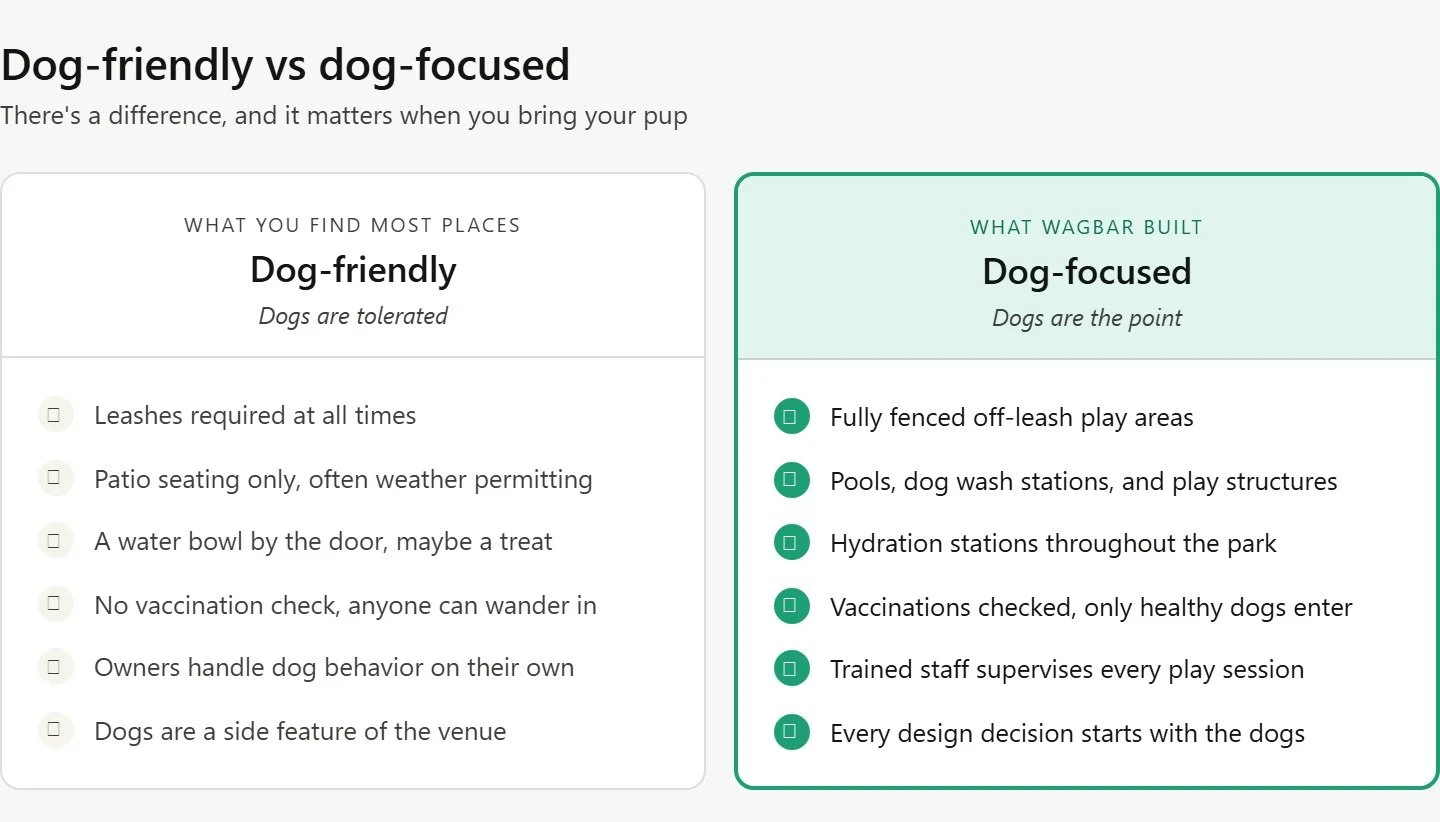
Total revenue at a sports bar is typically higher ($1.7M to $3.5M annually vs. variable for dog bars), but revenue isn't the same as profit. Dog bar franchises like Wagbar operate with significantly lower labor costs (15% to 22% vs. 28% to 35%), no food COGS, and recurring membership revenue, which can produce comparable or better owner earnings on a smaller revenue base with less capital invested.
What makes recurring membership revenue such a big deal?
Membership revenue is predictable, builds over time, and doesn't depend on events, weather, or promotions to generate. No sports bar franchise has an equivalent mechanism. Dog owners keep their memberships active because their dogs need regular exercise and socialization, creating structurally high retention that event-driven bars can't match.
How much less staff does a dog bar need compared to a sports bar?
A Wagbar location runs with 6 to 12 employees. A sports bar runs with 30 to 60+. The difference comes from eliminating the kitchen (no cooks, no dishwashers, no food runners) and operating with a simpler front-of-house model (no hosts, no bussers). Fewer employees means lower labor costs, less scheduling complexity, and less management time.
Do I need restaurant experience to own a dog bar franchise?
No. Wagbar's training program is designed for people without hospitality backgrounds. Current franchisees include people from financial services, IT, and corporate management. The simpler operating model (no kitchen, smaller team) means a shorter learning curve than a full-service restaurant.
What's the investment difference between a dog bar and sports bar franchise?
Wagbar's total investment ranges from $470,300 to $1,145,900, with most franchisees in the $600,000 to $850,000 range. Sports bar franchises typically require $800,000 to $7 million+, with most mid-range builds at $1.5 million to $2.5 million. The gap comes from Wagbar's no-kitchen build-out, container bar construction system, and simpler technology requirements.
How do I see Wagbar's actual financial performance numbers?
Request Wagbar's Franchise Disclosure Document (FDD), which contains detailed financial performance representations. You can also review the franchise cost breakdown for a detailed look at where the investment goes and explore what to look for when evaluating a dog bar franchise investment.
Bottom TLDR:
When comparing a dog bar franchise vs. sports bar franchise on margins, labor, and customer lifetime value, Wagbar's model keeps more of every revenue dollar by eliminating food costs, reducing staff by 70% to 80%, and generating recurring membership income that sports bars can't replicate. Sports bars win on gross revenue; dog bars win on return per dollar invested and owner quality of life. Visit Wagbar's franchise page to see detailed cost breakdowns and territory availability.