
Do You Let Your Dog on the Couch? The Real Answer Is More Complicated Than You Think
You already know where your dog sleeps when you leave the house. That warm spot on the middle cushion, the one with the permanent indent and the fur that no lint roller can fully remove. You told yourself no couch when you first brought them home. That lasted about three days.
If this sounds familiar, you are in the majority. Most dog owners eventually allow their dogs on the furniture, and the ones who say they don't are often just the ones who haven't checked their security cameras. The couch debate is one of those topics that sounds simple but actually touches on some of the most interesting and practical aspects of how dogs learn, how they interpret rules, and where the line is between a harmless habit and a real behavioral problem.
The Couch Is Not Really About the Couch
The furniture question gets emotional fast because it feels like a test of what kind of dog owner you are. Strict owners keep dogs off the furniture. Permissive owners let them up. And somewhere in between, millions of people have a dog that is technically not allowed on the couch but somehow ends up there every single evening.

Here is the part most people miss. Whether your dog is on the couch or not is not actually the issue. The issue is whether the rules in your house are clear, consistent, and understood by every human and animal living there. A dog that is allowed on the couch with clear expectations and good manners is in a better behavioral position than a dog that is technically banned from the couch but gets mixed signals from different family members and has no idea what the actual rule is.
Inconsistency is the real problem. Not the couch itself.
Can Dogs Actually Understand Different Rules in Different Places?
This is the question that makes the couch debate genuinely interesting from a behavioral science perspective.
The short answer is yes, but not the way you think.
Dogs are what researchers call context-dependent learners. They do not absorb a rule as an abstract concept the way humans do. When a dog learns "sit" in your living room, it has not learned the universal concept of sitting on command. It has learned that when you make a specific sound, in this specific room, with these specific smells and visual cues around, planting its rear on the ground produces a treat. Move that same dog to a busy park with new smells, sounds, and distractions, and it may act like it has never heard the word "sit" in its life.
This is called the generalization gap, and it is one of the most misunderstood concepts in dog ownership. Dogs notice everything. The surface under their paws, your body posture, the tension in your voice, background noise, nearby movement, environmental smells. All of those elements become part of the learned behavior. Change the context and the dog may not recognize the rule.
The flip side of this is actually good news for couch rules. Because dogs are so context-sensitive, they can learn "couch is fine at home but not at someone else's house" or "couch is fine when invited but not when you jump up uninvited" more easily than you might expect. Dogs are naturally wired to learn HERE but not THERE rules. The key is making each context clear and consistent rather than assuming the dog will figure out the abstract principle on its own.
This is also why dogs can behave one way at home and a completely different way at a dog park or social environment. They are not being defiant. They are responding to a different set of contextual cues, and they may genuinely not connect the rules from one environment to another unless you have specifically trained for that transfer.
The "My Dog Knows the Rule" Myth
You have probably heard someone say "My dog knows he is not supposed to be on the couch. He gets off when he hears me coming." Owners interpret this as guilt or sneakiness. The dog knows the rule and is choosing to break it when nobody is watching.
That is not what is happening.
What the dog has actually learned is a context-dependent behavior. The rule in the dog's mind is not "I am not allowed on the couch." The rule is "When the human is present, being on the couch leads to a negative outcome. When the human is absent, being on the couch leads to comfort with no negative outcome." The dog is not being sneaky. It is being perfectly rational within the framework of how dogs process cause and effect.
Dogs do not experience guilt the way humans do. That "guilty look" when you catch your dog on the couch is actually appeasement behavior. The dog is responding to your body language and tone, not to an internal sense of having broken a moral code. Research on canine cognition has repeatedly shown that the "guilty look" appears regardless of whether the dog actually did anything wrong. It is a response to human displeasure, not an admission of wrongdoing.
This matters because it changes how you approach training. If you punish a dog for being on the couch after the fact, the dog does not connect the punishment to the couch behavior. It connects the punishment to your arrival. Which means you are not teaching "stay off the couch." You are teaching "act worried when the human comes home." Those are very different lessons.
When the Couch Becomes a Real Problem
For most dogs, being on the couch is completely harmless. It is comfortable. It is warm. It smells like you. Dogs are social animals who want to be close to their people, and the couch is where their people spend time. There is nothing wrong with that.
The problems start when a dog begins treating the couch as a resource to be guarded.
Resource guarding is a behavior where a dog becomes possessive over something it considers valuable and responds defensively when it perceives a threat to that resource. Most people associate resource guarding with food bowls, bones, or toys. But furniture is one of the most common guarded resources, and it often catches owners off guard because it develops gradually.
Here is what the progression typically looks like.
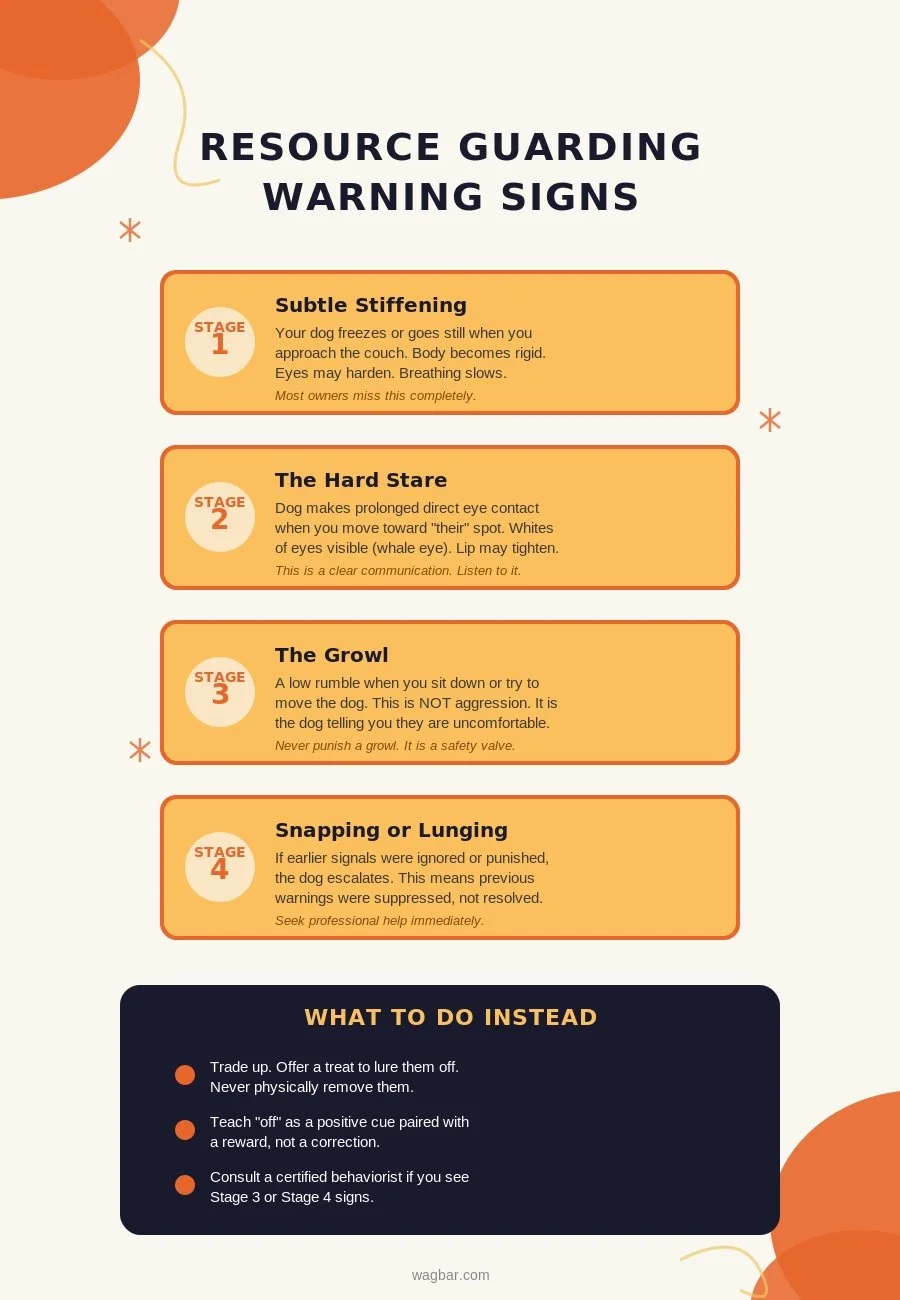
Stage one. The dog stiffens slightly when you sit down next to it on the couch. You probably do not notice.
Stage two. The dog gives you a side eye or a subtle lip lift when you approach the couch while it is lying there. You might notice but dismiss it as the dog being tired or grumpy.
Stage three. The dog growls when you try to sit down or when you ask it to move. This is where most owners finally realize something is off.
Stage four. The dog snaps or bites when someone approaches the couch while it is resting there.
The escalation does not happen overnight. It builds over weeks or months, and each stage that goes unaddressed teaches the dog that guarding works. The growl makes the human back off. The snap makes the human leave entirely. From the dog's perspective, the defensive behavior is succeeding, so it continues and intensifies.
This is not a dominance issue. The dog is not trying to be the boss. The dog is experiencing anxiety about losing access to a valued resource and is communicating that anxiety through the only escalation tools it has. The fear of losing the comfortable spot drives the behavior, not some power play.
What to Do If Your Dog Guards the Couch
If your dog growls, stiffens, or shows teeth when you approach the couch, do not escalate. Do not yell, do not physically force the dog off, and do not punish the growl.
This is critical. A growl is communication. It is your dog telling you it is uncomfortable before it resorts to something more serious. If you punish the growl, you are not eliminating the discomfort. You are eliminating the warning. The dog still feels the same anxiety about its spot, but now it has learned that growling does not work. The next step in its communication ladder is snapping or biting, which comes with no warning because you trained the warning out of it.
Instead, take these steps.
Remove access temporarily. Block the couch with cushions turned up, boxes, or baby gates. This is not punishment. It is preventing the dog from rehearsing the guarding behavior while you work on the underlying issue.
Build a "place" command. Teach your dog to go to a specific spot, a dog bed, a mat, a crate, on command. Reward heavily for choosing that spot. The goal is to make the alternative location as appealing as the couch.
Reintroduce couch access on your terms. Once the "place" command is solid, start inviting the dog onto the couch with a specific cue word. The dog learns that couch time happens by invitation, not by default. This small shift changes the emotional dynamic entirely.
Consult a professional. If the guarding has progressed to snapping or biting, work with a certified dog behaviorist or veterinary behaviorist. This is not a DIY problem at that point. The underlying anxiety needs professional assessment and a structured behavior modification plan.
Setting Boundaries That Actually Stick
Whether you want your dog on the couch, off the couch, or on the couch only sometimes, the approach that works is the same. Clarity, consistency, and reinforcement.
Every person in the household must follow the same rule. If you enforce "no couch" but your partner invites the dog up every evening, the dog has not learned a rule. It has learned that the couch is available 50% of the time and it just has to figure out when. Dogs do not understand exceptions delivered inconsistently. They understand patterns.
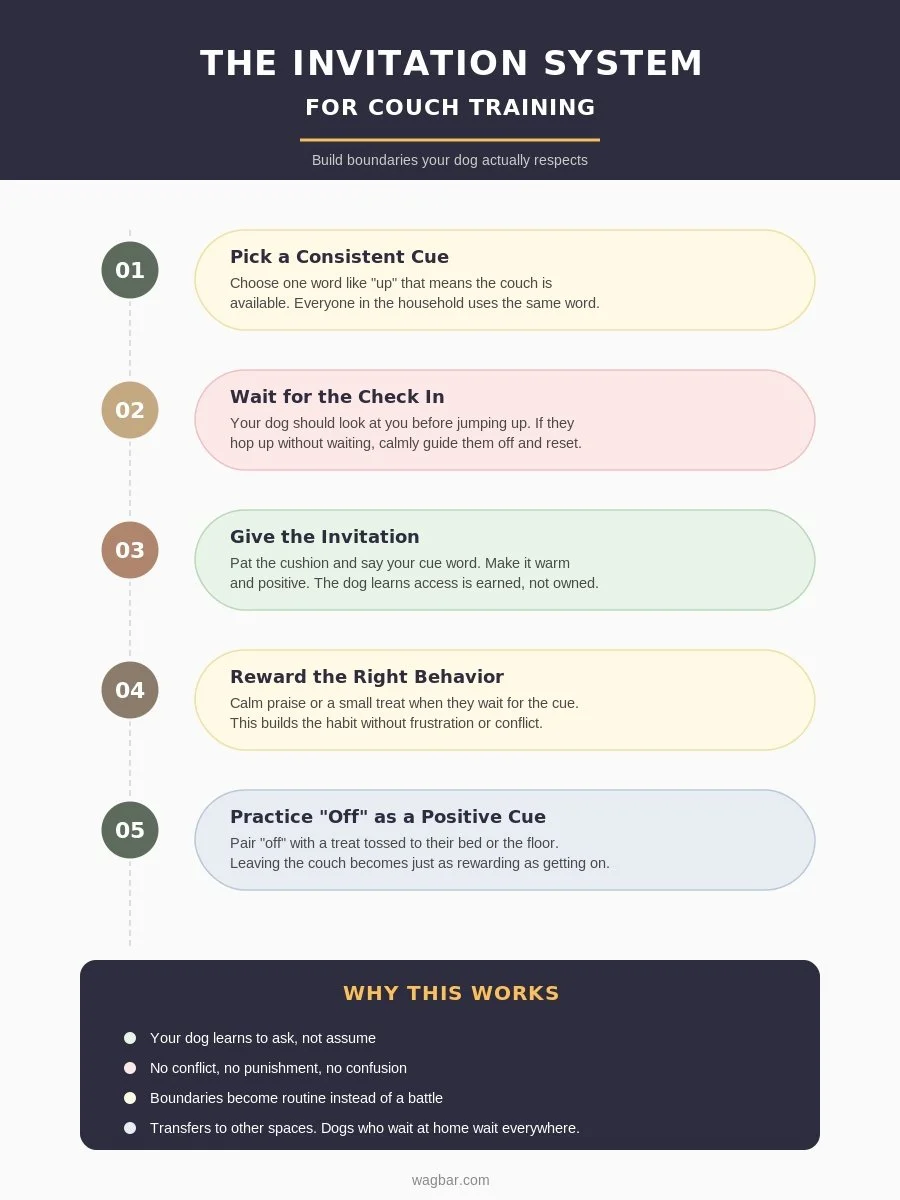
Use a clear cue for "on" and "off." If the dog is allowed on the couch by invitation, use a specific word like "up" when you want it to join you and "off" when you want it to leave. Reward both behaviors. The dog learns that getting on the couch is good when invited and getting off the couch is good when asked. Both directions produce positive outcomes.
Provide a genuinely appealing alternative. If you are asking a dog to stay off the couch, the floor is not an acceptable substitute. Get a quality dog bed, an orthopedic one for older dogs, and place it near the couch so the dog is still in the social space with you. Dogs want proximity to their people. Give them a comfortable way to have that without the furniture.
Be patient with the timeline. Most dogs respond to consistent furniture boundary training within two to four weeks when you combine clear commands, positive reinforcement, and a good alternative spot. Dogs that have had years of unrestricted couch access will take longer to adjust than puppies learning the rules from day one.
Never use physical punishment or scare tactics. Shock mats, spray bottles, and other aversive methods might keep a dog off the couch temporarily through fear, but they damage trust, increase anxiety, and often create new behavioral problems that are worse than the original issue. Positive reinforcement produces longer-lasting results because the dog wants to follow the rule rather than being afraid of the consequence.
The Invitation System That Most Trainers Recommend
The approach that works best for most households is not "always on" or "always off." It is the invitation system.
The dog is allowed on the couch but only when invited. This means the dog waits near the couch or on its bed until you pat the cushion and say "up." When you want the dog to leave, you say "off" and reward the dog for complying. If the dog jumps on the couch uninvited, you calmly redirect it to its bed and reward the redirect.
This system works because it satisfies both the human and the dog. The dog gets couch time and closeness. You maintain control over when and how that happens. And the framework prevents the kind of entitlement that leads to guarding behaviors because the dog learns that couch access comes from you, not from occupying the space first.
The invitation system also solves the common household argument where one person wants the dog on the couch and the other does not. With an invitation cue, the dog only comes up when actively invited. When the person who prefers a dog-free couch is sitting there, no invitation is given and the dog stays on its bed. Both preferences are accommodated without mixed signals.
Dogs on the Couch and Social Behavior Outside the Home
Here is where the couch conversation connects to something bigger. The way a dog learns rules at home directly affects how it behaves in social environments outside the home.
Remember that dogs are context-dependent learners. A dog that has clear, consistent rules at home, whether those rules allow couch access or not, tends to adapt better to new environments with new rules. The dog has learned the fundamental skill of reading contextual cues and adjusting behavior accordingly.
A dog that lives with inconsistent rules at home, sometimes on the couch, sometimes yelled at for being on the couch, with rules changing depending on who is home and what mood they are in, has learned that rules are unreliable. That dog tends to struggle more in new social settings because it has no framework for reading and responding to behavioral expectations.
This shows up at off-leash dog parks, at friends' houses, at outdoor dining patios, and at any environment where the dog needs to understand and follow a new set of expectations. Dogs with clear household boundaries tend to transition into new social environments with less stress and better behavior. Not because the specific rules are the same, but because the dog has practice at the skill of following rules.
Puppy socialization is the foundation, but ongoing boundary training at home is what maintains those skills into adulthood. The couch is one of the first and most consistent opportunities you have to teach your dog how rules work.
The Honest Truth About Dogs and Furniture
There is no single right answer to the couch question. Some of the best-trained, most well-adjusted dogs in the world sleep on their owner's couch every night. And some dogs with serious behavioral issues started down that path because couch access was never managed properly.
The couch is not the variable. The consistency is.
If you let your dog on the couch, make sure the rules are clear, the access is managed, and the dog can get on and off without any tension or anxiety. If you keep your dog off the couch, make sure the alternative is genuinely comfortable and the rule is enforced by everyone in the household.
And if your dog growls when you try to sit down next to it, that is not a couch problem. That is a behavioral issue that needs professional attention before it gets worse.
Whatever you decide, be honest about it. The dog already knows the real rule.
Frequently Asked Questions
Is it bad to let my dog on the couch?
No. For dogs with no behavioral issues, couch access is perfectly fine and can actually strengthen bonding. The only time it becomes a problem is when the dog develops resource guarding behaviors, when household rules are inconsistent, or when the dog has separation anxiety that is reinforced by constant physical contact. If your dog gets on and off the couch without tension and responds when asked to move, there is nothing wrong with sharing the furniture.
Why does my dog growl when I try to sit on the couch?
Your dog is resource guarding the couch. The growl is a warning that the dog feels threatened about losing its spot. Do not punish the growl. Instead, temporarily block couch access, build a strong "place" command with an alternative bed, and reintroduce couch access by invitation only. If the growling has escalated to snapping, work with a certified behaviorist.
How do I train my dog to stay off the couch?
Use a clear "off" command paired with positive reinforcement. Every time the dog gets off the couch on command, reward immediately. Provide a high-quality dog bed near the couch as an alternative. Be consistent across every family member. Most dogs adapt within two to four weeks with consistent training. Never use scare tactics or physical punishment.
Can dogs learn different rules for different houses?
Yes. Dogs are context-dependent learners, which means they actually learn location-specific rules more easily than abstract universal rules. A dog can learn "couch is fine at home but not at grandma's house" if the rules are consistently enforced in each location. The key is consistency within each context rather than expecting the dog to generalize across all environments.
Should I use a shock mat or spray to keep my dog off the couch?
No. Aversive deterrents work through fear, not understanding. They may suppress the behavior temporarily but often create anxiety, erode trust, and can lead to new problems like avoidance behaviors or increased stress. Positive reinforcement training with a clear alternative spot produces longer-lasting results and a healthier relationship with your dog.
My dog is fine on the couch with me but guards it from other family members. What does that mean?
This is selective resource guarding and it needs attention. The dog has learned that it can control access to the couch around certain people but not others, usually based on who has historically enforced boundaries and who has not. All family members need to practice the same boundary training protocol with the invitation system. If the guarding involves growling or snapping toward any family member, consult a professional.
Does letting my dog on the couch make them think they are the boss?
No. The outdated "dominance theory" has been largely debunked by modern canine behavioral science. Dogs do not get on the couch to assert dominance over you. They get on the couch because it is comfortable and it smells like their favorite person. Furniture access does not change the dog's perception of household hierarchy. What matters is whether the dog has clear rules and responds when asked to move.
Take the Boundaries You Build at Home and Test Them in the Real World
A dog that understands rules at home is a dog that handles new environments well. When your dog is ready for its next level of social confidence, a supervised off-leash space is one of the best ways to build it. Wagbar's screened, staffed environment lets dogs practice reading social cues and following rules in a new context while you enjoy a drink and watch. Check out Wagbar locations and see what your dog does when the rules are clear and the space is built for them.