

The Off-Leash Dog Bar Experience
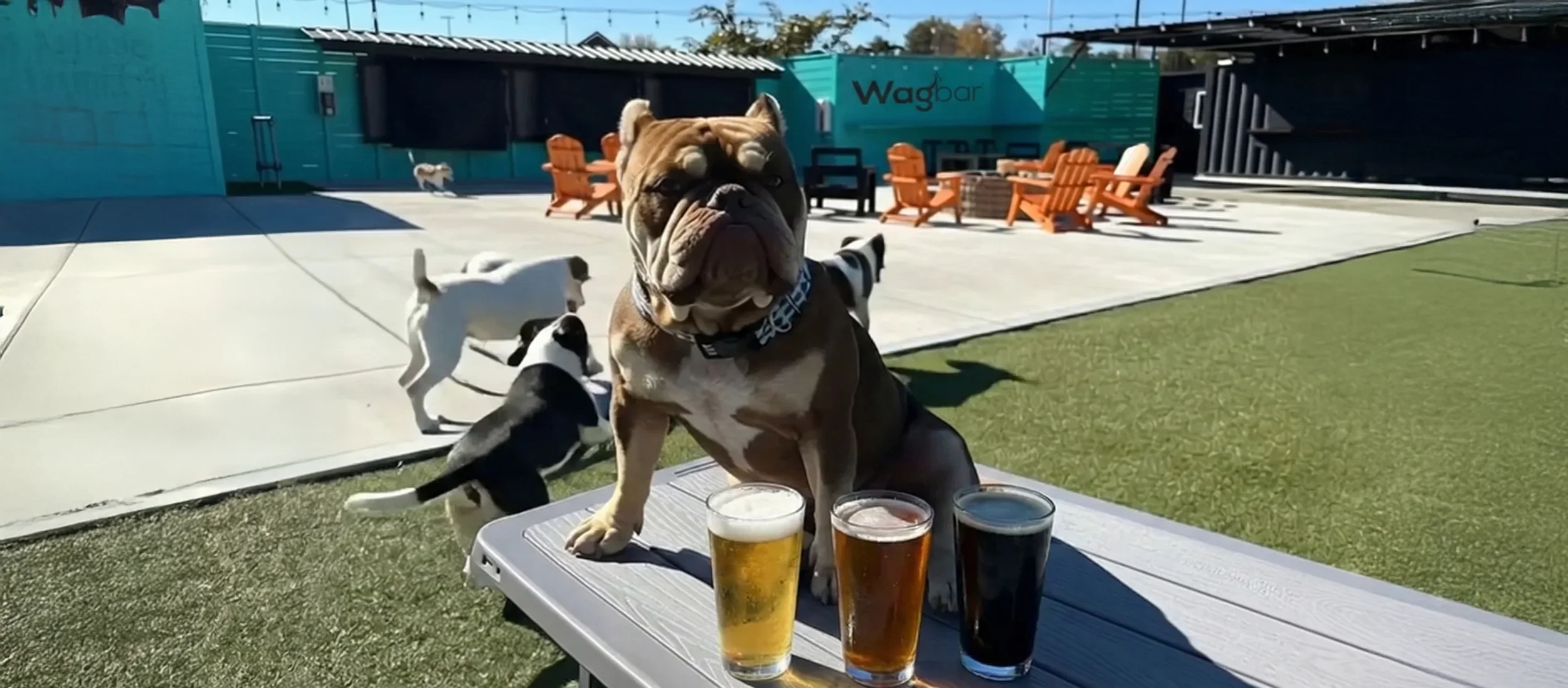
An off-leash dog bar is a supervised, fully fenced venue where dogs roam and play without leash restrictions while their owners enjoy craft beverages, rotating food trucks, live entertainment, and real social connection in the same space. It is not a dog park with a cooler. It is not a bar that tolerates your dog on a patio. It is a purpose-built environment designed equally for canine socialization and human enjoyment, staffed by trained professionals who monitor every interaction and maintained to standards that public parks will never meet.
The concept was born in Asheville, North Carolina, when Wagbar opened its doors and proved that dog owners would pay for a dramatically better experience than the muddy, unsupervised, anything-goes chaos of a typical city dog park. Since then, the model has expanded across the United States with locations in cities from Dallas to Los Angeles to Savannah, and dozens of independent operators and franchise concepts have followed. Wagbar itself now operates locations across North Carolina, South Carolina, Georgia, Texas, California, Virginia, Ohio, Maryland, Florida, and Arizona, with each facility maintaining the operational standards and supervised play model that defined the category from the beginning.
If you have ever stood in a sad public park holding a poop bag and a lukewarm coffee while your dog rolled in something questionable, you already understand why this concept exists. If you have never visited one, this guide covers everything you need to know before your first trip.
How the Whole Thing Actually Works
You show up with your dog and their vaccination records. Staff at the front check that your dog is current on rabies, bordetella, and distemper. They confirm your dog is at least six months old and spayed or neutered. If you are a member, your records are already on file and you walk straight through. If you are buying a day pass, the check takes about five minutes.
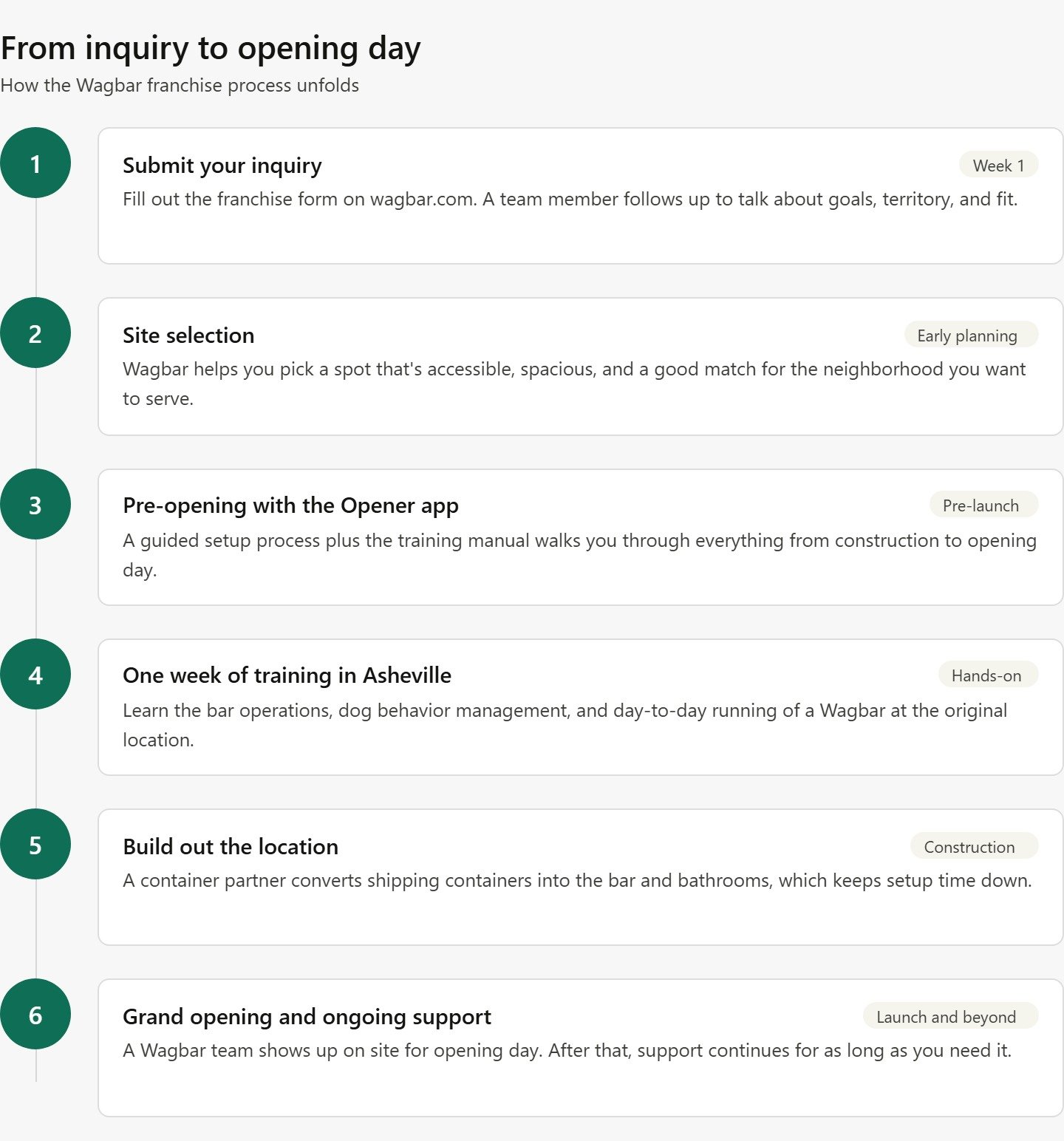
Then you enter through what is essentially an airlock. Two gates, one after the other, designed so no dog can bolt into the parking lot. You remove your dog's leash in the space between the gates. Your dog walks through the second gate into a secure, fenced play area and immediately has access to open space, other dogs, water stations, shade structures, and in many cases pools or splash pads.
While your dog figures out who they want to play with, you grab a seat and order a drink. Most facilities serve craft beer on draft, canned beer from local breweries, wine, ciders, hard seltzers, cocktails, frozen drinks, coffee, and a full non-alcoholic menu. Food comes from rotating local food trucks that change weekly, which means the menu is never the same two visits in a row.
Trained staff circulate through the play area the entire time you are there. These are not teenagers on their phones. They are people trained in canine body language who can spot the difference between a dog playing hard and a dog about to start something. They intervene before problems escalate. They redirect dogs who are getting too wound up. They clean up waste immediately. They monitor water stations and energy levels across the whole park.
This is the part that makes the model work. You are not responsible for policing every dog in the park. You are free to actually enjoy yourself, have a conversation, eat food, watch a game, listen to live music, or just sit there watching your dog be incredibly happy. That freedom is the entire point.
Why This Is Fundamentally Safer Than a Public Dog Park
I know people who refuse to visit public dog parks, and honestly, I get it. The average public dog park has zero entry requirements. No vaccination checks. No temperament screening. No spay or neuter policy. No professional supervision. No double gate system. No cleaning schedule. Nothing stopping someone from bringing a sick, intact, aggressive, or completely unsocialized dog into the same fenced area as your six-month-old puppy who just finished their vaccine series last week.
Off-leash dog bars solve every single one of those problems, and they do it through design rather than luck.
Vaccination verification is the foundation. Bordetella, the bacteria that causes kennel cough, spreads like wildfire in group settings where dogs are sniffing, licking, and breathing on each other. One unvaccinated dog can infect dozens before anyone notices symptoms. Rabies is legally required in most states and is one of the few diseases that crosses from dogs to humans. Distemper attacks the respiratory, gastrointestinal, and nervous systems simultaneously and kills unvaccinated dogs at alarming rates. When every dog in the facility is verified current on all three, the disease transmission risk drops to near zero.

Wagbar off-leash play
Wagbar staff trained in canine body language actively monitor play dynamics and intervene before tension escalates, distinguishing the model from unsupervised public dog parks.
The spay and neuter requirement is about behavior, not politics. Intact male dogs display hormonally driven behaviors in group settings that reliably escalate tension. Territorial marking, persistent mounting, fixation on females, and an intensity in their body language that other dogs read as threatening. These patterns are well documented by veterinary behaviorists. Removing them from the equation makes the entire environment calmer and safer for every dog present.
Age minimums exist because puppies younger than six months are still building their immune systems and have not completed their full vaccination series. They are also socially immature and can develop lasting fear responses if overwhelmed by the intensity of adult group play during a critical developmental window. Protecting them now prevents behavioral problems that owners spend years and thousands of dollars trying to fix later.
And then there is professional supervision, which is the single biggest differentiator between a dog bar and literally every other off-leash option. A trained staff member who recognizes the subtle shift from a relaxed play bow to a rigid forward lean can redirect the interaction in seconds. Most dog owners, even experienced ones, miss these signals because they happen fast and require specific knowledge of canine communication patterns. Having someone whose entire job is reading the room changes the safety equation completely. Research examining social behaviour of domestic dogs in public off-leash parks confirms that successful socialization and safety outcomes depend heavily on environmental management and active supervision, precisely what distinguishes professionally staffed dog bars from unsupervised public dog parks.
I genuinely believe this is the most underappreciated part of the whole experience. People think they are paying for a fancy dog park. They are actually paying for an environment where the risk of a bad outcome has been systematically reduced through operational design.
What Your First Visit Actually Looks Like
The anxiety around a first visit is almost always worse than the reality. Here is what actually happens so you know what to expect.
Before you leave home, pull up your dog's vaccination records. Most places accept a photo on your phone, a digital record from your vet's app, or a printed certificate. You need current rabies, bordetella, and distemper. If you are not sure whether your dog's bordetella is current, call your vet and ask. It needs to be given at least five to seven days before the visit for full efficacy.
When you arrive, the front desk verifies records and explains the house rules. This is not a power trip. It is a quick rundown so you know what to do if your dog starts getting too rough, where the water stations are, and how the gate system works. Staff might ask a couple of questions about your dog's temperament and history with group play. They are not trying to keep you out. They are trying to understand whether your dog might need a slower introduction.
You walk through the first gate, close it behind you, remove your dog's leash, and then open the second gate into the park. This two-gate system exists because dogs are opportunistic geniuses who will absolutely sprint for the parking lot if given a clear path. The transition zone also prevents the tension that happens when a leashed dog meets an unleashed one, which is one of the most common triggers for leash reactivity.
Once inside, your dog will do one of three things. They will sprint directly into the action and start playing immediately. They will cautiously sniff the perimeter and observe other dogs before deciding to engage. Or they will stay glued to your leg for the first ten minutes while they figure out the situation. All three responses are completely normal and none of them mean anything is wrong. The absolute worst thing you can do is drag a nervous dog into the middle of a group of playing dogs because you think it will help them warm up. Let them go at their own pace. Dogs who are allowed to choose when to engage develop confidence faster and form better relationships.
While your dog does their thing, find a seat and order something. Watch how the staff move through the park. Notice how they are not standing in one spot staring at a phone. They are circulating, watching energy levels, stepping between dogs who are getting too intense, and cleaning up waste in real time. This is the professional supervision you are paying for, and it is happening constantly whether you notice it or not.
Most people stay between one and three hours. Your dog will tell you when they are done. Lip licking, yawning, seeking shade, lying down in the middle of the park, or suddenly wanting to be near you instead of playing are all signals that they have had enough stimulation. When you are ready to go, leash up in the transition zone, settle your tab, and leave through the outer gate. Your dog will probably sleep for the rest of the day. The combination of physical exercise and social stimulation is exponentially more tiring than any leashed walk.
What Off-Leash Socialization Actually Does for Your Dog
The benefits here are not theoretical. They are observable, repeatable, and documented by veterinary behaviorists and canine researchers who study this exact topic.
Off-leash play provides cardiovascular exercise that leashed walks physically cannot match. Dogs in group play naturally engage in interval training. They sprint, rest, sprint again. They chase, get chased, wrestle, jump, change direction at full speed, and use every muscle group in their body. A 60-minute session of off-leash group play provides more physical benefit than an hour and a half of leashed walking. For high-energy breeds who need serious exercise to be happy and well-behaved at home, this is not a luxury. It is a necessity that most owners struggle to provide any other way.
Mental stimulation from social interaction is equally important and dramatically undervalued. During group play, a dog is constantly processing information. They are reading body language from multiple dogs simultaneously, making decisions about approach and retreat, calibrating their play intensity to match different partners, navigating spatial dynamics, and responding to shifts in energy across the entire group. This cognitive load tires the brain in ways that physical exercise alone never touches. Dogs who receive regular mental stimulation through social play are measurably less likely to develop destructive chewing, excessive barking, separation anxiety, and the restless pacing that drives owners crazy.
Socialization skills are built through practice, and there is no substitute for real-world experience. A dog who regularly plays with different breeds, sizes, energy levels, and play styles becomes more adaptable, more confident, and more socially fluent. They learn bite inhibition through wrestling. They learn approach and retreat protocols through chase games. They learn that unfamiliar dogs are potential friends rather than threats. These skills transfer directly to every other context where your dog encounters unfamiliar animals or people. Vet visits become less stressful. Walks become calmer. Travel becomes possible. Academic research on dog walking behavior and owner-dog attachment demonstrates that structured off-leash environments where dogs can explore freely while maintaining connection with their owners produce stronger attachment bonds and better behavioral outcomes than either leashed-only walks or completely unsupervised settings.
Leash reactivity, the lunging and barking that embarrasses owners on every single walk, is frequently rooted in frustration rather than aggression. The dog sees another dog, desperately wants to interact, and cannot because the leash prevents natural movement. That frustration builds into explosive behavior that looks aggressive but is actually a dog screaming "let me say hi." Regular off-leash socialization reduces this frustration by providing consistent, positive social experiences. The dog learns that they will get opportunities to interact freely, and the desperate need to force every on-leash encounter diminishes over time. Multiple owners report that their dog's leash reactivity decreases significantly within weeks of starting regular off-leash sessions.
I think the most important benefit is the one that does not fit neatly into a category. Off-leash play produces genuinely happier dogs. You can see it in the loose body language after a session. The soft eyes. The relaxed jaw. The way they get in the car and immediately fall asleep. A dog whose fundamental needs for exercise, stimulation, and social interaction have been fully met is a different animal than one who got a 20-minute leashed walk around the block and is expected to be content for the rest of the day.
What the Experience Does for You as a Human
The human benefits get overlooked constantly, and that is a mistake, because the social dynamics at a dog bar are unlike anything else that exists.
Dog owners have always been forced into a trade-off. You can exercise your dog, or you can go out and socialize. Rarely both at the same time. Before this concept existed, providing your dog with off-leash play meant standing in a public park doing nothing, and going out with friends meant leaving your dog at home feeling guilty. The off-leash dog bar collapses that trade-off completely. You are socializing while your dog is socializing. Nobody is waiting. Nobody is compromising. Nobody is checking the time because the other one needs to get home.
The social dynamics are also qualitatively different from a regular bar. Walking up to a stranger in a normal bar is awkward. Walking up to someone at a dog bar and saying "oh my god, what kind of dog is that" is the most natural conversation starter on earth. Every single person there shares at least one massive thing in common with you, and dogs are an infinite source of stories, opinions, and shared experiences. People who visit regularly report forming real friendships that extend beyond the venue. For people who have moved to a new city, work remotely and miss human interaction, or find traditional bar environments uncomfortable, a dog bar provides a social on-ramp that nothing else really matches.
You also do not need a dog to be there. Most facilities welcome anyone 18 and older whether or not they bring a pet. Some of the most loyal regulars are people who love dogs but cannot own one because of their apartment lease, work schedule, or lifestyle. The dog bar gives them access to canine interaction, the happiness that comes from being surrounded by happy animals, and a community of like-minded people, all without the responsibility of ownership.
Beyond the casual social experience, most dog bars host events that create recurring reasons to show up and build community over time. Trivia nights. Live music from local artists. Breed-specific meetups where every French Bulldog in town shows up on the same Saturday morning. Holiday celebrations. Adoption events with local rescue organizations. Corporate outings. Dog birthday parties where someone absolutely orders a pup cup and puts a tiny hat on their golden retriever. These events layer social value on top of the core experience and turn a place you visit into a place you belong to.
What Every Dog Bar Requires and Why It Matters
The entry requirements at a legitimate off-leash dog bar are not arbitrary rules. Each one exists because of a specific, documented safety concern that has been validated through years of operational experience across hundreds of facilities.
Rabies vaccination is legally mandated in most U.S. states. The virus is fatal in both dogs and humans and transmits through bites. No legitimate facility can or should waive this. Your dog's rabies certificate must be current with boosters administered every one to three years depending on vaccine type and state law.
Bordetella vaccination protects against the most contagious respiratory infection in environments where dogs share space. The bacteria spreads through airborne droplets and direct nose-to-nose contact. In a dog bar where greeting behavior is constant, one unvaccinated carrier can infect the entire population before symptoms appear. The vaccine should be administered at least five to seven days before your first visit. If your dog visits frequently, many vets recommend boosters every six months rather than annually.
Distemper vaccination covers a multi-system virus that attacks respiratory, gastrointestinal, and central nervous system pathways simultaneously. It is highly contagious in group settings and disproportionately lethal in young or immunocompromised dogs. This vaccine is typically included in the DHPP combination shot that your dog receives during routine veterinary care.
Spay and neuter requirements for dogs over six months reduce the hormonal behaviors that most consistently trigger group conflicts. Territorial aggression, persistent mounting, resource guarding escalation, and the intense fixation intact males display toward females are well documented behavioral patterns. Facilities that enforce this policy consistently report dramatically lower incident rates than those that allow exceptions.
The minimum age of six months protects puppies on two fronts. Their immune systems have not finished developing, leaving them vulnerable to diseases that vaccinated adult dogs carry asymptomatically. Their social skills are also immature, and a frightening experience during this critical developmental period can create fear responses that persist for years and require extensive professional intervention to address.
When evaluating facilities, these requirements should be non-negotiable. Any venue that waives vaccination verification, allows intact dogs, or lacks clear age minimums is operating below the safety standards that make this concept work. Established operators like Wagbar enforce these policies at every location precisely because they are the foundation of a safe environment. Independent operators and newer concepts should meet the same standards. If a facility is unclear about their policies or offers exceptions, that is a significant red flag worth taking seriously.
How to Know If Your Dog Is Actually Ready
Not every dog is an immediate fit for the off-leash dog bar environment, and that is not a failure. Recognizing where your dog is in their socialization journey and meeting them there is one of the most responsible things you can do as an owner.
Dogs who are great candidates have been around other dogs in positive settings before. They respond to their name or a recall command at least most of the time. Their body language around unfamiliar dogs is loose and relaxed rather than stiff and forward. They do not guard resources aggressively. They recover quickly from surprises. They show curiosity about other dogs rather than fear or fixation.
Dogs who need some preparation before jumping in include recent shelter or rescue adoptions with unknown social histories, dogs who have never been off-leash around unfamiliar dogs, dogs with a history of leash reactivity, and dogs who shut down or panic in new environments. None of these are disqualifying. They just mean you need to be more strategic about the introduction.
If your dog falls into the second category, start by visiting during off-peak hours when the park is quieter and less overwhelming. Keep the first session short, maybe fifteen or twenty minutes. Let your dog observe from the edges rather than pushing them into the middle of active play. Consider working with a trainer on recall reliability and basic impulse control before attempting group settings. Some facilities offer introduction sessions or small group assessments specifically designed for first-timers who are not sure how their dog will respond.
Dogs who should genuinely not visit include those with documented aggression toward other dogs, dogs who have not completed their vaccination series, intact dogs at facilities requiring sterilization, and dogs recovering from illness or injury whose immune systems are compromised.
I think the most important thing here is honesty. It is tempting to convince yourself that your nervous, undersocialized dog will "figure it out" once they get inside. Sometimes they do. Sometimes they do not, and the experience sets back their confidence instead of building it. The smart play is always gradual exposure, always patient timing, and always letting your dog's actual behavior guide decisions rather than your hope for what their behavior might be.
Dog Bar vs. Dog-Friendly Bar vs. Dog-Friendly Restaurant
People confuse these three constantly, and the differences are enormous.
A dog bar is a purpose-built facility where dogs are the central design consideration. The space is fenced and secure. Dogs are off-leash. Professional staff supervise all interactions. Vaccinations are required. The bar serves craft beverages and rotates food trucks. The entire environment exists so both dogs and humans have a complete, satisfying experience at the same time.
A dog-friendly bar is a regular bar that allows dogs on the premises, usually outdoors on a patio. Dogs stay leashed. There is no off-leash area. There is no supervision. There are no vaccination requirements. The bar was designed for humans. Dogs are permitted, not centered.
A dog-friendly restaurant follows the same model but with full table service. Dogs are typically restricted to outdoor patio seating, must remain leashed and under the table, and have zero opportunity for exercise, interaction, or stimulation. Your dog's experience is essentially sitting still in a new place while you eat.
The experiential gap is massive. At a dog-friendly restaurant, your dog gets proximity to you in public. At a dog-friendly bar, your dog gets slightly more space but still no exercise and no socialization. At an off-leash dog bar, your dog gets physical exercise, mental stimulation, social interaction with other dogs, freedom of movement, professional supervision, and a clean maintained environment while you enjoy everything a good bar offers.
If your goal is to have your dog physically present while you eat or drink, a dog-friendly restaurant works fine. If your goal is for both you and your dog to actually have a great time, the off-leash dog bar is the only model that delivers.
What Else Happens at a Dog Bar Besides Off-Leash Play
The play area is the foundation, but most facilities build a full experience around it that gives you reasons to come back every week and stay for hours.
Beverage programs rival standalone craft bars. Draft beer rotates seasonally with an emphasis on local breweries. Wine, ciders, hard seltzers, cocktails, frozen drinks, and a growing non-alcoholic menu ensure everyone finds something. Coffee and espresso are standard at locations that open mornings. You are not drinking out of a cooler in a parking lot. The bar is a real bar.
Food truck rotations bring variety without the overhead of a full kitchen. Most dog bars partner with three to six local trucks on weekly rotation and publish the schedule on social media so you can plan around your favorites. Taco truck Wednesday becomes a thing you look forward to. The model supports local food entrepreneurs and keeps the experience fresh in a way that a static menu never could.
Events create the community layer that turns visitors into regulars and regulars into friends. Trivia nights are wildly popular because they give groups a reason to come together on a specific night. Live music from local artists sets the vibe on weekends. Breed meetups let every doodle, bulldog, or lab owner in town connect over their shared obsession. Adoption events partner with local rescues and regularly result in dogs finding homes. Holiday celebrations, costume contests, and themed nights add seasonal flavor. Private event spaces handle everything from corporate team outings to dog birthday parties to fundraisers.
Amenities for dogs go beyond an open field. Swimming pools and splash pads at some locations. Agility equipment. Shaded rest areas with fans. Multiple water stations. Self-serve dog wash stations so you do not bring a muddy, soaking wet dog into your car. These features vary by location, which makes each one worth visiting even if you are already a member somewhere else.
How the Money Works
Understanding pricing helps you see the value proposition clearly.
Day passes run between ten and twenty-five dollars per dog depending on the city and the facility. This is the right option for first-time visitors, travelers, and people who only come occasionally. You will need to show vaccination records at every visit.
Monthly memberships provide unlimited visits for a flat fee, generally thirty to sixty dollars per dog. Your records stay on file so you skip the check-in process. You can visit as often as you want. Most facilities offer discounts for additional dogs from the same household. If you plan to visit even twice a week, a monthly membership saves money by the second week.
Annual memberships offer the lowest per-visit cost and usually include perks like guest passes, event discounts, and priority booking for private events.
Human entry is free at the overwhelming majority of dog bars. You do not pay to walk in, access the bar, or attend events. Membership fees apply only to dogs entering the off-leash play area. This means you can show up for a drink and vibes any time without spending a cent on admission.
When you compare this to the alternatives, the value becomes obvious. A single dog daycare session costs thirty to fifty dollars and you are not there for it. A professional dog walker charges twenty to thirty-five dollars for thirty minutes and your dog gets exercise but no real socialization. A dog bar membership gives you daily access to supervised play, real socialization, physical and mental exercise for your dog, and your own social experience for roughly the same monthly cost as two daycare sessions. The math is not even close.
First-time visitors should start with a day pass regardless of how confident they feel about the concept. The pass lets you evaluate whether your dog actually enjoys group play, whether the facility meets your standards for cleanliness and supervision, and whether the location fits your schedule and routine. If your dog has a great first experience and you live close enough to visit regularly, upgrading to a monthly membership makes financial sense by your third visit. Annual memberships are worth considering only after you have established a consistent pattern of weekly or multiple-times-per-week attendance over at least a couple of months.
Why This Concept Is Growing So Fast
The off-leash dog bar is not a trend that peaked. It is a structural response to how modern dog owners live, work, socialize, and spend money.
Sixty-seven percent of American households own a pet and dogs are the most popular companion animal by a wide margin. The pet industry hit $261 billion globally in 2024 and has grown consistently for over a decade, including during recessions. The experiential segment of pet services, meaning venues and activities rather than products, is the fastest-growing category in the entire industry. Bloomberg Intelligence projects the U.S. pet market alone will approach $200 billion by the end of this decade.
Several shifts in how people live are accelerating demand specifically for this model. Urban and suburban dog owners increasingly lack access to safe, maintained off-leash spaces. Apartment living rarely includes a yard. Public dog parks are free but unsupervised and inconsistent. Millennials and Gen Z dog owners, who now represent the majority of new pet owners, prioritize experiences over products and willingly pay for premium environments that match their values. Remote and hybrid work has increased the time people spend with their dogs, which has correspondingly increased demand for socialization outlets that serve both species.
The franchise model has turbocharged geographic expansion. Wagbar has expanded from its original Asheville location to facilities across multiple states including North Carolina, South Carolina, Georgia, Texas, California, Virginia, Ohio, Maryland, Florida, and Arizona. Each location maintains the same operational standards, vaccination requirements, and supervised play protocols that made the original successful. MUTTS Canine Cantina operates primarily in Texas with locations in Dallas and Fort Worth. Skiptown has locations in Texas, Tennessee, and Colorado. Pups Pub focuses on the Southeast with locations in Georgia and surrounding states. Dozens of independent operators have opened in cities where the major chains have not yet expanded.
The result is a growing national network of off-leash dog bars in cities that would not have had one three years ago. New locations open regularly because demand continues to outpace supply. This is not a fad that will saturate and collapse. It is an industry category that is still in its early growth phase, solving a genuine problem for millions of dog owners who have been waiting for something exactly like this to exist.
If you live in a city with multiple options, visiting each facility at least once makes sense. Different venues attract different crowds, maintain different energy levels, and offer different amenities. Some locations skew toward smaller breeds and calmer play. Others attract high-energy working breeds and intense wrestling sessions. Your dog's temperament and play style will determine which environment they prefer, and you will not know until you observe their behavior in each setting. Many regular attendees maintain memberships at two facilities and alternate based on schedule, weather, or which food truck is rotating that week.
Finding a Location Near You
Availability varies significantly by region, but the network is expanding rapidly. A search for "off-leash dog bar" or "dog bar" plus your city name will show what exists locally. Most facilities maintain active social media accounts with current hours, membership information, and event schedules.
Wagbar locations span the Southeast, Texas, the mid-Atlantic, and California, with the original Asheville facility still operating as one of the most established examples of the model. MUTTS Canine Cantina serves the Dallas-Fort Worth area. Skiptown operates in multiple states including Texas, Tennessee, and Colorado. Independent operators have opened in cities where larger chains have not yet reached, and new locations launch regularly as the concept continues proving its viability across different markets.
When evaluating any facility, prioritize clear communication of vaccination requirements, visible trained staff rather than passive monitoring, clean surfaces with regular waste removal, adequate shade and water stations, and a functional double-gate entry system. Red flags include facilities that waive vaccination checks, allow intact dogs, lack visible supervision, appear understaffed for the number of dogs present, or have negative online reviews specifically mentioning safety incidents or cleanliness problems.
Before committing to a membership, confirm operational details that directly impact your experience. Ask what their vaccination requirements are and whether they verify at every visit or just the first one. Ask whether staff are trained specifically in canine behavior or just general hospitality. Ask about their incident protocol for managing dogs who become aggressive or overly rough. Ask about cleaning schedules and waste management procedures. Legitimate facilities answer these questions directly because they have established protocols. Evasive or unclear responses suggest gaps that impact safety.
Common Questions from People Who Have Never Been
Do I need to bring a dog?
No. Most off-leash dog bars welcome all adults 18 and older whether or not they have a pet. Human entry is free. Plenty of regulars visit specifically for the atmosphere, the beverages, and the joy of being surrounded by happy dogs without owning one.
What if my dog has never been off-leash around other dogs?
Visit during a quiet time, keep the first session short, and let your dog set the pace. Staff at good facilities are experienced with nervous first-timers and will help guide the introduction. There is no pressure to stay for hours.
Are certain breeds not allowed?
Reputable dog bars do not enforce breed bans. Every dog is held to the same behavioral standards regardless of breed. Behavior-based policies are more effective and more fair than blanket breed restrictions.
What if dogs start fighting?
Trained staff intervene immediately using safe separation techniques. True fights are rare in well-supervised facilities because staff recognize and redirect escalating behavior long before it reaches that point. This is the entire reason professional supervision exists.
How long should I stay?
Most people visit for one to three hours. Watch your dog for signs they have had enough. Yawning, lip licking, seeking shade, lying flat, or suddenly wanting to be near you instead of playing all mean it is time to wrap up.
Is it safe when it is really hot outside?
Quality facilities provide covered shade, fans, misting systems, multiple water stations, and pools for cooling. Staff monitor for heat stress. On extreme heat days, shorter visits and frequent water breaks are smart regardless of the amenities available.
Can I bring two dogs?
Most facilities allow two dogs per person. Each dog needs their own day pass or membership and must independently meet all vaccination and behavior requirements.
Which location should I visit first if I have multiple options nearby?
Start with whichever facility is most convenient to your home or regular route. If your dog enjoys the experience and you plan to visit regularly, proximity matters more than minor differences in amenities. If your dog seems overwhelmed or under-stimulated after the first visit, trying a different location with a different energy level makes sense before deciding the concept is not a fit.
Is Wagbar better than independent operators or other chains?
Wagbar established the category and maintains consistent operational standards across all locations, which means you know what to expect whether you visit Asheville or Austin. Independent operators and regional chains can be excellent, often bringing unique local character and a community focus. The best facility is the one that maintains rigorous safety standards, employs trained staff, and matches your dog's play style and energy level.
The off-leash dog bar is not a novelty and it is not going away. It is the answer to a problem that dog owners have worked around for decades. The absence of a single place where both the dog and the owner can genuinely have a great time. That place exists now, it is expanding across the country, and it is changing how communities connect around the animals they love.