

Bar Franchise: Every Type of Bar You Can Franchise in 2026 (And What Each One Actually Costs)

Top TLDR: A bar franchise in 2026 ranges from $250,000 for a wine bar to over $2 million for a sports bar. Wagbar's dog bar franchise starts at $470,300 total investment, requires no commercial kitchen, and is the only bar franchise built on recurring membership revenue rather than one-time visits. Use the comparison table in this guide to see how Wagbar stacks up on cost, staffing, and revenue model against every other bar franchise category.
The U.S. bar and nightclub industry generates roughly $39 billion in annual revenue across about 70,000 establishments (IBISWorld, 2026). Most of those bars are independently owned single-location businesses, and the franchise category is still relatively small compared to fast food or fitness. That's where the opportunity sits.
If you've been researching bar franchise options, you've probably noticed that most of the results are either directory listings or generic overviews that don't help you actually decide. This guide takes a different approach. We're going to walk through what a bar franchise is, break down every category that exists in 2026, and then show you exactly where Wagbar's off-leash dog park and bar model fits in the picture. We built Wagbar because we saw a gap in this industry, and understanding the full bar franchise landscape is the best way to see why.
What Is a Bar Franchise?
A bar franchise is a business where you license a proven bar concept from a franchisor and operate it under their brand. You get the name, the operational systems, the training, and the supply chain relationships. In return, you pay a franchise fee upfront and ongoing royalties on your revenue.
The bar franchise model works for people who genuinely enjoy being around others, who can manage staff in a hospitality setting, and who have enough capital to cover the full investment without stretching themselves thin. Bars take time to build a customer base, and undercapitalization is one of the fastest ways to fail in this space.

According to the National Restaurant Association, roughly 60% of independent restaurants and bars close within their first year, and 80% close within five years. Franchise failure rates run significantly lower across every category, mainly because of the built-in support systems: training, vendor relationships, marketing playbooks, and operational guidance from people who have already figured out what works.
That support infrastructure is one of the reasons we built Wagbar as a franchise from the start. The dog bar concept works because there's a proven system behind it, not because one person got lucky in one market.
The Bar Franchise Landscape in 2026
Before diving into Wagbar's specific model, it helps to see the full range of what's available. Six main bar franchise categories exist in 2026, and they vary wildly in cost, complexity, and who they're designed for.
Sports Bar Franchises
Sports bars are the most recognizable bar franchise type. They're built around big screens, game-day energy, and full menus that go well beyond bar food. A typical sports bar franchise needs 3,500 to 5,000+ square feet, a full commercial kitchen, an extensive A/V system with dozens of HD screens, and a staff of 15 to 25 people per shift.
Hotshots Sports Bar & Grill, one of the more established brands, lists total investment between $969,000 and $2,156,000 with a $50,000 franchise fee (Hotshots FDD). Royalties run 4% to 6% of gross sales plus 2% to 4% for a marketing fund. Average gross sales for a well-run sports bar land between $2.5 million and $3.5 million annually, but the operational load is heavy. Food cost alone targets 28% to 32%, and the kitchen is the single biggest source of labor, expense, and regulatory complexity.
Sports bars peak on evenings, weekends, and game days. If your revenue depends on the NFL schedule and March Madness, you're at the mercy of the sports calendar.
Craft Beer Bar Franchises
Craft beer bars sit in the mid-range. They're smaller venues, usually 2,500 to 4,000 square feet, built around rotating tap walls with 20 to 60+ craft selections and a limited food menu. The Brass Tap is one of the more visible brands here, with total investment of $793,000 to $1,280,000 and a $25,000 franchise fee (Brass Tap FDD). Royalties run 5% with a 2% marketing fund.
Craft beer bars still require full liquor licenses in most markets, and they need enough food service to keep customers on site and comply with licensing requirements. Average yearly gross sales at Brass Tap run around $1.3 million per location. Staffing is lighter than a sports bar but still in the 10 to 18 range per shift.
Pub and Tavern Franchises
Pubs are the neighborhood bar franchise model, built on comfort food, familiar drinks, and regular customers. Barrel House lists total investment from $540,000 to $1,215,000 with a $40,000 franchise fee (Barrel House FDD). Royalties are 5% with a 3% marketing fund plus 1% minimum local marketing spend.
Full commercial kitchens are standard, which means your food cost, labor, and equipment requirements are comparable to a full-service restaurant. The success of a pub franchise depends on building a base of regulars who come back multiple times per week, and that takes time, consistency, and an owner who's visible in the community.
Wine Bars and Cocktail Lounges
Wine bars and cocktail lounges round out the landscape. Wine bar franchises can start as low as $250,000, making them the cheapest entry point. But the franchise ecosystem is small, the customer base is narrow, and the growth path is limited. Cocktail lounges run $500,000 to $1.5 million, require full liquor licenses, and depend heavily on urban nightlife markets. The franchise options in both categories are thin compared to other bar types.
Why Wagbar Built a Different Kind of Bar Franchise
Every bar franchise category above runs on the same basic economics: a customer walks in, buys drinks (and maybe food), and leaves. Whether that customer comes back next Tuesday depends on the game schedule, the weather, their social plans, and a dozen other things outside your control.
That transactional model has worked for decades, but it creates a revenue pattern that's inherently unpredictable. Your best month might be three times your worst month, and you're constantly marketing to fill seats.
Wagbar was built to solve that problem. Founded in Weaverville, North Carolina in 2019, the concept came from a simple observation: public dog parks are unmonitored, poorly maintained, and give owners nothing to do while their dogs play. So Wagbar put a craft bar right next to a secure, staffed, off-leash play area and created something that didn't exist before in the bar franchise category: a bar with built-in daily demand.
The difference isn't just the dogs. It's the revenue model. Wagbar is the only bar franchise built around recurring membership revenue. Members pay monthly for unlimited access to the off-leash park. That creates a cash flow floor that no sports bar, craft beer bar, or pub has. On top of memberships, revenue comes from day passes, bar sales, private events, and food truck revenue share. That's five distinct income streams from a single location.
Dog owners don't visit once and drift away. Their dogs need exercise, socialization, and stimulation every single day. A Wagbar location becomes part of their daily or weekly routine, not a once-a-month outing. That's why the pet industry has proven recession-resistant: Americans spent over $147 billion on their pets in 2023 (American Pet Products Association), and that number keeps climbing.
What a Wagbar Bar Franchise Actually Costs
A Wagbar franchise requires a total investment of $470,300 to $1,145,900 with a $50,000 franchise fee (Wagbar FDD). The investment range is wide because real estate is the biggest variable. A half-acre suburban lot costs a fraction of what the same footprint runs in an urban market.
The build-out is simpler than any other bar franchise on this page. Wagbar uses a proprietary container bar system that converts shipping containers into fully equipped bar and restroom facilities. No pouring a foundation for a commercial kitchen. No installing 40 TVs. No months-long interior build-out with custom millwork and acoustic treatment. The container system compresses your construction timeline and keeps your build-out costs predictable.
Wagbar operates on a beer-and-wine license, which is dramatically simpler and cheaper than the full liquor licenses that sports bars, craft beer bars, and pubs require. In states where a full liquor license costs $100,000+ and takes six months to process, a beer-and-wine license might run $300 to $1,000 and be approved in weeks. That difference directly affects how fast you open and how soon you start generating revenue. Check the licensing and regulations guide for specifics on how this works by state.
Most single-unit Wagbar franchisees land between $650,000 and $850,000 in total investment. That midpoint covers a typical suburban market with a container build-out and standard beer-and-wine licensing. Wagbar also offers a multi-unit discount of 50% off the franchise fee when you commit to three or more locations.
Royalties are 6% of gross sales with a 1% marketing fund contribution. The 1% marketing fund is lower than the 2% to 4% charged by most sports bar and craft beer bar franchises, and it goes toward system-wide brand development that benefits every location.
How Wagbar Compares to Every Other Bar Franchise Type
Here's the side-by-side comparison across all six categories:
Category Total Investment Franchise Fee Royalty Staff/Shift Kitchen? License Type Revenue Model Sports Bar $969K - $2.16M $50,000 4-6% 15-25 Full commercial Full liquor Transactional Craft Beer Bar $793K - $1.28M $25,000 5% 10-18 Limited menu Full liquor Transactional Pub/Tavern $540K - $1.22M $40,000 5% 12-20 Full commercial Full liquor Transactional Cocktail Lounge $500K - $1.5M Varies Varies 8-15 No to limited Full liquor Transactional Wagbar Dog Bar $470K - $1.15M $50,000 6% 4-8 No Beer & wine Membership + passes + bar Wine Bar $250K - $750K Varies Varies 3-8 No Beer & wine Transactional
A few things jump off this table. Wagbar has the lowest minimum investment among bar franchises with established multi-location systems. It requires the smallest staff per shift. It's one of only two categories that operate without a commercial kitchen. And it's the only bar franchise in any category that generates recurring membership revenue.
Wine bars technically start lower, but the franchise options in that space are limited, and the growth trajectory is narrower. Wagbar sits at the intersection of two massive industries, the $39 billion bar industry and the $147 billion pet industry, which gives it a market tailwind that single-industry bar franchises don't have.
What Running a Wagbar Location Actually Looks Like
The daily rhythm of a Wagbar is different from any other bar franchise. There's no lunch rush to staff for, no kitchen prep at 6 AM, and no dependence on a sports schedule. A typical day starts in the morning when the park opens and members arrive with their dogs. Foot traffic builds through the afternoon and peaks after work, when the bar side of the business picks up alongside the dog park. Weekends are busy all day.
Your staff is managing two things at once: the bar experience (pouring drinks, greeting customers, running events) and the park experience (monitoring dog behavior, managing entry, maintaining the play area). That's a different skill set than a restaurant, and it's one that the Wagbar training program is specifically designed to teach.
Training starts with Wagbar's proprietary "Opener" app, a digital tool that walks you through the entire pre-opening process from lease signing to grand opening. That's followed by a one-week intensive at the Asheville, NC headquarters covering dog behavior management, bar operations, staff training, and local marketing. A Wagbar team is on site for your grand opening, and ongoing support includes quarterly business reviews, marketing materials, and access to the franchisee network.
No restaurant experience is required. Wagbar's system is built so that someone coming from a corporate career in finance, IT, or management can learn the operation from scratch and run it confidently. What does matter is a genuine love for dogs, comfort managing a small team, and enough capital to execute without cutting corners.
The Markets Where Wagbar Works Best
Not every city is the right fit for a dog bar franchise, just like not every city supports a cocktail lounge or a wine bar. The best markets for Wagbar share a few characteristics: high dog ownership rates, an active outdoor culture, young-to-middle-aged residents with disposable income, and a social scene that values community gathering spots.
Wagbar is currently open in Weaverville/North Asheville, NC (the flagship) and Knoxville, TN, with franchise locations in development across more than a dozen markets including Charlotte, NC, Dallas, TX, Los Angeles, CA, Phoenix, AZ, Richmond, VA, Cincinnati, OH, Savannah, GA, Orlando, FL, and Myrtle Beach, SC. The full list of current and developing locations is here.
Each of those markets was selected based on demographic analysis and growth data that maps dog ownership patterns, median household income, population density, and existing competition. If you don't see your city on the list, it doesn't mean it's off the table. Wagbar is actively evaluating new territories.
How to Evaluate Any Bar Franchise Before You Commit
Whether you end up pursuing Wagbar or a different bar franchise entirely, the evaluation process should follow the same steps.
Read the Franchise Disclosure Document
The FDD is a legal document every franchisor must provide before you sign anything. Focus on three items. Item 7 lists every cost to open, from franchise fee to working capital. Item 19, if included, shows financial performance data from existing locations. Item 20 lists every current and former franchisee with contact information, and calling those people is the single most useful thing you can do during your research.
Calculate Your True All-In Cost
The investment range in any FDD is a starting point. Add your personal living expenses during the pre-revenue period (3 to 6 months for most bar franchises), any construction overruns, and marketing spend for your opening push. Budget 10% to 15% above the high end of Item 7 as a safety cushion.

Visit an Operating Location
Go to a franchised bar as a customer without announcing yourself. See how it operates on a slow Tuesday afternoon and a packed Saturday night. Talk to the staff. Count the crowd. Look at the prices. Then call the franchisee separately and ask what they'd do differently. The honest ones will tell you the truth. If you want to see a Wagbar in action, the Weaverville and Knoxville location are open for visits.
Match the Model to Your Market
A sports bar needs a college-football town. A cocktail lounge needs a dense urban nightlife district. A Wagbar needs a market where people spend on their dogs and value outdoor social spaces. Don't fall in love with a concept before confirming the demand exists in your target city. The market demographics analysis is a good starting point for evaluating dog bar demand.
Be Honest About Your Lifestyle
Every bar franchise requires evening and weekend work, especially in year one. Sports bars chain you to the game schedule. Cocktail bars need you on Friday and Saturday nights. Wagbar follows a more predictable pattern tied to after-work routines and weekend leisure time, but you're still on your feet managing people and operations. Think about the next three to five years, not just the excitement of opening week.
Financing a Wagbar Bar Franchise
Most bar franchise owners don't pay cash. The two most common paths are SBA 7(a) loans and ROBS (Rollover for Business Startups).
SBA 7(a) loans are backed by the Small Business Administration and typically require 10% to 20% down. Interest rates are tied to the prime rate plus a margin, with terms of 7 to 10 years for equipment and up to 25 years for real estate. You generally need a credit score above 680, a solid business plan, and collateral. Approval takes 30 to 90 days.
ROBS lets you use funds from a 401(k) or IRA to invest in your franchise without early withdrawal penalties or taxes. It's legal and IRS-approved, but the setup must be handled by a specialized administrator. ROBS works well for career changers who have retirement savings but limited liquid capital.
Understanding what to look for when investing in an off-leash dog bar franchise can help you evaluate how financing fits into the broader decision. Wagbar's franchise development team can also connect you with preferred lenders who are familiar with the dog bar franchise model.
FAQ: Bar Franchise Questions About Wagbar
Is a bar franchise a good investment?
The U.S. bar and nightclub industry generates $39 billion annually with a 3% compound annual growth rate over the last five years (IBISWorld, 2026). Bar franchises in general have lower failure rates than independent bars. What makes Wagbar stand out from other bar franchise options is the recurring membership revenue model. Monthly membership payments create a cash flow floor that traditional transactional bar models don't have. The pet industry's recession-resistant track record adds another layer of stability.
How much does a Wagbar bar franchise cost?
Total investment ranges from $470,300 to $1,145,900, with a $50,000 franchise fee. Most single-unit franchisees invest between $650,000 and $850,000, reflecting typical suburban markets with container bar build-outs and standard beer-and-wine licensing. That's lower than craft beer bar franchises ($793K+), pub franchises ($540K+), and sports bar franchises ($969K+). The full cost breakdown is here.
Do I need bar or restaurant experience to own a Wagbar?
No. Wagbar's training program is built for people without hospitality backgrounds. The Opener app guides you through pre-opening, the one-week Asheville intensive covers operations from dog behavior to bar service, and a Wagbar team is on site for your grand opening. Current franchisees come from finance, IT sales, corporate management, and other non-restaurant fields. What matters more than industry experience is management ability and a genuine connection with the dog-loving community.
How long does it take to open a Wagbar?
Typical timeline is 6 to 12 months from signing to opening. The biggest variables are real estate (site selection and lease negotiation), permitting, and the container bar build-out. Because Wagbar operates on a beer-and-wine license instead of a full liquor license, the alcohol licensing step is significantly faster than for sports bars or craft beer bars, where full liquor license applications can add 2 to 6 months. The Opener app keeps every phase of the process on track.
What territories are available?
Wagbar is growing across the Southeast, Southwest, Midwest, and West Coast. Active locations include Weaverville, NC and Knoxville, TN. Franchise locations in development include Charlotte, Dallas, Los Angeles, Phoenix, Richmond, Cincinnati, and more. New territories are being evaluated regularly. Contact the franchise team to check availability for your target market.
Can I own multiple Wagbar locations?
Yes. Wagbar offers a multi-unit development discount of 50% off the franchise fee when you commit to three or more locations. Multi-unit operators benefit from shared staffing strategies, consolidated marketing, and economies of scale on supplies and insurance. The pet franchise opportunity page covers multi-unit details.
How is a dog bar franchise different from other bar franchises?
Three things separate Wagbar from every other bar franchise type. First, recurring membership revenue creates predictable monthly cash flow instead of purely transactional income. Second, there's no commercial kitchen, which eliminates the biggest cost, labor, and regulatory burden in traditional bar franchises. Third, customer retention is built into the model because dog owners need a place for their dogs every day, not just on game nights or date nights. Explore the full dog bar business model breakdown for a deeper look at how this works.
Summary
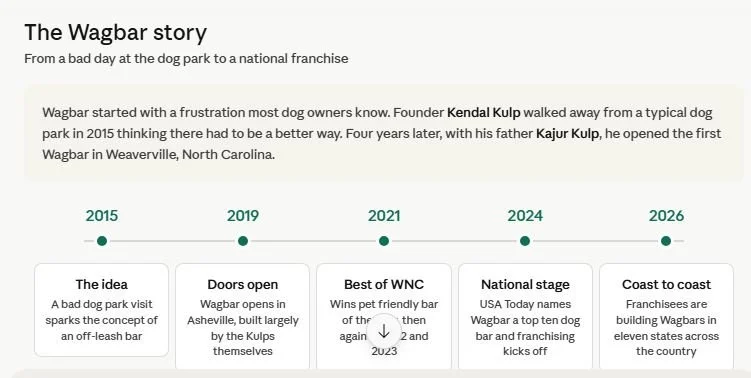
The bar franchise landscape in 2026 includes sports bars, craft beer bars, pubs, wine bars, cocktail lounges, and dog bar franchises, each with very different investment requirements and operational realities. Wagbar sits in a category of its own: the only bar franchise with recurring membership revenue, no commercial kitchen, beer-and-wine-only licensing, and a customer base that shows up daily instead of occasionally. Total investment starts at $470,300, staffing is 4 to 8 per shift, and the model works in any market where people love their dogs and value community gathering spots. Request Wagbar's franchise information to see the full FDD details, or explore locations in development to find a territory near you.
Bottom TLDR: Wagbar's bar franchise model is built differently from sports bars, craft beer bars, pubs, and cocktail lounges. With total investment starting at $470,300, 4 to 8 staff per shift, beer-and-wine-only licensing, and membership-based recurring revenue, it operates at lower cost and complexity than any full-service bar franchise. Request Wagbar's franchise information at wagbar.com/franchising to see the full investment breakdown for your target market.