
Alcohol Licensing for Dog Park Bars: Complete State-by-State Regulatory Guide

Top TLDR: Alcohol licensing for dog park bars requires navigating complex state regulations ranging from $1,000 beer/wine licenses to $300,000+ full liquor licenses, with requirements varying dramatically by jurisdiction regarding license types, animal facility combinations, and health department approvals. Prospective dog park bar franchise owners must consult local alcohol control boards and health departments during site selection to understand specific costs, timelines (3-12 months typical), and feasibility before committing to locations.
Opening a dog park bar franchise means navigating one of the most complex regulatory landscapes in small business: alcohol licensing combined with animal facilities. The challenges extend beyond simply applying for a bar license. You're asking regulatory bodies to approve a concept that doesn't fit neatly into existing categories—where animals and alcohol coexist in ways health departments and alcohol control boards rarely encounter.
The regulatory framework governing alcohol sales varies dramatically between states, and even between counties within the same state. Some jurisdictions make licensing relatively straightforward with costs under $5,000 and approval timelines of 60-90 days. Others create nearly insurmountable barriers: six-figure license costs, year-long approval processes, quota systems limiting new licenses, and health departments concerned about animals near alcohol service. Understanding these variations before selecting locations determines whether your franchise investment succeeds or stalls in regulatory quicksand.
This guide examines alcohol licensing requirements state-by-state, focusing on practical considerations for dog park bar operators. While comprehensive legal guidance requires consultation with attorneys licensed in your specific jurisdiction, this overview helps prospective franchisees identify favorable markets, anticipate major regulatory hurdles, and ask informed questions during location evaluation.
Understanding Alcohol License Types and Classifications
The Three-Tier System Foundation
The 21st Amendment gave states complete control over alcohol regulation within their borders after Prohibition ended. Most states implement "three-tier systems" separating manufacturers (breweries, wineries, distilleries), distributors, and retailers. This structure affects how you purchase inventory and what you can sell on premises.
For dog park bars operating as retailers, you'll typically need on-premises consumption licenses allowing customers to purchase and drink alcohol at your location. These differ from off-premises licenses (liquor stores, convenience stores) that only allow sealed container sales for consumption elsewhere. Understanding this distinction helps you identify the right license category when researching requirements.
The specific license names vary wildly between states: "retailer license" in some jurisdictions, "on-premises consumption permit" in others, "tavern license," "restaurant license," or dozens of other designations. This naming inconsistency creates confusion during research, making it essential to work with local experts familiar with your jurisdiction's specific terminology.
Full Liquor versus Beer/Wine Licenses
Most states offer two basic on-premises license tiers: full liquor licenses allowing beer, wine, and spirits, and beer/wine licenses excluding spirits. The choice dramatically affects both costs and revenue potential.
Full liquor licenses provide maximum flexibility and revenue opportunity. Cocktails typically generate higher margins than beer and wine, attracting customers willing to pay premium prices for craft cocktails. However, these licenses cost substantially more—ranging from $5,000-$15,000 in favorable states to $50,000-$300,000+ in restricted markets with limited license availability.
Beer and wine licenses offer more affordable alternatives, typically costing $1,000-$15,000 depending on jurisdiction. While limiting beverage options, these licenses still capture the majority of potential revenue in dog park bar contexts where customers often prefer beer over spirits. Many successful operations start with beer/wine licenses, upgrading to full liquor later if demand justifies the additional investment.
Some states offer specialty recreational licenses specifically for venues where alcohol service is ancillary to other activities (sports facilities, theaters, museums). These licenses sometimes cost less than standard bar licenses and may better fit dog park bar concepts. However, availability and specific terms vary dramatically by state.
Quota Systems and License Availability
Several states limit the total number of alcohol licenses available, creating quota systems where obtaining new licenses becomes extremely difficult. These quota states include:
New Jersey: Severe restrictions tie liquor license availability to population ratios. Limited supply drove some license prices above $400,000 in high-demand municipalities. Alternative special licenses (brewpub, restaurant with limited liquor) may provide workarounds.
Pennsylvania: Quota system limiting licenses to one per 3,000 residents in each municipality. Existing licenses sell on secondary markets for $50,000-$500,000+ depending on location. Recent reforms allow some additional licenses but availability remains constrained.
California: While not technically a quota state, many localities effectively limit licenses through discretionary approval processes. Some cities welcome new licensees while others rarely approve applications.
Understanding whether your target state uses quotas determines whether you'll need to purchase existing licenses from current holders (expensive, time-consuming) or can apply for new licenses directly from the state (typically faster and cheaper where available).
State-by-State Licensing Overview
Control States versus License States
Eighteen states operate as "control states" where state government monopolizes wholesale or retail alcohol sales. These states create unique considerations:
Control States: Alabama, Idaho, Iowa, Maine, Michigan, Mississippi, Montana, New Hampshire, North Carolina, Ohio, Oregon, Pennsylvania, Utah, Vermont, Virginia, West Virginia, Wyoming.
In control states, you'll navigate additional layers of regulation beyond just licensing. Some control only spirits distribution while allowing private beer/wine sales. Others control all alcohol sales at some level. These structures affect pricing, product selection, and procurement processes.
License states give private businesses more control over alcohol sales within regulatory frameworks. Most dog park bar operations find license states easier to navigate, though specific regulations within each state matter more than the broad categorization.
High-Cost, High-Complexity Markets
New York: Full liquor licenses (on-premises) cost $4,000-$5,000 for the initial two-year term plus renewal fees. However, New York City often sees licenses trading on secondary markets for $100,000-$300,000+ due to unofficial scarcity. Outside NYC, costs remain more reasonable. Beer/wine licenses cost significantly less ($1,000-$2,000).
Application process requires detailed business plans, proof of premises, background checks, and typically takes 3-6 months. Health department concerns about animals near alcohol service create additional scrutiny for dog park bars.
California: License costs vary dramatically by locality. Base state fees run $13,000-$15,000 for full liquor (Type 47 on-sale general license), $200-$1,000 for beer/wine only. However, California allows cities/counties to adopt local rules, and many impose additional requirements, fees, or effectively limit new licenses.
Application processes take 3-6 months minimum, often extending to 8-12 months with protests or complicated applications. Health departments in California scrutinize animal-alcohol combinations closely, requiring detailed plans for physical separation and sanitation.
Massachusetts: Strong local control means approval varies dramatically by city. Boston and surrounding suburbs make obtaining new licenses difficult through discretionary approval processes. License costs range $5,000-$10,000 for applications, but existing licenses trade for $200,000-$400,000 in competitive markets.
Moderate-Cost, Reasonable Complexity Markets
North Carolina: Full liquor licenses (mixed beverage permit) cost approximately $1,000 annually. Beer/wine licenses cost $400 annually. The state's Alcoholic Beverage Control Commission handles approvals, typically completing processes in 60-120 days for straightforward applications.
As a control state, North Carolina maintains ABC stores controlling spirits distribution. On-premises consumption requires purchasing spirits through ABC stores rather than private distributors. This creates minor inconveniences but doesn't fundamentally prevent operations.
Georgia: Alcohol licenses cost $5,000-$7,500 for full liquor, $1,000-$3,000 for beer/wine, varying by municipality. License states and local approval requirements create moderate complexity. Atlanta and suburbs generally welcome new businesses, completing approvals in 90-180 days typically.
Georgia allows local municipalities substantial control over alcohol regulations, creating patchwork requirements across the state. Some counties remain "dry" (prohibiting alcohol sales entirely) while others impose restrictive rules. Site selection must account for local attitudes toward alcohol.
Texas: Mixed beverage permits (full liquor) cost $6,000 for two years. Beer/wine permits cost approximately $1,000. The Texas Alcoholic Beverage Commission (TABC) handles applications, typically completing reviews in 60-90 days for non-controversial applications.
Texas generally maintains business-friendly attitudes toward alcohol licensing. Urban areas like Dallas, Houston, and Austin welcome new establishments. Health department requirements focus on standard restaurant/bar sanitation but may question animal-alcohol combinations, requiring detailed operational plans.
Virginia: As a control state, Virginia maintains ABC stores for spirits retail but allows private on-premises consumption. Mixed beverage licenses cost $1,900-$4,150 depending on locality. Beer/wine licenses cost approximately $300-$500.
The Virginia Alcoholic Beverage Control Authority approves licenses relatively efficiently, completing uncontested applications in 60-90 days. Control state status creates minor procurement complications but doesn't prevent dog park bar operations.
Lower-Cost, Lower-Complexity Markets
Tennessee: Full liquor licenses cost approximately $2,500. Beer permits cost $250-$500. The Tennessee Alcoholic Beverage Commission processes applications in 45-90 days typically.
Tennessee cities like Nashville and Knoxville maintain favorable business climates. Health departments may question animal-alcohol combinations but generally approve well-planned operations. The state's moderate costs and reasonable timelines make it attractive for franchise expansion.
South Carolina: Licenses cost $2,800-$5,000 for full liquor, $400-$1,000 for beer/wine only. The South Carolina Department of Revenue handles alcohol licensing, completing typical applications in 60-120 days.
Coastal markets like Myrtle Beach and Charleston welcome hospitality businesses. Health departments focus on sanitation standards but don't create insurmountable barriers for dog park bars with proper facility design separating animal areas from beverage service.
Ohio: As a control state, Ohio requires purchasing spirits through state stores. However, on-premises licenses cost just $2,264 for full liquor (D-5 permit), $1,012 for beer/wine. The Ohio Division of Liquor Control processes applications in 30-90 days typically.
Ohio cities generally support new hospitality businesses. Cincinnati, Columbus, and Cleveland offer strong markets with reasonable regulatory environments. Control state status creates minor inconveniences but licensing costs remain affordable.
Florida: Full liquor licenses (4COP) cost approximately $1,820. Beer/wine licenses cost around $390. The Florida Division of Alcoholic Beverages and Tobacco completes application reviews in 30-60 days for straightforward cases.
Florida's business-friendly environment extends to alcohol licensing. Major markets like Jacksonville, Orlando, Tampa, and Miami welcome new establishments. Health departments maintain standards but rarely create barriers for professionally-designed facilities.
Navigating Health Department Approvals
Physical Separation Requirements
The combination of animals and alcohol service creates health department concerns that don't exist for standard bars or typical pet facilities. Inspectors worry about cross-contamination between dog waste and food/beverage service areas. Addressing these concerns during facility design prevents expensive retrofits.
Most jurisdictions require physical barriers between dog play areas and alcohol service zones. Specific requirements vary:
Complete separation (required in some jurisdictions): Separate rooms with doors, no direct sightlines, independent ventilation systems, and prohibition on dogs entering beverage service areas. This strict interpretation creates operational challenges by preventing customers from accessing bar service while supervising dogs.
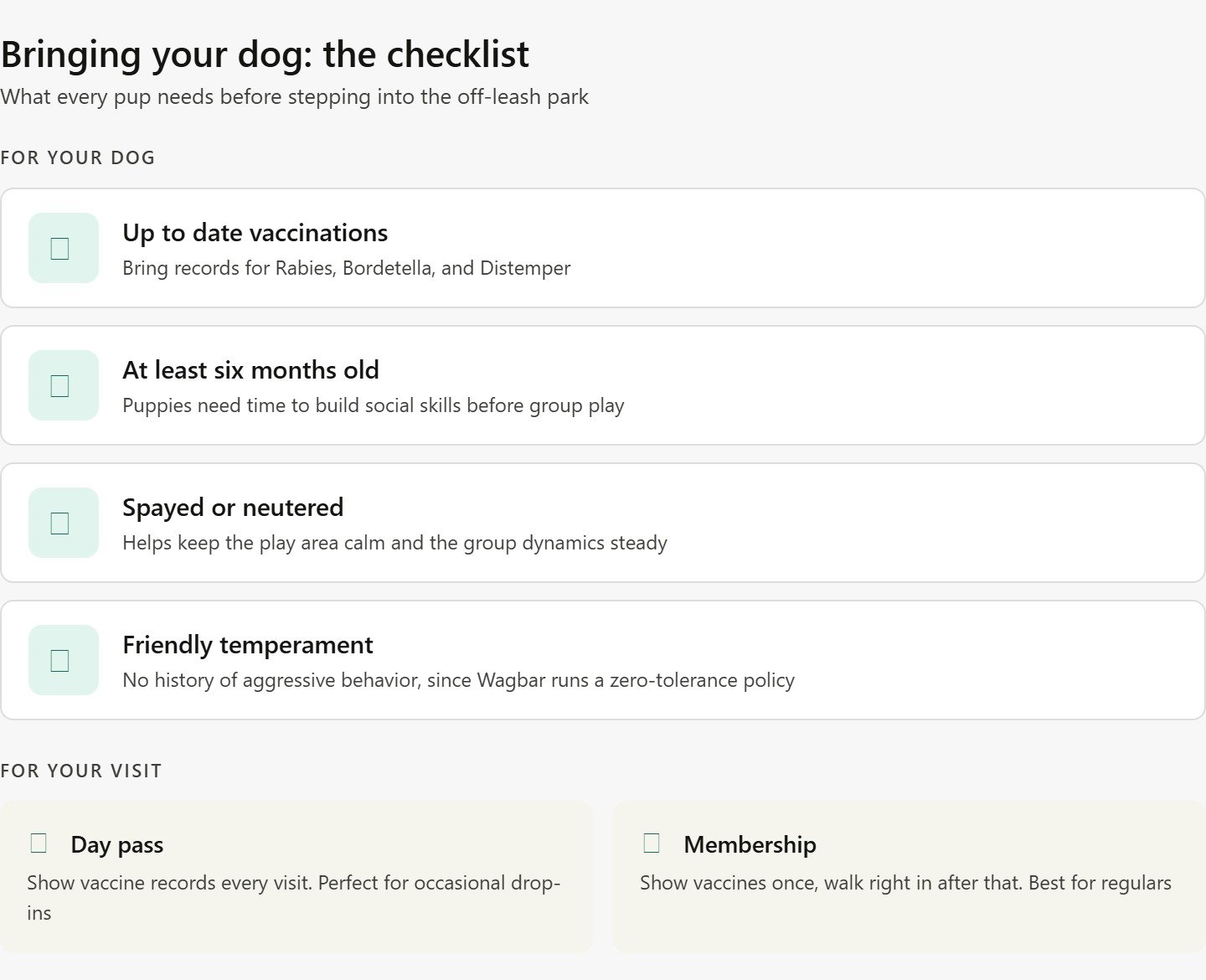
Partial separation (acceptable in many jurisdictions): Waist-high barriers, designated zones with clear boundaries, rules prohibiting dogs in bar areas, and enhanced sanitation protocols. This balanced approach maintains operational flexibility while addressing contamination concerns.
Open plan with protocols (accepted in limited jurisdictions): No physical barriers but strict rules about dog behavior, enhanced cleaning procedures, and continuous staff supervision. This permissive approach works only in jurisdictions with flexible health departments.
During location evaluation, schedule consultations with local health inspectors before finalizing facility designs. Present your concept, show preliminary layouts, and get feedback about what they'll require. This proactive engagement builds relationships and prevents surprises during official inspections.

Enhanced Sanitation Standards
Dog park bars face heightened sanitation expectations compared to standard bars without animals. Implementing robust protocols demonstrates commitment to health standards:
Handwashing stations: Place sinks at transitions between dog areas and beverage service zones, requiring all staff and customers to wash hands before handling food/drinks. Minimum four stations for typical facilities, more for larger operations.
Flooring and drainage: Use impermeable materials that don't absorb liquids in dog areas. Install floor drains with proper trapping preventing backups. Slope floors directing liquids toward drains, preventing standing water.
Waste management: Provide separate waste systems for dog waste and bar waste. Use dedicated receptacles, double-bagging protocols, and separate dumpsters preventing cross-contamination.
Cleaning schedules: Implement documented protocols with frequency exceeding standard bars. Daily pressure washing of dog areas, multiple-times-daily surface disinfection, and professional deep cleaning weekly demonstrates commitment to sanitation.
Maintaining detailed cleaning logs provides evidence during health inspections that you're following protocols. Documentation proves compliance when inspectors have concerns.
Timeline and Process for License Applications
Pre-Application Planning Phase
Begin alcohol licensing efforts 6-12 months before desired opening date. Rushing applications creates mistakes and frustration. The planning phase includes:
Location verification: Confirm zoning allows your intended use. Some jurisdictions zone alcohol sales separately from animal facilities, requiring special permits or variances when combining concepts.
Distance requirements: Many states prohibit alcohol sales within specific distances of schools, churches, or other sensitive uses. Verify your site meets distance requirements before committing to leases.
Attorney consultation: Hire attorneys licensed in your jurisdiction who specialize in alcohol licensing. Their expertise navigates local requirements and increases approval likelihood.
Preliminary health department consultation: Meet informally with health inspectors, discussing your concept and getting feedback about facility requirements. This early engagement prevents expensive surprises.
Financial preparation: Secure funding covering license costs, application fees, attorney fees, and potential delays. Budget 20-30% above estimated costs for unexpected expenses.
Application Submission and Review
The formal application process typically spans 90-180 days but can extend to 12+ months for complicated situations:
Application completion: Submit detailed forms including business plans, ownership information, site plans, financial statements, and background checks for all principals. Incomplete applications cause delays.
Public notice and protest period: Most jurisdictions require posting public notices and allowing community members to protest applications. Protests don't automatically prevent approval but require responses and sometimes hearings.
Investigation phase: Regulators verify information in applications, conduct background checks, and sometimes interview applicants. The thoroughness of investigations varies by jurisdiction and application complexity.
Conditional approval: Many states grant conditional approvals requiring final inspections before issuing licenses. This allows you to proceed with buildout while awaiting final licensing.
Final inspection and license issuance: Once construction completes, schedule final inspections verifying compliance with all requirements. After passing inspections, regulators issue licenses allowing legal operations.
Common Delays and How to Avoid Them
Several factors commonly extend licensing timelines beyond initial estimates:
Incomplete applications: Missing documents or information requires resubmissions and restarts review timelines. Work with attorneys ensuring complete initial submissions.
Community protests: Neighborhood opposition can delay or prevent approvals. Proactive community engagement explaining your concept and addressing concerns preemptively reduces protest likelihood.
Background issues: Criminal records, financial problems, or regulatory violations in applicants' histories create complications. Full transparency about potential issues allows addressing them proactively rather than having them surface during investigations.
Health department concerns: Inspectors questioning animal-alcohol combinations need education about your operational protocols and facility design. Detailed plans with professional architectural drawings address concerns more effectively than verbal explanations.
Political complications: In jurisdictions with elected alcohol control boards or political approval processes, timing applications around election cycles and securing political support improves approval likelihood.
Working With Franchise Support on Licensing
How Franchisors Can Help
Reputable dog park bar franchises provide substantial licensing support that dramatically eases the approval process. Franchisors offer:
Proven facility designs: Architectural plans and layouts that have achieved health department approval in other jurisdictions provide templates for your location. These plans address typical inspector concerns about separation, ventilation, and sanitation.
Regulatory guidance: Franchisors familiar with licensing requirements across multiple states direct you toward favorable jurisdictions and warn about problem areas. This knowledge comes from collective experience across franchise systems.
Attorney referrals: Connections to local attorneys who have successfully obtained dog park bar licenses provide expertise navigating your specific jurisdiction. These referrals are often more valuable than generic business attorney relationships.
Application templates: Sample business plans, operating procedures, and application materials that have succeeded previously save enormous time compared to creating documents from scratch.
Support during inspections: Franchisor representatives can attend health inspections and alcohol board hearings, providing credibility through their experience with similar operations nationwide.
What Support Doesn't Cover
Even with excellent franchise support, you remain responsible for:
Local relationship building: Establishing trust with local inspectors, boards, and officials requires your personal engagement. Franchisors can facilitate introductions but can't build relationships for you.
Jurisdiction-specific research: Each state, county, and municipality maintains unique requirements. You must verify specific rules in your location rather than assuming processes match other franchise locations.
Legal fees and costs: Franchise fees typically don't include alcohol licensing expenses. Budget separately for attorney fees, application costs, and license fees that commonly total $25,000-$75,000 beyond franchise fees.
Timeline management: Opening date predictions must account for regulatory approval timelines in your specific location. Aggressive schedules that don't accommodate licensing delays create financial pressure when openings postpone.
Bottom TLDR: Alcohol licensing for dog park bars requires understanding state-specific regulations ranging from affordable beer/wine permits ($400-$5,000) in business-friendly states like Tennessee, Florida, and Ohio to expensive full liquor licenses ($50,000-$300,000) in restricted markets like New York, New Jersey, and Massachusetts. Successful franchise operations begin licensing efforts 6-12 months before desired opening dates, working with local attorneys and health departments to navigate unique requirements for combining animal facilities with alcohol service, ultimately securing approvals through proactive engagement and properly designed facilities that address contamination concerns.
Frequently Asked Questions
How much do alcohol licenses cost for dog park bars? Alcohol license costs vary dramatically by state and license type. Beer/wine licenses typically range from $400-$15,000 in most states. Full liquor licenses cost $2,000-$15,000 in favorable states like Texas, Georgia, North Carolina, and Florida but can reach $50,000-$300,000+ in restricted markets like New York, New Jersey, California, and Massachusetts where quota systems or secondary markets drive up prices. Budget $25,000-$75,000 total for licensing including attorney fees, application costs, and license purchases when planning franchise investments.
How long does it take to get alcohol licenses approved? Typical approval timelines range from 60-180 days in states with straightforward processes and reasonable regulators. Complex applications, community protests, or health department concerns can extend timelines to 6-12 months. New Jersey, California, and Massachusetts often take longer than average. Tennessee, Florida, and Ohio typically complete reviews in 60-90 days. Begin application processes 6-12 months before desired opening dates to accommodate potential delays.
Do all states allow dogs and alcohol together in one facility? No states explicitly prohibit the combination, but health departments in each jurisdiction maintain discretion about approving operations. Success depends on facility design properly separating dog areas from alcohol service, enhanced sanitation protocols, and convincing health inspectors that cross-contamination risks are managed. Most jurisdictions approve well-designed facilities after reviewing detailed operational plans. Work with franchisors and local health departments during planning to understand specific local requirements.
Can I start with a beer/wine license and upgrade to full liquor later? Yes, most states allow upgrading from beer/wine to full liquor licenses, though processes and costs vary. This approach reduces initial investment while capturing majority of potential beverage revenue. Monitor customer demand for spirits; if substantial interest appears, upgrade applications typically take 30-90 days. However, some quota states make obtaining full liquor licenses extremely difficult regardless of upgrade attempts. Verify upgrade feasibility in your jurisdiction before committing to this strategy.
Which states are easiest for dog park bar alcohol licensing? Tennessee, Florida, Ohio, and Georgia generally offer the most favorable combinations of reasonable costs ($2,000-$7,500 for full liquor), efficient approval processes (60-120 days), and health departments open to well-designed dog park bar concepts. North Carolina and South Carolina also provide good environments despite control state status. Texas offers favorable regulations in urban markets like Dallas, Houston, and Austin. Avoid quota states like New Jersey, Pennsylvania, and highly-restricted California municipalities unless prepared for six-figure license costs and extended timelines.