

Dog Park Bar Franchise: The Ultimate Guide to Combining Pet Care and Hospitality
Top TLDR: Dog park bar franchises merge off-leash dog parks with full-service bars, creating dual-revenue business models where membership fees and day passes from dog owners combine with food and beverage sales to capitalize on the $147 billion pet industry. This innovative franchise concept requires $470,300-$1,145,900 in initial investment but offers recession-resistant returns by serving both the growing pet services market and the social hospitality sector through a community-focused model where dogs play safely while owners socialize over craft beverages.
The traditional dog park offers a simple value proposition: fenced outdoor space where dogs can run off-leash while owners stand around watching. The traditional bar provides another straightforward service: a place where people gather to drink and socialize. What happens when you combine these concepts into a single business model? You create something genuinely different—a destination where the pet care industry intersects with hospitality in ways that transform both experiences while generating revenue streams neither achieves alone.
Dog park bars represent one of the fastest-growing segments in the pet franchise industry, driven by demographic shifts, changing pet ownership patterns, and consumer demand for experiences rather than just services. American pet owners spent $147 billion on their animals in 2023, with experiential services growing faster than traditional product categories. Meanwhile, the craft beverage movement created consumers seeking unique social venues beyond standard bars and restaurants. Dog park bars sit at the intersection of these trends, offering differentiated experiences that competitors can't easily replicate.
This comprehensive guide examines the dog park bar franchise model from concept through operations, exploring how these businesses work, what makes them successful, and what prospective franchisees need to know before investing. Whether you're an entrepreneur passionate about dogs, a hospitality professional seeking new opportunities, or an investor evaluating pet industry trends, understanding this emerging franchise category reveals opportunities and challenges that define success in this unique market.
Understanding the Dog Park Bar Concept
Origins and Evolution of the Model
The dog park bar concept emerged from frustration with existing options rather than formal business planning. Traditional public dog parks provide free access but minimal amenities, poor maintenance, and inconsistent supervision that creates safety concerns. Dog owners seeking better alternatives find commercial options limited: dog daycares and boarding facilities that keep dogs separated from owners, or dog-friendly restaurants and bars where dogs must remain leashed and often aren't the focus.
The realization that drove early pioneers: dog owners would pay for premium dog park experiences if those venues also offered adult amenities making the time enjoyable rather than just tolerable. Instead of standing in muddy fields watching dogs play, owners could sit comfortably with beverages and food while their dogs enjoyed safe, supervised off-leash play. This simple insight created a business model that serves both species simultaneously.
Wagbar pioneered this concept starting in Asheville, North Carolina in 2019, proving the model's viability even through pandemic challenges. The success demonstrated that dog park bars aren't novelty concepts but sustainable businesses addressing real market gaps. Today, the model has evolved from single proof-of-concept locations into franchise opportunities expanding across multiple markets as entrepreneurs recognize the potential to replicate success in their communities.
The modern dog park bar franchise incorporates lessons learned from early operations: proper facility design preventing safety issues, staff training protocols ensuring consistent service quality, membership models creating recurring revenue, and community-building strategies that transform customers into advocates. These refinements make today's franchise opportunities less risky than pioneering independently.
What Makes Dog Park Bars Different from Alternatives
Dog park bars occupy a distinct market position separate from other pet businesses and hospitality venues. Understanding these differences clarifies the competitive advantages and helps franchisees position their businesses effectively.
Compared to traditional free public dog parks, dog park bars provide professional supervision by trained staff who intervene in conflicts before they escalate, vaccination verification reducing disease transmission risks, climate-controlled indoor options or covered outdoor spaces allowing year-round operation, and clean, well-maintained facilities with proper drainage and regular sanitation. These upgrades justify entry fees that free parks don't charge.
Unlike dog daycares or boarding facilities, dog park bars keep owners present with their dogs rather than dropping off and leaving. This creates different operational requirements (hospitality and entertainment alongside pet care) but also different revenue opportunities (selling food and beverages to owners present for hours). The customer experience centers on socializing with other dog owners while dogs play, not just knowing dogs are safe while owners work.
Traditional dog-friendly bars and restaurants allow leashed dogs but don't focus on them as primary customers. Dogs must behave calmly in confined spaces, can't interact freely with other dogs, and often face restrictions about where they can sit or what areas they can access. Dog park bars flip this dynamic: dogs are the main attraction with full freedom to play, while human amenities enhance rather than define the experience.
The off-leash dog park bar concept creates unique value by serving needs that alternative options don't address: dog owners wanting quality off-leash play for their pets while enjoying adult social time for themselves, in climate-controlled comfortable environments with proper safety supervision. No other business category delivers this specific combination.
Core Components of Successful Operations
Every successful dog park bar combines several essential elements working together. Missing or poorly executing any component compromises the overall model.
The physical space requires adequate square footage for safe dog play—typically 3,000-8,000 square feet minimum for the dog park area, with additional space for bar, seating, storage, and staff areas. Proper flooring providing traction and easy cleaning, secure fencing preventing escapes, climate control maintaining comfortable temperatures, and lighting creating visibility without harsh glare all contribute to functional facilities.
The bar component needs full liquor licenses (where regulations allow) or beer/wine licenses at minimum, plus equipment for serving: taps, refrigeration, glassware, POS systems, and comfortable seating for customers not actively supervising dogs. Food service ranges from full kitchens producing meals to minimal offerings like pre-packaged snacks, with rotating food trucks providing middle-ground solutions.
Staffing combines pet care skills with hospitality training. Dog area supervisors need to understand canine body language, break up conflicts safely, and enforce rules consistently. Bar staff need standard hospitality skills: making drinks, managing inventory, providing customer service, and maintaining cleanliness. Cross-training helps staff understand both sides of the operation.
Revenue structures typically center on dog entry fees: day passes for occasional visitors, monthly or annual memberships for regulars, and sometimes punch passes for moderate users. Beverage and food sales provide additional revenue from the same customers. Some locations add retail (dog supplies, branded merchandise), private events, or partnerships with dog trainers and groomers for supplementary income.
Safety protocols form the foundation everything else builds on: vaccination verification at entry, age and spay/neuter requirements, behavioral screening for aggressive dogs, continuous supervision by trained staff, and immediate incident response procedures. Without proper safety systems, the business model collapses under liability claims and customer distrust.
The Dual Revenue Stream Business Model
Membership and Entry Fee Structures
Dog entry fees represent the primary revenue stream for most dog park bar operations, generating 50-70% of total revenue. The fee structure determines how much money the business generates per dog visit while affecting conversion rates and customer satisfaction.
Day pass pricing typically ranges from $10-$20 per dog depending on market, facility quality, and competitive landscape. Higher prices work in affluent markets with limited alternatives; lower prices compete better in areas with multiple free public dog parks. Day passes capture occasional visitors: tourists, people trying the facility before committing to membership, or local residents who visit irregularly.
Monthly memberships create recurring revenue and customer commitment. Typical pricing runs $40-$80 per dog per month, offering unlimited visits during operating hours. The economics work well for owners visiting 4+ times monthly, who save money compared to day passes while the business captures predictable revenue even during slower periods. Monthly members form the core customer base, visiting regularly and developing strong facility attachment.
Annual memberships provide upfront cash flow and maximum customer commitment. Pricing generally ranges from $400-$800 per dog annually, equivalent to 10-12 months of monthly membership. The discount incentivizes annual commitment while the business receives payment covering an entire year immediately. Annual members rarely cancel mid-year even if visit frequency declines, making them the most valuable customer segment.
Multi-dog pricing strategies accommodate households with multiple pets. Most facilities charge full price for the first dog, then 20-40% discounts for additional dogs from the same household. This pricing recognizes that the second or third dog creates minimal additional costs while discounts make membership affordable for multi-dog families who might otherwise find the service too expensive.
Punch passes serve customers wanting more visits than day passes justify but less commitment than monthly memberships require. A 10-visit pass priced at $120-$150 (equivalent to $12-$15 per visit) provides moderate savings while requiring partial upfront payment. These passes work well for customers with variable schedules or those building up to regular membership.
The membership model creates network effects: as more dogs become regular visitors, each dog enjoys better socialization opportunities with familiar playmates, making the experience more valuable and increasing retention. Successful facilities report 60-75% of revenue from memberships rather than day passes, indicating strong conversion to recurring customers.
Food and Beverage Revenue Opportunities
While dog entry fees provide primary revenue, food and beverage sales offer high-margin supplementary income from customers already on premises. Optimizing F&B operations can add 30-50% to total revenue while enhancing customer experience.
Craft beer selections appeal to the demographic dog park bars naturally attract: millennials and Gen X consumers with discretionary income, interest in quality beverages, and lifestyle priorities that include pets. A well-curated draft list (8-12 taps) featuring local breweries creates differentiation while building community relationships. Pricing typically follows local craft beer bar standards: $6-$9 per pint depending on market.
Wine and cocktails expand beyond beer-focused offerings, capturing customers preferring those beverages and increasing average tickets. Wine by the glass (6-8 options spanning varietals and price points) and simple signature cocktails using quality spirits provide enough variety without requiring extensive expertise or inventory. Cocktail pricing generally ranges $10-$14, wines $8-$12 per glass.
Non-alcoholic options matter more than in standard bars because dog park bars often operate during daytime hours when many customers don't drink alcohol. Quality coffee programs (espresso drinks, cold brew), specialty sodas, kombucha, and creative non-alcoholic beverages ensure non-drinkers have appealing choices. This inclusivity expands the customer base beyond just alcohol consumers.
Food service approaches vary by facility capabilities and market preferences. Full kitchens producing meals require significant investment in equipment, licensing, and staffing but generate substantial revenue and keep customers on-site longer. Limited menus focusing on easy-to-produce items (pizzas, sandwiches, appetizers) balance capability with revenue. Packaged snacks provide minimal offerings with minimal effort.
Food truck partnerships offer middle-ground solutions gaining popularity. Rotating trucks (2-3 different vendors weekly) provide meal variety without requiring kitchen infrastructure, with facilities taking percentage fees (typically 10-15% of truck sales) or simply using trucks as amenity attracting customers who buy more drinks. This model works particularly well for facilities with outdoor space accommodating trucks.
Retail sales of dog supplies, treats, and branded merchandise generate modest supplementary revenue while enhancing customer convenience. High-quality dog treats, waste bags, toys, and facility-branded items (t-shirts, hats, pint glasses) typically don't produce major revenue but add 3-8% to top-line sales with minimal effort required.
Average customer spending on F&B typically ranges $12-$25 per visit beyond entry fees, varying by daypart (higher evenings when more alcohol is consumed), length of stay, and food availability. A facility with 30 customers present on average day generating $18 in F&B spending produces $540 daily or $16,000+ monthly in supplementary revenue.

Projecting Revenue and Path to Profitability
Understanding realistic revenue projections and profitability timelines helps prospective franchisees evaluate whether dog park bar business models meet their financial goals.
Membership capacity determines maximum potential revenue from dog entry fees. A 5,000 square foot dog park can safely and comfortably accommodate 40-50 dogs simultaneously at peak times. If operating hours span 60 hours weekly (10 AM - 8 PM daily, shorter Sundays), maximum annual dog-hours equals 2,400-3,000 hours weekly or 125,000-156,000 hours yearly. At $15 effective average revenue per dog-hour (accounting for memberships, day passes, and multiple dogs), this equals $1,875,000-$2,340,000 in theoretical maximum revenue.
Realistic utilization during the first 12-18 months typically reaches 30-40% of capacity as the business builds membership base. This translates to $562,500-$936,000 in year-one dog entry revenue for a well-located facility with effective marketing. Add $200,000-$400,000 in F&B revenue assuming customers spend $15-$20 per visit, producing total year-one revenue of $762,500-$1,336,000.
Operating expenses consume 65-75% of revenue during the first two years: rent/mortgage (15-20% of revenue), labor (30-35%), cost of goods sold for F&B (20-25% of F&B revenue), utilities (4-6%), insurance (3-5%), marketing (5-8%), franchise royalties (6-7%), and maintenance/supplies (3-5%). First-year profitability is uncommon; breaking even or generating small losses is normal.
Years 2-3 see improving economics as membership base matures and operational efficiency increases. Utilization typically reaches 50-60% of capacity, revenue grows to $1,000,000-$1,600,000, and operating expense ratios improve through scale economies. EBITDA margins of 10-20% become achievable, generating $100,000-$320,000 in annual profit before owner compensation.
Mature facilities (year 4+) operating at 60-70% capacity can achieve revenues exceeding $1,500,000 with EBITDA margins of 20-25%, producing $300,000-$450,000 in annual profit. These figures assume competent management, good location, effective marketing, and stable competitive environment.
Payback periods on initial investment typically span 4-7 years for franchisees taking owner draws from profits. Investors evaluating returns should use realistic rather than optimistic projections, recognizing that location quality, management capability, market demographics, and competitive dynamics all significantly impact actual performance.
Navigating Regulatory Complexity
Alcohol Licensing and Service Requirements
Operating bars requires comprehensive understanding of alcohol regulations that vary dramatically by state, county, and municipality. The pet franchise business combined with alcohol service creates unique regulatory considerations.
License types depend on offerings and local availability. Full liquor licenses allowing beer, wine, and spirits provide maximum revenue opportunity but cost more ($50,000-$300,000 in some markets) and face severe restrictions in jurisdictions limiting licenses. Beer and wine licenses offer more affordable alternatives ($1,000-$15,000) with fewer restrictions but limit beverage options. Some states offer special recreational licenses at lower cost specifically for venues like dog parks where alcohol is ancillary rather than primary business focus.
Three-tier system regulations separate manufacturers, distributors, and retailers, affecting how you purchase inventory. Most states require buying all alcohol through licensed distributors rather than directly from breweries or wineries, with limited exceptions for on-premises sales of locally-produced beverages. Understanding your state's three-tier rules prevents costly violations.
Responsible beverage service training requirements mandate staff certification in many jurisdictions. Programs like TIPS, ServSafe Alcohol, or state-specific training teach staff to check IDs, refuse service to intoxicated customers, and prevent underage drinking. Some states require manager and every server to hold current certification; others require just management. Budget $20-$50 per employee every 2-3 years for training and certification.
Happy hour and pricing regulations restrict promotional activities in some states. All-day drink specials, two-for-one offers, unlimited drink packages, and below-cost pricing may be prohibited or restricted. Some states limit happy hours to specific days or times. Review your state's promotional restrictions before planning marketing campaigns around drink specials.
Liability for over-service extends beyond injuries occurring on your premises. Dram shop laws in many states hold bars liable for damages caused by intoxicated customers after they leave the facility. This creates significant liability exposure requiring robust policies: training staff to recognize intoxication signs, cutting off over-served customers even when uncomfortable, offering alternative transportation for impaired customers, and maintaining comprehensive liability insurance.
Food service requirements sometimes accompany alcohol licenses. Some jurisdictions require bars to serve food meeting minimum standards (prepared on premises, specific percentage of revenue, always available during alcohol service hours). Verify whether your alcohol license requires food service beyond the snacks you might prefer offering.
Operating hour restrictions limit when you can serve alcohol. Many jurisdictions prohibit alcohol sales before noon Sundays, require stopping service at midnight or 2 AM, or ban alcohol sales on certain holidays. These restrictions affect your business model by limiting revenue hours, particularly for venues relying on evening bar traffic.
Animal-Related Permits and Health Department Approvals
Operating facilities where animals and food/beverages coexist requires navigating health department regulations designed primarily for restaurants or animal facilities individually, not combinations.
Health department consultations before facility design prevent expensive retrofits. Schedule meetings with local health inspectors during planning phase, presenting your concept and getting feedback on what they'll require. Inspectors appreciate proactive engagement and provide valuable guidance about specific concerns they'll evaluate during licensing inspections.
Physical separation between dog areas and food preparation/service often becomes the most contentious requirement. Some health departments demand complete separation: separate rooms with doors, no airflow between areas, independent ventilation systems, and prohibition on dogs entering food service areas. Others allow open-plan designs with partial barriers and rules keeping dogs away from food service zones. Understanding your local requirements before designing facilities prevents major redesign costs.
Handwashing station requirements extend beyond standard restaurant needs. Facilities need adequate stations for: bar staff before handling food/drinks, dog area staff before entering food service areas, customers after handling dogs before eating/drinking, and anyone entering from outdoor dog areas. Budget for 4-6 handwashing stations minimum, more for larger facilities.
Flooring and drainage requirements prevent cross-contamination between dog waste and food service areas. Health departments may require: impermeable flooring materials that don't absorb liquids, floor drains in dog areas with proper trapping preventing backups, and sloped floors directing liquids toward drains. Coordinate flooring selection with health department requirements early in design.
Waste handling systems need clear separation between dog waste and food waste. Provide: dedicated dog waste receptacles emptied into separate dumpsters, double-bagging or sealed containers for dog waste disposal, and protocols preventing cross-contamination during waste removal. Some jurisdictions require completely separate waste systems for dog and food areas.
Pest control programs prove essential for maintaining health department approval. Indoor dog facilities attract flies and other pests through waste and food debris. Implement: monthly professional pest control treatments, daily cleaning protocols removing food and waste, and integrated pest management addressing entry points and breeding sites. Document all pest control activities for health department inspections.
Regular inspections verify ongoing compliance. Health departments typically inspect annually or semi-annually, plus complaint-driven inspections if issues arise. Maintain: daily cleaning logs, pest control records, equipment maintenance documentation, and staff training certificates available for inspector review. Minor violations are common and correctable; major violations can force temporary closure.
Zoning, Building Codes, and ADA Compliance
Real estate considerations extend beyond finding available space with good traffic. Zoning and building codes determine whether your business model is allowed at specific locations.
Zoning classifications determine permitted uses for properties. Most dog park bars fall into multiple categories: "recreation" (dog park), "restaurant/bar" (food and beverage service), "animal care facility" (in some jurisdictions), or "entertainment venue." Some zoning codes don't contemplate this combination, requiring special permits or variances. Verify zoning allows your intended use before committing to leases or purchases.
Conditional use permits or variances may be necessary when zoning doesn't explicitly allow dog park bars. These processes require: submitting detailed business plans to planning commissions, attending public hearings where neighbors can object, demonstrating your business won't create problems (noise, parking, odors), and potentially agreeing to conditions limiting operations. This process takes 3-6 months and costs $2,000-$10,000 in application fees and legal costs.
Parking requirements often exceed what's needed for customer convenience. Most codes require parking spaces based on square footage or maximum occupancy. Standard ratios (1 space per 300 square feet) can require 20-30 spaces for medium facilities. Location selection must account for adequate parking or nearby public parking supplementing on-site spaces.
Building code compliance ensures structural and safety standards. Key requirements include: adequate exits based on occupancy load (typically two exits minimum), emergency lighting and exit signs illuminating evacuation routes, fire suppression systems (sprinklers) in some jurisdictions, proper electrical service for equipment loads, and plumbing sufficient for restrooms and handwashing stations.
Americans with Disabilities Act compliance creates accessible facilities. Requirements include: accessible parking spaces (one per 25 spaces minimum), accessible entrance routes from parking to entry, doorways minimum 36 inches wide accommodating wheelchairs, accessible restrooms with grab bars and proper clearances, and service counters at wheelchair-accessible heights. While dogs can accompany customers through facilities, service areas where dogs play may not require full accessibility if no services are provided in those areas.
Occupancy calculations determine maximum legal capacity. Fire marshals calculate occupancy based on floor area and exit capacity, typically allowing 15-20 square feet per person. A 5,000 square foot facility might be permitted 250-333 maximum occupancy, but practical limits accounting for dog areas and equipment typically support 100-150 customers safely. Display occupancy limits prominently as required by code.
Outdoor spaces face additional requirements. Zoning may limit outdoor alcohol service hours more restrictively than indoor areas. Noise ordinances affect outdoor music and events. Some jurisdictions require additional permits for outdoor areas. Fencing heights may be regulated. Verify all requirements before developing outdoor spaces.
Identifying and Targeting Ideal Customers
Demographic and Psychographic Profiles
Understanding who uses dog park bars helps with location selection, marketing messaging, and service design. The target market shows distinctive patterns transcending simple demographics.
Primary age range spans millennials (27-42) and older Gen X (43-58), with millennials slightly overrepresented compared to population percentages. These generations drive pet ownership growth, viewing dogs as family members deserving premium experiences. They're comfortable with experiential spending and seeking social venues beyond traditional bars or restaurants. Younger Gen Z customers (21-26) attend but represent smaller percentages, while baby boomers (59+) visit but less frequently.
Income levels trend toward upper-middle class: household incomes $75,000-$150,000 represent the core market, with tails extending into $50,000-$75,000 (occasional visitors) and $150,000+ (frequent visitors with multiple memberships). These income ranges afford discretionary spending on both monthly memberships and regular food/beverage purchases without financial strain.
Education correlates positively with usage: college-educated professionals comprise 65-75% of regular customers. This educational attainment associates with work schedules allowing visits (professional jobs with flexible hours or remote work options), disposable income supporting membership costs, and values prioritizing pet wellbeing through socialization and exercise.
Urban and suburban residents use facilities most heavily. True rural residents rarely appear (they have space for dogs at home), while dense urban dwellers visit frequently (they lack home space for dogs to exercise). Close-in suburbs with small yards but high property values represent ideal markets: residents have dogs but limited home space for meaningful exercise.
Household composition skews toward: young couples without children but with dogs ("DINKs with dogs"), young families with children and dogs who see dog park bars as family activities, and empty nesters whose adult children have left but dogs remain central to lifestyle. Single individuals visit but represent smaller percentage than these household types.
Lifestyle characteristics matter more than pure demographics. Target customers prioritize: urban dog living and related activities, social experiences over material goods, health and wellness for themselves and pets, and community connection through shared interests. They seek venues aligning with these values.
Understanding Customer Visit Patterns and Behavior
Optimizing operations requires understanding when and how customers use facilities. Usage patterns inform staffing, inventory, and facility design decisions.
Weekly patterns show strong weekend traffic, particularly Saturday afternoons (noon-5 PM) and Sunday mornings/early afternoons (10 AM-3 PM). Friday evenings see increasing traffic as customers stop after work. Weekday patterns vary: morning visits (7-10 AM) from remote workers or non-traditional schedules, lunch hours (11:30 AM-1:30 PM) from nearby workers, and evening peaks (5-8 PM) after traditional work hours.
Seasonal fluctuations affect indoor versus outdoor operations differently. Indoor facilities see stronger winter usage when outdoor alternatives become unpleasant, while outdoor venues peak in spring and fall (mild weather) with summer seeing moderate usage and winter dropping significantly. Understanding these patterns helps with financial planning and marketing focus.
Visit duration averages 90-120 minutes for regular customers, long enough for dogs to play extensively and owners to relax. Day pass customers often visit slightly shorter (60-90 minutes) as they're testing the facility or visiting for specific purposes. Extended stays of 2-3+ hours happen during events or when customers bring laptops to work while dogs play.
Visit frequency for members typically ranges from 2-4 times weekly for most engaged customers, who form the community core. Monthly members visiting less than twice monthly typically cancel within 3-6 months, having determined the value doesn't justify cost. Day pass customers who visit 3+ times monthly usually convert to memberships once they recognize the savings.
Group dynamics influence facility usage. Solo visitors constitute 40-50% of customers, particularly weekday daytime visitors. Pairs (couples, friends) represent 30-40%, while larger groups of 3-4 people appear less frequently but create concentrated bar sales opportunities. Managing group dynamics prevents crowding and maintains comfortable environment.
Multi-dog households visit slightly less frequently than single-dog households but spend more per visit on entry fees and food/beverage. These households represent particularly valuable customers and respond well to multi-dog pricing incentives encouraging membership purchases.
Lifecycle patterns affect retention. New customers visit frequently initially (3-5 times monthly first 2-3 months) as dogs and owners get comfortable, then settle into steady patterns (2-3 times monthly) long-term. Pregnancies, moves, work changes, dog health issues, and other life events create usage changes. Strong retention requires staying connected with customers during lower-usage periods to prevent cancellation.
Marketing Strategies That Build Community
Dog park bars succeed through community building rather than transactional marketing. The most effective strategies create belonging and connection transcending simple service provision.
Grand opening campaigns establish initial customer base. Effective approaches include: soft opening weeks with free or discounted entry for first customers, partnerships with local rescues and shelters bringing adoptable dogs for exposure, collaboration with neighborhood associations and community organizations, and influencer events inviting local social media personalities to experience and share the facility. Budget $10,000-$20,000 for grand opening marketing spread over 4-6 weeks.
Social media marketing dominates ongoing customer communication. Focus platforms where target demographics spend time: Instagram for visual content showcasing happy dogs playing, Facebook for community building and event promotion, and potentially TikTok for reaching younger audiences. Post daily showing: customer dogs enjoying the facility (with owner permission), upcoming events and promotions, staff introductions humanizing your team, and behind-the-scenes content building connection.
User-generated content multiplies marketing reach without additional cost. Encourage customers to: tag your facility in their dog photos, use location tags and facility hashtags, write reviews on Google and Yelp, and share their experiences with friends. Feature customer content on your channels (with permission), creating flywheel effects where customers see themselves represented and post more content seeking similar recognition.
Events build community while creating marketing opportunities. Successful events include: breed-specific meetups (doodles, small breeds, large breeds), holiday celebrations (Halloween costume contests, holiday photos), customer appreciation days with food, drinks, and activities, and charity fundraisers benefiting local animal organizations. Events generate social media content, bring lapsed customers back, and create reasons for members to invite friends.
Partnership marketing expands reach through complementary businesses. Collaborate with: local veterinarians who recommend your facility to clients, pet supply stores cross-promoting services, dog trainers offering classes at your facility, groomers providing mobile services in your parking lot, and dog photographers shooting professional photos at your venue. These partnerships generate referrals while adding value for existing customers.
Referral programs incentivize members spreading awareness. Offer: free month of membership for referring friends who purchase memberships, day pass credits for referrals buying day passes, or prize drawings for members generating multiple referrals. Track referrals through unique codes or simply asking new customers how they heard about you.
Email marketing maintains engagement with members and prospects. Send weekly or bi-weekly emails featuring: upcoming events and activities, new food or beverage offerings, member spotlights showcasing community members, seasonal content about dog health and wellness, and exclusive member promotions. Maintain 30-40% open rates by providing genuine value rather than constant selling.
Local advertising supplements digital marketing. Effective channels include: local magazines and newspapers targeting affluent readers, neighborhood newsletters and community websites, digital ads on local news sites and blogs, and sponsorships of community events (farmers markets, festivals, charity runs). Budget $2,000-$5,000 monthly for paid advertising after initial launch period.
Operational Logistics and Staffing
Facility Design and Layout Considerations
Physical space design determines operational efficiency, customer experience, and safety outcomes. Poor layout creates problems that can't be fixed without major renovation.

Dog park zones should accommodate different needs: main play area (largest space) for active adult dogs, separate small dog section protecting smaller breeds from rough play, quiet area for less active or older dogs, and entry/transition zone for controlled introductions. Typical ratios allocate 60% of dog space to main area, 20% to small dogs, 10% to quiet zone, and 10% to entry.
Fencing and barriers require careful specification. Use: 6-foot minimum height preventing most dogs from jumping or climbing over, buried or L-footer extensions preventing digging under, small-gauge mesh or vertical pickets preventing small dog escapes, and gates with double-door systems creating airlocks preventing escape during entry/exit. Check fencing daily for damage and repair immediately.
Bar and seating areas need sightlines allowing customers to watch dogs while enjoying food and drinks. Design options include: elevated bar areas overlooking dog parks, strategic window placement for indoor facilities, and outdoor seating directly adjacent to play areas. Avoid layouts requiring customers to choose between supervising dogs or accessing bar services.
Storage requirements exceed expectations for facilities of this size. You need: liquor storage for full bar inventory, refrigeration for beer kegs and wine, dry goods storage for food and supplies, cleaning supply storage separate from food areas, and retail display for merchandise. Plan 300-500 square feet minimum for storage across these categories.
Restroom capacity follows building codes but should exceed minimums for customer convenience. Provide: adequate number of fixtures based on maximum occupancy, family-friendly single-stall options accommodating parents with children, and high-quality fixtures that withstand commercial use. Clean restrooms reflect overall facility quality in customer minds.
Staff areas allow employees to take breaks away from public spaces. Include: small break room with seating and refrigeration, secure storage for personal belongings, and employee restroom if customer restrooms are distant from staff areas. Staff working 8+ hour shifts need spaces where they can decompress during breaks.
Office space handles administrative work: scheduling, inventory management, bill payment, and private conversations with employees or customers. A modest 100-150 square foot office suffices, requiring: desk space for computer and paperwork, file storage for records, and door providing privacy for conversations.
Equipment rooms house mechanical systems: HVAC equipment, water heaters, electrical panels, and sometimes bar equipment like beer coolers. Size these rooms adequately during initial design rather than cramming equipment into undersized spaces creating maintenance challenges.
Staffing Models and Training Requirements
Labor represents your largest operating expense (30-35% of revenue) and most variable factor affecting customer experience quality. Getting staffing right makes everything else easier.
Organizational structure for medium facilities (5,000 square feet, $1M annual revenue) typically includes: general manager overseeing all operations, assistant manager sharing management duties and providing coverage, 3-4 dog park supervisors staffing play areas during operating hours, 2-3 bartenders covering bar service needs, and 1-2 additional support staff for entry desk and cleaning duties. Total staff might include 10-15 people with overlapping schedules covering 60-70 operating hours weekly.
Dog park supervisor responsibilities center on safety: continuously scanning play areas identifying conflicts before escalation, intervening in rough play or mounting behaviors, breaking up fights if they occur despite prevention, admitting dogs at entry and verifying vaccinations, and communicating with owners about dog behavior concerns. Prior experience working with dogs helps but isn't required if training is thorough.
Bartender responsibilities match standard bar operations: preparing drinks according to recipes, maintaining bar cleanliness and organization, processing payments and tips, checking IDs and refusing service when appropriate, and light food preparation if the facility offers simple menu items. Standard hospitality experience translates directly to dog park bar settings.
Cross-training improves flexibility and reduces labor costs. Train: bartenders in basic dog supervision so they can monitor play areas during slow bar periods, dog supervisors in basic drink preparation so they can help during busy bar rushes, and all staff in entry procedures so anyone can admit customers during peak arrival times. This flexibility allows you to optimize staffing to actual customer patterns rather than maintaining separate dedicated staff for each function.
Training programs for new employees should span 2-3 shifts over one week, including: facility tour and introduction to policies, demonstration and practice of key skills (depending on role), shadowing experienced employees during actual operations, and supervised performance doing tasks independently while trainer observes and provides feedback. Budget 10-15 hours of training per new employee, paying both trainer and trainee for this time.
Ongoing training maintains skill levels and addresses new challenges. Quarterly training sessions (paid 2-hour meetings) should cover: review of recent incidents and what we learned, updates to policies or procedures, practice of low-frequency skills (like fight breakup) that decay without use, and introduction of new products or services launching soon. Annual training addresses major topics like safety protocol refreshers.
Compensation levels must attract quality employees in your market. Dog park supervisors typically earn $14-$18 per hour depending on experience and local wage rates. Bartenders earn $12-$16 per hour plus tips that usually add $8-$15 per hour. Managers earn $45,000-$65,000 annually for general managers, $35,000-$45,000 for assistant managers. Benefits (health insurance, paid time off) become important for full-time employees and help with retention.
Investment Requirements and Financial Planning
Initial Capital Requirements and Uses
Franchise opportunities require substantial upfront investment before generating first dollar of revenue. Understanding where money goes helps evaluate whether your capital is sufficient.
Franchise fees for established brands like Wagbar start at $50,000, granting rights to use trademarks, access to operations manuals and training, and ongoing support from franchisor. This fee is non-refundable and paid upfront when signing franchise agreements. Some franchisors offer multi-unit discounts: 50% off for committing to three or more locations.
Real estate costs vary dramatically by market and whether you lease or purchase. Leasing requires: first and last month's rent plus security deposit (typically 3 months total), improvements/build-out costs ranging $100,000-$400,000 depending on space condition, and potentially lease acquisition costs if brokers are involved ($5,000-$20,000). Total real estate investment when leasing: $150,000-$500,000.
Purchasing real estate requires larger upfront investment but provides equity building. Down payments typically equal 20-30% of purchase price; a $500,000 building requires $100,000-$150,000 down plus $50,000-$150,000 for renovations. Total real estate investment when purchasing: $150,000-$400,000 down payment plus closing costs.
Equipment and fixtures include everything needed to operate: bar equipment (refrigeration, taps, POS system), furniture and seating, fencing and gates for dog areas, HVAC and climate control systems, and initial inventory of food and beverages. Budget $80,000-$150,000 for complete equipment packages. Used equipment reduces costs but requires evaluation for remaining useful life.
Licenses and permits vary by jurisdiction but typically include: business licenses, alcohol licenses (potentially $50,000-$300,000 depending on state), health department permits, signage permits, and building permits for construction. Total licensing costs: $60,000-$350,000 depending primarily on alcohol license costs in your market.
Working capital covers operating expenses before revenue is sufficient. Plan for 3-6 months of expenses: payroll, rent, utilities, insurance, and supplies. This cushion prevents crisis when grand opening generates less immediate revenue than hoped. Budget $60,000-$150,000 for working capital reserves.
Professional fees include: attorney fees for lease review and entity formation ($5,000-$15,000), accountant fees for setting up systems ($2,000-$5,000), architect and engineering fees for facility design ($10,000-$30,000), and insurance deposits (often 3 months premium totaling $5,000-$15,000). Total professional fees: $22,000-$65,000.
Marketing launch budgets support grand opening campaigns: website development ($3,000-$8,000), signage and exterior graphics ($10,000-$25,000), grand opening events and promotion ($10,000-$20,000), and initial advertising ($5,000-$10,000). Total marketing investment: $28,000-$63,000.
Contingency reserves buffer for unexpected costs that always arise during startup. Budget 10-15% of total investment as contingency: $47,000-$145,000 for the range outlined above. These reserves cover change orders during construction, equipment repairs, and other surprises.
Total initial investment ranges from $470,300 (minimum) to $1,145,900 (upper end), aligning with Wagbar franchise disclosure documents. Lower investments occur in lower-cost markets with existing suitable spaces requiring minimal renovation; higher investments happen in expensive markets needing substantial facility improvements.
Financing Options and Capital Stack
Few franchisees fund entire investments from personal savings. Understanding financing options helps structure capital stacks optimally.
SBA loans represent the most common financing for franchise businesses. The Small Business Administration guarantees portions of loans made by approved lenders, reducing lender risk and enabling better terms. SBA 7(a) loans (general purpose, up to $5 million) or SBA 504 loans (real estate/equipment focus, up to $5.5 million) both work for dog park bars. Terms typically include: 10-25 year amortization, 10-11% interest rates, and 10-20% down payment requirements.
Conventional commercial loans without SBA guarantees sometimes offer better terms for well-qualified borrowers. Banks may provide: similar loan amounts, potentially lower interest rates (8-10%), but often require larger down payments (25-30%) and shorter amortization (10-15 years). Commercial loans work best for borrowers with strong credit, substantial assets, and previous business ownership experience.
Franchisor financing programs help qualified candidates bridge capital gaps. Some franchisors offer: deferred franchise fee payment (pay over 2-3 years instead of upfront), equipment leasing arranged through franchisor partnerships, or introduction to preferred lenders offering streamlined approval. Ask franchisors what financing assistance they provide beyond just information.
Home equity loans or lines of credit allow homeowners to borrow against property equity. If you own real estate with substantial equity, this source often provides: lower interest rates (7-9%), no business plan review required, and fast approval processes. However, personal liability for business debt becomes concerning if the business fails.
Retirement account rollovers (ROBS) let you invest 401(k) or IRA funds in your business without early withdrawal penalties or taxes. This complex structure requires: establishing C-corporation, rolling retirement funds into corporation's 401(k) plan, and investing those funds in your business. ROBS costs $5,000-$8,000 in setup fees but accesses retirement funds that otherwise couldn't fund businesses without major tax penalties.
Partner equity brings in co-owners sharing investment and risk. Partnerships work well when: complementary skills make the business stronger (one partner focused on dogs, another on hospitality), neither partner can fund the full investment alone, or partners provide sweat equity (working in the business) rather than just capital. Structure partnerships with detailed operating agreements specifying roles, decision-making authority, and exit procedures.
Personal savings remain essential even with financing. Most lenders require 20-30% of investment from personal sources, expecting entrepreneurs to have "skin in the game." Even with optimal financing, plan to invest $100,000-$300,000 from personal funds in most scenarios.

ROI Analysis and Exit Strategies
Understanding potential returns and exit options helps determine whether franchise investment makes sense for your goals.
Return on investment calculations typically focus on cash-on-cash return (annual cash flow divided by equity invested) and IRR (internal rate of return accounting for timing). Mature dog park bar operations generating $300,000+ EBITDA annually on $250,000 equity investment produce 120% cash-on-cash returns—excellent by any standard.
However, reaching maturity takes time. More realistic analysis shows: year 1 negative returns as business ramps up, years 2-3 achieving 10-30% returns as operations stabilize, and years 4+ producing 40-100%+ returns as business matures. Five-year average returns of 30-50% represent very good outcomes but require patience through startup phase.
Comparable alternatives for capital deployment include: stock market index funds averaging 8-10% annually, real estate rental properties producing 6-12% returns, corporate jobs paying salaries of $75,000-$150,000 (equivalent to returns on invested time rather than capital), or other franchise concepts with different risk/return profiles. Dog park bar franchises should justify higher returns than passive investments due to active management required.
Lifestyle returns supplement financial metrics for many franchisees. Running dog park bars provides: working with dogs daily, building community around shared passions, flexible schedules as the owner, and pride of entrepreneurship creating something from nothing. These intangibles have value that pure financial returns don't capture.
Exit strategies determine how you eventually harvest investment value. Options include: selling to another franchisee interested in existing operation (typically selling for 3-5x EBITDA), selling to franchisor who may buy back successful locations, selling to independent buyer who wants turnkey business, or passing to family members wanting to continue operation. Mature locations with demonstrated profitability sell for $800,000-$2,000,000+ depending on performance.
Holding periods typically span 7-15 years before selling makes sense. You need 3-5 years to reach maturity and stabilize operations, then 4-10 years of mature operation to maximize value before age or burnout make exit desirable. Entrepreneurs planning shorter holding periods (3-5 years) rarely maximize value.
Risk factors affect whether projected returns materialize: location quality matters enormously, competitive dynamics can change quickly, local economic conditions impact discretionary spending, your management capability determines actual performance, and unforeseen events (pandemics, natural disasters, regulatory changes) create downside scenarios. Prudent analysis considers these risks seriously rather than assuming best-case outcomes.
Bottom TLDR: Dog park bar franchises succeed by combining off-leash dog park memberships generating recurring revenue with food and beverage sales creating high-margin supplementary income, requiring $470,300-$1,145,900 initial investment and 4-7 year payback periods for franchisees who navigate regulatory complexity around alcohol licensing and animal facilities. This emerging franchise category capitalizes on pet industry growth, experience economy trends, and demand for community gathering spaces by creating destinations where dogs socialize safely while owners enjoy craft beverages and social connection, producing mature-location returns of 40-100%+ annually for well-operated facilities in strong markets.
Frequently Asked Questions
How much does it cost to open a dog park bar franchise? Initial investment for dog park bar franchises like Wagbar ranges from $470,300 to $1,145,900, including $50,000 franchise fee, $150,000-$500,000 for real estate (lease deposits and improvements or purchase down payment), $80,000-$150,000 for equipment, $60,000-$350,000 for licenses and permits (primarily alcohol licenses varying dramatically by state), and $60,000-$150,000 in working capital reserves. Lower investments occur in affordable markets with suitable existing spaces; higher investments happen in expensive markets requiring extensive renovations or where alcohol licenses cost $100,000-$300,000.
What revenue can dog park bar franchises generate? Realistic first-year revenue typically ranges $762,500-$1,336,000 for well-located facilities, combining dog entry fees ($562,500-$936,000 from memberships and day passes) with food and beverage sales ($200,000-$400,000). Mature operations (year 4+) at 60-70% capacity can exceed $1,500,000 annual revenue. Revenue composition typically shows 50-70% from dog entry fees with 30-50% from F&B sales. Profitability emerges years 2-3 with EBITDA margins reaching 10-20%, growing to 20-25% at maturity.
Do you need alcohol and animal facility licenses to operate? Yes, dog park bars require multiple licenses: alcohol licenses (beer/wine or full liquor depending on desired offerings, costing $1,000-$300,000+ depending on jurisdiction), business licenses from local municipalities, health department permits for food service areas, building permits for construction/renovation, and potentially special animal facility permits depending on local regulations treating group dog facilities like kennels. Consult with local health departments and alcohol licensing boards during planning to understand specific requirements before committing to locations.
What are the biggest operational challenges? The primary challenges include managing dual business models requiring both pet care and hospitality expertise, staffing facilities with employees skilled in dog behavior and customer service, navigating health department concerns about animals near food/beverage service, maintaining consistently safe environments preventing dog conflicts and injuries, and building initial customer base in markets unfamiliar with the concept. Successful operators address these through comprehensive staff training, proactive health department engagement during design phase, strict safety protocols, and patient community-building marketing.

How long does it take to become profitable? Most dog park bar franchises break even or generate small losses during year one while building membership base and refining operations. Year two typically produces modest profits as utilization reaches 40-50% of capacity and operational efficiency improves. Meaningful profitability ($100,000-$320,000 EBITDA annually) emerges years 3-4 as facilities reach 50-60% utilization with mature revenue and controlled expenses. Payback periods on initial investment typically span 4-7 years for franchisees taking owner distributions from profits, requiring patience through startup phase before achieving desired returns.
What locations work best for dog park bar franchises? Ideal locations combine high dog ownership density with affluent demographics supporting membership spending, typically found in urban neighborhoods and close-in suburbs where residents have dogs but limited home space for exercise. Look for areas with household incomes $75,000-$150,000+, populations 27-58 years old (millennials and Gen X), and existing dog-friendly culture demonstrated by dog-related businesses and parks. Specific sites need adequate square footage (5,000-10,000 total including dog park, bar, and support areas), parking for 20-30 vehicles, and zoning allowing the use without lengthy variance processes.
How is a dog park bar different from a regular dog daycare? Dog park bars keep owners present with their dogs while providing bar amenities making the time enjoyable for humans, whereas daycares have owners drop off dogs and leave. This creates different business models: dog park bars sell memberships and day passes for dog access plus food and beverages to owners present for hours, while daycares charge day rates or hourly fees for dog supervision alone. Customer experience centers on socializing with other dog owners in dog park bars versus simply knowing dogs are safe in daycare. Operational requirements differ with dog park bars needing full hospitality infrastructure and staffing alongside pet care capabilities.
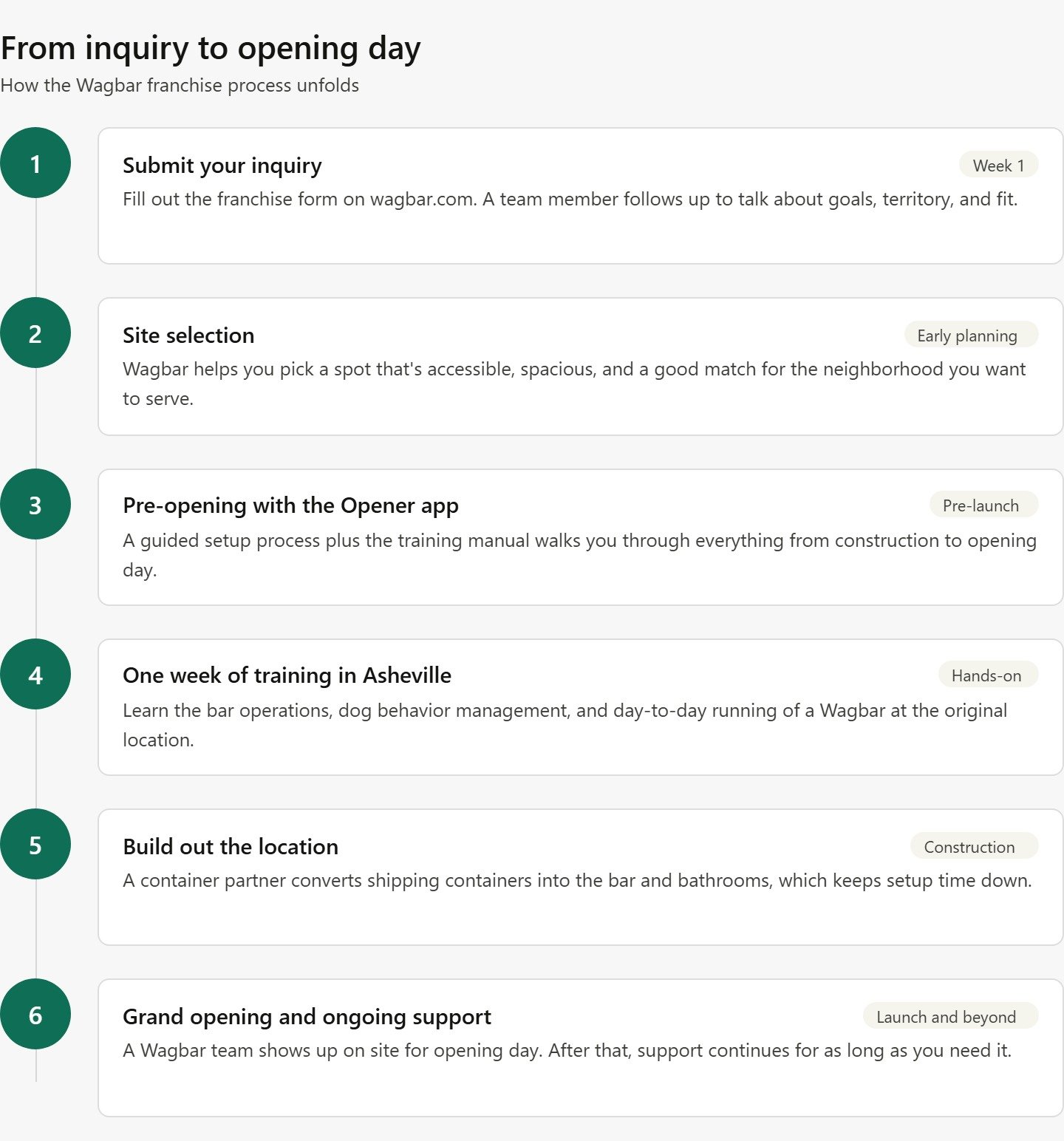
What support do franchisors provide to new franchisees? Reputable dog park bar franchisors offer comprehensive support including site selection assistance evaluating potential locations, facility design guidance creating functional layouts, construction management or contractor recommendations, one week on-location intensive training in Asheville NC covering dog behavior management and bar operations, proprietary operations app guiding pre-opening activities, on-site grand opening support from franchisor team, ongoing operational support through quarterly business reviews, marketing materials and brand guidelines, technology infrastructure for memberships and payments, and franchisee community enabling peer learning. Quality of support varies significantly between franchisors, making this a critical evaluation factor when choosing franchise opportunities.