
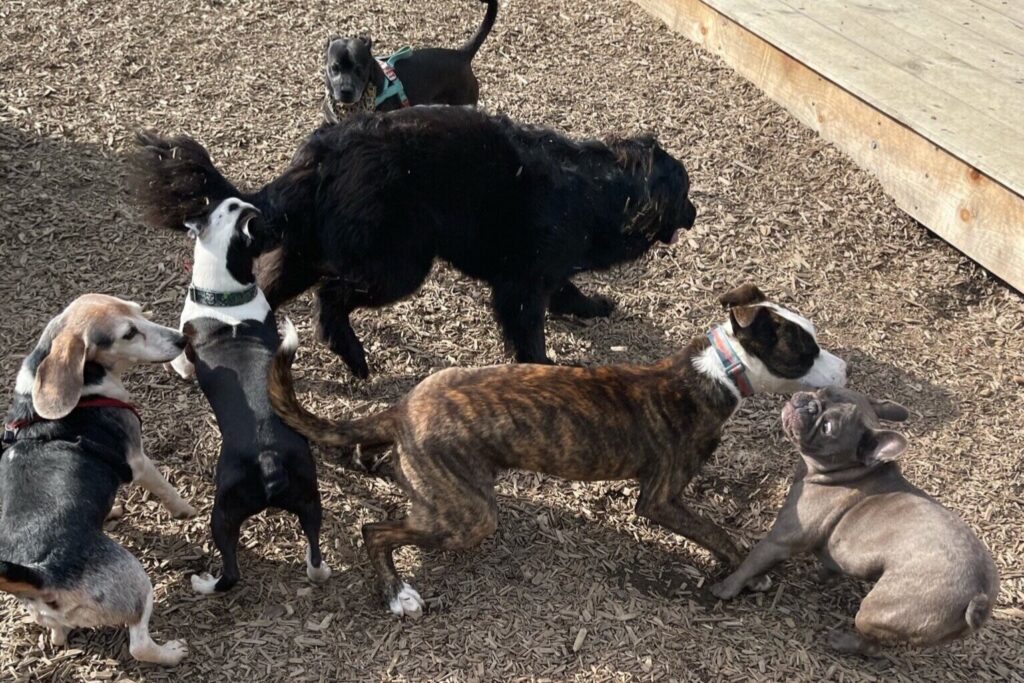
Top TLDR: A Bark Ranger is Wagbar’s trained yard-team member — and the role is deliberately different from a babysitter. Owners are responsible for their own dog. Bark Rangers keep an eye on the yard as a whole, read the room, and step in when the warning signs show up. This guide walks you through what Bark Rangers do, how they’re trained, and why the owner-first model keeps the park safer.
Walk into a dog bar and you’ll see them in the yard — hands free, eyes moving, drink nowhere in sight. The industry calls them Bark Rangers. At Wagbar they’re Bark Rangers, and what they do isn’t bartending and it isn’t babysitting. Owners stay with their own dog. Bark Rangers watch the whole pack.
- Not a bartender who likes dogs. A Bark Ranger is a yard supervisor trained in canine behavior.
- Reads body language in real time: play bows, stiff posture, whale eye, mounting, displacement signals.
- Intervenes before fights, not after. De-escalation is the job. Breaking up fights means the system failed.
- Enforces no-feeding, vaccine checks, yard rules and waste removal.
Every dog bar with an off-leash yard needs someone whose full-time job is watching the dogs. Not glancing at them while wiping down the bar. Not checking on them between drink orders. Watching — continuously, deliberately and with trained eyes that catch the signals most owners miss. That person is the Bark Ranger, and they’re the reason a well-run off-leash venue stays safe while a poorly staffed one ends up with injuries, lawsuits and a reputation that empties the yard.
Ready to see it in action? Head to our locations page to find the park nearest you and plan your first visit. The Bark Rangers will be watching for you before you even reach the door, which is exactly the point.
What a Bark Ranger Actually Does
A day in the life of a Bark Ranger looks nothing like a day behind a drink bar. The shift starts before the first dog arrives: walking the yard, inspecting surfaces for hazards, testing gates, filling water stations and confirming the first-aid kit is stocked. Once the dogs start arriving, the Bark Ranger stations at the gate to check vaccine records and manage the entry flow so new arrivals don’t overwhelm the pack dynamic.
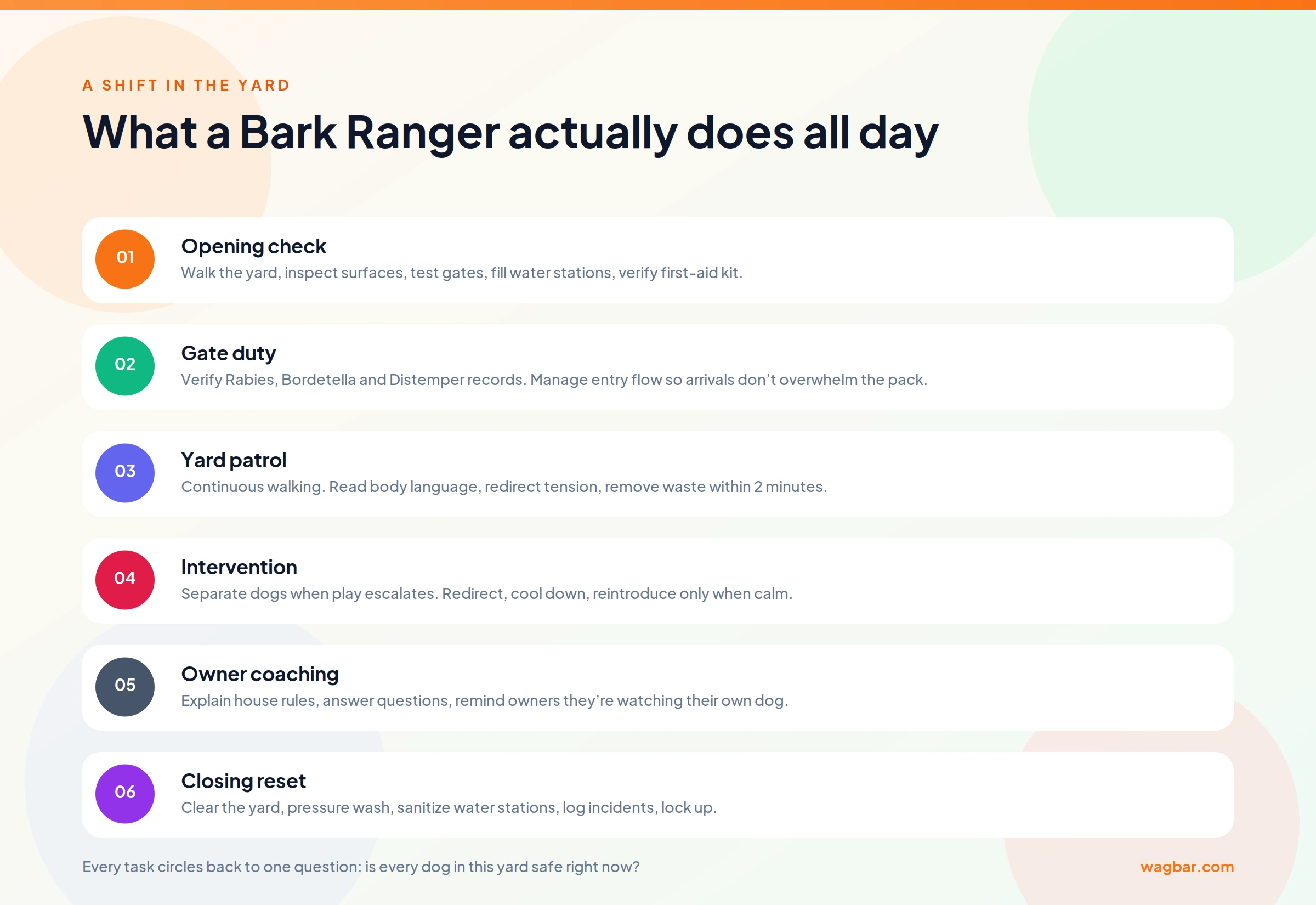
Once the yard fills, the real work starts. The Bark Ranger walks the yard continuously — not standing in one spot, not sitting behind a desk. Walking. Eyes up, scanning the full yard for the signals that predict conflict five to ten seconds before it happens. When play is healthy, the Bark Ranger stays back and lets the dogs socialize. When play crosses a threshold, they step in.
The Training Behind the Bar
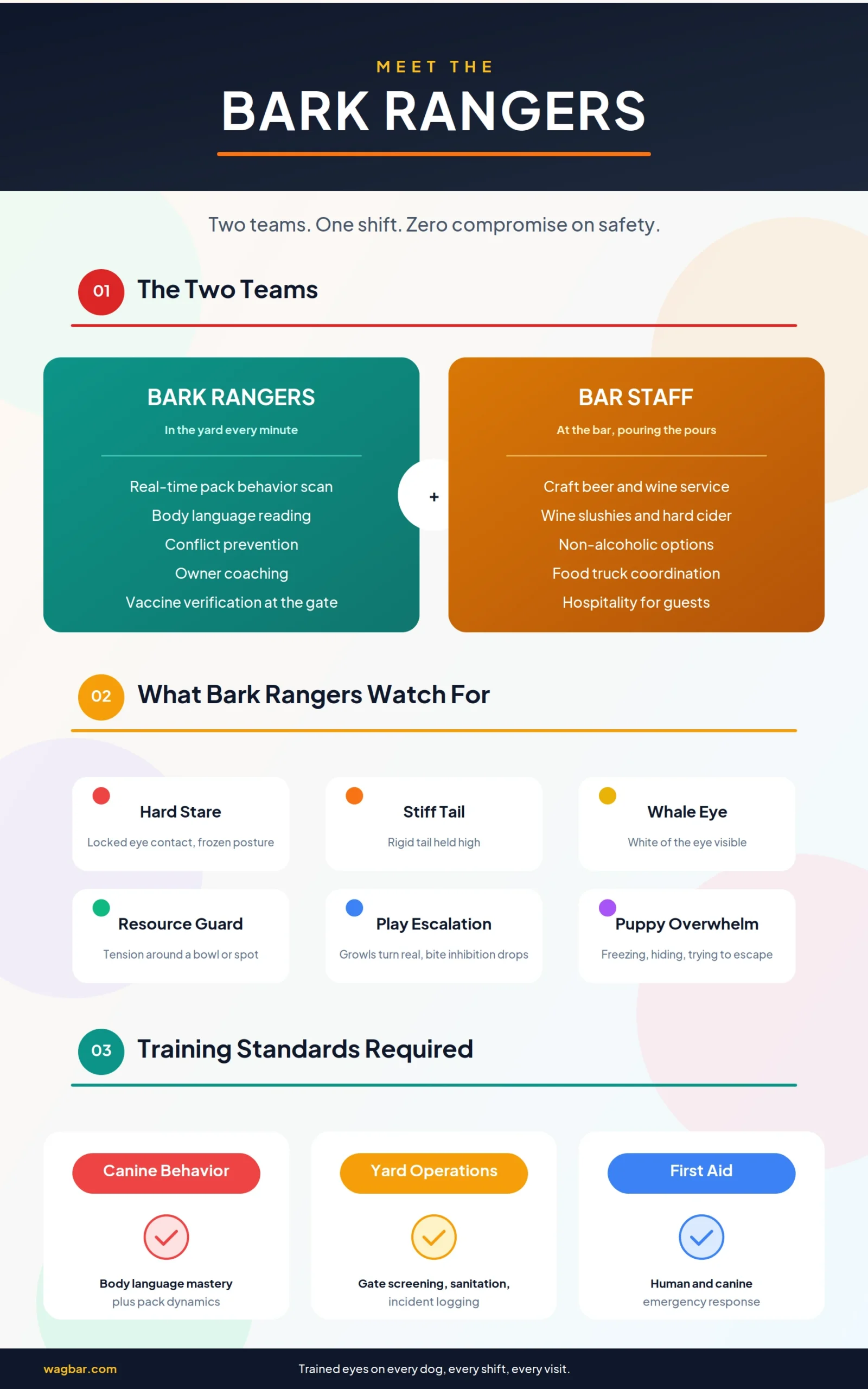
Before a new hire ever pours their first beer at Wagbar, they move through a training program covering canine communication signals, pack dynamics, safe intervention techniques, breed specific behavior tendencies, and emergency protocols. The training references material aligned with the dog body language decoder approach that Wagbar publishes openly for members. Staff learn to spot a hard stare from across the yard, distinguish play growls from real ones, recognize the stiff tail that signals a dog is about to blow up, and read the whale eye of a dog asking for space.
Wagbar also aligns the behavioral portion of training with the standards published by Fear Free Pets, the industry certification body that trains pet professionals in low stress handling and behavior assessment. The bar side of training runs parallel with standard alcohol service certification, food handling, and product knowledge for the local beer selection. Every bartender is expected to hold both credentials at all times.
Reading Dogs While Pouring Drinks
The skill that makes a Bark Ranger rare in the hospitality world is real time canine assessment while managing human customers. A pour takes 20 seconds. In those 20 seconds, they have already scanned the yard twice. Which dogs are playing well. Which one is over threshold. Whose owner just walked in without checking their dog in properly. Whether the Golden Retriever near the fence has been standing stiffly for too long. Whether the puppy who came in an hour ago is starting to get overwhelmed by the pack size.
Reactive dogs benefit from this constant attention because escalation gets caught early. If your dog struggles in busy spaces, our reactive dog training resource covers the training side. For an authoritative overview of dog body language basics, the American Kennel Club publishes accessible material every dog owner should read once. Owners of anxious dogs often say the Bark Ranger presence is why they keep coming back to Wagbar week after week. Someone is always watching, and that someone knows what to look for.
Bark Ranger vs. Regular Bartender
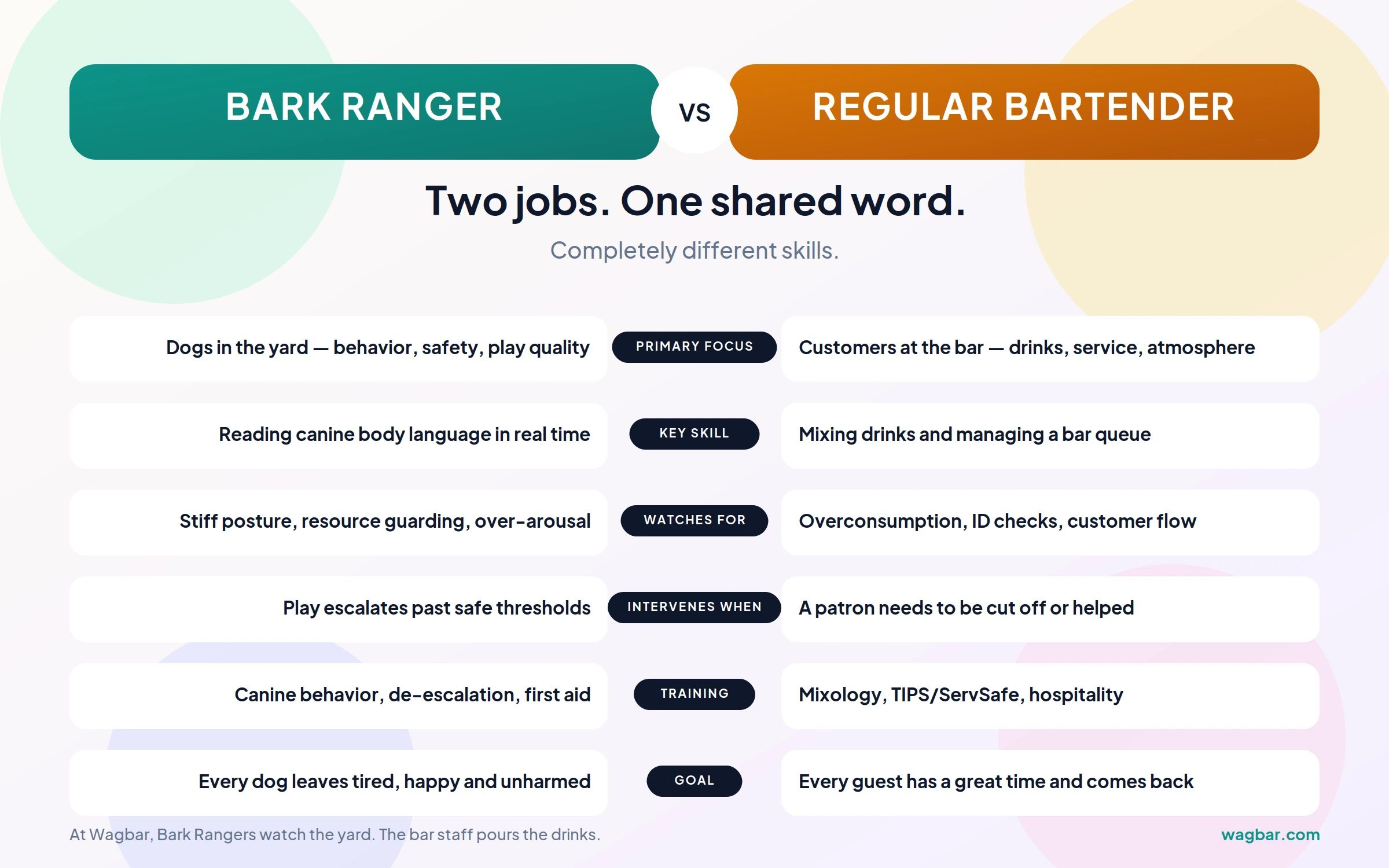
The name creates confusion. A Bark Ranger doesn’t pour drinks. At Wagbar, the bar staff handles drink orders, cocktail mixing and customer service. The Bark Ranger handles the yard. The two roles share a venue but require completely different training, instincts and attention patterns. A regular drink bartender watches a room full of people. A Bark Ranger watches a yard full of animals who communicate without words and escalate without warning.
The Seven Signals: What Bark Rangers See
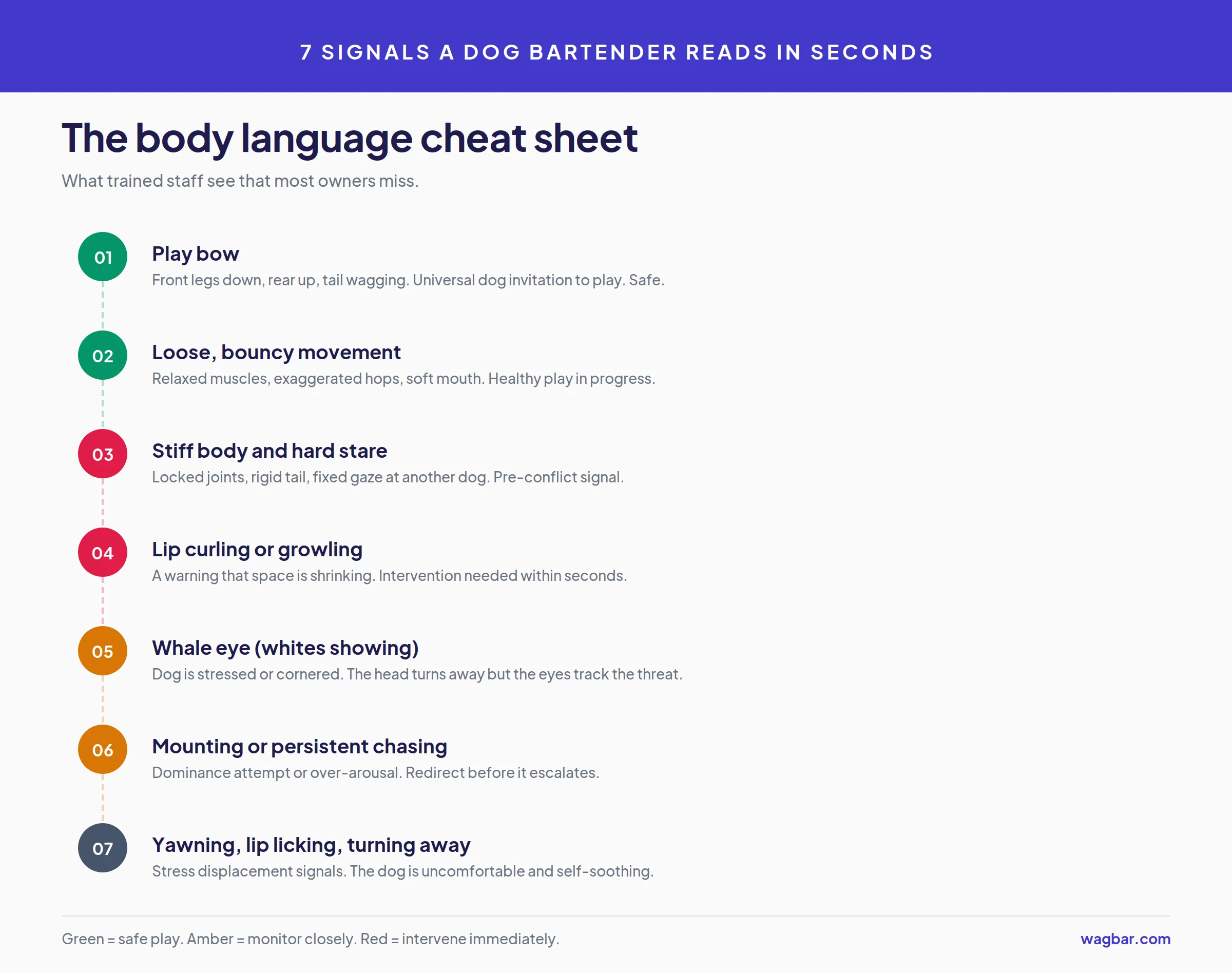
Understanding how Bark Rangers are trained to read dogs starts with the body language signals they’re watching for every second of every shift.
Safe play signals (green)
Play bows — front legs down, rear end up, tail wagging. This is the universal dog invitation that says “I’m playing, not fighting.” A yard full of play bows is a yard running smoothly. Loose, bouncy movement confirms it: relaxed muscles, exaggerated hops, soft open mouths. Healthy play looks silly and uncoordinated on purpose — dogs deliberately handicap themselves to keep the game fair.
Monitor signals (amber)
Whale eye (the whites of the eyes showing) means a dog is stressed or cornered. The head turns away but the eyes stay locked on the perceived threat. Mounting or persistent chasing signals over-arousal or a dominance attempt — neither is healthy in a mixed group. Yawning, lip licking and turning away when no food is present are displacement behaviors: the dog is uncomfortable and self-soothing. All three are cues for the Bark Ranger to move closer and prepare to redirect.
Intervene signals (red)
Stiff body and hard stare — locked joints, rigid tail, fixed gaze directly at another dog. This is the final signal before a snap or lunge. Lip curling or growling confirms it: the dog is telling the other animal that space is shrinking and tolerance is gone. A trained Bark Ranger recognizes these signals and steps between the dogs before contact, using body positioning and calm energy to break the escalation. Understanding what happens when dogs don’t get along at a dog bar is core to the job — the protocol is prevention first, separation second, reintroduction only when both dogs are calm.
How Bark Rangers Oversee Off-Leash Play
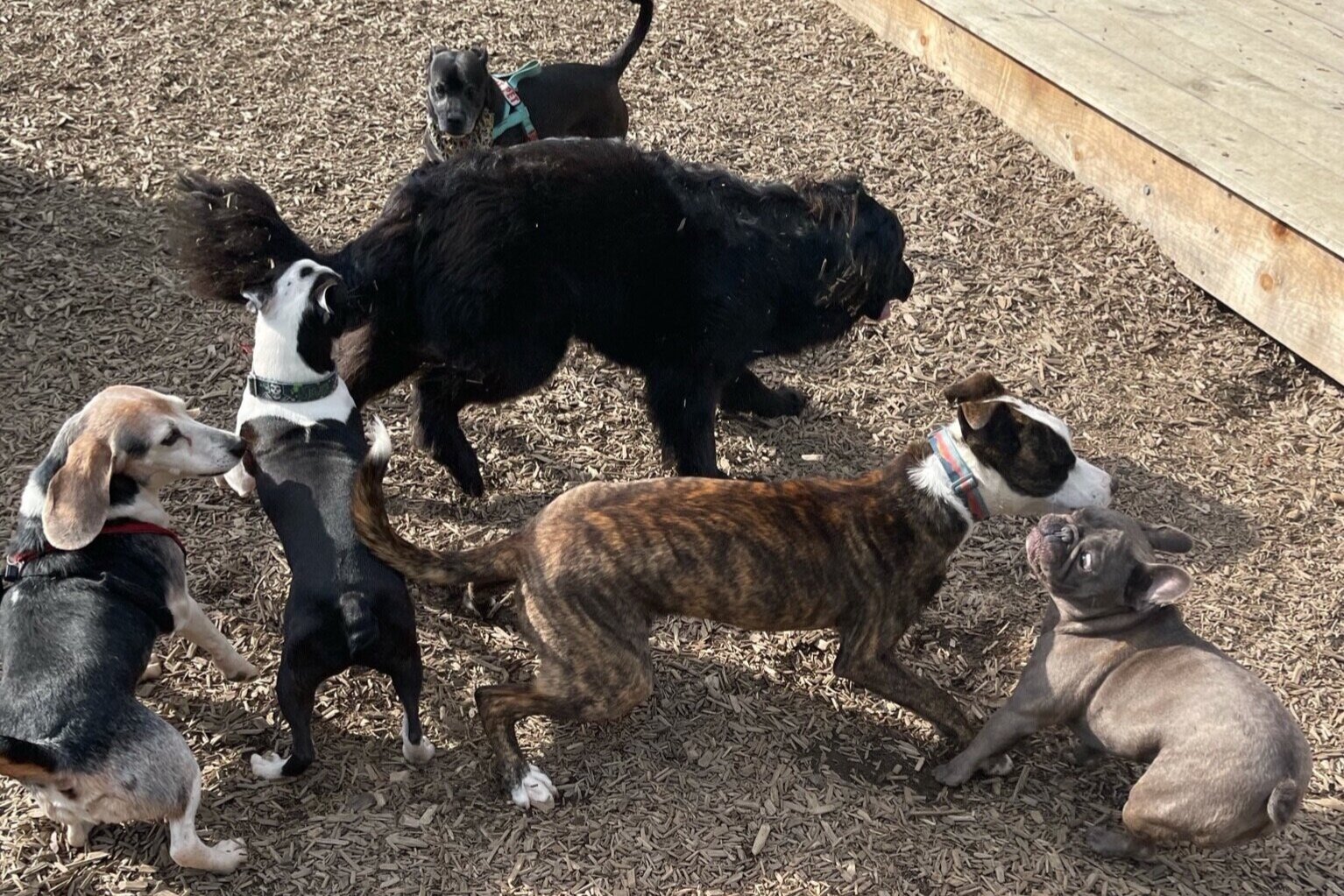
The supervision model at Wagbar isn’t “one person watches 50 dogs from a chair.” It’s active, mobile and ratio-based. How Bark Rangers oversee off-leash play comes down to three principles.
- Staff-to-dog ratio. Wagbar maintains staffing levels that keep the yard manageable. When the yard fills beyond what one Bark Ranger can safely monitor, a second staffer enters.
- Continuous movement. Standing still creates blind spots. Walking the perimeter and cutting through the middle catches interactions that a stationary observer would miss.
- Zone awareness. High-traffic areas (the gate, the water stations, shaded spots) see more tension than open run zones. The Bark Ranger spends more time in conflict-prone areas without neglecting the rest.
The No-Feeding Rule: A Bark Ranger’s Best Friend
Wagbar’s no-feeding policy — no food, treats or edible items inside the play yard — exists partly because of what it does for the Bark Ranger’s job. Food in a yard full of dogs creates resource guarding flashpoints that even the most skilled staff member can’t prevent fast enough. A treat in one dog’s mouth triggers competition from every dog within smelling distance. Remove the food entirely, and the Bark Ranger’s job shifts from policing food fights to facilitating play. The yard calms down, the dogs focus on socializing instead of scavenging, and the cleaning load drops because there are no crumbs, drips or melted treats on the surface.
Why It Matters: Supervised vs. Unsupervised
A public dog park has no Bark Rangers. Nobody checks vaccines at the gate. Nobody reads body language across the yard. Nobody intervenes when a stiff-bodied shepherd fixates on a nervous terrier. The result is predictable: fights, injuries, disease transmission and owners who stop coming because they don’t feel safe. A professionally supervised off-leash venue inverts every one of those outcomes. The Bark Ranger is the reason the inversion works.

Bark Ranger FAQs
What is a Bark Ranger?
A Bark Ranger is a trained staff member at a dog bar whose job is supervising the off-leash play yard. They read canine body language, intervene before conflicts escalate, enforce yard rules and manage gate check-ins. They don’t pour drinks — that’s the bar staff.
Do Bark Rangers need special training?
Yes. Dog bartenders at Wagbar are trained in canine body language recognition, de-escalation techniques, basic canine first aid and the venue’s specific protocols for gate checks, conflict intervention and yard management.
How do Bark Rangers stop fights?
They prevent fights rather than stop them. By reading body language signals (stiff posture, hard stare, whale eye), a trained Bark Ranger steps in and redirects dogs before physical contact. If a fight does occur, they use body positioning and practiced separation techniques — never grabbing a dog’s collar during an active fight.
Why don’t public dog parks have Bark Rangers?
Public parks are municipally funded and rely on owner self-policing. There’s no staffing budget for yard supervisors. Professionally managed dog bars like Wagbar employ Bark Rangers because the membership model funds the labor that makes supervision possible.
Can I become a Bark Ranger?
If you have a genuine interest in canine behavior and can stay focused in a high-stimulus environment, yes. Wagbar trains its Bark Rangers internally. Experience with dog daycare, veterinary clinics or animal shelters is helpful but not required.
Build a Team That Keeps the Yard Safe
The Bark Ranger is the most important hire at any off-leash venue. Wagbar’s training program, supervision model and operational protocols are built into every franchise location. Learn how a Wagbar franchise staffs and trains its team.

Wagbar does not represent what a franchise owner will earn. Verified performance data is available only in Item 19 of the FDD, provided to qualified candidates during formal disclosure. Published cost figures are FTC-required regulatory estimates and are not profitability guarantees.
Your Dog Plays. Trained Eyes Watch.
A Bark Ranger doesn’t take breaks from watching. They don’t check their phone. They don’t get pulled behind the bar. Their job is your dog, and they do it all day. Bring your pup’s vaccine records and see what supervised play actually looks like at the nearest Wagbar.
Bottom TLDR: A Bark Ranger is a trained yard supervisor at a dog bar — not someone who pours drinks. They read seven key body language signals (play bows, loose movement, stiff posture, hard stare, whale eye, mounting, displacement behaviors), intervene before conflicts escalate, manage gate check-ins, enforce the no-feeding policy and walk the yard continuously throughout every shift. The role is why professionally supervised off-leash venues stay safe while unsupervised public parks don’t. At Wagbar, the Bark Ranger is the most important person on staff.