

Top TLDR: Off-leash play at Wagbar runs on two layers that work together: owners watch their own dog, and Bark Rangers watch the yard. The gate check is vaccines only — Rabies, Bordetella and Distemper — not a temperament test. Inside the yard, Bark Rangers walk the pack, read group energy, and step in when the warning signs show up. The model works because responsibility stays with the owner; Bark Rangers are the second set of eyes.
Supervised dog play isn’t one person watching your dog for you. At Wagbar it’s two layers running at the same time. Owners stay with their own dog — reading your own dog’s mood is your job, nobody else’s. Bark Rangers watch the yard as a whole, catching the shifts that one owner can’t see from one spot. The combination is what makes off-leash play work.
- Five supervision layers run simultaneously — gate, patrol, body language, redirection, environmental control.
- Staff walk the yard continuously. Standing still creates blind spots. Sitting down is not an option.
- The escalation ladder gives staff a response for every intensity level: observe → monitor → redirect → separate → resolve.
- No food in the yard. The no-feeding policy removes the single biggest trigger for resource guarding.
Wondering whether dog bars are actually safe comes down to one question: who’s watching the yard? At a public park, the answer is nobody — or, optimistically, the owners themselves, who are checking their phones, talking to friends and trusting that their dog “is friendly.” At a professionally managed dog bar, the answer is trained staff whose only job during their shift is supervising off-leash play. Here’s how that supervision actually works, layer by layer.
The Five-Layer Supervision Model
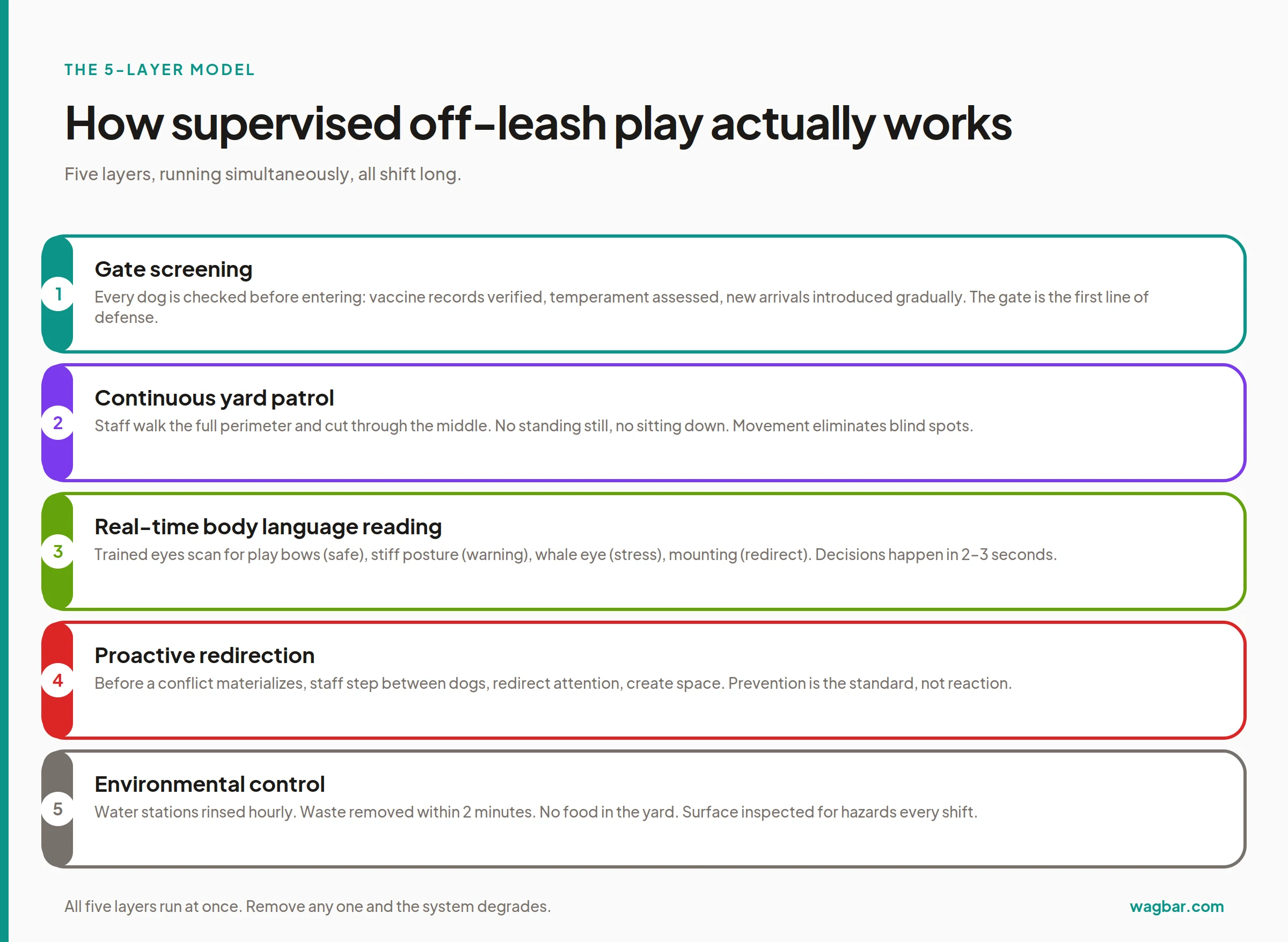
Layer 1: Gate screening
Supervision starts before a dog enters the yard. At Wagbar, every dog is checked at the gate for current vaccine records (Rabies, Bordetella and Distemper). Owners know their own dog; the Bark Ranger watches how the dog reacts to the gate environment, other dogs visible through the fence, and the energy level of the yard. Dogs showing extreme fear, aggression or over-arousal at the gate are handled individually rather than released into the full pack.
Layer 2: Continuous yard patrol
Once the yard is active, staff walk it. Not from one fixed spot. Not from behind the bar window. Walking the full perimeter, cutting through the middle, circling back through high-traffic zones near the gate, water stations and shaded areas. Movement is the foundation of supervision because it eliminates the blind spots that stationary observation creates. A staff member standing in one corner can’t see what’s happening in the opposite corner behind the play structures.
Layer 3: Real-time body language reading
The core skill. Staff are trained to recognize seven key signals in real time: play bows and loose bouncy movement (safe play), whale eye and displacement behaviors like yawning and lip licking (stress), mounting and persistent one-sided chasing (over-arousal), stiff body and hard stare (pre-conflict). The read happens in two to three seconds. The decision follows immediately.
Layer 4: Proactive redirection
Redirection means stepping in before a conflict materializes — not after. A staff member who sees a stiff-bodied dog fixating on a smaller dog doesn’t wait for a growl. They move into the space between the dogs, break the eye contact with their body positioning, and redirect the fixating dog’s attention with voice and movement. The goal is to de-escalate without physical contact. Grabbing a dog during a tense moment often makes it worse.
Layer 5: Environmental control
The physical environment directly affects dog behavior. Water stations rinsed and refilled hourly prevent resource guarding over stale bowls. Waste removed within two minutes prevents dogs from rolling in or eating feces (both are disease vectors). No food or treats in the yard eliminates the single biggest trigger for possessive behavior. Surface inspected every shift for broken ground cover, exposed hardware or standing water. These aren’t cleaning tasks — they’re supervision tasks with sanitation benefits.

Supervised vs. Unsupervised: The Gap
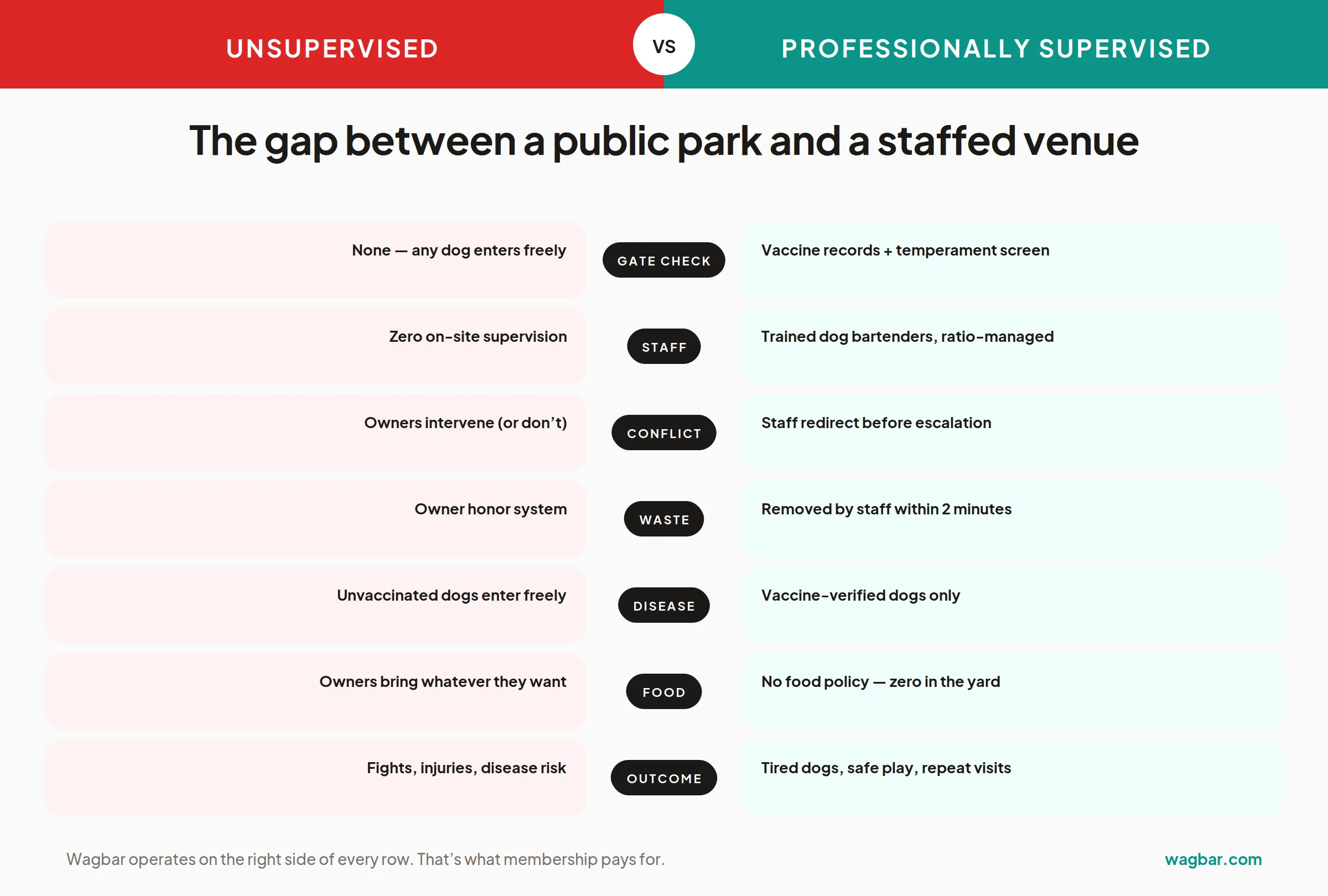
The difference isn’t subtle. An unsupervised public park has no gate check (unvaccinated, aggressive or intact dogs enter freely), no staff (conflict intervention depends on owners), no waste protocol (the honor system produces predictable results) and no food restrictions (owners bring treats that trigger guarding). A professionally supervised venue has all of these systems running simultaneously, staffed by people trained to execute them.
The outcome gap follows: professionally supervised venues report dramatically fewer bite incidents, near-zero disease transmission within the yard, higher customer retention and the kind of calm, social atmosphere that makes owners want to stay for two hours instead of twenty minutes.
The Escalation Ladder: Staff Response by Intensity Level
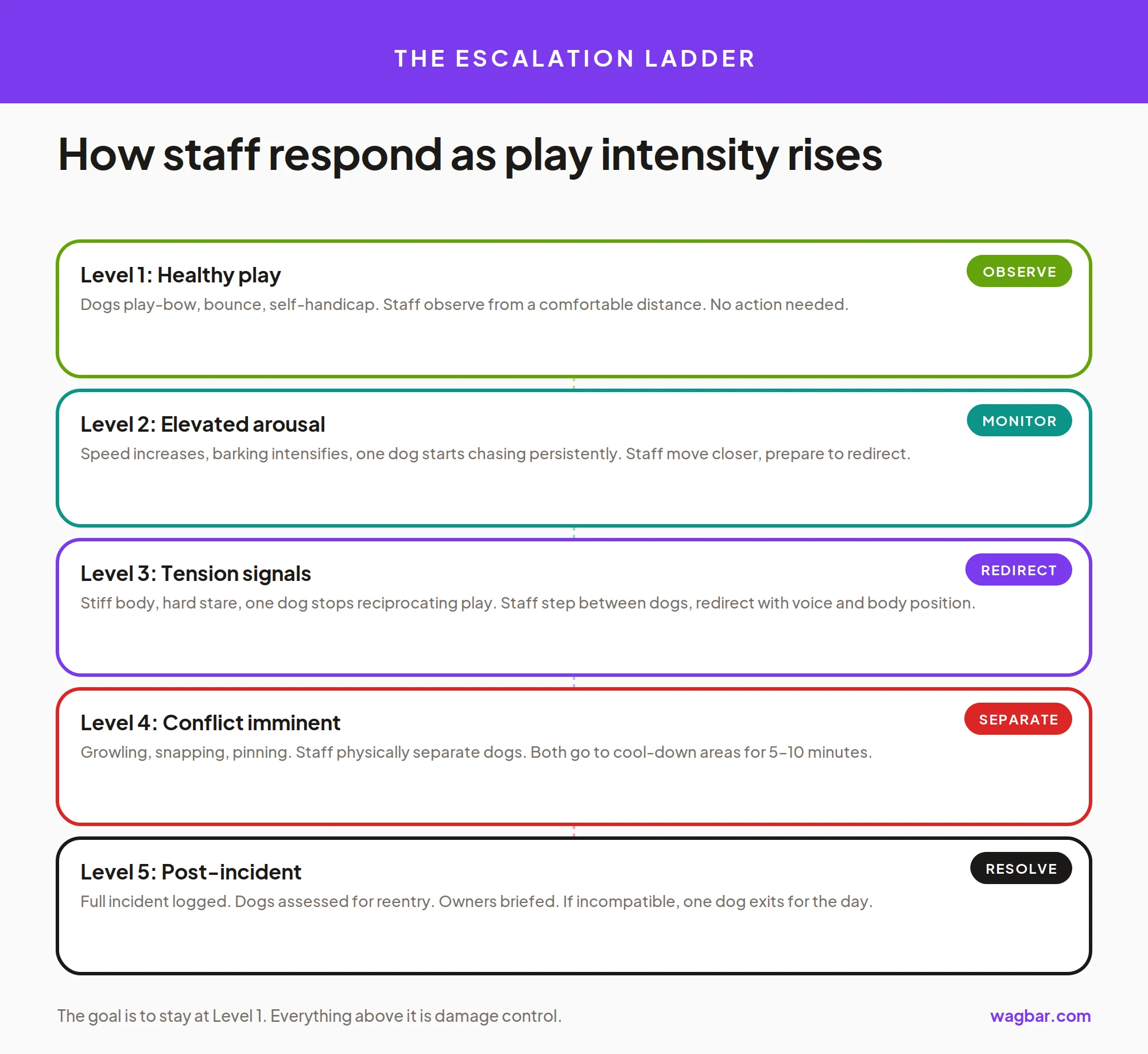
Not every situation requires the same response. The escalation ladder gives staff a framework that matches intervention intensity to play intensity.
- Level 1 — Observe: healthy play. Play bows, bouncy movement, mutual chasing. Staff watch from a comfortable distance. No action needed.
- Level 2 — Monitor: arousal rising. Speed increases, barking intensifies, one dog starts chasing without reciprocation. Staff move closer and prepare to act.
- Level 3 — Redirect: tension signals. Stiff body, hard stare, play stops being mutual. Staff step between dogs and redirect attention using voice and body position.
- Level 4 — Separate: conflict imminent or underway. Growling, snapping, pinning. Staff physically separate both dogs. Each goes to a cool-down area for 5 to 10 minutes.
- Level 5 — Resolve: post-incident. Full incident logged. Both dogs assessed for reentry. Owners briefed. If the dogs are incompatible, one exits for the day.
The goal is to spend all day at Level 1 and rarely see Level 4. A well-supervised yard with good gate screening and proactive redirection keeps almost every interaction in the green zone.
The No-Feeding Policy as a Supervision Tool
Wagbar bans all food, treats and edible items from the play yard. This isn’t a preference — it’s a supervision decision. Food in a shared off-leash space creates resource guarding flashpoints that even the most skilled staff can’t always intercept in time. A bone in one dog’s mouth triggers competition from every dog within range. Remove the food entirely, and the Bark Ranger’s job shifts from policing food fights to facilitating play. The yard calms down. The dogs focus on socializing. The cleaning load drops because there are no crumbs or melted treats degrading the surface.

Supervised Play FAQs
How many staff watch the yard at once?
Wagbar maintains ratio-based staffing. When the yard fills beyond what one Bark Ranger can safely monitor, a second enters. The exact ratio depends on the yard size and the mix of dogs present.
What happens if two dogs don’t get along?
Staff separate both dogs immediately. Each goes to a cool-down area. After 5 to 10 minutes, staff assess whether reintroduction is safe. If the dogs are fundamentally incompatible, one exits the yard for the session.
Do owners have to watch their own dogs?
Owners are welcome to watch and enjoy the yard, but supervision is not their responsibility. That’s what the Bark Rangers are for. Owners should still follow yard rules (no food, leash off inside the gate, pick up after their dog if staff haven’t reached it yet).
Is supervised play safer than a public dog park?
Measurably, yes. Gate screening, trained staff, body language reading, proactive redirection and environmental controls all reduce the risk of fights, injuries and disease transmission compared to unsupervised public parks.
What training do yard staff receive?
Wagbar trains its Bark Rangers in canine body language recognition, de-escalation techniques, basic canine first aid, gate screening protocols and the venue’s specific operational procedures.
Build a Venue Where Play Is Always Supervised
The five-layer model, the escalation ladder and the no-feeding policy aren’t suggestions — they’re operational requirements at every Wagbar franchise. See how Wagbar trains and staffs its locations.

Wagbar does not represent what a franchise owner will earn. Verified performance data is available only in Item 19 of the FDD, provided to qualified candidates during formal disclosure. Published cost figures are FTC-required regulatory estimates and are not profitability guarantees.
Let the Trained Eyes Do the Watching
You relax. Your dog plays. The staff never stop scanning. Bring your pup’s vaccine records and see supervised play in action at the nearest Wagbar.
Bottom TLDR: Supervised off-leash play uses a five-layer model: gate screening, continuous patrol, body language reading, proactive redirection and environmental control. The escalation ladder gives staff a response framework from observe (healthy play) through separate (conflict) to resolve (post-incident). The no-feeding policy removes resource guarding triggers. Supervised venues outperform unsupervised parks on every safety metric: fewer fights, fewer injuries, no unvaccinated dogs, calmer atmosphere and higher customer retention.