
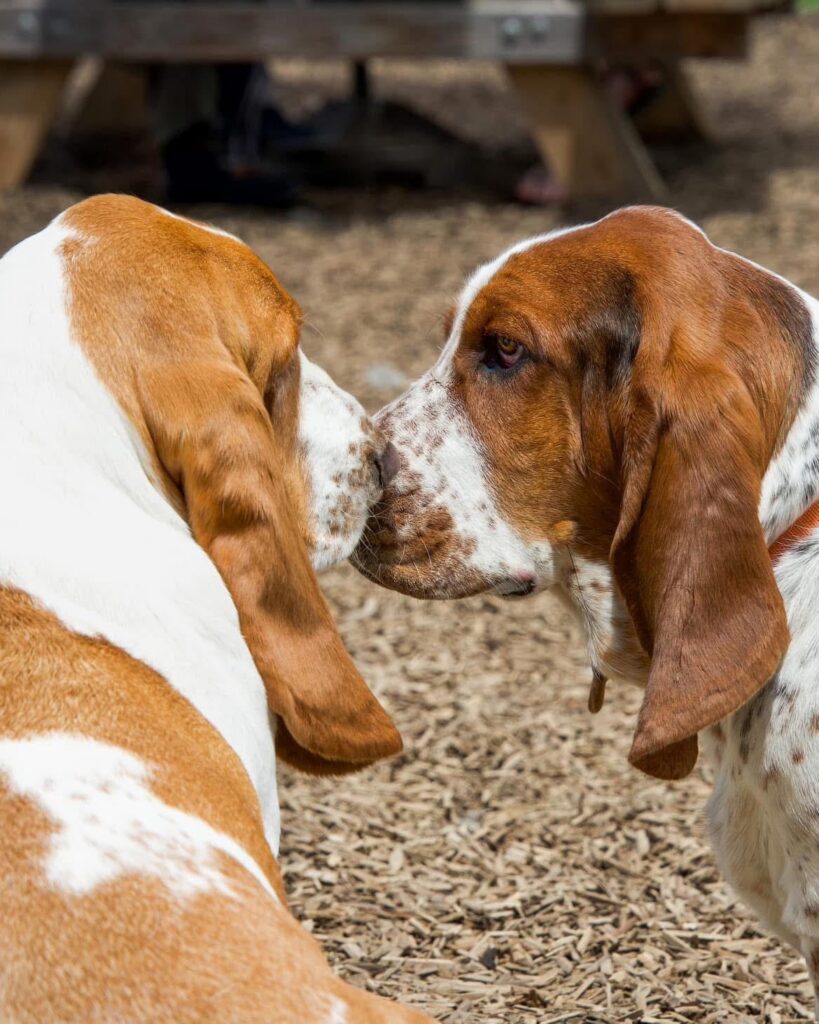
Most dog owners have frozen mid-sip watching two dogs crash into each other and wondered: is this still fun or is something about to go wrong? The good news is that dogs give you a lot of information once you know what to look for.
Rough play is completely normal. Growling, body slamming, mouthing, and chasing are all part of how dogs communicate and burn energy. The difference between play and a real conflict almost always comes down to body language, pacing, and whether the interaction is mutual. Here’s how to read it.
The Play Bow: The Clearest Signal You’ll See
A play bow is exactly what it sounds like. The dog drops their front end to the ground, chest near the floor, rear end up in the air, and usually the tail is wagging. It’s one of the most reliable signals in dog body language because it specifically means “what comes next is play, not a threat.”
Dogs use play bows at the start of a chase or wrestling match, and they also use them mid-play as a reset. If you see a play bow after a particularly intense burst, the dog offering it is essentially saying, “Still playing, I promise.” Watch for this signal especially when the energy is high and you’re unsure how one dog is feeling.
Role Reversals: The Strongest Sign That Both Dogs Are Into It
Healthy play is give and take. One dog chases, then the other chases back. One dog pins, then gets pinned. One dog mouths, then lets themselves be mouthed. This back-and-forth is called a role reversal, and it’s probably the single most reliable indicator that both dogs are genuinely enjoying themselves.
When the same dog is always on top, always chasing, always the one initiating while the other dog tries to move away, that balance is gone. That’s when you want to pay closer attention. Mutual play looks like a conversation. One-sided play starts looking like something else.
Natural Pauses: Play Has Breathing Room
Watch for pauses. Dogs engaged in healthy play stop frequently, even if just for a second or two. They shake off, sniff the ground, look away briefly, then re-engage. These micro-breaks are self-regulating behavior. Each dog is checking in with themselves and with the other dog before continuing.
Play with no pauses, where the intensity only escalates and never resets, is worth watching more closely. It doesn’t always mean trouble is coming, but sustained escalation without any natural breaks is a pattern that can build toward an overreaction from one or both dogs.
Body Language That Means Play
Playful dogs look loose. Their movements are bouncy and exaggerated. Mouths are open and relaxed, sometimes showing what looks like a big goofy grin. Tails wag in wide sweeps. Even when a dog growls during play, the sound tends to be higher-pitched and rhythmic compared to a real warning growl.
Look for:
- Loose, wiggly body posture throughout the interaction
- Open, relaxed mouth rather than a tight, closed jaw
- Tail carried in a wide, easy wag rather than stiff and upright
- Bouncy, almost theatrical movements like exaggerated pouncing
- Regular eye contact between dogs that breaks easily (not a hard, locked stare)
Body Language That Says Step In Now
Escalation signals are usually subtle at first, which is why watching the whole body matters more than any single feature. A dog that goes still, tucks its tail low, flattens its ears, or starts moving in slow deliberate steps has shifted out of play mode.
Signs it’s time to interrupt:
- One dog repeatedly trying to move away while the other keeps following
- A hard, direct stare with a stiff, forward-leaning posture
- Lips pulled back tightly to show teeth in a fixed snarl (different from a play face)
- Growling that drops in pitch and becomes a long, low, continuous sound
- Hackles raised from shoulders all the way down the back
- No role reversals for an extended stretch
When in doubt, you can do a quick “consent check.” Separate the dogs briefly by stepping between them or gently removing one. If both dogs bounce right back toward each other to re-engage, that’s a strong indicator the interaction was mutual. If one dog drifts away and doesn’t return, it was probably done with the interaction before you stepped in.
Why Supervised Off-Leash Space Makes This Easier to Manage
Reading dog play is easier when the environment is designed for it. Off-leash play spaces with regular visitors develop something real over time: a pack of dogs that already knows each other, owners who recognize each other’s dogs, and shared awareness of which pairings work well and which ones need more space.
That community context matters a lot. A stranger at a public park may not know your dog’s history, your dog’s body language quirks, or whether your pup is having an off day. At a venue like Wagbar where the same dogs come back week after week, regulars naturally build that knowledge. Experienced members often notice a shift in dynamics before a newcomer would.
One thing worth understanding before your first visit: at Wagbar, owners are expected to actively watch their dogs throughout the session. The Bark Rangers on staff keep an eye on the whole space and will step in when a situation calls for it, but they’re there to support attentive owners, not replace them. Staying engaged with what your dog is doing is part of what makes the environment work well for everyone.
Vaccination requirements and structured entry also mean the dogs sharing a space are more likely to be healthy, socialized animals, which keeps the baseline energy more predictable from the start. You can read more about whether your dog is ready for off-leash group play and what to expect from that kind of environment before your first visit.
A Note on Breed and Play Style
Different dogs play differently, and knowing your dog’s breed tendencies helps you read them more accurately. Herding breeds may nip at heels and try to circle other dogs, which can look alarming but is often just wired-in behavior. Bully breeds tend to play through body contact and wrestling. Sighthounds often prefer chase over wrestling and may seem uninterested in close contact play.
Size differences don’t automatically mean a problem either. Plenty of small dogs match energy with large dogs just fine, and many large dogs are remarkably gentle with smaller playmates. What matters is whether both dogs are choosing to be in the interaction. Size becomes a concern when a large dog is persistently pursuing a small dog that is actively trying to leave.
FAQ
Is it okay to let dogs growl at each other during play?
Yes, in most cases. Growling during play is normal and doesn’t automatically mean aggression. Playful growls tend to be higher-pitched, come in short bursts, and happen alongside loose body language and an open mouth. The growl to watch for is low, steady, and accompanied by a still or stiffened body. That one usually means the dog is done playing and is issuing a warning.
How long is too long to let a rough play session go without a break?
There’s no universal timer, but most dog behavior experts suggest watching for natural pauses and stepping in to create one if you haven’t seen a break in a few minutes of sustained intensity. A brief separation, even 15 to 20 seconds, lets each dog reset their arousal level before returning to play. It’s not about punishing the play, just giving both dogs a breath.
My dog plays rough at home but freezes up around new dogs. Is that normal?
Completely normal. Dogs read context and history. A dog that roughhouses confidently with a known housemate may need more time to warm up to strangers. Repeated low-pressure exposure to new dogs in a calm, open space is usually the best path forward. Forcing a nervous dog into play before it’s comfortable often backfires, so patience and letting your pup set the pace tends to produce better results over time.