
Zoning a 1-2 Acre Parcel for an Off-Leash Dog Park Bar: What to Confirm Before Signing a Lease
Top TLDR: Zoning a 1-2 acre parcel for an off-leash dog park bar requires confirming three separate regulatory tracks before any lease is signed: commercial land use, animal facility permits, and alcohol licensing. Most municipalities handle these through different departments on different timelines. Start your research with a direct call to the local planning and zoning department before engaging any commercial real estate broker.
An off-leash dog bar sits at the intersection of at least three regulatory categories. It's an outdoor commercial food and beverage operation. It's an animal services facility. And in most states, it's an alcohol-serving establishment subject to Alcohol Beverage Control rules. Each category has its own permitting path, and none of them automatically follows from the others.
That layered reality is what makes zoning research for an off-leash dog bar different from checking whether a parcel is zoned C-2 and calling it a day. You need to confirm all three tracks are accessible on your target site before you're anywhere near lease negotiations.
Why Zoning Research Has to Come Before the Lease
Once you've signed a lease, your timeline and your holding costs are running. A zoning complication discovered after signature -- a conditional use permit that requires a public hearing, a liquor license category that isn't available by application in that jurisdiction, a fencing requirement that doesn't fit the parcel -- turns into a negotiated problem rather than a site selection decision.
The right time to do zoning research is before you have any financial commitment to a location. That means before the letter of intent, before any deposit, and before you spend money on site planning or architectural drawings. For starting an off-leash dog bar business, the zoning walkthrough described here should happen in parallel with your demographic and real estate analysis, not after it.
The Three Regulatory Tracks Running at the Same Time
Commercial land use governs whether any business can operate on the parcel at all, and what types of commercial uses are permitted by right versus by special approval. This is determined by the zoning district assigned to the property -- general commercial, highway commercial, neighborhood business, or similar designations that vary by municipality.
Animal facility permitting governs whether a business with on-site animals can operate. This is often handled separately from base zoning, and many municipalities require an additional layer of approval -- a conditional use permit, a special use permit, or a specific animal facility license -- on top of standard commercial zoning.
Alcohol licensing is a state and local process entirely separate from land use. It runs through the state's Alcohol Beverage Control board and often through a local municipality layer as well. Timeline, availability, and license category requirements vary considerably by state. The zoning and compliance requirements for pet businesses add another layer specific to commercial animal operations.
You need all three tracks to produce a clear path before the site is viable.
Checking Base Zoning: The First Question to Answer
The first call is to the city or county planning department. You're asking two things: what is the current zoning designation for the parcel, and does that designation permit a food and beverage service establishment as a permitted use by right?
"By right" means it's automatically allowed under that zone -- no special approval, no public hearing, just standard permitting. If it's permitted by right, that's the best-case starting point. If it's listed as a conditional use or special exception, you need to understand what that process involves before proceeding.

General commercial and highway commercial zones typically support food and beverage uses by right in most jurisdictions. Neighborhood business and office-commercial zones are more variable. Industrial zones are generally a non-starter for this concept. Pet business legal compliance requirements include base zoning as the first line of the checklist for a reason.
Get the zoning designation in writing from the planning department, and ask for a copy of the permitted uses table for that zone. That document will tell you exactly what categories of use are allowed and under what approval pathway.
Conditional Use Permits and Special Use Permits
Most of the regulatory friction in opening an off-leash dog bar comes from this category. Even when a parcel is correctly zoned for commercial use, municipalities often require an additional approval layer before an animal-related business can operate there.
A conditional use permit (CUP) -- sometimes called a special use permit or a special exception -- is a discretionary approval that typically requires a public hearing before a planning commission or zoning board. The outcome isn't guaranteed. Neighbors can object. The approval may come with conditions attached: fencing requirements, operating hour restrictions, noise mitigation measures, or landscaping buffers.
The key questions to ask the planning department upfront:
Is an animal facility a permitted use in this zone? If yes, is it permitted by right or as a conditional use? If conditional, what is the typical timeline from application to hearing to final approval? What conditions are most commonly attached?
Before investing time in a specific parcel, knowing whether you're looking at a 30-day administrative approval or a 90-180 day discretionary hearing process is a material data point. For validating a pet business franchise market, this regulatory timeline feeds directly into your project schedule and holding cost estimates.
Fencing, Setbacks, and Animal Facility Requirements
Once the base zoning question is answered, animal facility requirements bring a second layer of physical constraints. These vary by municipality and state, but common requirements include:
Fencing height and type. Off-leash dog facilities typically require minimum 6-foot perimeter fencing, with some jurisdictions specifying chain link, wood, or vinyl materials. The requirement may be set by the animal control code rather than the zoning code -- which means you need to check with the animal services department as well as planning.
Setbacks from property lines and residential uses. Commercial uses generally have standard setback requirements from property lines. Animal facilities in some jurisdictions have additional buffer requirements from residential zoning districts. If your target parcel sits adjacent to a residential area, this is worth checking specifically.
Lot coverage and impervious surface limits. Outdoor dog parks require a large open ground area. If the municipality caps impervious surface coverage on commercial lots (for stormwater management reasons), that cap may affect how much of your parcel can be paved for parking versus left as turf or decomposed granite.
A 1-2 acre parcel typically accommodates the core footprint without these constraints becoming deal-breakers. But knowing the numbers early lets you assess whether a specific parcel works before committing to it.
Alcohol Licensing Is Its Own Track
The alcohol license question runs completely separately from the land use process and is often the longer of the two timelines. For an off-leash dog park bar concept, the relevant license category is typically beer and wine or a limited retail liquor license rather than a full spirits license.
State processing timelines. In states with straightforward beer and wine licensing, an application can be processed in 30-60 days. In states with quota-based systems, the license you need may not be available by new application -- you may need to purchase an existing license at market rates, which adds cost and timeline.
Local municipality layer. Many states require both a state-level ABC license and a local approval from the city or county. The local layer often adds 30-60 days to the total timeline.
License type and restrictions. Some license categories come with restrictions on operating hours, on-site food requirements, or entertainment permits for live music. Know what the license allows and what it restricts before building your operating model around assumptions.
The practical approach: contact the state's Alcohol Beverage Control board early -- before you've committed to a lease -- and ask directly about license availability and timeline for the address or municipality you're targeting.
Noise Ordinances and Outdoor Operations
Outdoor hospitality venues with dogs, music, and events generate noise. In markets where commercial property sits near residential zoning, noise ordinances will govern your operating hours and amplification.
Most municipalities have separate daytime and nighttime decibel limits at property lines. Live music and amplified sound often require a separate entertainment permit on top of the base business license. Revenue streams for off-leash dog bars include events and programming -- so understanding what's operationally permitted under local noise rules is a real business planning question, not just a compliance box.
Ask the planning or code enforcement department about: standard operating hour restrictions for outdoor commercial uses, amplified sound and entertainment permit requirements, and any existing noise complaints on file for the parcel or immediate area.
Parking, Access, and ADA Requirements
Commercial properties require off-street parking at ratios set by the municipal zoning code. For a hybrid park-and-bar use, parking calculations may be applied differently to different components of the operation. A dog park may be calculated by acreage, a bar by square footage or seating capacity.
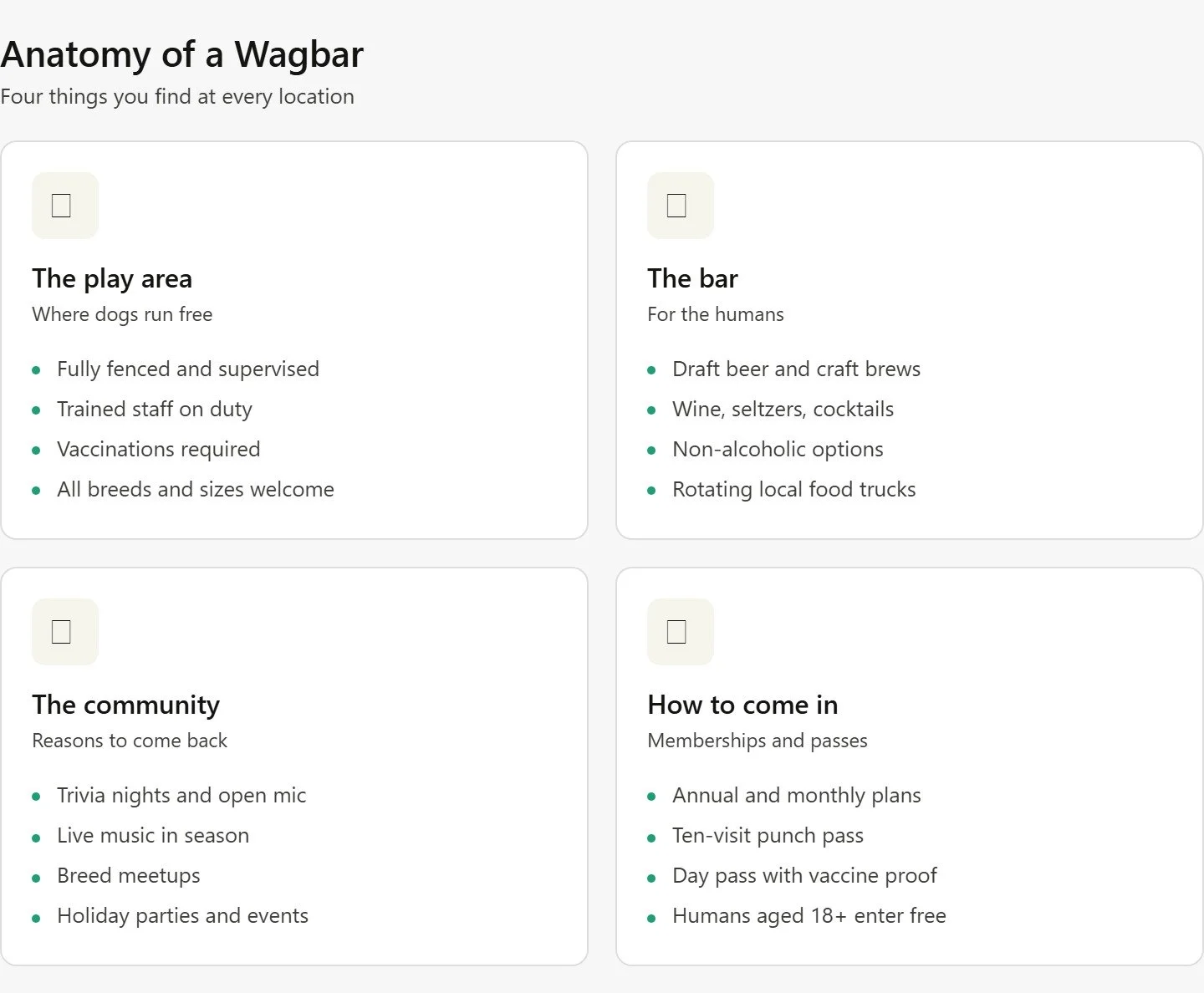
ADA accessibility requirements apply to commercial properties and cover parking, accessible routes from parking to the entrance, and accessible restrooms. The container bar build-out option used by Wagbar franchisees is designed to meet these requirements, but confirming ADA compliance for the specific site and existing infrastructure is part of the pre-lease checklist.
Access from a public road matters for two reasons: it affects how easily members can get to your location, and it may be subject to curb cut permits or encroachment permits if you need to add or modify access from a municipal road. For market selection for a dog franchise, road access is a customer experience variable as much as a regulatory one.
Who to Call and What to Ask
The zoning research process for an off-leash dog bar involves three separate contacts:
City or county planning department. Ask: What is the zoning designation for this parcel? Is a food and beverage service establishment a permitted use? Is an animal facility (commercial off-leash dog park) a permitted use by right or as a conditional use? What are the setback and fencing requirements for animal facilities in this zone?
Animal control or animal services department. Ask: What state and local permits are required to operate a commercial off-leash animal facility? Are there specific facility inspections required prior to opening? What are the staff-to-dog ratio or supervision requirements, if any?
State Alcohol Beverage Control board. Ask: What license category is appropriate for beer, wine, and canned cocktails without hard liquor? Is that license type available by new application in this jurisdiction, or is it quota-controlled? What is the current processing timeline? Are there operating restrictions that come with that license type?
Each of these conversations can be had before you've spent a dollar on the site. The information they produce determines whether you're looking at a 60-day permitting timeline or a 9-month one -- a meaningful difference for a pet franchise opportunity that's ready to move.
How Wagbar's Site Selection Support Fits In
Wagbar provides franchisees with site selection assistance as part of the franchise support package. In practice, that means the development team has pattern recognition across the regulatory environments of multiple states and municipalities -- knowledge that's genuinely useful when you're evaluating a market you haven't operated in before.
The team can flag municipalities where the conditional use permit process has historically added timeline, identify states where alcohol licensing is quota-controlled (and what the current license market looks like), and review proposed sites against the footprint and access requirements that Wagbar locations need to function well.
That support doesn't replace your own due diligence or your independent legal review. But it does give you a knowledgeable starting point that a first-time site evaluator wouldn't have on their own. The Wagbar franchise development process is structured so that site selection happens with development team input rather than in isolation.
Frequently Asked Questions
What's the difference between a conditional use permit and a variance?
A conditional use permit (CUP) allows a use that is already listed as conditionally permitted in a zone -- it's an approval process, not an exception. A variance is a request to deviate from a specific code requirement (like a setback distance) that the property can't meet. CUPs are more common and more predictable; variances are harder to obtain and involve a higher burden of proof. For most off-leash dog bar sites, you're more likely to encounter a CUP requirement than a need for a variance.
How long does the conditional use permit process typically take?
It depends heavily on the municipality. Administrative CUPs (decided by staff without a public hearing) can take 2-4 weeks. Discretionary CUPs requiring a planning commission hearing typically run 60-120 days from application to decision, depending on hearing calendars and whether the application is complete on first submission. Some jurisdictions have longer timelines in high-volume planning markets.
What happens if the parcel's zoning doesn't allow an animal facility?
If the base zoning doesn't permit animal-related commercial use, you have a few options: look for a different parcel in a zone that does allow it, apply for a zoning amendment (a longer and less certain process), or check whether adjacent parcels with more permissive zoning are available. In most cases, moving to a better-zoned parcel is faster and more reliable than attempting to rezone. What is a franchise doesn't answer zoning questions, but it does cover how franchise development support helps with site selection decisions like this.
Do I need separate permits for food trucks at the location?
In most jurisdictions, yes. Permanent food service operations require a food handler's permit and a certificate of occupancy from the health department. Mobile food vendors (food trucks) typically need their own mobile vendor permit from the city, separate from your business license. Confirming that your site can accommodate permitted food truck vendors is worth adding to the zoning checklist, particularly if rotating food trucks are part of your planned programming.
What's the fastest way to confirm whether a site will work?
A phone call or in-person visit to the planning department with the parcel's address and APN (assessor's parcel number) in hand. Staff can usually confirm the zoning designation and tell you whether food and beverage use and animal facilities are allowed within a single conversation. That call takes 15-20 minutes and tells you whether the site is worth investigating further before you spend time on anything else.
Bottom TLDR
Before committing to any site, confirm the parcel's base zoning permits both commercial food and beverage service and animal-related use -- whether by right or through a conditional use permit. Alcohol licensing is a separate state process with its own timeline. Zoning a 1-2 acre parcel for an off-leash dog park bar successfully starts with those two research calls made well before any lease negotiation begins.