
Why Public Dog Parks Can Go Wrong: The Behavioral Science Behind Unsupervised Play
Top TLDR: Public dog parks can go wrong because unsupervised group play removes the behavioral guardrails dogs need for safe social interaction. Without vaccination requirements, entry screening, or trained staff, the conditions that cause fights, disease transmission, and lasting behavioral damage are consistently present. If your dog has had a bad experience at a public dog park, the environment, not the dog, is usually the problem.
Most dog owners find out the hard way. You bring your dog to the public park, expecting a happy afternoon of running and play. Twenty minutes later, there's a scuffle. Or your dog comes home and spends three days subdued and off. Or worse, something happens that requires a vet visit.
The frustrating part is that public dog parks are supposed to be the answer. More exercise. More social time. Less guilt about apartment living or long work hours. But the behavioral science tells a more complicated story about what actually happens in unmonitored group dog settings, and why good intentions don't always produce good outcomes.
The Open Access Problem
Most public dog parks operate with essentially no entry requirements. You walk in, your dog walks in, and whatever happens next happens. There's no vaccination check. No behavioral screening. No size separation in many cases. No trained person watching the space.
That's a meaningful problem, and not just for obvious reasons.
Research published in Preventive Veterinary Medicine found that dog parks with formal entry requirements, including verified vaccination records and some form of behavioral screening, reported significantly fewer disease transmission events and physical altercations than open-access facilities. The absence of requirements doesn't just allow more risk into the space. It changes the entire composition of the dog population that shows up.
When a park has no standards, the dogs that tend to cause problems show up there because they've been excluded everywhere else. An aggressive dog that gets removed from a daycare facility or a managed off-leash park doesn't just stop going out. It finds the path of least resistance, which is usually the nearest public park with no entry policy.
This is what behavioral researchers sometimes call adverse selection in shared animal spaces. The easiest environment to enter becomes the one that accumulates the highest-risk participants. The dog owners who have worked hard to socialize and manage their dogs responsibly end up sharing space with dogs that haven't had the same investment.
What Happens to Behavior Without Supervision
Dogs are very good at reading social situations, but they need the situation to be manageable. Group dynamics in dog play are genuinely complex, and they shift quickly.
Play in a healthy group involves continuous social negotiation. Dogs take turns, break off interactions, reset, and re-engage. A trained observer watching a group of dogs can see this playing out in real time through body posture, movement patterns, and the give-and-take of who's chasing whom. It looks loose and chaotic from a distance. Up close, it's actually structured.
What breaks that structure is arousal escalation. When arousal levels in a dog group climb and keep climbing without natural breaks, the social negotiation starts to fail. Play bows stop happening. Pauses disappear. What was mutual chase becomes one-sided. And the dog on the receiving end of that one-sided attention has nowhere to go.

In an open public park, this progression often goes unnoticed until it's already a fight. The owners are distracted. There's no staff. Nobody is tracking the group's energy as a whole. By the time people react, the situation has already escalated past the point where easy intervention was possible.
Understanding dog park fight prevention starts with recognizing this escalation pattern before it completes.
The Disease Risk That Doesn't Get Talked About Enough
Dog parks are high-contact environments. Dogs greet each other physically. They share water sources. They investigate the same ground. Under those conditions, pathogens spread efficiently.
The diseases most relevant to shared dog spaces are Bordetella (kennel cough), distemper, and in unvaccinated populations, parvovirus. Bordetella is airborne and spreads through direct contact, making it particularly easy to transmit in group settings. Parvovirus can survive in soil for months and is highly contagious to unvaccinated or incompletely vaccinated dogs.
At a public park with no vaccination requirement, any dog in that space could be carrying any of those pathogens. You have no way of knowing. The dog that looked completely healthy trotting in might be shedding Bordetella. The ground itself might be contaminated.
This isn't a theoretical concern. The American Veterinary Medical Association has documented outbreaks traced directly to shared off-leash dog spaces with no vaccination requirements. The mechanism is well understood: you put enough unscreened dogs in close contact with shared surfaces, and disease circulates through the population.
Vaccination requirements aren't just gatekeeping. They're a public health measure for dogs, creating a layer of herd protection that meaningfully reduces transmission risk even for dogs whose own immunity isn't perfect. It's the same logic that applies to human vaccination programs: individual protection matters, but so does the protection you get from being surrounded by others who are also vaccinated.
The dog health and safety standards at Wagbar exist precisely because this math is straightforward: require vaccinations, reduce disease events.
How Inattentive Ownership Compounds the Problem
There's a human dimension to public dog park problems that doesn't get enough attention.
Owners at unmonitored parks are often distracted. Phones come out. Conversations with other owners pull attention away. Someone's dog wanders to the other side of a large park, and the owner stops tracking exactly what that dog is doing.
Research on dog bite incidents in shared spaces consistently identifies inattentive ownership as a contributing factor. This isn't about blaming owners. It's about understanding that dogs in a group setting require active monitoring, and without staff support, that monitoring falls entirely on people who have no training and plenty of other things competing for their attention.
The other dynamic at play is what researchers call bystander diffusion in group settings. When a concerning situation develops at a public park and there are multiple owners present, each owner tends to assume someone else will handle it or that it's not actually a problem. Staff changes this entirely. A trained staff member has both the responsibility and the authority to intervene. Other owners in the space don't feel that same obligation, and the presence of many adults watching a situation can paradoxically mean that no one acts.

Knowing how to read canine body language is a skill that takes deliberate practice most dog owners haven't had. Expecting untrained owners to catch early warning signs, while also managing their own dogs and possibly holding a coffee, sets up a gap that supervision fills.
The Behavioral Damage of Bad Experiences
A single bad experience at a dog park can do lasting damage to a dog's social behavior. This is not an exaggeration.
Dogs learn through association, and they learn negative associations faster than positive ones. It's an adaptive mechanism. An organism that requires multiple exposures to learn that something is dangerous won't survive long. One frightening or painful experience in a social context can produce generalized anxiety around similar contexts.
A dog that's been pinned, chased relentlessly, or attacked at a dog park may become reactive toward other dogs in future encounters. Not because the dog has a bad temperament, but because the dog has learned, from direct experience, that other dogs in group settings are a threat. Reactive dogs often have a history, not a disposition problem. What looks like aggression in a dog that lunges at other dogs on leash often traces back to a specific experience where the dog's social environment failed them.
This is one of the less visible costs of unmonitored dog parks. The incidents you see and hear about are the bites, the fights, the obvious injuries. The behavioral damage, the dog that used to love other dogs and now doesn't, is quieter. It shows up months later. And it's much harder to address than a physical injury.
The reactive dog training guide covers how to work with dogs whose reactivity developed from situations like this, but the more important point is that prevention is considerably easier than rehabilitation.
What Good Group Dog Play Actually Requires
If public dog parks with no requirements are too high a risk, what does a safer group dog environment actually need?
Vaccination requirements are the baseline. They need to be verified, not just self-reported. The dogs in the space should at minimum have current rabies, Bordetella, and distemper (DHPP) vaccinations, the core diseases with meaningful transmission risk in shared settings.
Behavioral screening matters as much as health screening. A dog with a documented history of aggression shouldn't be in a shared off-leash environment. Not because those dogs don't deserve social time, but because putting them in that environment creates risk for every other dog present. Entry requirements that include behavioral history, combined with a clear policy for removing dogs that cause problems, change the population of dogs that's actually in the space.
Trained supervision isn't optional. It's the mechanism that catches escalating arousal before it becomes a fight, intervenes when one dog is being overwhelmed, and maintains the overall behavioral environment of the group. One person trained in dog park behavior and group play dynamics can prevent the majority of incidents that occur in unmonitored settings.
Space design matters too. Overcrowding raises arousal across the group. A well-designed off-leash space gives dogs room to self-regulate, approach and retreat on their own terms, and exit interactions they don't enjoy. These aren't luxuries. They're the physical conditions for the behavioral processes that make group play healthy.
The Difference You Actually Feel

Dog owners who've used both types of facilities tend to describe the difference clearly. At an open public park, there's always some background level of vigilance. You're watching your dog more carefully because you know you're the only one watching. At a well-managed facility, that tension lifts. Someone else with training is also watching. The dogs in the space have been screened. The standards for behavior are enforced.
That's not a small thing. It changes how much you enjoy being there. And it changes how your dog reads the environment. Research on emotional contagion between dogs and their owners makes clear that owner stress transmits. A tense, watchful owner produces a more tense, watchful dog. A relaxed owner, in a space designed to support that relaxation, contributes to a better experience for the dog.
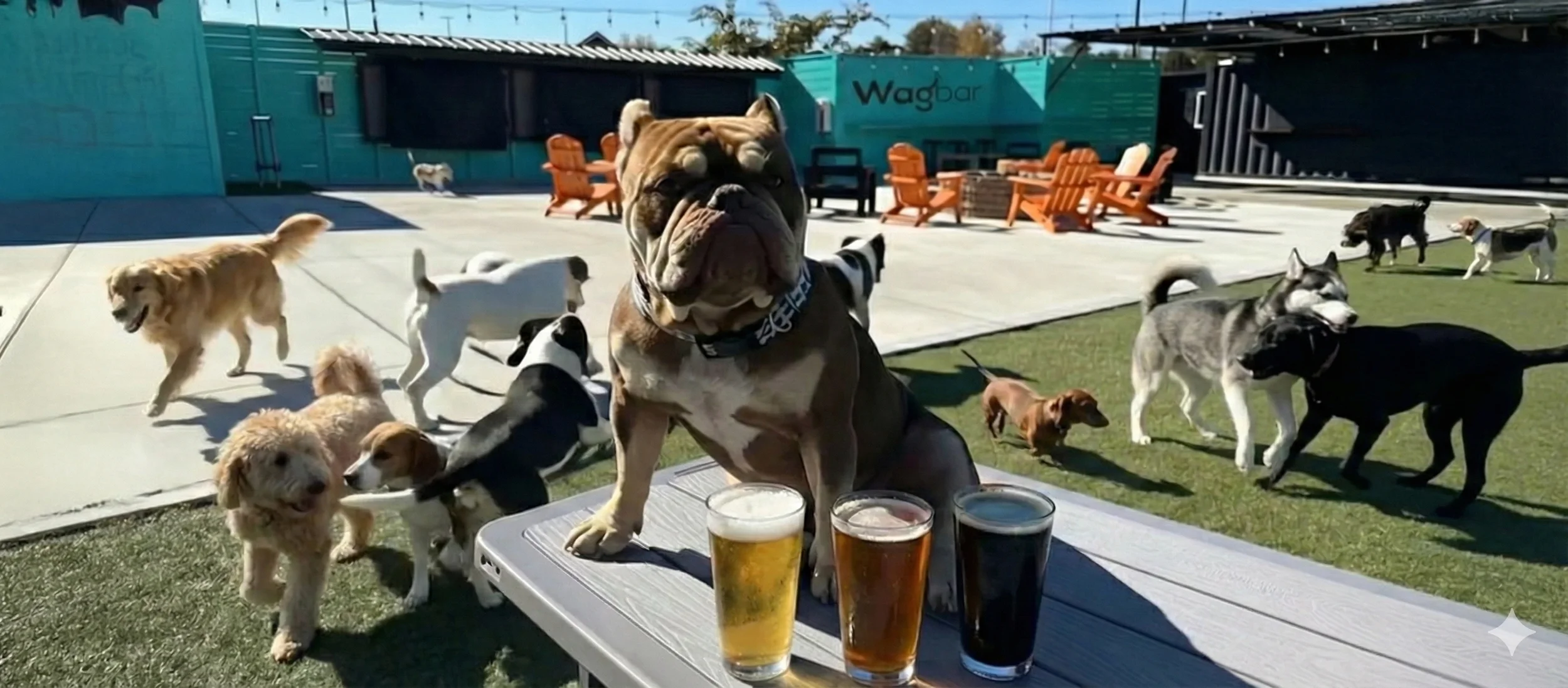
This is why the off-leash dog bar model works on a practical level. It's not just about adding a bar to a dog park. It's about designing an environment where dogs have the behavioral conditions for good socialization, and owners have the environment to actually be present and relaxed while it happens.
Wagbar's complete dog park guide goes deeper on what responsible group dog management looks like in practice, including the etiquette and safety standards that make a shared space work for everyone in it.
Frequently Asked Questions
Are all public dog parks dangerous?
Not necessarily, but the absence of requirements and supervision creates consistent structural risks. Public parks without vaccination checks, behavioral screening, or trained staff have significantly higher rates of disease transmission and altercation incidents than managed facilities. The specific risk depends on the park and the other dogs present on any given day, which is exactly the problem with having no standards.
My dog has always been fine at public parks. Should I be worried?
Good outcomes at public parks are common. Problems are less common but real. The concern isn't that every visit will end badly. It's that the conditions for bad outcomes are consistently present when there's no oversight, and a single serious incident can have lasting behavioral consequences. The calculus is about risk management over time, not about whether any individual visit is likely to go wrong.
How do I know if my dog is ready for group off-leash play?
Dogs should have reliable recall, be comfortable around other dogs in controlled settings, and have no history of aggression. The off-leash readiness checklist covers the specific behaviors and signals that indicate a dog is ready for the social complexity of group off-leash settings.
Can a bad dog park experience be reversed?
Yes, but it takes time and deliberate work. Dogs that have developed reactivity or anxiety from negative social experiences can improve significantly with proper training and gradual positive reintroduction to social settings. The key is not rushing the process and not returning to high-risk environments before the dog has rebuilt positive associations.
What should I look for in a managed off-leash facility?
Verified vaccination requirements for all dogs, a clear behavioral policy with real enforcement, trained staff monitoring the space during operating hours, and physical design that gives dogs room to move freely and self-regulate. These aren't premium extras. They're the basic conditions for group dog play to be consistently safe.