
Why Pet Businesses Are Thriving in the Experience Economy: The Shift From Services to Social Venues
Key Takeaways
Pet spending in the U.S. topped $147 billion in 2023, with the fastest growth in experience-based services rather than products or basic care
Off-leash dog park bars combine socialization, bar service, and community to generate repeat visits that transactional pet businesses can't match
Membership models built around experience drive higher retention than single-service formats
If you're evaluating a pet franchise in the experience economy, the social layer isn't a nice-to-have; it's the competitive moat
The pet industry has been growing for decades, but something shifted noticeably after 2020. Spending on traditional pet services held steady, but a specific segment pulled ahead: businesses where people didn't just drop their dogs off or pick up supplies. They stayed. They socialized. They came back the following weekend.
This is what economists and consumer researchers call the experience economy at work, and it's reshaping what pet businesses need to offer to build durable customer relationships.
What the Experience Economy Actually Means
The experience economy is a framework first described by B. Joseph Pine II and James H. Gilmore in a 1998 Harvard Business Review piece. The core idea is that consumers have moved through stages of economic value creation, from commodities to goods to services, and now to experiences. People don't just want to buy a thing or pay for a task to be done. They want to be part of something worth remembering.
In practice, this explains why people pay more to watch a movie in a premium recliner theater versus a standard one, why escape rooms became a $1 billion global industry, and why the pet services sector has seen its most aggressive growth in concepts that combine multiple touchpoints into a single visit.

For pet businesses specifically, the experience economy reframes the core question. It's not "what does this dog need?" but "what does the dog owner want their life with their dog to look like?" That's a fundamentally different prompt, and it opens up a very different business model.
Understanding off-leash dog parks and bars as a concept requires thinking in these terms. The product isn't a service delivered to a dog. It's an experience that belongs equally to the dog and the owner, shared in a social setting.
How Pet Spending Changed After 2020
The American Pet Products Association tracks U.S. pet industry spending annually. In 2020, spending crossed $103 billion for the first time. By 2023, it had reached $147 billion. That's nearly $45 billion in additional annual spending in three years.
Part of that increase reflects inflation and the general rise in pet ownership during the pandemic years. But the more interesting trend is where the growth concentrated. Basic categories like pet food grew steadily. Veterinary care grew with rising costs. But the discretionary, experience-adjacent categories, things like boarding upgrades, dog-friendly travel, premium daycare with socialization programs, and membership-based parks, grew faster in percentage terms.
This reflects something behavioral researchers have been documenting since at least 2017: the humanization of pets. American dog owners increasingly treat their dogs as family members, not property. They spend accordingly, and they evaluate pet services with the same lens they'd apply to any experience purchase for a family member. Is this worth my time? Is this somewhere I want to be?
That question has consequences for the pet industry's competitive structure. Businesses that can answer "yes" to both parts (worth my time, and somewhere I want to be) are building a fundamentally different kind of customer relationship than businesses that only address one.
Why Traditional Pet Services Struggle to Retain Customers
A traditional boarding kennel, grooming salon, or dog daycare does something genuinely useful. But from a customer retention standpoint, it has a structural problem: the owner doesn't experience the service. They drop the dog off, go do something else, and pick the dog up later. The service is transactional.
Transactional relationships can generate repeat business, but they're price-sensitive. If a competing groomer opens a few blocks away for $10 less per session, there's no emotional cost to switching. The owner never built a relationship with the space. The dog was there, but the owner wasn't.
Compare that to a business where the owner is present for the entire experience. They're at the bar. They're watching their dog run with other dogs. They're talking to the couple at the next table who also has a border collie. They have a favorite staff member who remembers their dog's name. Now switching costs aren't just about price. They're about losing a community.
This is the retention mechanism that experience-driven pet businesses have built into their model by design.
The Social Layer as a Competitive Moat
In business strategy, a moat is something that makes it hard for competitors to replicate what you've built. The experience economy creates moats that product businesses can't create, because the moat isn't a patent or a secret recipe. It's a community.
When an off-leash dog bar builds a real community of regulars, that community becomes self-reinforcing. Members come because their friends come. They bring new people. The new people become regulars. The community makes each individual visit better, which increases the perceived value of the membership, which makes people less likely to cancel, which keeps the community intact.
This is distinct from the loyalty mechanisms traditional pet businesses use. A punch card or a discount for repeat visits is a financial incentive. It doesn't create community. When the incentive runs out or a competitor matches it, the retention advantage disappears.
The community-building dimension of dog-focused businesses explains why Wagbar, for example, consistently generates reviews that talk about human friendships formed at the park, not just what the dog did. Customers aren't just paying for their dog to run around. They're paying for a social life that includes their dog, and that's a much stickier value proposition.
Off-Leash Dog Bar Model vs. Traditional Pet Services: What the Numbers Suggest
When comparing revenue structures, the contrast is significant. A grooming salon earns revenue once per service transaction. A boarding facility earns per night. The unit economics are bounded by how many transactions the staff can handle.
An off-leash dog bar with a membership model creates recurring revenue that isn't directly tied to staff-hours-per-customer. A monthly member who visits four times a month generates consistent revenue across the year. Their acquisition cost is one-time. Their retention cost is lower per month than a transactional customer who has to be marketed to again before each visit.
According to research on subscription and membership businesses published by Bain and Company, increasing customer retention rates by just 5% can increase profits by 25% to 95%. The model that gets customers to pre-commit to a monthly or annual membership front-loads the customer relationship and changes the entire financial structure of the business.
Wagbar offers daily passes, 10-visit punch passes, monthly memberships, and annual memberships. That tiered structure serves multiple customer segments, from first-time visitors who want to try before committing to regular customers who prefer the predictability of an annual pass. Each tier also creates a natural progression: a daily pass visitor who enjoys their experience has a clear path to becoming a monthly member without being pushed into a financial commitment that feels risky.
For prospective franchisees evaluating what to look for in a dog bar franchise investment, this membership architecture is one of the more important structural advantages to understand. It's not just a customer convenience. It's the foundation of a different revenue profile than a transactional pet service business.
Experience-Driven Pet Spending Growth: What the Data Shows
The American Pet Products Association's data tracks broad categories, but more granular signals come from related research areas. The Global Wellness Institute has tracked the overlap between pet ownership and the wellness economy, and found significant growth in premium pet experiences among millennial and Gen Z owners, demographics that now represent the majority of new dog owners.
A 2023 survey by the Human Animal Bond Research Institute found that 85% of pet owners consider their pet a member of the family. Among millennial pet owners, that number climbs higher. Millennial pet owners also outspend older demographics on pet services on a per-pet basis, and they're more likely to choose experience-based options over transactional ones when both are available.
This aligns with what regional pet spending patterns research shows about urban and college-educated markets. Higher pet humanization rates correlate with higher per-pet spending and stronger preference for social, experience-oriented businesses over utilitarian ones.
Cities like Denver, Austin, Asheville, and Richmond consistently rank among the top metro areas for per-capita pet spending and pet-friendly infrastructure investment. It's not coincidental that these are also cities where the off-leash dog bar concept has found its strongest early markets.
Why This Model Works in Pet-Friendly Cities
Not every market is equally ready for a premium pet experience business. The best cities for dog franchise success share a cluster of demographic and cultural characteristics: above-average household incomes, high rates of dog ownership, a culture of spending on local experiences, and strong community identity.
These cities tend to have active dog communities already. Dog owners in cities like Asheville, Knoxville, or Richmond have often built informal social networks around their dogs: the regular group at the neighborhood park on Saturday mornings, the text thread when someone's dog has puppies, the Facebook group for the breed club. An off-leash dog bar plugs into this existing social infrastructure and gives it a permanent home.
Wagbar's flagship location in Weaverville (serving the Asheville, NC area) reflects this. Asheville has a strong independent business culture, high dog ownership rates, an active outdoor and wellness community, and a population that actively seeks out local experiences over chain alternatives. The concept worked there because the market was already primed for it.
The Knoxville, Tennessee location at the former Creekside site follows a similar logic. Knoxville has a large university presence, growing millennial homeownership, and a food and beverage scene that's been expanding rapidly. Dog ownership rates in college-adjacent markets are high, and the demographics skew young enough to favor the experience-forward model over traditional boarding or daycare.
The Dual Revenue Structure That Separates Social Venues From Service Businesses
One of the most commercially significant features of the off-leash dog bar model is the dual revenue stream: dog park memberships and passes on one side, beverage and food truck sales on the other. This structure has implications that go beyond simple diversification.
When a customer visits a traditional dog park (free municipal parks being the main alternative), the park earns nothing from their visit. The owner might stop at a coffee shop before or grab food after, but those transactions happen elsewhere. An off-leash dog bar captures the spending that would otherwise happen around the dog park visit, at the same time and in the same location.
A customer who pays a day pass for their dog and then orders two drinks has generated revenue from two separate sources in one visit. A monthly member who visits on a Saturday afternoon and stays for three hours while their dog plays contributes to both revenue lines each time they come.
This is what the revenue streams analysis for off-leash dog bars demonstrates in practice. The combination isn't just convenient for customers. It's structurally more profitable per visit than any single-service model can achieve.
For franchise investors reviewing the pet franchise opportunity landscape, this dual-stream model is worth understanding deeply. It means the business isn't dependent on maximizing dog park throughput alone. Bar revenue can be strong on a slow dog day. Membership revenue provides a floor even when bar sales dip.
What Dog Owners Actually Buy When They Buy an Experience
It helps to be concrete about what the customer is actually purchasing when they buy a Wagbar membership or day pass. On the surface, it looks like access to a fenced off-leash area. But that's the feature, not the benefit.
What dog owners in the experience economy are actually buying is permission to not worry for a few hours. A municipal dog park requires constant vigilance: watching for aggressive dogs, managing your own dog's behavior around strangers, cleaning up and hoping other owners do the same. There's no staff, no screening, no oversight.
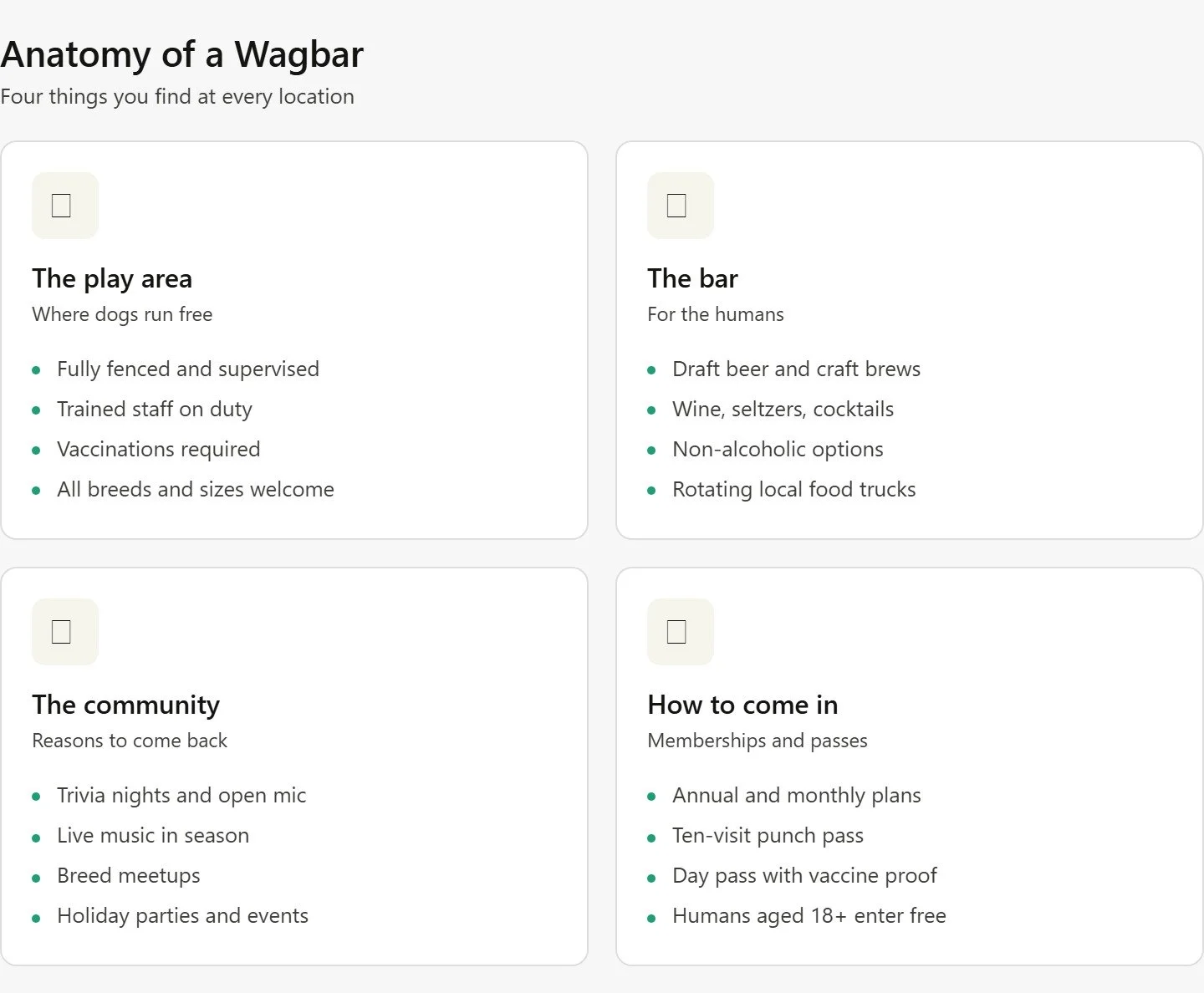
An off-leash dog bar removes the anxiety. Dogs are screened for vaccinations and behavior before entering. Staff monitor the park and intervene when play gets too rough. The owner can sit down, order a drink, and actually relax while their dog socializes. That's not a marginal improvement on the free option. It's a categorically different experience.
As one Wagbar customer put it in a review: "I remain amazed how few of these dog bars there are. It's such an obvious concept: create an enjoyable spot to imbibe your favorite beverage while your dog gets to run around and enjoy themselves."
The dog park safety and behavior infrastructure that makes this possible is part of what the customer pays for, even if they never think about it in those terms. They just know the visit was better than the free park. That subjective quality difference is the experience economy at work.
How the Experience Layer Affects Franchise Viability
For someone evaluating the off-leash dog park and bar franchise concept as a business investment, the experience economy context matters for projecting both revenue potential and competitive durability.
On revenue potential: experience-based businesses typically command higher price points than comparable service businesses. A monthly membership to an off-leash dog bar is priced differently than a monthly grooming plan, and the customer calculus is different too. Membership to a community with recurring social value is stickier than a service that can be comparison-shopped on price alone.
On competitive durability: a competitor opening a similar grooming salon a few blocks away represents a direct threat to a grooming business. A competitor opening a second off-leash bar in the same market is a more complex situation, and in many markets actually expands the category rather than splitting existing demand. Once consumers understand and value the experience, the total addressable market for it grows.
The 50 profitable pet business ideas guide covers a wide range of formats, and the experience-integrated ones consistently show stronger membership retention characteristics in their modeling. The social layer isn't decoration. It's load-bearing.
Initial franchise investment for a Wagbar location ranges from $470,300 to $1,145,900 (see the Franchise Disclosure Document for detailed figures), with a $50,000 franchise fee and 6% royalty on adjusted gross sales. These figures should be evaluated in the context of what the model delivers: recurring membership revenue, dual revenue streams, and the competitive positioning that comes with being a genuine community hub rather than a transaction-based service.
Frequently Asked Questions
What is the experience economy and how does it apply to pet businesses?
The experience economy describes a stage of economic development where consumers prioritize memorable, participatory experiences over products or basic services. For pet businesses, it means customers increasingly choose businesses where they're present and engaged during the service, not just where a task is performed for their pet while they're elsewhere.
Why do off-leash dog bars have better retention than traditional pet services?
Traditional pet services are transactional: an owner drops their dog off, the service is performed, the owner picks up and pays. There's no emotional connection to the space because the owner never experienced it. An off-leash dog bar puts the owner inside the experience, building social relationships and community attachment that make switching to a competitor feel costly in ways that go beyond price.
How does the membership model benefit an off-leash dog bar franchise?
Membership revenue is predictable and recurring, which gives the business financial stability that pay-per-visit models don't provide. A monthly or annual member has already paid, which means they're more likely to visit frequently (to get their money's worth), which reinforces their attachment to the community, which reduces cancellation rates.
What drove the acceleration in experience-based pet spending after 2020?
Several factors converged: a large increase in pet adoptions during pandemic lockdowns, an accelerated shift among millennial pet owners toward treating dogs as family members, and a broader consumer trend away from spending on physical goods toward spending on experiences. Pet owners who adopted dogs during 2020-2021 are now spending their discretionary pet budget on businesses that align with the relationship they've built with their animals.
Is the experience economy trend durable or a passing phase?
The academic and market research consensus is that the experience economy represents a structural shift in consumer values, not a trend. B. Joseph Pine II and James Gilmore described the framework in 1998, and the shift has accelerated consistently since then across virtually every consumer category. Pet spending has shown particular resilience even during economic downturns, making experience-based pet businesses relatively recession-resistant compared to other premium experience formats.
How important is location for an experience-based pet business?
Very important. Markets with higher household incomes, higher dog ownership rates, and a cultural preference for local experiences over chain alternatives tend to perform better for experience-based pet businesses. College towns, urban neighborhoods with high millennial homeownership, and cities with strong independent business cultures are consistently strong markets for this model.
What makes Wagbar's model different from a standard dog park?
Wagbar combines a fully staffed, screened off-leash park with licensed bar service in one location. Dogs require proof of vaccinations and are monitored by trained staff. Owners have access to beverages, food from rotating local food trucks, and a social environment built around shared dog ownership. The result is a dog park visit that generates revenue and community simultaneously, which free municipal parks don't do.
The Shift Is Already Underway
The pet businesses growing fastest right now aren't the ones that do the same things more efficiently. They're the ones that changed what they offer entirely, turning a service visit into a destination, and a single customer into a community member.
That's what the experience economy does to any industry it touches. In pet services, the shift from transactional to experiential is still in relatively early stages compared to other consumer categories, which means the market opportunity is real and the competitive landscape is still forming.
For dog owners, the value proposition of an off-leash social venue is intuitive once you've experienced it. For investors and franchisees, the business case follows from the same logic: recurring memberships, dual revenue streams, and a community moat that a traditional pet service business simply can't build.
If you're curious about bringing this model to your market, explore Wagbar's franchise opportunities and review the FDD for detailed financial performance data.
Bottom TLDR
The experience economy has reshaped what pet businesses need to offer to build lasting customer relationships. Off-leash dog bars thrive because they put the owner inside the experience, generating community attachment that transactional grooming or boarding businesses can't replicate. Combined with membership-based recurring revenue and dual income streams from bar and park, this model produces stronger retention and more durable competitive positioning. Review Wagbar's franchise information to see how this translates into a specific investment opportunity.