

Why Dog Park Bars Fix the Loneliness Problem That Regular Bars Can't
Top TLDR: Dog park bars fix the loneliness problem that regular bars can't because dogs give strangers a built-in, non-awkward reason to talk on every visit. The U.S. Surgeon General declared loneliness a public health crisis in 2023, and research consistently shows that recurring, low-pressure in-person contact is what actually reduces it. If you want to meet people as an adult without it feeling forced, showing up with your dog is one of the most reliable ways to do it.
In 2023, the U.S. Surgeon General released an advisory with a headline that surprised a lot of people: loneliness is a public health crisis.
Not a social media problem. Not a generational quirk. A genuine public health crisis, on par with smoking in terms of mortality risk.
What made the advisory striking wasn't just the data, it was the implication. Americans have access to more social tools than at any point in history. More apps, more platforms, more ways to message and connect and stay in touch. And yet roughly half of American adults reported measurable loneliness, with adults under 30 faring some of the worst (U.S. Surgeon General, "Our Epidemic of Loneliness and Isolation," 2023).

The problem isn't a lack of connection options. It's a lack of the right kind of connection: recurring, low-pressure, in-person contact with people you didn't specifically plan to meet.
That's exactly what dog park bars are quietly providing. And it's why regular bars, for all their social promise, consistently fall short.
What Regular Bars Actually Do (and Don't Do) for Loneliness
Bars have always been pitched as social spaces. Friendly strangers, shared drinks, easy conversation. The reality is more complicated.
Research on bar culture and social behavior consistently shows that most people who go to bars arrive with their existing social group and leave with the same people they came with. The physical environment of a typical bar, dim lighting, loud music, high-top tables arranged facing away from other groups, is designed more for privacy within your party than for genuine stranger interaction (Kuntsche & Kuntsche, Alcohol and Alcoholism, 2017).
Alcohol does lower inhibitions, but it doesn't give two strangers anything to talk about. Walk up to someone you don't know at a bar and start a conversation cold. It's awkward. It reads as a pickup attempt or an intrusion. The social script of most bars doesn't have a comfortable slot for "I just want to meet someone new tonight."
Gyms have the same problem. So do coffee shops, to a lesser degree. You're surrounded by people but functionally alone, orbiting each other without any natural mechanism to pull you together.
Why Dogs Change the Entire Social Equation
Dogs are social catalysts in a way that almost nothing else in adult life is.
When two dogs approach each other in an off-leash yard, something happens that is genuinely involuntary: their owners start talking. There's no choice involved. Your dog has already committed you to an interaction. You don't have to calculate whether it's appropriate to speak first, whether you'll seem weird, whether the other person wants to be bothered. The dogs took care of all of that before you even noticed.
A 2015 study published in PLOS ONE found that people who walked with dogs were significantly more likely to initiate and receive social contact from strangers than those walking without dogs, with 83% of dog walkers reporting that their dog had helped them meet people they wouldn't have otherwise spoken to (McNicholas & Collis, PLOS ONE, 2015). Dogs were described by participants as "social catalysts," a term the researchers used specifically to distinguish this from normal social interaction.
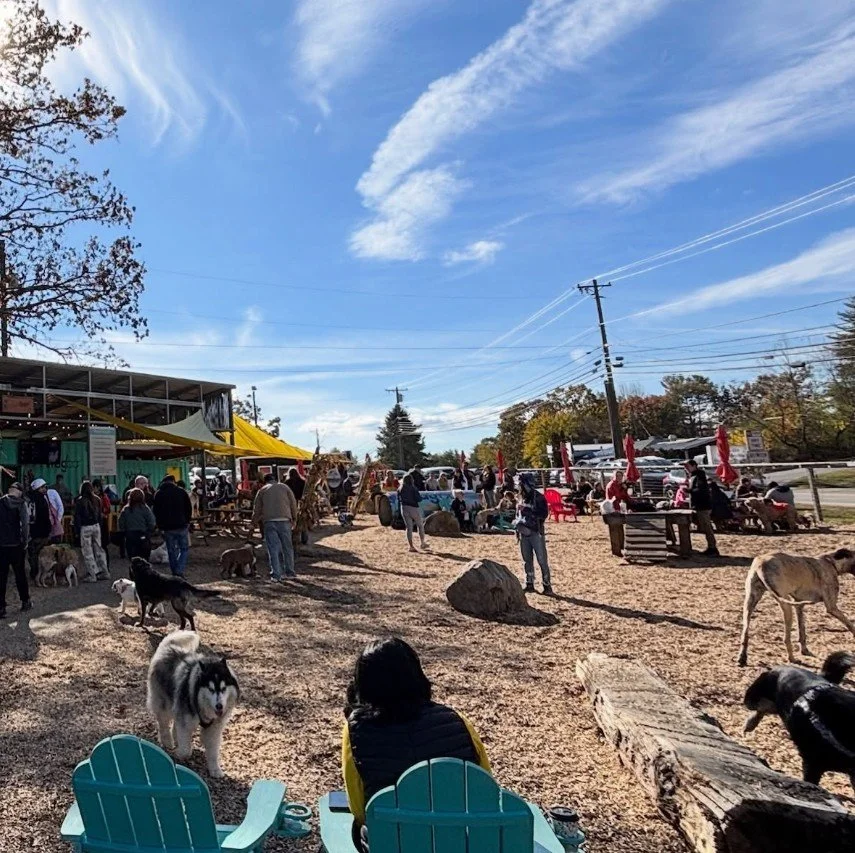
This effect is amplified in an off-leash environment. At a regular dog park, people often stand separately watching their dogs. At a dog park bar like Wagbar, the design pulls people into the same shared space. You're sitting near each other. You're watching the same yard. Someone's dog does something funny and three people who didn't know each other five minutes ago are laughing together.
That's not a bar thing. That's a dog thing.
The Research on Pet Ownership and Social Connection
The connection between dog ownership and reduced loneliness shows up across multiple studies, not just anecdotal reports.
A 2020 study in the journal Aging & Mental Health found that pet owners reported significantly lower levels of loneliness than non-owners, with the effect size comparable to having a close friend (Brooks et al., Aging & Mental Health, 2020). The mechanism wasn't just the animal's companionship directly. It was what the animal prompted in terms of human social contact: conversations with neighbors, interactions at parks, routine encounters with other dog owners.
According to the American Pet Products Association (APPA), 67% of U.S. households owned a pet in 2023, and dogs remain the most common choice. That's a massive built-in community of people who share daily routines, common experiences, and a specific kind of mutual understanding about what it's like to care for another creature. Dog owners already have something in common with each other. They just don't always have a good place to act on it.
Dog park bars create that place. As Wagbar puts it in its own mission: "Unleashing joy and connection for dog lovers with a unique fusion of off-leash park and social bar atmosphere, strengthening community bonds and creating lasting memories."
Why Recurring Contact Is the Key Ingredient
The Surgeon General's advisory pointed to something specific about why modern loneliness is so stubborn: people are having fewer sustained, recurring, in-person interactions with the same people over time.
Seeing the same faces regularly, in the same place, doing the same loose social ritual, is what builds genuine connection. It's the mechanism behind why your neighborhood coffee shop feels different from a chain, why a barbershop becomes a community fixture, why regulars at a local bar feel something those venues can't manufacture on purpose.
Dog park bars create this naturally. Dog owners are creatures of routine. Most people bring their dogs on a consistent schedule, same days, same times. Within a few weeks of regular visits, you start recognizing faces. Staff learn your dog's name. You know which dogs play well together and which need more space. You start to track small stories: the shy rescue who's finally coming out of its shell, the elderly Lab who's been coming for years, the new puppy on its first visit.
These accumulated, low-stakes interactions are exactly what loneliness research identifies as protective. A 2019 study in PLOS ONE found that people who had regular access to "third places," informal gathering spots outside home and work, reported significantly higher levels of social satisfaction and more close friendships than those who didn't (Enns, Mayrhofer et al., PLOS ONE, 2019). The recurring nature of the contact mattered more than the intensity of any individual interaction.
Wagbar's membership model supports exactly this. Members don't have to show vaccination records on repeat visits. They show up, they're recognized, they settle in. The friction is low enough that regular visits become habits rather than events.
For a deeper look at how dog socialization works in group settings, including what's happening socially for your dog at the same time it's happening for you, Wagbar's socialization guide covers the behavioral science.
What Actually Happens When You Show Up
Wagbar's customers describe the experience in ways that sound less like a bar review and more like a neighborhood coming to life.
Adam A. put it plainly: "I remain amazed how few of these dog bars there are. It's such an obvious concept: create an enjoyable spot to imbibe your favorite beverage while your dog(s) get to run around and enjoy themselves. Friendly staff, great selection of local beers, beverages, snacks and food in a very nice setting."
Drew B. noted specifically how the structure of the space changed his experience: "The staff is very attentive to breaking up any roughhousing so you and your pup can enjoy in peace. All dogs are checked for vaccine requirements and you feel very secure."
That sense of security matters more than it might seem. One of the documented barriers to connection in urban adult life is ambient social anxiety: the low-level wariness that comes from being around strangers in environments where anything could happen. Wagbar's vaccination requirements, trained staff, and clear code of conduct create a setting where people can actually relax. Relaxed people talk to each other. Anxious people don't.
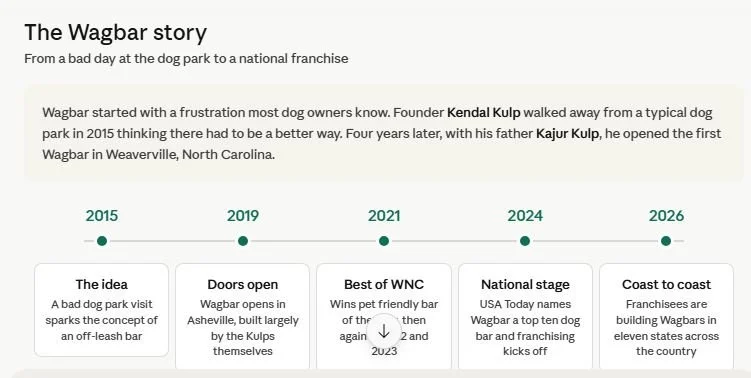
Even the origin story of Wagbar itself points to community as the core idea. Founder Kendal Kulp wasn't trying to build a bar with dogs. He was frustrated by a mediocre day at a traditional dog park and started imagining what it would look like to combine off-leash play with a social atmosphere designed for connection, not just coexistence. That distinction, coexistence versus connection, is exactly what separates a dog park bar from both a regular park and a regular bar.
The Structure That Regular Bars Are Missing
Here's the honest answer to why regular bars can't solve what dog park bars solve.
A standard bar can be loud, dark, crowded, and anonymous. You can sit in a bar for two hours and leave having spoken only to the people you arrived with. The social architecture doesn't require anything of you.
A dog park bar is different in a structural way. The yard creates shared attention. The dogs create shared involvement. The safety protocols create shared responsibility. The regulars culture creates shared identity over time. None of these things happen by accident; they're built into the format.
Wagbar's events calendar makes this even more explicit. Weekly trivia nights give the same people a reason to show up on the same day. Breed meetups pull together micro-communities of people who already have something specific in common. Live music and open mic nights lower inhibitions without requiring alcohol to do the work. Dog adoption events draw people whose values around animals are already aligned.
These aren't just fun additions. They're the mechanisms by which a space stops being a venue and starts being a community.
Why This Matters Beyond Dog Owners
One point worth making explicitly: you don't need a dog to use a dog park bar this way.
Wagbar is open to anyone 18 and older. Human entry is free. Some of the most regular visitors at Wagbar's Asheville-area location don't own dogs; they come because they love dogs and the people who bring them.
This matters for the loneliness problem because it means dog park bars can serve as community infrastructure for a broader group than their name suggests. They're spaces where dog owners and dog-adjacent people, and people who are just curious, can all show up without a strong prior relationship and leave having made one.
That's genuinely rare in adult life. Most adult social spaces require you to already belong before you can belong. Dog park bars let the dogs do the belonging first.
To find a Wagbar location near you, or to learn about bringing this model to your own community through franchising, the locations page has the current list of open and upcoming venues.
Frequently Asked Questions
Does visiting a dog park bar actually reduce loneliness?
No single visit does. What the research supports is that recurring, low-stakes in-person contact with the same people over time reduces loneliness. Dog park bars create the conditions for that kind of contact more reliably than most adult social venues because the dogs provide a natural, non-awkward reason for strangers to interact on every visit.
Why are regular bars less effective for social connection than dog park bars?
Most bar environments are designed for groups who already know each other. The social architecture, seating arrangement, noise levels, social scripts, doesn't have a comfortable mechanism for genuine stranger interaction. Dog park bars add a shared focus (the yard, the dogs) and a built-in conversation starter that removes most of the friction of meeting someone new.
Do you need to bring a dog to benefit socially from a dog park bar?
No. Wagbar is open to all guests 18 and older, with or without a dog. Human entry is free. The social dynamics described in this article apply to anyone who shows up consistently.
What does the research say about dogs and social connection?
Multiple studies have found that dogs function as "social catalysts," meaningfully increasing the frequency and quality of social contact between strangers. A 2015 study in PLOS ONE found that 83% of dog walkers reported their dog had helped them meet people they wouldn't have otherwise spoken to. Separately, pet ownership has been linked to reduced loneliness in multiple peer-reviewed studies across age groups.
What is Wagbar's approach to building community?
Wagbar describes its mission as creating connection for dog lovers through a combination of off-leash space, social bar atmosphere, and programming. Practically, this means trained staff, consistent safety protocols, membership models that encourage regular visits, and a rotating events calendar that gives people recurring reasons to show up to the same place with the same people.
Bottom TLDR: Regular bars keep people socially coexisting; dog park bars get them actually connecting. The combination of dogs as social catalysts, a shared yard, safety protocols that lower ambient anxiety, and recurring community programming creates conditions for real friendship that most adult social venues never achieve. Find a Wagbar location and see for yourself what consistent visits do over time.