

Why College Towns and Tech Corridors Are Strong Pet Franchise Markets
Top TLDR: College towns and tech corridors are among the strongest pet franchise markets because they combine high dog ownership rates, above-average incomes, and dense social communities. Young professionals and graduate students treat their dogs like family and actively seek premium off-leash experiences. If you're evaluating a pet franchise opportunity, these two market types deserve serious attention.
Picking the right location is one of the biggest decisions any franchise owner makes. Two market types consistently show up at the top of the list for pet franchise opportunities: college towns and tech corridors.
Neither category is obvious at first glance. College towns conjure images of college students on tight budgets, and tech corridors can seem too competitive. But when you look at the actual data on dog ownership, income levels, and lifestyle patterns, both markets have the demographics that make a community-driven pet business work.
Here's why these markets punch well above their size.
The Demographics Behind the Data
When Wagbar's founders were developing the business model, they weren't just thinking about people who love dogs. They were thinking about a specific kind of dog owner: someone with disposable income, a social lifestyle, and a genuine desire for experiences over transactions.
That profile maps almost perfectly onto two groups: young professionals in tech-heavy metros and the graduate student plus young professional mix that anchors college towns.
According to the American Pet Products Association, 67% of U.S. households own a pet, with dogs being the most popular choice. But dog ownership rates among 25-to-40-year-olds skew even higher, and this is the age group that defines both tech corridors and college towns. They also spend more per dog than any other demographic. Pet owners nationally spent over $147 billion on their pets in 2023, and a significant portion of that came from younger, higher-income households in exactly these kinds of markets.

The key metrics to look at when evaluating any location for a dog bar franchise are median household income, educational attainment, population density, and the presence of an active social scene. College towns and tech corridors hit all four.
What Makes College Towns Work
This surprises a lot of people. The word "college town" suggests a population of broke undergrads, but the reality is more interesting.
Successful college towns aren't just home to students. They attract graduate students and postdoctoral researchers, university faculty and staff, tech startups that cluster near university research programs, medical professionals tied to university hospital systems, and the broader professional community that grows up around a large institution.
The result is a mixed population with a wide income range but a strong social fabric and a genuine appetite for community-driven businesses.
Graduate students, in particular, adopt dogs at high rates. Owning a dog when you're working through a PhD or a law degree is common, and those owners are exactly the kind of members that sustain a membership-based business like Wagbar. They're in the same city for three to seven years, they form tight social networks, and they're motivated to find regular places to go that feel like community rather than just transactions.
Towns like Knoxville, Tennessee illustrate this well. With the University of Tennessee anchoring the local economy and a rapidly growing professional population, Knoxville was an obvious expansion market. The Wagbar Knoxville location opening at the former Creekside site reflects exactly this kind of thinking about population mix.
College towns also tend to have lower commercial real estate costs than major metros, which can meaningfully affect the startup investment picture. A smaller total footprint with strong membership density can outperform a large-market location struggling with high overhead.
Why Social Culture Matters as Much as Income
One number that doesn't show up in standard franchise site selection reports is what you might call "social density," which is the degree to which people in a given market actively seek out shared experiences with others.
College towns are built around it. Campus culture, local bar scenes, community events, and neighborhood gathering places are part of the DNA. People who choose to live in a college town, even as non-students, tend to prefer that environment over the anonymity of a large suburban metro.
Tech corridors have their own version of this. Cities like Austin, Denver, Richmond, and Raleigh-Durham have developed strong cultures of live music, craft beverages, outdoor recreation, and community events. The people working in those tech ecosystems are often transplants looking to build social connections in a new city. A place where you can bring your dog and meet other dog owners fills a real gap.
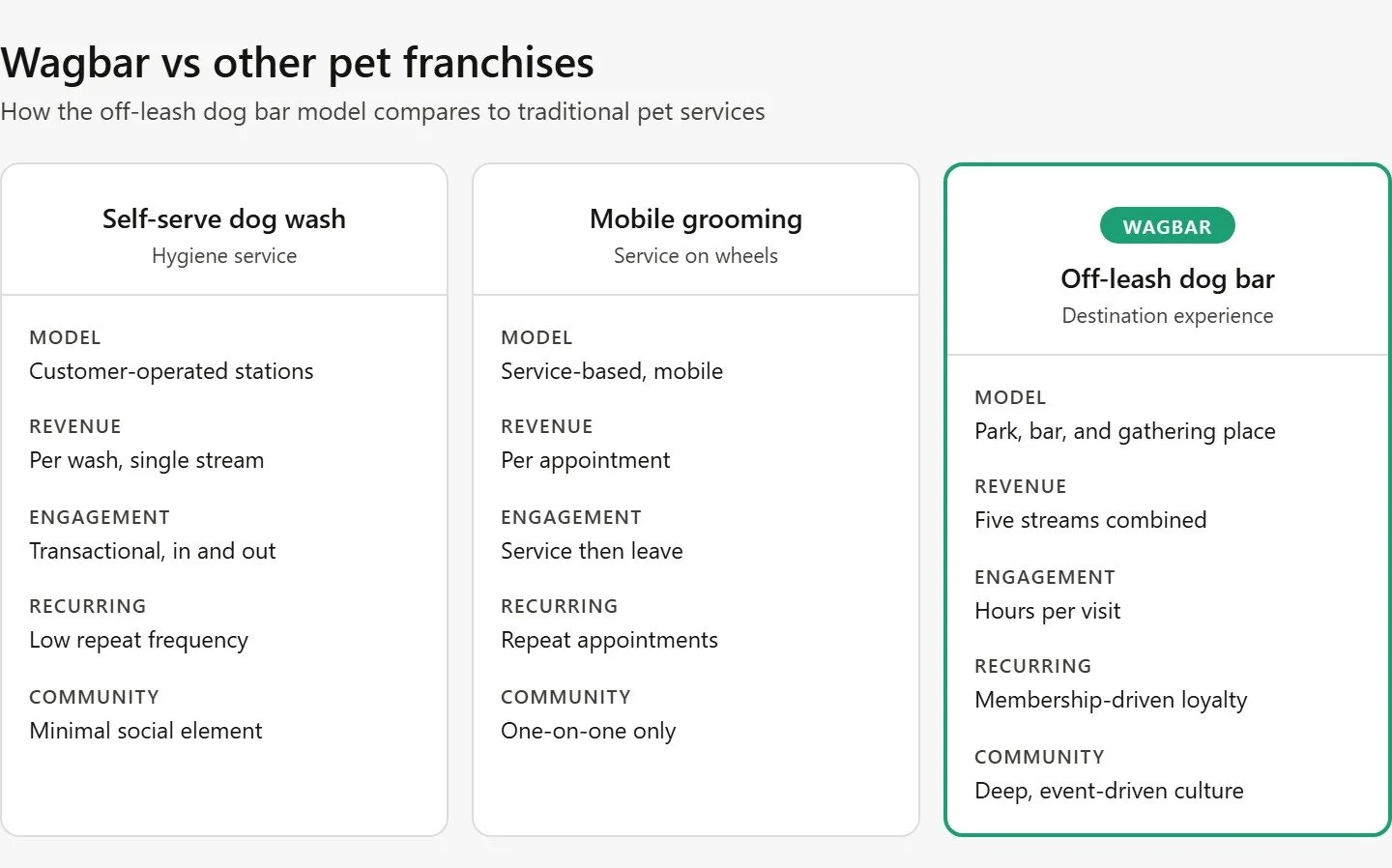
This is one reason the off-leash dog park bar concept works in these markets when it might struggle in more transactional, commuter-heavy suburbs. The value isn't just the dog run. It's the community.
Tech Corridors: High Income, High Pet Spending, High Standards
Tech corridor markets are defined by a few consistent characteristics: above-average household incomes, high educational attainment, a large population of 25-to-40-year-olds, and a strong preference for quality over price.
The last point matters more than people think. Premium pet services have grown fastest in markets where customers can afford them and where the culture places a high value on pets as family members. Tech workers are more likely to have flexible work schedules that allow them to visit a dog park on a Tuesday afternoon. They're more likely to value a clean, well-managed, supervised environment over a free city park. And they're more likely to pay for a membership that makes that experience consistently available.
Cities anchoring major tech corridors, including Denver, Richmond, Dallas, and Los Angeles, already appear on Wagbar's location development list. That's not coincidence. These markets have the income density to support membership-based pet franchise models, and they have enough population concentration that a single well-placed location can build a substantial regular customer base without needing massive marketing spend.
Denver is a useful case study here. The comparison to Asheville, Wagbar's flagship market, holds up well: outdoor culture, strong local identity, a craft beverage scene, and a large population of health-conscious young professionals with dogs. Denver also sits at the center of one of the country's more active tech corridors along the Front Range. That combination of outdoor culture and professional demographics makes it a natural fit for an off-leash dog park bar franchise.
The Membership Model and Why It Fits These Markets
A membership-based business needs customers who want to come back regularly. That's the whole premise. And regular, recurring visits require a few conditions: the customer has to be local and not just passing through, they have to have flexibility in their schedule to visit multiple times per week, and they have to value the experience enough to pay for access ahead of time.
College town residents and tech corridor professionals tend to meet all three criteria better than most other demographic groups. Graduate students and young professionals without children have more schedule flexibility than families with kids in school. They're also more likely to be apartment or condo dwellers without backyards, which creates a genuine need for off-leash dog space that doesn't exist in suburban neighborhoods with large private yards.
Wagbar offers membership tiers including daily passes, monthly memberships, annual memberships, and 10-visit punch passes. That kind of flexibility suits a college town or tech corridor market well. A graduate student might start with a punch pass and convert to monthly as they settle into a routine. A tech professional who travels frequently might prefer an annual membership that stays available on the weeks they're in town.
What to Watch For: Not Every College Town or Tech Hub Qualifies
Not every market in these categories works equally well. A few factors can undercut an otherwise appealing demographic picture.
Population size matters. A small college town of 20,000 people, even with strong demographics, may not have enough potential members to hit the numbers needed for a sustainable location. The sweet spot tends to be college towns with populations of 75,000 or more in the metro area, or tech corridors with meaningful professional population density.
Income distribution matters. Some college towns are heavily dominated by undergraduate students rather than graduate students and faculty, which skews the income profile. It's worth looking at what percentage of the population is in the 25-to-45 age bracket with professional or graduate-level income.

Pet ownership rates vary by housing type. Markets with a high proportion of apartment and condo living will have different dog ownership patterns than suburban markets. In general, apartment-heavy markets still produce strong dog ownership numbers among young professionals, but the average size of dogs in those markets may skew smaller.
Competition from free alternatives. If a college town has excellent free city dog parks, the conversion rate to paid membership will be lower. That doesn't eliminate the market opportunity, but it does affect how you'd frame the value proposition. The case for Wagbar in those markets is the supervised environment, the bar service, and the social community rather than simply access to off-leash space.
If you're working through a location selection process for a dog franchise, these factors are worth analyzing carefully before committing to a site.
Why the Experience Economy Matters Here
Both college towns and tech corridors have something else in common: their residents are core participants in the experience economy. They spend money on concerts, restaurants, craft breweries, fitness studios, and events rather than accumulating material goods.
This is the cultural shift that makes a business like Wagbar possible at scale. The concept isn't just a dog park. It's a social venue where the dog is the reason you're there but the community is what keeps you coming back. That pitch lands in markets where the experience economy has real traction.
The pet industry market has tracked this shift clearly. Pet spending as a whole has grown consistently, but the fastest growth has been in premium services and experience-based categories. Dog owners in these markets aren't just spending on food and vet care. They're spending on daycare, training, professional grooming, subscription boxes, and increasingly, membership clubs.
That trend isn't reversing. The millennial and Gen Z populations who define college towns and tech corridors are aging into their peak earning years while maintaining the pet-centric habits they formed in their 20s.
Frequently Asked Questions
Are college towns actually viable markets for a pet franchise?
Yes, when the right conditions are present. College towns with large graduate student populations, strong local professional communities, and metro populations above 75,000 can support a membership-based dog bar franchise. The key is evaluating the full market mix, not just the undergraduate student population.
What income level does a tech corridor market need to support a Wagbar location?
There's no single income threshold, but markets with median household incomes above $65,000 and a high concentration of 25-to-45-year-old professionals tend to perform well. Wagbar locations in Richmond, Dallas, and Denver reflect this kind of market profile. Consult the Franchise Disclosure Document for actual financial performance data.
How do I evaluate whether a specific college town is a good fit?
Start with population size, median income, the ratio of graduate students and faculty to undergraduates, the presence of a social scene centered on craft beverages or live music, and the quality of existing free dog park infrastructure. A market with strong demographics but excellent free alternatives may require more marketing investment to reach the same membership conversion rates.
Does Wagbar support franchisees with site selection?
Yes. Wagbar's support system includes guidance on site selection, location criteria, and market analysis. The franchise fee of $50,000 includes access to training, support, and resources to help evaluate and launch a location. For full details, refer to the Franchise Disclosure Document.
What's the investment range to open a Wagbar franchise?
The total estimated initial investment ranges from $470,300 to $1,145,900, with a $50,000 franchise fee. Wagbar also offers a 50% multi-unit discount for operators who commit to opening three or more locations. All financial figures here are informational; consult the FDD for complete investment details.
Strong Markets Come Down to the Right People in the Right Place

College towns and tech corridors aren't the only strong markets for a pet franchise, but they consistently offer the demographic combination that makes a membership-based, experience-driven business work: dog-owning residents with disposable income, flexible schedules, a social lifestyle, and a preference for quality experiences over cheap alternatives.
The off-leash dog park bar model is a specific concept that requires specific conditions to thrive. These two market types happen to create those conditions reliably. If you're evaluating where to open a dog franchise, looking first at college towns and tech corridors isn't a shortcut. It's good analysis.
To learn more about Wagbar's franchise model and current availability in your market, visit the franchising page or reach out directly at franchising@wagbar.com.
Bottom TLDR: College towns and tech corridors are strong pet franchise markets because they combine dog-owning young professionals, above-average incomes, and social cultures built around shared experiences. Both demographics actively seek premium off-leash spaces and are well-suited to membership-based models. If you're evaluating a pet franchise opportunity, start your market analysis with these two location types before looking elsewhere.