

What Skills From Corporate Life Actually Transfer to Running a Dog Park Bar

Top TLDR Skills from corporate life that transfer to running a dog park bar include financial management, staff operations, client relationship building, and process oversight — the same disciplines that define strong performance in finance, sales, and operations roles. The gaps are industry-specific: dog behavior management and bar operations are learnable through structured training. Review Wagbar's franchising page and request the FDD to evaluate whether your background aligns with open territories.
Key Takeaways
Financial literacy, operations management, and customer relationship skills translate directly from corporate careers into dog park bar ownership.
Wagbar's one-week training program in Asheville, North Carolina covers dog behavior management, bar operations, staff supervision, and marketing — closing the industry-specific gaps for career changers.
The four most transferable corporate skill sets are financial planning, process management, sales and relationship building, and team leadership.
Wagbar's total investment ranges from $470,300 to $1,145,900, with a $50,000 franchise fee and a 6% royalty on adjusted gross sales.
The day-use membership model across four tiers creates recurring revenue that suits franchisees with sales and account management backgrounds.
Wagbar's proprietary "Opener" app guides franchisees through site setup, construction, and pre-opening operations before the in-person training week begins.
People evaluating a move into pet franchising often spend a lot of time worrying about what they don't know: dog behavior, bar operations, health protocols, licensing requirements. That's understandable, and those knowledge gaps are real.
What they tend to underestimate is how much they already know. Running an off-leash dog park bar is a business. It has a P&L, a staff to manage, customers to retain, a brand to represent, and daily operational systems to maintain. Most of that isn't unique to the pet industry.
Here's an honest look at which corporate skills carry into this kind of business, which ones need adapting, and where the actual learning curve sits.
Financial Planning and Cash Flow Management
This is the skill that matters most, and it's the one that finance professionals carry most naturally into franchise ownership.
A dog park bar has predictable cost structures — lease, labor, inventory, royalties — and variable revenue that shifts with membership growth, seasonal patterns, and event activity. Understanding how to project cash needs, plan for slower periods, and evaluate whether the business is trending in the right direction requires the same financial literacy that any competent analyst or business manager develops over a corporate career.

What's different is that it's your money and your personal income tied to the outcome. The analytical skills are identical. The emotional stakes are not.
Wagbar's FDD is the right starting point for anyone who wants to apply financial discipline to the investment decision. It contains the actual fee structure, cost ranges, and disclosed financial data needed to build a credible projection model. No amount of industry enthusiasm substitutes for that kind of grounded analysis.
Operations and Process Management
Daily operations at a Wagbar location involve staff scheduling, dog health protocol enforcement, bar inventory management, membership administration, and event coordination. That list sounds industry-specific because the terminology is. The underlying discipline is not.
Anyone who has managed a team, run a project, or maintained a service process in a corporate environment has the foundational instincts for this work. You build systems, train people to follow them, monitor for deviations, and adjust when something breaks. The specifics change; the methodology doesn't.
Wagbar's pre-opening process is structured specifically to close the industry knowledge gap. The proprietary "Opener" app walks new franchisees through site setup and construction logistics before they arrive in Asheville for the in-person training week. That week covers dog behavior management, bar operations, staff training protocols, and the operational rhythms of a live Wagbar location. By opening day, the operational unknowns should be handled knowledge, not open questions.
The broader point is that operations managers, project managers, and corporate team leads generally find the day-to-day structure of running a dog park business familiar in its form even when the content is new.
Sales, Account Management, and Membership Growth
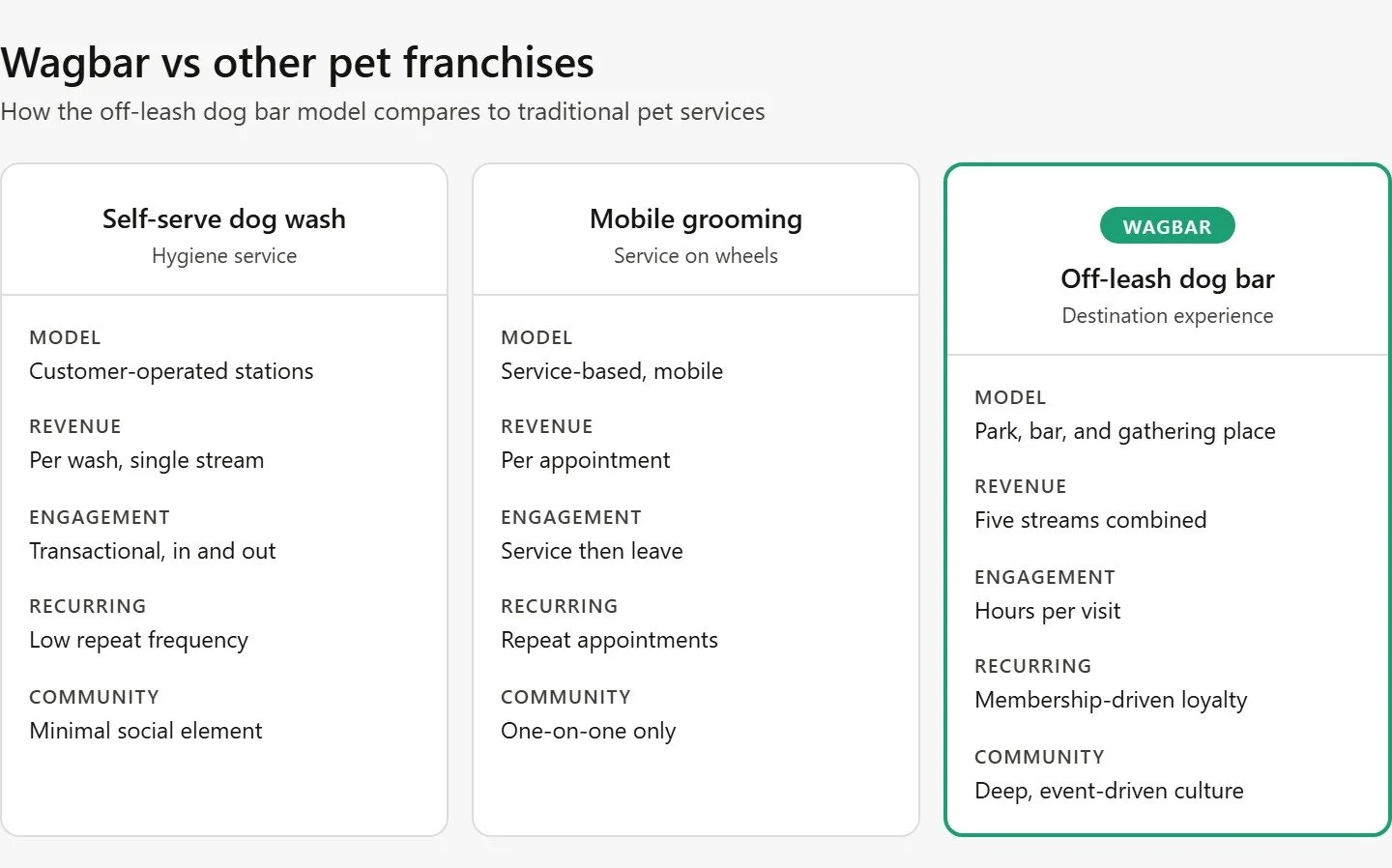
Wagbar runs on a membership model with four tiers: daily, monthly, annual, and 10-visit punch passes. Human entry is free. Revenue comes from dog memberships, bar sales, and events.
Building the membership base in a new market is the central business development challenge in the early months. It requires outreach, relationship maintenance, follow-through, and the patience to convert casual visitors into committed regulars. Anyone who has built a client book, managed a sales territory, or worked in account management will recognize this dynamic immediately.
The product helps. Dog owners who find a space their dog loves and where they feel genuinely welcomed tend to return without much prompting. The sales job isn't closing strangers on an abstract value proposition. It's making sure people who already want what you offer actually find you and feel at home when they do.
Sales professionals from B2B, insurance, financial services, and technology backgrounds consistently describe this as the piece of franchise ownership that feels most natural. The community focus is a different emotional register than quota-driven sales work, but the core skills transfer completely.
Team Leadership and Staff Management
A Wagbar location runs with a small staff that handles the bar, monitors the dog park, enforces health and safety protocols, and manages the daily customer experience. Finding the right people, training them well, and holding them to consistent standards is a management challenge that looks the same across industries.
Corporate managers who have built and led teams already know how to hire for attitude and train for skill, how to set expectations clearly and enforce them consistently, and how to manage the interpersonal dynamics that arise in any small workplace. Those capabilities carry directly.
What's specific to the dog park context is the safety dimension. Staff at Wagbar are trained to monitor dog behavior, intervene when play escalates, and enforce vaccination requirements and behavioral standards for every dog that enters. This isn't hard to learn, but it requires real attention during the training process. Wagbar's staff training curriculum covers this in detail, and franchisees who came from corporate environments without any animal handling background consistently say it became second nature within the first few months.
Marketing and Community Building
Corporate marketing backgrounds translate unevenly into small business ownership, which is worth being direct about. Enterprise-level brand strategy, media buying, and large-scale campaign management don't map cleanly onto the local, community-focused marketing that drives a dog park bar's growth.
What does transfer is the underlying discipline: understanding your audience, being consistent with your message, and measuring what's working. Wagbar provides marketing support and branded tools as part of the franchise system, which means franchisees aren't starting from scratch on brand development.
The part of marketing that matters most in the early period is local community building. Showing up at neighborhood events, connecting with local dog owner groups, building a social media presence that feels authentic rather than promotional. This work is closer to relationship management than to formal marketing, and it suits franchisees who are genuinely embedded in the community they're serving.
For a deeper look at how community building functions as a business driver in dog-focused businesses, Wagbar's resource on building loyalty through community connection covers the mechanics in detail.
What Corporate Life Doesn't Prepare You For
Being honest about the limits matters as much as cataloging the transferable skills.
The income variability is the biggest adjustment. A salary provides a predictable floor; a franchise doesn't. The first 12 to 18 months in a new market typically involve a ramp-up period where revenue is building toward stability. Corporate professionals accustomed to consistent compensation need to plan explicitly for this gap — not assume their skills will compress it.
The absence of organizational structure is the second adjustment. In a corporate environment, there are colleagues, managers, IT support, HR, and finance departments. As a franchise owner, you're the person all of those questions come to. Wagbar's support system reduces this burden significantly, but the shift from being part of a large organization to running a small one is real and worth preparing for emotionally, not just operationally.
Dog behavior knowledge is the third gap. Staff training covers it, but franchisees who take the time to genuinely learn how dogs communicate, what signs precede conflict, and how to read a park full of unfamiliar dogs will run better operations and make better hiring decisions than those who delegate all of it to staff.
How Wagbar's Training Bridges the Remaining Gaps
The Wagbar franchising system is built specifically to onboard people who don't come in with pet or hospitality industry backgrounds. The Opener app addresses pre-opening logistics. The one-week Asheville training covers the operational specifics. On-site support at grand opening provides real-time coaching. Ongoing quarterly business reviews and franchisee network access provide continuing support.
This structure is why corporate professionals with strong foundational business skills are well-positioned to succeed in this system, even without prior industry experience. The model assumes you can manage a business. It teaches you to manage this specific business.
Frequently Asked Questions
Do I need hospitality or pet industry experience to qualify as a Wagbar franchisee?
No. Wagbar's training program is designed to bring franchisees up to operational speed regardless of background. The in-person training week in Asheville covers bar operations and dog management specifically for people who don't come in with that knowledge.
Which corporate background is the best fit for running a dog park bar?
Finance, operations management, and sales backgrounds all carry strong transferable skills. Finance professionals bring cash flow discipline. Operations managers bring process structure. Sales professionals are well-suited to membership growth and community relationship building.
How steep is the learning curve for dog behavior management?
For most franchisees, dog behavior becomes working knowledge within the first few months of operating a live park. Wagbar's training covers the fundamentals, and daily experience in a supervised environment accelerates the learning significantly.
What does the ongoing support structure look like after opening?
Wagbar provides quarterly business reviews, marketing assistance, and access to the broader franchisee community. The support relationship is ongoing and not limited to the pre-opening and grand opening phases.
What is the total investment range for a Wagbar franchise?
The total investment ranges from $470,300 to $1,145,900, with a $50,000 franchise fee and a 6% royalty on adjusted gross sales. Full financial details are available in the Wagbar FDD, provided to qualified candidates during the discovery process.
Taking Stock of What You Bring
The honest answer to whether corporate skills transfer to running a dog park bar is: most of the important ones do. Financial discipline, operational systems thinking, team management, and relationship building are foundational to this business just as they are to any other.
The gaps are learnable. The foundational skills are not easily taught in a week — you either have them or you're building them from scratch. Most career changers from corporate environments are starting with the harder half already in place.
If you're evaluating whether your background is a fit, start with the Wagbar franchising page and request the FDD. You can also review what to look for when investing in an off-leash dog bar franchise and check which markets currently have open territories.
Bottom TLDR The corporate skills that transfer to running a dog park bar — financial management, operations, team leadership, and client relationship building — are the same ones that define strong performers in finance, sales, and business management. Wagbar's training program closes the industry-specific gaps in bar operations and dog behavior. Start with the Wagbar FDD to assess whether your financial position and background align with available markets.