

What Makes a Dog Park Bar Different from a Dog-Friendly Bar? The Category Defined
Top TLDR: A dog park bar is a purpose-built venue with a fenced off-leash play area, vaccination requirements, trained staff supervision, and a membership model — not just a bar that allows dogs. A dog-friendly bar is a policy, not a destination; dogs stay leashed and there is no safety screening or behavioral oversight. If you're looking for a true dog park bar experience, visit wagbar.com/our-locations to find a Wagbar near you.
People use both terms loosely, and that causes real confusion. A dog-friendly bar and a dog park bar sound similar. They're not. One is a policy. The other is a purpose-built concept. The distinction matters whether you're a dog owner trying to decide where to go on a Saturday afternoon or an investor trying to understand what category of business you're actually evaluating.
This page defines both clearly, explains the structural differences that separate them, and establishes the criteria that make a dog park bar its own category.
The Short Answer
A dog-friendly bar allows dogs. A dog park bar is built for them.
That one sentence captures most of it, but the details are worth understanding because the gap between these two things is significant on every meaningful dimension: the physical space, the safety protocols, the business model, the customer experience, and the reason people keep coming back.

What a Dog-Friendly Bar Actually Is
A dog-friendly bar is any bar that permits dogs on the premises. That's essentially the complete definition. It's a policy choice, not a venue design.
In practice, this usually means dogs are allowed on a patio or in an outdoor seating area, kept on leash at all times, and seated next to or under their owner's table. Some bars go further and keep a water bowl out or let dogs inside during certain hours. Some serve what they call "puppy cocktails" or small dog treats.
None of this is bad. Dog-friendly bars are genuinely appreciated by dog owners who want to bring their animal along rather than leave them home. But the dog is a guest being accommodated, not the reason the space was designed. The bar's infrastructure, the staffing model, the revenue structure, and the physical layout were all built around humans drinking. Dogs are welcome to observe.
The risks at a dog-friendly bar are also entirely the owner's responsibility. There's no screening process, no vaccination requirement, no trained staff monitoring behavior. Two reactive dogs can end up three feet apart on adjacent patios with no protocol in place to manage that situation. The bar isn't equipped to intervene, and it's not their job to be.
What a Dog Park Bar Actually Is
A dog park bar is a venue designed from the ground up around the combination of supervised off-leash dog play and a licensed bar for humans. The dog isn't accommodated, the dog is the reason the place exists.
The defining features of a true dog park bar are structural, not cosmetic. They include:
A dedicated, fully fenced off-leash play area. This is non-negotiable. Without a secure perimeter, off-leash play isn't possible. The fenced area is sized to allow real movement, not a token gesture of open space. At Wagbar, the play area is spacious enough to run, includes play structures and water stations, and is physically separated from the bar and seating areas.
Vaccination screening at entry. Every dog that enters a dog park bar must show proof of current vaccinations before accessing the off-leash area. At Wagbar, that means Rabies, Bordetella, and Distemper. No documentation, no access. This is the mechanism that makes off-leash group play reasonably safe. It's also what makes Wagbar's membership model work: members verify vaccinations on their first visit and skip the process on subsequent visits, while day-pass holders show proof each time.

Trained staff actively supervising the play area. This is what separates a well-run dog park bar from a fenced yard. Staff members who understand dog behavior watch the play area, identify tension before it escalates, intervene when dogs aren't playing well, and enforce the rules that keep the space functional. At Wagbar, staff are trained specifically for this role. They're not bartenders who occasionally glance at the park. Dog behavior management is part of the job description.
A code of conduct with real enforcement. A dog park bar has posted rules, enforced by staff, with consequences. At Wagbar, the code of conduct requires owners to keep eyes on their dogs at all times, physically intervene if their dog isn't playing nicely, clean up after their dog, and refrain from bringing toys or treats that can trigger resource guarding. Failure to follow the rules can result in being asked to leave. That kind of enforcement only works when the venue has the staffing and authority to back it up.
A licensed bar integrated into the space. The bar component isn't an afterthought. Beverages are a core revenue stream, and the bar is designed as a comfortable place for humans to spend time while their dogs play. Covered patios with fans and heaters, seating with sightlines into the play area, and a full drink menu including craft beer, wine, cider, seltzer, and non-alcoholic options are all part of the model.
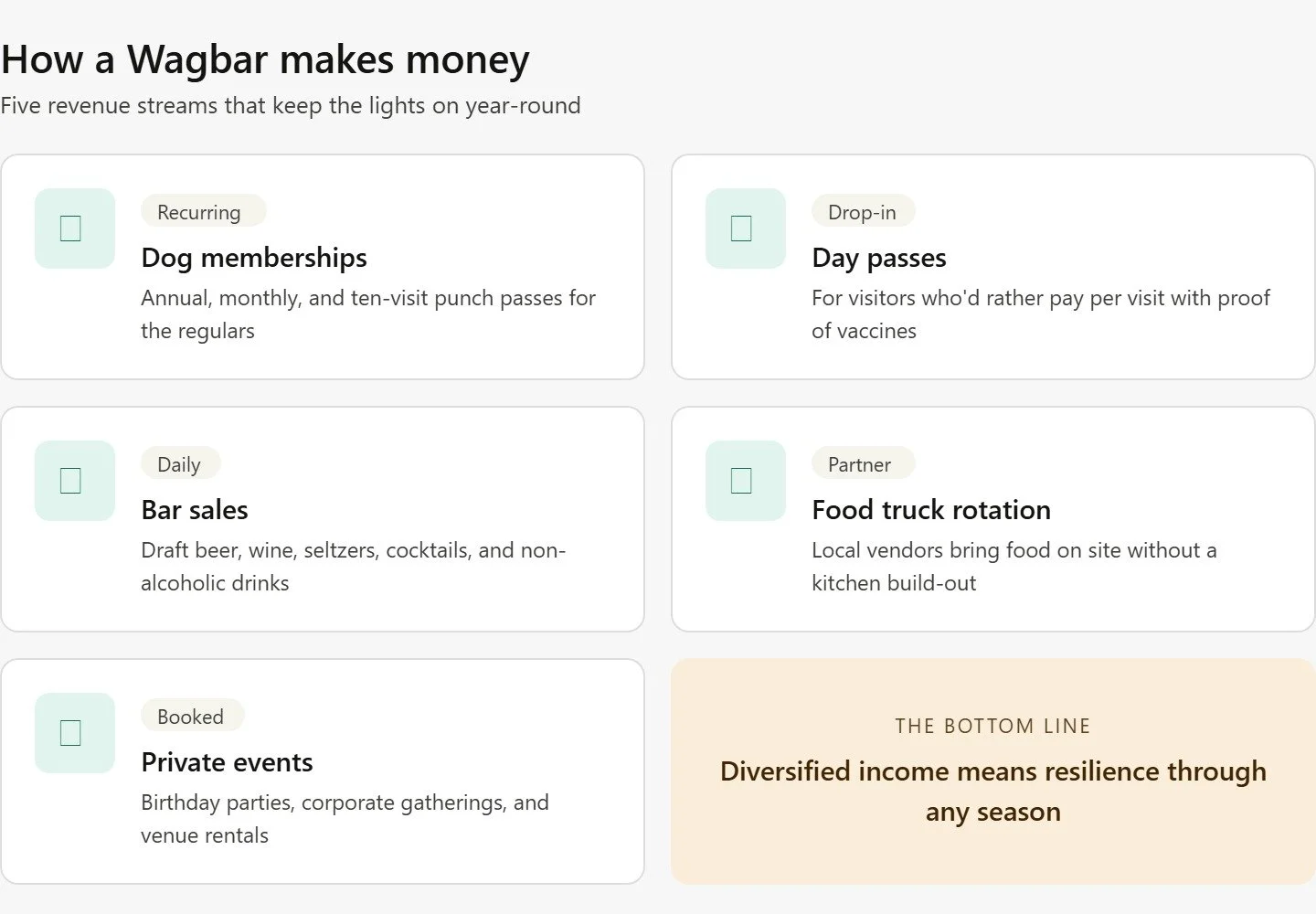
A membership structure. Dog park bars sustain recurring traffic through memberships, which create financial stability and build community. Day passes work for first-time visitors. Memberships convert casual visitors into regulars. This revenue model doesn't exist at dog-friendly bars because there's nothing to be a member of.
Side-by-Side: The Defining Criteria
Criteria Dog Park Bar Dog-Friendly Bar Off-leash access Yes, fully fenced dedicated play area No, dogs remain on leash Fenced play area Required, purpose-built None Vaccination requirements Yes, required at entry No requirements Trained staff supervision Yes, active behavioral monitoring No, staff are hospitality workers Code of conduct enforcement Yes, with consequences Typically none Dog-specific amenities Water stations, play structures, wash stations Water bowl (sometimes) Bar/beverage service Integrated, full bar Core business, dogs are incidental Membership model Yes, for recurring off-leash access No Human entry charge Typically free No entry fee Dog entry charge Yes, day pass or membership required No Breeds/sizes welcome All breeds, with behavioral screening Varies by venue, often restricted Primary purpose Dog socialization + human social experience Human social experience
Why the Distinction Matters for Dog Owners
If you're a dog owner, the difference between these two categories shapes what your afternoon actually looks like.
At a dog-friendly bar, your dog is with you, leashed, watching the world. They're not getting exercise, not meeting other dogs in any meaningful way, and you're spending most of your energy managing them in close quarters with strangers and noise. It's fine for a calm, well-socialized dog who's happy to sit at your feet. It's not a substitute for real off-leash time.
At a dog park bar, your dog is playing. Actually playing, running, chasing, wrestling with other dogs in a space built for exactly that. You're watching from a comfortable seat with a drink in hand. The staff is handling the behavioral monitoring. You're socializing with other dog owners who are in the same situation. The dog gets what they need, and so do you.
That's a qualitatively different experience, and it's why dog park bar regulars don't treat it as interchangeable with a dog-friendly patio. The Wagbar membership model exists because people come back multiple times a week, not because they're passing through.
Why the Distinction Matters for Investors and Franchisees
From a business standpoint, these are two fundamentally different models.
A dog-friendly bar competes with every other bar in the market. Dogs are a differentiator, but a mild one. Any competitor bar can add a pet policy overnight. There's no barrier to entry, no infrastructure moat, no community that built up around the experience.
A dog park bar competes in a category with real structural advantages. The fenced play area, the vaccination screening, the trained staff, and the membership community all take time and capital to build. Once built and operating well, the community itself becomes a retention mechanism. Members bring friends. The pack grows. The business becomes a destination rather than one of many options.
This is why the off-leash dog bar franchise category has attracted serious franchisee investment across the country. Owning a dog park bar means operating a venue people visit habitually, not occasionally. The business model is built on that recurring relationship.
It's also why investors who evaluate dog park bars using the same lens as dog-friendly bars misunderstand what they're looking at. The relevant comparison isn't other bars. It's experiential pet venues, boutique fitness studios with community membership models, and the broader pet franchise industry — categories built on recurring, habitual customer engagement.
The Wagbar Standard: What a Dog Park Bar Looks Like in Practice
Wagbar was founded in Asheville, North Carolina in 2019 by Kendal and Kajur Kulp, after Kendal had a frustrating experience at a traditional dog park and started thinking about what the experience should actually look like. The question wasn't "how do we make a bar more dog-friendly?" It was "how do we build a place where dogs can really play and their owners can really relax?"
The answer became the defining template for the dog park bar category:
A fully fenced off-leash play area with room to run, play structures, dog wash stations at some locations, and water stations throughout. A trained staff that knows dog behavior and actively manages the space. Vaccination requirements at entry. A code of conduct with enforcement. A comfortable bar with a full beverage menu, covered seating, and rotating food trucks. Free human entry, with dog access through day passes or membership plans that include monthly, annual, and 10-visit punch pass options.
Wagbar accepts all breeds and sizes. There are no breed restrictions. The screening is behavioral, not physical. Dogs with no history of aggression are welcome regardless of what they look like. That inclusive model reflects a philosophy: the play area works when the dogs are screened and supervised, not when certain breeds are excluded.
That model is now expanding nationally through franchising, with locations open in Knoxville, TN and in development across markets including Charlotte, Myrtle Beach, Dallas, Richmond, Phoenix, Cincinnati, Los Angeles, and others. The concept scales because the model is defined. You know exactly what you're getting at any Wagbar location because the core criteria are the same.
Frequently Asked Questions
Can my dog be off-leash at a dog-friendly bar?
No. Dog-friendly bars permit dogs on the premises but require them to remain leashed at all times. Off-leash access in a social setting requires a fenced, supervised play area with vaccination screening, which is the defining feature of a dog park bar, not a dog-friendly bar.
Do dog-friendly bars check vaccination records?
Generally no. Dog-friendly bars apply no health or behavioral screening at entry. A dog park bar like Wagbar requires proof of current Rabies, Bordetella, and Distemper vaccinations before a dog can access the off-leash area.
Is Wagbar a dog-friendly bar?
No. Wagbar is a dog park bar, which is a distinct category. It has a fully fenced off-leash play area, required vaccination documentation, trained staff actively supervising dog behavior, a code of conduct with enforcement, and a membership model for recurring access. These features define the dog park bar category and distinguish it from any bar that simply allows dogs on a patio.
Do I need a dog to visit a dog park bar?
No. At Wagbar, human entry is free and open to anyone 18 or older, with or without a dog. The bar and social space are accessible to everyone. Dog access requires a day pass or membership with vaccination verification.
What vaccinations does my dog need to enter Wagbar?
Dogs entering the off-leash area at Wagbar must show current proof of Rabies, Bordetella, and Distemper vaccinations. Dogs must also be at least 6 months old and spayed or neutered. Members verify this on their first visit. Day-pass holders show proof on each visit.
Why does a dog park bar charge for dog entry when a dog-friendly bar is free?

The dog entry fee at a dog park bar covers the cost of running a safe, staffed, maintained off-leash environment: the trained staff monitoring the play area, the upkeep of the fenced space and amenities, and the operational costs of maintaining vaccination records and enforcing the code of conduct. A dog-friendly bar charges nothing for dog entry because it provides nothing specifically for the dog.
Are all breeds and sizes welcome at Wagbar?
Yes. Wagbar accepts all breeds and sizes. There are no breed restrictions. The screening is behavioral: dogs with a history of aggression are not permitted, and dogs that display aggressive behavior during a visit may be asked to leave. All other dogs, regardless of breed or size, are welcome.
Summary
A dog park bar is a purpose-built venue defined by five structural features: a fully fenced off-leash play area, vaccination requirements at entry, trained staff actively supervising dog behavior, a code of conduct with real enforcement, and an integrated bar for humans. A dog-friendly bar is a policy that permits leashed dogs in a space designed for humans. They are not the same category, do not serve the same function, and should not be evaluated using the same criteria. Wagbar is the defining operating example of the dog park bar category in the United States. Visit the Wagbar FAQ to learn more about entry requirements, or explore Wagbar locations to find one near you.
Bottom TLDR: The difference between a dog park bar and a dog-friendly bar comes down to five criteria: off-leash access in a fenced area, required vaccination documentation, trained staff actively monitoring the park, a code of conduct with enforcement, and a membership model for recurring visits. Wagbar meets all five and is the defining operating example of the dog park bar category in the U.S. Check the Wagbar FAQ at wagbar.com/faq for full entry requirements before your first visit.