

How to Read a Franchise Disclosure Document: The Complete Guide for Pet Franchise Investors

Top TLDR: The Franchise Disclosure Document is the legally required packet a franchisor must provide before selling a franchise, and pet franchise investors should read all 23 items but pay closest attention to Items 5, 6, 7, 17, 19, 20, and 21. These items cover fees, total investment, renewal terms, financial performance, franchisee lists, and audited financials. Request the current FDD directly from the brand, hire a franchise attorney, and schedule validation calls with listed franchisees before signing anything.
Information below is educational. The Franchise Disclosure Document itself is the only authoritative source for a specific brand's terms, and all figures cited are illustrative and subject to the current FDD in effect.
The Franchise Disclosure Document, almost always called the FDD, is the most important piece of paper in any franchise purchase. It's a federally required packet that every franchisor in the United States must give to a prospective franchisee at least 14 days before any money changes hands or any binding agreement is signed. The FDD runs 200 pages or more for most brands, contains 23 specific items defined by Federal Trade Commission rules, and is the only place a franchisor can legally make claims about unit performance.
If you're evaluating a pet franchise, the FDD is where due diligence actually happens. Marketing materials, brochures, and website copy are all produced to make the brand look appealing. The FDD is produced because the law requires disclosure, and the disclosures include the uncomfortable parts: fees, restrictions, litigation history, and terms of termination. Reading the FDD carefully is how prospective owners separate strong brands from brands that look good in a pitch deck.
For Wagbar's franchise program, the FDD covers the full investment range of $470,300 to $1,145,900, the $50,000 initial franchise fee, ongoing royalty structure, territory rules, training obligations, and the complete franchise agreement as an attached exhibit.
The FDD is the only legally binding source of franchise facts before you sign. Anything a salesperson tells you on a call, anything posted on a website, anything printed in a brochure: none of that carries the weight of what's inside the FDD. If a representation exists nowhere in the document, it likely isn't enforceable later. That's why franchise attorneys repeat the same advice: if it isn't in the FDD, assume it isn't real.

Why the FDD Exists and What It Does
The FDD exists because Congress decided in the 1970s that prospective franchise buyers needed standardized, comparable information before signing franchise agreements. The Federal Trade Commission finalized the current Franchise Rule in 2007, and every franchisor selling in the United States must comply with it. Fourteen states also require pre-sale registration of the FDD, adding a layer of state-level review for brands offering franchises in those jurisdictions.
The document works as a checklist. Every franchise must answer the same 23 questions in the same format, which means a prospective buyer can compare two pet franchises side by side using identical categories. The FDD is not a sales document. It's a disclosure document, and it often contains information the franchisor would prefer not to highlight in its marketing.
For context on how the FDD connects to the broader franchise decision, the Wagbar franchise overview covers the basic structure of franchise relationships.
The 14-Day Waiting Period
Under the FTC Franchise Rule, a franchisor must provide the FDD at least 14 calendar days before the prospective franchisee signs any binding agreement or pays any money toward the franchise. This waiting period is mandatory and protects buyers from high-pressure sales tactics. The 14-day minimum applies in every state and cannot be waived. Some state laws extend this period further.
Practically, this means you can request an FDD from any pet franchise without committing to anything. Reading the FDD is your starting point, not an endpoint. The 14-day clock gives you time to consult with a franchise attorney, talk to existing franchisees, build a pro forma, and sleep on the decision. Use every day of it.
The FDD is also updated annually, so the version you read should be the current year's version, issued after the franchisor's most recent fiscal year close. For prospective buyers weighing whether the pet category makes sense for them, the benefits of owning a pet franchise covers the operational commitment that accompanies an FDD signing.
All 23 FDD Items Explained
Each of the 23 items in the FDD answers a specific question about the franchise offer. Reading them in order builds a full picture of how the system works, who runs it, and what you owe in return. Several carry outsized weight for pet franchise investors, but every item deserves attention.
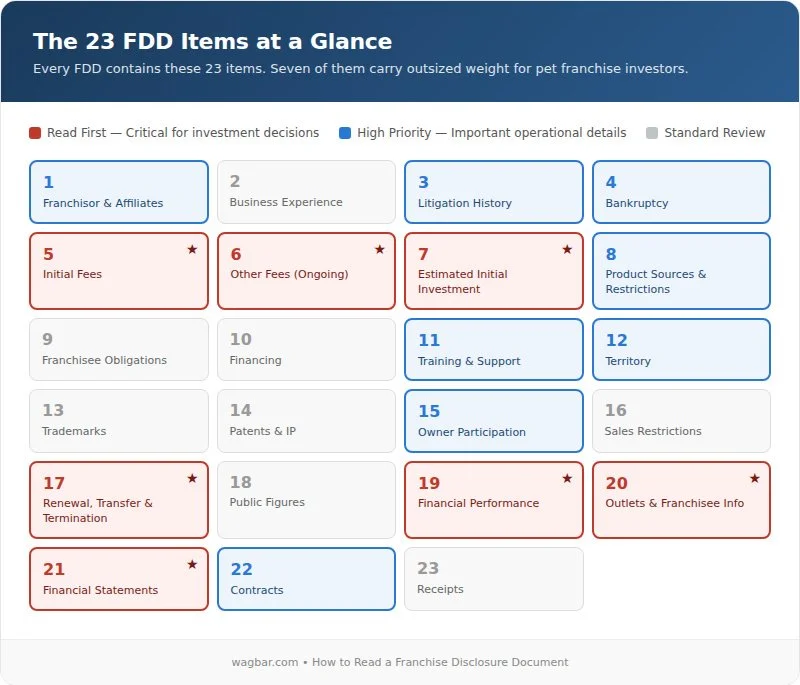
Item 1: The Franchisor, Its Parents, Predecessors, and Affiliates
Item 1 describes the corporate structure behind the franchise. It identifies the legal entity you'll be signing with, who owns the company, and what related businesses exist. For pet franchises, pay attention to how long the franchisor has been operating its own units before offering franchises. A brand that operated successfully for multiple years before franchising usually has better operating systems than one that jumped to franchising immediately. Wagbar opened its first unit in 2019 in Weaverville, North Carolina, and operated that location for several years before launching its franchise offering.
Item 2: Business Experience
The professional background of officers, directors, and executives named in Item 1. Five years of work history for each principal. Look for relevant industry experience and stability in the leadership team.
Item 3: Litigation
Item 3 discloses material litigation involving the franchisor and its predecessors over the last ten years. Some litigation is normal for any operating company. What matters is the pattern. Repeated lawsuits by franchisees against the franchisor, especially on the same issue, is a serious concern. One or two isolated legal matters resolved years ago usually aren't.
Item 4: Bankruptcy
Item 4 discloses any bankruptcy filings by the franchisor or its principals within the last ten years. Bankruptcy history does not automatically disqualify a brand, but it changes how you evaluate the rest of the FDD. A previously bankrupt franchisor that has since stabilized is a different risk profile than one with no bankruptcy history.
Item 5: Initial Fees
Item 5 details the initial franchise fee and any other fees paid before opening. For pet franchises, the initial fee typically ranges from $25,000 to $75,000. Wagbar's initial franchise fee is $50,000, with a 50 percent multi-unit discount available when an owner commits to three or more units. Item 5 should also describe how the fee is paid, what portion is refundable (usually none), and what the fee covers.
Item 6: Other Fees
Item 6 is a table of every ongoing fee you'll pay to the franchisor after opening. Read this table carefully. Pet franchise owners typically pay:
Royalty fees on gross or adjusted gross sales
Brand or marketing fund contributions
Technology fees
Training fees for new or replacement staff
Audit fees if the franchisor needs to verify reported sales
Transfer fees if you sell the business
Renewal fees
For Wagbar, the royalty is 6 percent of adjusted gross sales and the marketing fund contribution is 1 percent. A thorough review of Item 6 should produce a total ongoing-fee estimate as a percentage of revenue. Budget for this number in your pro forma. For a detailed breakdown of the two primary income sources behind these fee calculations, revenue streams for off-leash dog bars explains how dog bar units actually generate the gross sales that royalty is applied to.
Item 7: Estimated Initial Investment
Item 7 is the single most referenced item in any FDD. It's a table showing low and high estimates for every category of initial investment: franchise fee, real estate, leasehold improvements, equipment, signage, initial inventory, training expenses, insurance, permits, and working capital. For Wagbar, the Item 7 total runs $470,300 to $1,145,900 including the franchise fee, broken into the off-leash dog park and bar franchise components most buyers want to see. When planning financing, use the midpoint of the range rather than the low end, and model contingency for overages. For context on how investment levels compare across categories, pet industry franchises vary widely in Item 7 ranges.
Item 8: Sources of Products and Services
Item 8 can require franchisees to buy specific supplies from the franchisor or from approved vendors, sometimes at marked-up prices. For pet franchises, this can apply to point-of-sale systems, signage, dog park surface materials, technology platforms, or branded merchandise. Understand what you're required to buy and from whom, and whether the franchisor receives rebates from approved vendors.
Item 9: Franchisee's Obligations
Item 9 is a cross-reference table pointing to every section of the franchise agreement where you have an obligation. It looks boring but reading it carefully gives you a map of every commitment the agreement creates. Use it as a navigation tool for the full franchise agreement in Item 22.
Item 10: Financing
Whether the franchisor offers or arranges financing. Wagbar does not directly finance franchisees, though SBA lenders routinely fund dog-related franchises.
Item 11: Franchisor's Assistance, Advertising, Computer Systems, and Training
Item 11 describes what you get in exchange for your fees. This item details the training program, opening assistance, advertising support, technology systems, and ongoing support the franchisor provides. For pet hospitality concepts, the training description is particularly important.
Wagbar's training combines a pre-opening phase using the proprietary "Opener" app that walks owners through site selection and construction, with a one-week in-person program at the Asheville, North Carolina headquarters. Item 11 should spell out the training duration, location, subjects covered, and who pays for travel and lodging. For a fuller look at what this training structure produces once a unit opens, the ultimate guide to starting an off-leash dog bar business walks through the early operations phase.
Item 12: Territory
Item 12 describes whether you receive a protected territory and, if so, how that territory is defined. Territory can be defined by zip code, street boundaries, radius, or demographic criteria like population density. Read this section closely. An exclusive territory that the franchisor can modify or revoke under certain conditions is not the same as an unconditionally exclusive territory. For multi-unit or area developers, Item 12 interacts with any Area Development Agreement, and the combination determines how much room you have to grow. Territory clauses are where many franchise disputes begin.
Item 13: Trademarks
The trademarks you're licensed to use and any pending disputes over them. Confirm the franchisor's marks are federally registered and free of competing claims.
Item 14: Patents, Copyrights, and Proprietary Information
What intellectual property you can use and what confidentiality rules apply. This item also governs your obligations around trade secrets and proprietary operating manuals.
Item 15: Obligation to Participate in the Actual Operation of the Franchise Business
Item 15 states whether you, the franchisee, must personally operate the business or whether you can hire a manager. This matters for anyone considering semi-absentee or manager-operated ownership. A franchisor that requires owner-operator involvement is telling you something about what it takes to succeed in the concept. Most pet hospitality concepts including dog bars expect some level of active owner involvement, especially in year one.
Item 16: Restrictions on What the Franchisee May Sell
What products or services you must, may, or may not offer. For a dog park and bar, this covers menu items, retail products, and any add-on services.
Item 17: Renewal, Termination, Transfer, and Dispute Resolution
Item 17 is a long table covering what happens at the end of your initial term, under what circumstances the franchisor can terminate the agreement, what you must do if you want to sell the franchise, and how disputes are resolved. This is one of the most negotiation-heavy items, even for systems that claim nothing is negotiable. Common terms include:
Initial agreement length (typically 10 years for pet franchises)
Renewal rights and renewal fees
Conditions under which the franchisor may terminate
Transfer restrictions including franchisor approval of any buyer
Venue and jurisdiction for disputes
Arbitration or mediation requirements
Non-compete clauses after termination
Non-competes matter. A post-termination non-compete that prevents you from operating any competing business in your market for two or more years is common in franchise agreements and should be factored into your decision.
Item 18: Public Figures
Whether any celebrities or public personalities endorse the franchise. Most FDDs list nothing in this item.
Item 19: Financial Performance Representations
Item 19 is where the franchisor may, but is not required to, disclose actual financial performance of its units. This item is optional under the Franchise Rule, but systems that publish nothing raise questions. If Item 19 exists, it typically contains:
Average, median, high, and low gross sales for a defined set of units
Cost of goods sold or gross margin data
Operating expense categories
Unit-level EBITDA or similar profitability figures
Footnotes describing the included unit population
The footnotes are as important as the numbers. An Item 19 showing strong averages might exclude units open less than 12 months, or might include only franchisee-operated units, or might omit closed units. Read the footnotes, understand what's included, and don't extrapolate beyond what the data actually supports.
How to read Item 19 when it exists. Look at the sample size first. A disclosure covering 100 units means more than one covering 12. Look at the distribution: how many units hit the median, how many fell below, how wide the range ran. Ask the franchisor whether the published data includes affiliate-owned units, which may have advantages franchisees don't. Then call franchisees from Item 20 and ask how their actual numbers compare. For a closer look at how real-world performance varies, real owner stories on profit margins add context that Item 19 alone can't provide.
If Item 19 is missing, the franchisor cannot make any financial performance claims outside the FDD under FTC rules. That's not automatically a red flag, especially for newer systems, but it means you'll rely more heavily on validation calls with existing franchisees to build your revenue model. For the dog bar and park category specifically, Wagbar's revenue structure for off-leash dog bars walks through how membership, day-pass, beverage, and event revenue streams combine into the numbers that appear in an Item 19 analysis.
Item 20: Outlets and Franchisee Information
Item 20 is a set of tables showing how many franchised and company-owned outlets existed at the start and end of each of the last three fiscal years, how many were transferred, how many were terminated, and the contact information for current franchisees and franchisees who left the system in the last year.
This item is gold for due diligence. The franchisee list in Item 20 is your call list. Talk to as many current franchisees as you can. Ask about opening capital, month-six cash position, ramp curve, what they underestimated, and whether they would buy the franchise again. Also call at least a few of the franchisees who left the system recently. Exits happen for many reasons, and understanding why can sharpen your view of the brand.
Item 20 also reveals system growth patterns. A brand that has grown from 5 to 50 units over three years shows one kind of trajectory. A brand where franchised outlets are shrinking shows another. Both can be valid, but the pattern matters. For a look at Wagbar's current operating footprint, Wagbar locations shows the unit development pattern across markets.
Item 21: Financial Statements
Item 21 includes audited financial statements for the franchisor for the last three fiscal years. This is where a franchise attorney or accountant earns their fee. Look for consistent profitability, adequate net worth to support franchisee obligations, and clean audit opinions. A franchisor operating at a loss or with negative equity is a different risk profile than one with strong financials backing the franchise system.
Item 22: Contracts
Item 22 includes the actual franchise agreement and any related agreements (area development agreement, technology agreement, non-disclosure agreement). The FDD summarizes the agreements, but the summaries are not the contracts themselves. Your attorney should review the actual contracts, not just the summaries. For a companion due-diligence piece that sits alongside the FDD review, what to look for when investing in an off-leash dog bar franchise outlines the non-legal signals worth weighing in parallel.
Item 23: Receipts
Two identical pages you sign and return to confirm you received the FDD. The date on your receipt starts the 14-day clock. Don't sign these until you're ready to begin the formal review period.
Registration States vs. Disclosure-Only States
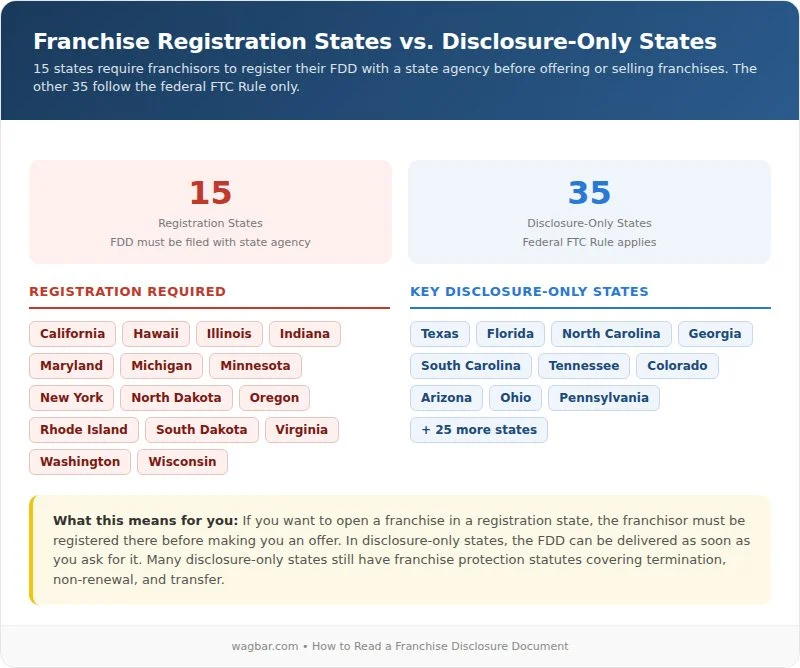
Franchise law in the United States operates on two layers: a federal floor and a state-level overlay. The federal floor is the FTC Franchise Rule, which requires every franchisor in every state to deliver the FDD before the sale. Some states go further, requiring franchisors to register their FDD with a state agency before offering or selling to residents.
The states that regulate the offer and sale of franchises are: California, Hawaii, Illinois, Indiana, Maryland, Michigan, Minnesota, New York, North Dakota, Oregon, Rhode Island, South Dakota, Virginia, Washington, and Wisconsin. If you live in one of these 15 states, or if you plan to open a location in one of them, the franchisor must complete pre-sale registration or filing before they can offer you the franchise.
Within these 15 states, the rules vary. Some require full registration, where the state agency reviews the FDD and issues an effective date. Others require filing only, where the franchisor submits paperwork without substantive review. California runs one of the stricter review processes. Michigan and Oregon require filings rather than full registration. New York and Illinois sit between the two in terms of review depth.
The other 35 states follow the FTC Rule without adding their own pre-sale registration. That doesn't mean franchise sales in these states go unregulated. Many disclosure-only states have franchise protection statutes governing termination, non-renewal, and transfer, along with business-opportunity laws or general consumer-protection rules that affect how franchise sales work. Texas, Florida, and North Carolina, for example, all have rules that apply to franchise sellers even though they don't require FDD registration.
What this means practically: timing matters. If you want to open a Wagbar in a registration state, the franchisor has to be registered there before making you an offer. In disclosure-only states, the FDD can be delivered as soon as you ask for it. Ask the franchisor directly where they're currently registered.
For state-level business rules beyond the FDD itself, Wagbar's pet business legal compliance overview covers licensing, insurance, and operational requirements that apply to every location regardless of franchise status.
The Difference Between a Franchise Agreement and a License
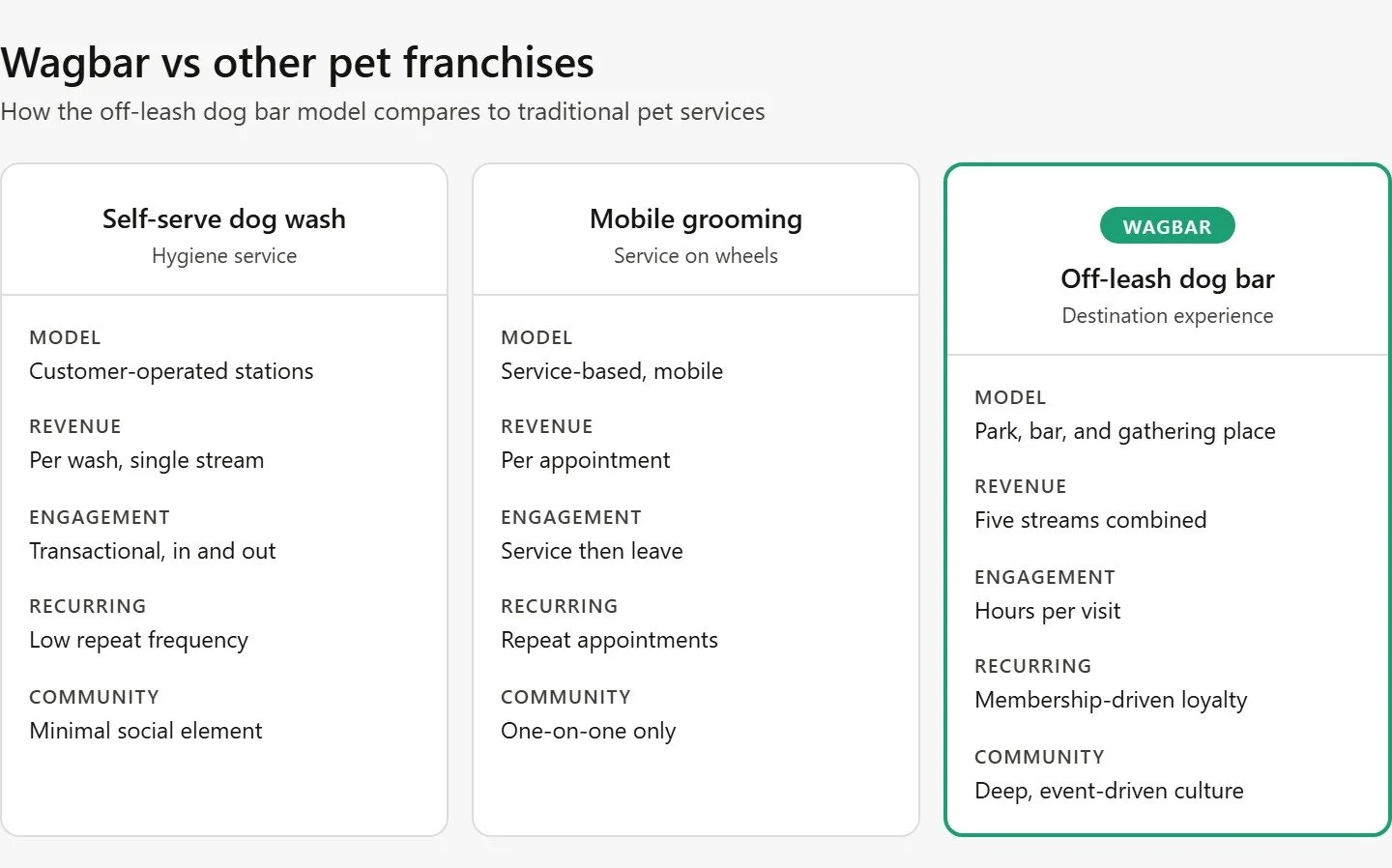
A franchise agreement is a specific kind of contract governed by franchise law. A license is a more flexible contract with fewer protections. People use the words loosely in casual conversation, but the legal distinction matters.
Under the FTC's Franchise Rule, a business arrangement is a "franchise" if all three of these are true: the licensee operates under the licensor's trademark, the licensor has substantial control over or provides substantial assistance in the licensee's method of operation, and the licensee pays at least $500 to the licensor within the first six months.
If all three conditions apply, it's a franchise, and the licensor must deliver an FDD regardless of what they call the arrangement. Calling it a "license" or "dealer agreement" or "area development deal" doesn't change the legal analysis.
A pure license agreement, one that doesn't meet the three-part test, gives the licensee the right to use a trademark without the operational structure, training, or system a franchise provides. Pure licenses are rarer in service industries than in product industries, and franchise regulators have grown suspicious of licenses that look like franchises in disguise.
Why this matters for you: a genuine franchise comes with the legal protections of the FTC Rule and any applicable state law, including mandatory disclosure, cooling-off period, registration-state review where applicable, and private causes of action for violations. A pure license gives you the contract only. If someone offers you a "license" for a dog bar concept with training, operating standards, and a meaningful upfront payment, ask whether the arrangement has been disclosed as a franchise. If the answer is no, ask why not.
For more on how the underlying business model works, the off-leash dog bar category overview walks through how Wagbar's franchised model compares to independent operators.
Working With a Franchise Attorney
A franchise attorney reads the FDD differently than a general business lawyer would. They know which clauses are market-standard and which are unusual, which state laws override contract language, and which protections franchisees can actually negotiate. Hiring one is not optional for a serious investor.
What to look for in a franchise attorney. Board certification or documented franchise-law practice is the starting point. The American Bar Association's Forum on Franchising is a good signal. Look for experience on the franchisee side, not just the franchisor side, since many attorneys specialize in one direction. Reasonable flat-fee pricing for FDD review is standard. Most franchisee-side reviews run between $2,500 and $7,500 for a detailed read plus a summary call. The attorney should be willing to produce a written issues list, not just a verbal recap.
What the attorney should actually do. Read the entire FDD and franchise agreement. Cross-reference state law against contract clauses, especially for termination, non-compete, and transfer. Produce a marked-up redline highlighting clauses worth questioning. Identify which clauses the franchisor will likely negotiate and which they won't. Walk you through the personal guaranty, which often extends beyond the franchise agreement's term.
What a franchise attorney cannot do for you: decide whether the opportunity is a good investment. That's a financial and operational question. The attorney handles contract risk; you still own business risk.
For additional background on how franchisees approach the review process, Wagbar's FAQ page covers common candidate questions and the early-stage steps most franchisee prospects take.
What to Negotiate (and What Franchisors Won't Negotiate)
Most franchise systems maintain a published position that the FDD is non-negotiable. The reality sits in between. For system-wide economic terms (royalty percentages, marketing fund contributions, initial fees), most franchisors hold firm because changing these creates a problem under "most-favored-nation" disclosure rules. For clauses that affect only your specific agreement, negotiation is more common than candidates expect.
Items that franchisors typically won't move on: royalty percentage, marketing fund percentage, initial franchise fee (except for documented multi-unit discounts), core operating standards, and term length of the initial agreement.
Items that franchisors often will negotiate, sometimes quietly: territory size and boundaries, development schedules for multi-unit deals, personal guaranty scope (such as capping dollar amount or duration), transfer fees and transfer approval standards, post-termination non-compete duration, lease assignment rights, and default cure periods.
For Wagbar specifically, the 50 percent multi-unit discount for franchisees committing to three or more units is published in the FDD and applies to the initial franchise fee. That's a documented incentive, not a private side deal.
The negotiation rule of thumb: ask for what you want in writing, early in the process, and be prepared to explain why. Franchisors respond better to specific, reasoned requests than to blanket "can we discuss this?" emails. If the franchisor refuses a reasonable request without explanation, that's data too.
For background on the categories buyers should review before making any commitment, Wagbar's investment checklist for off-leash dog bar franchises walks through the brand, support, location, financial, and legal categories worth vetting before signing.
Red Flags and Green Flags When Reading Any FDD
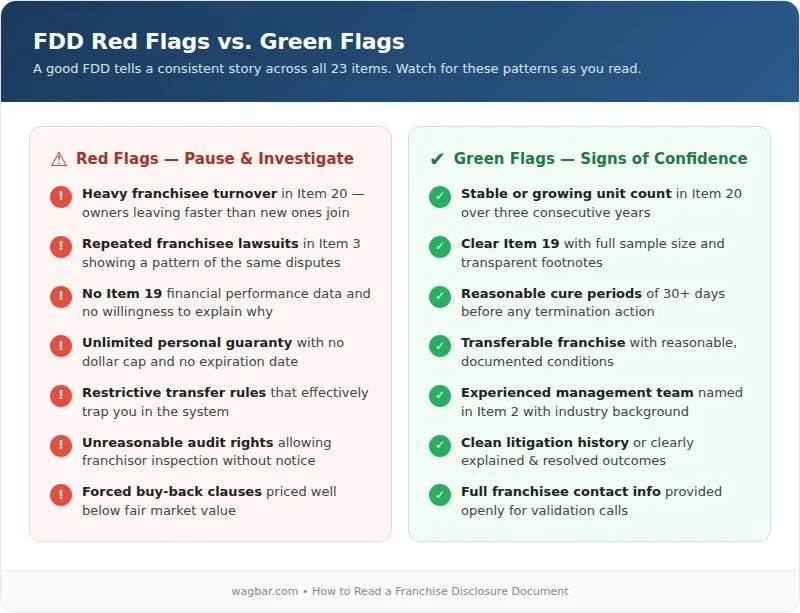
A good FDD tells a consistent story across all 23 items. A weaker one hides contradictions or gaps. As you read, watch for both signs of concern and signs of confidence.
Red flags worth pausing on. Heavy turnover in Item 20 where franchisees are leaving faster than new ones join. Frequent litigation in Item 3 with a pattern of franchisee disputes. No Item 19 and no willingness to explain why. A personal guaranty with unlimited scope and no expiration. Transfer restrictions that effectively trap you in the system. Audit rights that let the franchisor inspect without reasonable notice. Mandatory buy-back clauses priced well below fair market value.
Green flags worth noticing. Stable or growing unit count in Item 20. Clear Item 19 with full sample size disclosed. Reasonable cure periods (30 days minimum) before termination. Transferability with reasonable conditions. Named, experienced franchisor management in Item 2. Clean litigation history or explained outcomes. Direct contact information for current franchisees.
Wagbar's approach sits on the transparent side of these markers. The system discloses its investment range openly on its pet franchise opportunity page and maintains an active franchisee network with regular quarterly business reviews built into the support structure.
Financial Reality Check Before You Sign
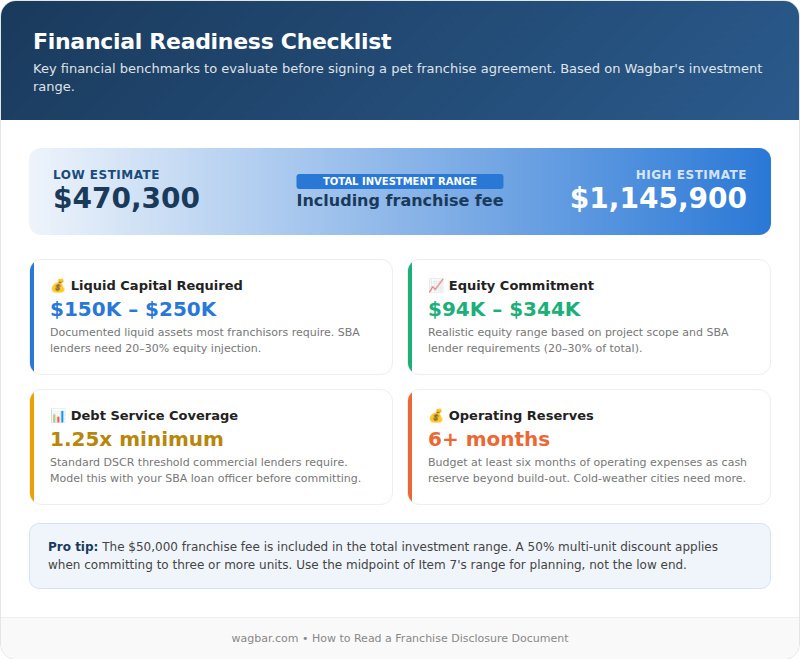
The FDD gives you the contract facts. Your own financial position determines whether the deal makes sense for you. Before signing, most franchise attorneys and financial advisors recommend running these checks.
Liquid capital available. Most franchisors require documented liquid assets of $150,000 to $250,000, and SBA lenders require the borrower to inject 20 to 30 percent equity. For Wagbar's range of $470,300 to $1,145,900, a realistic equity commitment sits between $94,000 and $344,000 depending on project scope and lender requirements.
Net worth. Franchisors publish minimum net worth requirements in Item 5 or Item 7. The Wagbar range places the opportunity within the typical food-service-plus-entertainment investment band.
Debt capacity. A franchise attorney or SBA loan officer can model your debt-service coverage ratio before you commit. Commercial lenders typically want to see a debt-service coverage ratio of 1.25 or higher.
Operating reserves. Budget at least six months of operating expenses as a cash reserve beyond your build-out budget. Dog bars in cold-weather cities need heavier winter reserves than those in year-round-warm climates.
For candidates evaluating market fit before signing, Wagbar's research on dog-franchise-friendly cities covers demographic and income factors that affect unit-level economics.
Timeline From FDD Receipt to Opening
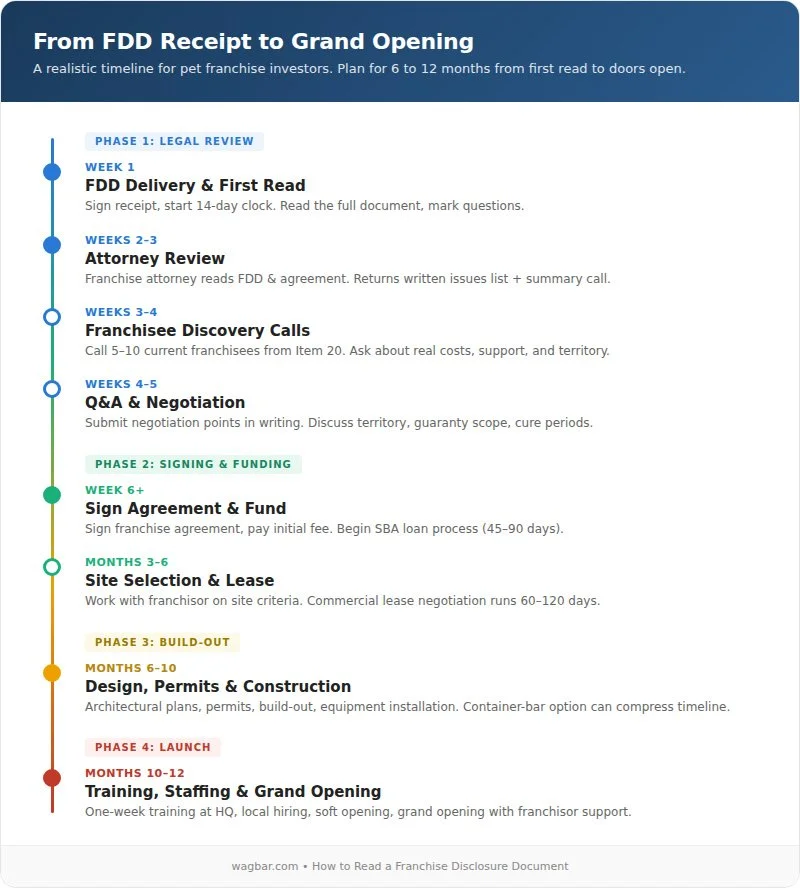
Most candidates underestimate how long the legal and regulatory process takes. A realistic timeline runs six to twelve months from FDD receipt to opening, depending on state registration status, attorney availability, financing, and site selection.
Week 1: FDD delivery and first read. You request the FDD and sign the receipt. The 14-day clock starts. Read the document once all the way through. Mark questions as you go.
Weeks 2 to 3: Attorney review and questions list. Send the FDD to your franchise attorney. Most attorneys turn around a review within 7 to 14 days. You'll receive a written issues list and a summary call. Use the call to prioritize questions for the franchisor.
Weeks 3 to 4: Franchisee discovery calls. Call 5 to 10 current franchisees from Item 20. Ask about real-world costs, support quality, territory performance, and what they wish they'd known before signing. These calls often surface the most useful information in the entire process.
Weeks 4 to 5: Franchisor Q&A and negotiation. Submit your negotiation points and outstanding questions in writing. Franchisors tend to respond faster to organized, specific requests than to open-ended ones.
Week 6 onward: Signing and funding. Once terms are settled, you sign the franchise agreement, pay the initial franchise fee, and begin financing and entity setup. SBA loans typically take 45 to 90 days from application to funding.
Months 3 to 6: Site selection and lease negotiation. Work with the franchisor on site criteria. Commercial lease negotiation often runs 60 to 120 days.
Months 6 to 10: Build-out and pre-opening. Design, permits, construction, equipment installation. For Wagbar, the container-bar build-out option compresses part of this timeline by delivering a pre-fabricated bar and bathroom structure to the site.
Months 10 to 12: Training, staffing, and opening. One-week training in Asheville, local staff hiring and training, soft opening, grand opening with on-site franchisor support.
AJ Sanborn's experience is one example of how a new franchisee moves from signing through planning to location selection. See the Richmond franchisee announcement for how a Wagbar candidate moved from a financial-services career into pet-industry franchise ownership.
Timelines vary with financing and site availability. Candidates shopping multi-unit deals or custom build-outs should plan for the longer end of the range.
Items That Often Surprise First-Time Buyers

A few items catch buyers off guard beyond the high-profile sections. Knowing what to look for in advance saves time.
Item 8 on sources of products and services can lock you into purchasing from the franchisor or approved vendors at marked-up prices. For pet franchises, this can apply to point-of-sale systems, signage, dog park surface materials, technology platforms, or branded merchandise. Understand what you're required to buy and from whom before you sign.
Item 9 on franchisee obligations is a cross-reference table pointing to every section of the franchise agreement where you have an obligation. It looks boring but reading it carefully gives you a map of every commitment the agreement creates.
Item 22 on contracts includes the actual franchise agreement and any related agreements (area development agreement, technology agreement, non-disclosure agreement). The FDD summarizes the agreements, but the summaries are not the contracts themselves. Your attorney should review the actual contracts, not just the summaries.
Frequently Asked Questions
How do I request a Franchise Disclosure Document?
Contact the franchisor's franchise development team directly and ask for the current FDD. Most brands require a short prequalification conversation or application before issuing the FDD, which is fine. Legitimate franchisors will provide the FDD at no cost within a few days of the request. If a brand resists sharing the FDD or charges for it, treat that as a warning sign.
Do I need a lawyer to review the FDD?
Yes, if you're serious about buying the franchise. Franchise agreements are complex, state laws vary, and a franchise attorney will catch provisions you might miss. General legal training isn't the same as franchise-law practice. Attorneys who work in other specialties routinely hire franchise counsel for their own franchise deals. Expect to pay $2,500 to $7,500 for a thorough FDD and franchise agreement review. That fee is small compared to the six-figure investment you're making, and it often pays for itself in negotiated improvements to the agreement.
Can the FDD terms be negotiated?
Some can, some can't. Most franchisors will not change the core economic terms (royalty rate, franchise fee, territory structure) because doing so creates unfair treatment across the franchisee base. Peripheral terms like transfer provisions, personal guarantee scope, and dispute resolution venue are sometimes open to negotiation, especially for multi-unit commitments. Your attorney can identify which provisions have room to move.
What is Item 19 and why does it matter?
Item 19 is the Financial Performance Representations section, where a franchisor may disclose financial data about existing units. Not every franchisor includes an Item 19, and franchisors that do are legally required to follow strict disclosure rules. When an Item 19 exists, it is the only legally reliable source of financial performance data from the franchisor. Outside of Item 19, franchisors cannot legally make financial claims about unit performance.
How long does it take to review an FDD properly?
Most buyers spend 10 to 20 hours over two to three weeks reviewing an FDD, talking to franchisees, and discussing findings with legal counsel. That matches the mandatory 14-day waiting period well. Rushing an FDD review to meet an artificial deadline is how people miss important terms.
What happens if a franchisor sells me a franchise without delivering an FDD?
Selling a franchise without the required FDD is a violation of federal and state franchise law. Remedies vary but can include rescission (unwinding the sale), damages, and in some states, attorney's fees. If this happens, contact a franchise attorney immediately. Do not sign anything additional.
Can I back out after receiving the FDD but before signing?
Yes. Receipt of the FDD does not commit you to anything. You can walk away at any point before signing the franchise agreement and paying the initial fee. Most franchisors accept this as normal.
Is Wagbar registered in my state?
Registration status in registration states can change over time as Wagbar expands. Contact franchising@wagbar.com for current status in your state. Local rules for site-specific licensing also apply; the state-level zoning and compliance overview for pet businesses covers the city-and-county rules that sit on top of franchise law.
What's the difference between Item 19 and Item 20?
Item 19 shows financial performance (revenue, cost, or income data) if the franchisor chooses to publish it. Item 20 shows unit counts, openings, closures, transfers, and franchisee contact information. Both matter. Read them together.
What should I ask current franchisees when I call them?
Ask about real upfront costs versus the FDD range, the quality of pre-opening and ongoing support, how accurate Item 19 projections proved to be, whether the territory holds up in practice, and what they would do differently. Also ask whether they would sign again today.
What if I can't find an answer to a question in the FDD?
Ask the franchisor's development team. Legitimate questions deserve legitimate answers. If you're told information isn't available or you should "just trust us," that's meaningful. The whole purpose of the FDD is transparency, and a franchisor that resists transparency is signaling something. To submit a question directly to the team behind Wagbar's offering, the pet franchise opportunity page has the contact form used for franchise development inquiries.
Bottom TLDR
Understanding the Franchise Disclosure Document is the single most important due-diligence step in any pet franchise purchase. Focus on Items 5, 6, 7, 17, 19, 20, and 21 for fees, investment, renewal terms, performance data, franchisee lists, and financials. Hire a franchise attorney, understand whether your state requires pre-sale registration, and use the mandatory 14-day waiting period to call existing franchisees from the Item 20 list before signing anything. Allow four to six weeks from FDD receipt to signing for a thorough legal and financial review.
Disclaimer: This information is not intended as an offer to sell, or the solicitation of an offer to buy, a franchise. It is for information purposes only. An offer is made only by Franchise Disclosure Document. Currently, the following states regulate the offer and sale of franchises: California, Hawaii, Illinois, Indiana, Maryland, Michigan, Minnesota, New York, North Dakota, Oregon, Rhode Island, South Dakota, Virginia, Washington, and Wisconsin. If you are a resident of, or wish to acquire a franchise for a Wagbar to be located in one of these states or a country whose laws regulate the offer and sale of franchises, we will not offer you a franchise unless and until we have complied with applicable pre-sale registration and disclosure requirements in your jurisdiction. Wagbar Franchising LLC, (828) 554-1021, 7 Kent Place, Asheville, NC, 28804.