

Understanding Item 7 of the FDD: Initial Investment Tables Explained

Top TLDR: FDD Item 7 is the initial investment table inside a Franchise Disclosure Document, a standardized breakdown of every startup cost category with estimated low and high ranges and payment timing. The true all-in cost for a pet franchise typically runs 20–40% above the FDD's Item 7 high estimate once you add lease deposits, working capital, pre-opening marketing, insurance, and contingency reserves. Reading Item 7 correctly means cross-referencing Items 5, 6, and 19 alongside the table totals, then building a real budget on top. Request the current FDD from any pet franchise you're seriously evaluating and have a franchise attorney review it before signing.
Key Takeaways
Item 7 of any Franchise Disclosure Document covers a narrow slice of opening costs and assumes things go right.
The real all-in cost for a pet franchise runs 20–40% above the FDD high estimate once deposits, working capital, and overruns get added in.
Working capital and pre-opening marketing account for the two biggest underestimates among new pet franchise owners.
Build your own line-item budget with 6–12 months of operating reserves before signing anything.
Item 7 of the Franchise Disclosure Document is one of the most practically useful sections a prospective franchisee can read and one of the most consistently misread. It contains a table that lists every major startup cost category, a low and high estimate for each, and notes on when and to whom each cost is paid. If you know how to read it, Item 7 tells you what it actually costs to open a franchise. If you don't, you risk entering a purchase decision with an incomplete picture of the capital required.
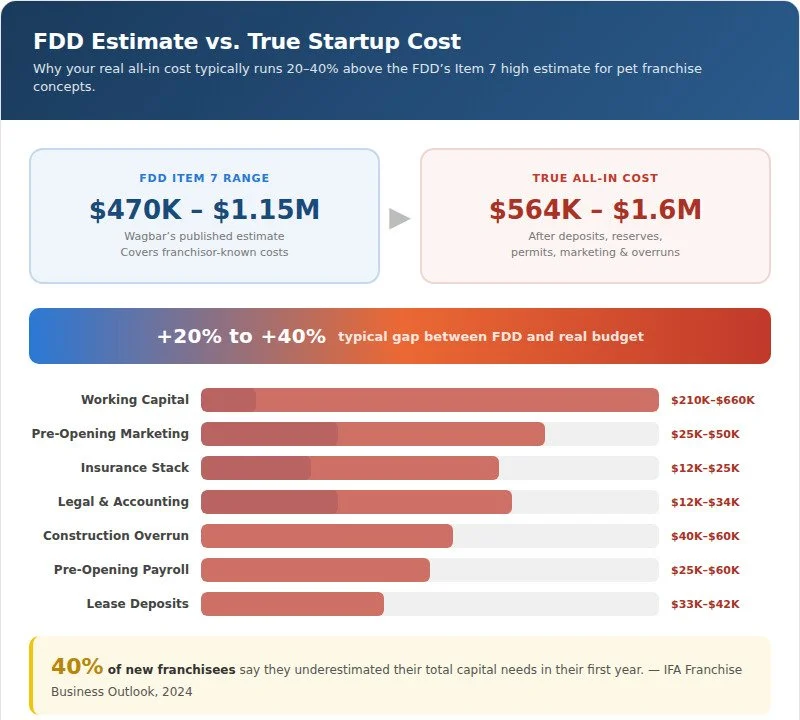
If you've been reading FDDs for pet franchises and thinking the numbers look manageable, this page is for you. The Franchise Disclosure Document gives you a legally required starting point, but that range almost never reflects what you'll actually spend before your doors open and revenue kicks in. According to the International Franchise Association, roughly 40% of new franchisees say they underestimated their total capital needs in their first year (IFA Franchise Business Outlook, 2024).
This page explains how FDD Item 7 investment tables are structured, what each column means, where estimates come from, what the hidden costs are that push real budgets past the FDD numbers, and what to look for when comparing Wagbar's numbers against other pet franchise opportunities. All financial figures referenced here should be verified against the current FDD for any franchise you're seriously evaluating. Nothing in this guide constitutes legal or financial advice. Consult a franchise attorney and a CPA before signing any franchise agreement.

What Item 7 Is and Why It Exists

The Franchise Disclosure Document is a federally mandated disclosure that franchisors must provide to prospective buyers before any agreement is signed or money changes hands. It has 23 numbered items covering everything from the franchisor's background and litigation history to fees, obligations, and financial performance representations.
Item 7 is specifically the estimated initial investment. The Federal Trade Commission requires franchisors to present this information in a standardized format so buyers can compare competing franchise systems on a common basis. The intent is transparency, and every franchisor uses the same structure, which in theory makes comparison straightforward.
In practice, the tables require some interpretation. The numbers are estimates, not guarantees. The ranges can be wide. And the footnotes often contain information that's just as important as the figures themselves. Two things drive the gap between FDD numbers and real-world costs. First, the FDD covers what the franchisor can reasonably predict, including equipment, fees, build-out estimates, and opening inventory. Second, it leaves out or under-counts items that vary heavily by location, like commercial real estate deposits, local permitting headaches, and pre-opening payroll.
For context on the disclosure itself, our breakdown of how franchise systems work walks through what an FDD does and doesn't disclose.
The Structure of an Item 7 Table
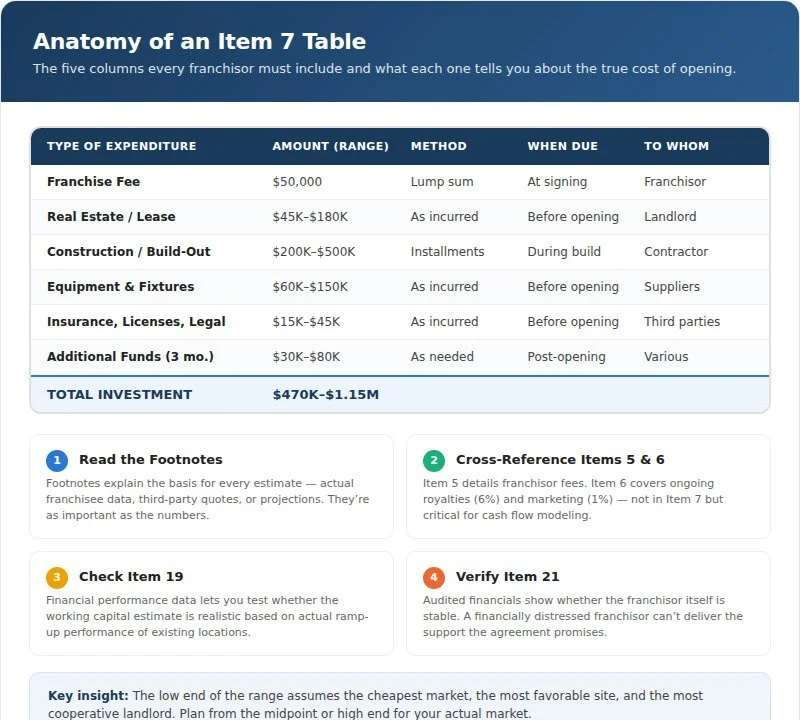
A standard Item 7 table has five columns. Understanding what each one represents is essential before you try to use the numbers.
Type of Expenditure names the cost category. Common line items include the initial franchise fee, real estate and lease costs, construction and leasehold improvements, equipment and fixtures, signage, initial inventory, training expenses, insurance, professional fees (legal and accounting), and initial working capital. The exact line items vary by franchise concept. A dog park bar will have different categories than a dog grooming studio or a pet supply store.
Amount gives the estimated cost range for that line item, expressed as a low and high figure. This is the column most buyers focus on, but it only makes sense in context of the other columns.
Method of Payment describes how the cost is paid, whether lump sum, as incurred, or in installments. This affects your cash flow planning. Some costs hit all at once while others spread over the pre-opening period.
When Due specifies the timing: at signing, during construction, before opening, or within a certain period after opening. This column is critical for sequencing your funding. You may need to have certain costs covered months before others.
To Whom Paid identifies who receives the payment, whether that is the franchisor directly, an approved supplier, a third-party contractor, or a government entity. This matters because it tells you which costs are controllable and which are fixed.
Reading the Total at the Bottom
The bottom of the Item 7 table adds up the low estimates for all line items and the high estimates for all line items, giving you a total investment range. For Wagbar, that publicly stated range is $470,300 to $1,145,900.
That range looks wide because it is. The honest explanation is that the real cost of opening a physical location varies substantially based on where it's located, what the site requires, and what lease terms the buyer negotiates. A property in a secondary market with favorable landlord terms and minimal site prep needs will cost meaningfully less to open than a metro location with high construction labor costs and a site that requires significant grading.
The total row does not include ongoing royalties, costs that arise after the initial investment period defined in the FDD, or any unanticipated costs that fall outside the line items listed. The working capital line item is an estimate of what you'll need during the initial operating period, but if your ramp-up takes longer than the FDD models, you'll need more than what the table shows.
What the Footnotes Tell You
Most buyers read the columns and skip the footnotes. That's a mistake. The footnotes beneath an Item 7 table typically contain some of the most important context in the entire section.
Footnotes often explain the basis for estimates, whether figures come from actual franchisee experience, third-party quotes, or the franchisor's internal projections. They may describe what assumptions the working capital estimate is based on, such as an assumed operating period before profitability or a specific revenue model. They may also clarify which line items are paid to the franchisor versus independent third parties.
For any line item that seems unusually low or high compared to your expectations, the footnote is the first place to look for an explanation. If there's no footnote and the figure still seems inconsistent with what you're hearing from contractors or real estate brokers in your target market, that's a question worth raising directly with the franchise team and with a franchise attorney.
The Hidden Cost Categories Most Owners Miss
Below are the line items that consistently push pet franchise budgets past the FDD high end. None of these are mysterious. They just don't always show up in the headline number.
Real Estate Deposits and Lease Costs
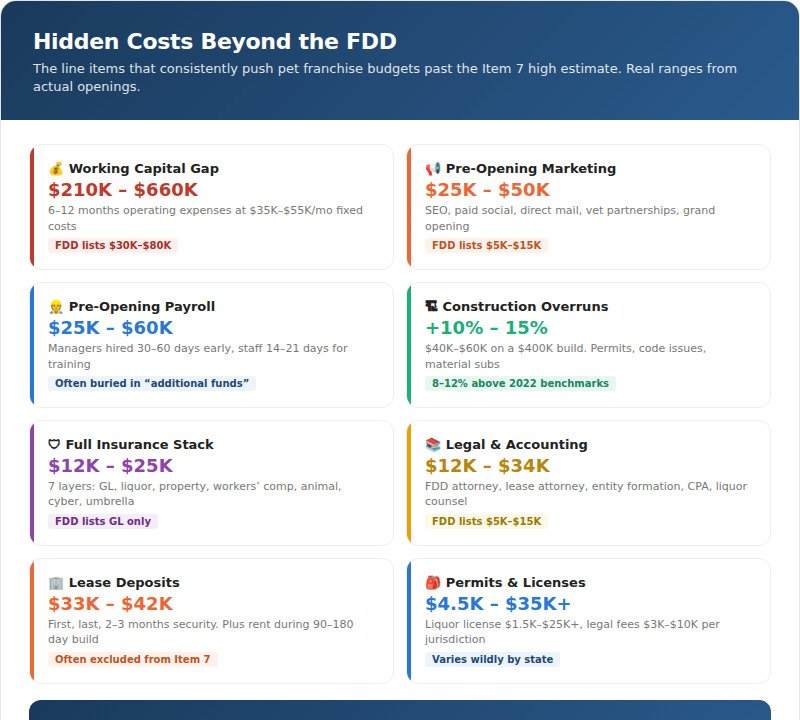
Commercial landlords typically want first month's rent, last month's rent, and a security deposit equal to two or three months of rent before handing over keys. For a 4,000-square-foot space at $25 per square foot annually, that's roughly $33,000 to $42,000 sitting on a landlord's books before you open.
You may also pay for a tenant improvement allowance shortfall, broker fees if you used one, and rent during your build-out period. Most leases require you to pay rent during construction, which can run 90 to 180 days.
Working Capital, the One Everyone Lowballs
This is the biggest gap between FDD estimates and reality. The FDD might list "additional funds" of $30,000 to $80,000 for three months. The SBA recommends six to twelve months of operating expenses on hand for new businesses (SBA Small Business Resources, 2024).
For a pet franchise running $35,000 to $55,000 per month in fixed costs, that means $210,000 to $660,000 in working capital, not $30,000. Owners who run out of cash in month four are the ones who didn't separate startup capital from operating reserves.
Looking at real numbers from owners already running their locations, our breakdown of dog franchise profit margins shows how revenue ramps in the first 12 months.
Pre-Opening Marketing
The FDD usually budgets $5,000 to $15,000 for opening marketing. Real costs are often double or triple that for a pet franchise that depends on local awareness from day one. You'll likely spend on local SEO setup and a Google Business Profile push, paid social campaigns for 60 to 90 days pre-launch, direct mail to nearby zip codes with high dog ownership rates, sponsored local events or partnerships with veterinarians and groomers, and grand opening event production including signage, giveaways, and food trucks.
For a dog-focused concept, marketing spend often runs $25,000 to $50,000 across pre-opening and the first 90 days. Numbers vary by city, and the strongest dog franchise markets show stronger word-of-mouth dynamics, as outlined in our look at the best markets for dog franchises.
Permitting and Compliance Surprises
A pet business serving alcohol, like an off-leash bar concept, faces a stack of approvals including liquor license, food handling permits, zoning variances, animal use permits, fire code inspections, and ADA compliance review. Each carries fees, and each can trigger delays that cost rent and payroll.
Liquor licenses alone range from $1,500 in some Southern states to $25,000+ in transfer-only markets like Florida and Pennsylvania. Add legal fees of $3,000 to $10,000 to walk an application through a contested jurisdiction.
Our reference on zoning rules for pet businesses breaks down the state-by-state differences that drive these costs. And the broader requirements covered in our pet business legal compliance walkthrough cover insurance and licensing in more depth.
Construction Overruns
Build-out estimates in an FDD assume an average market and an average space. Real construction costs in 2024–2025 still run 8–12% above 2022 benchmarks due to material and labor inflation (Associated General Contractors of America, 2024).
Common overruns include permit-driven changes such as fire suppression, HVAC capacity, and grease traps; discovery of code issues during demo involving electrical, plumbing, or accessibility; surface conditions on existing slabs that need replacement; and material substitutions when specified items have long lead times.
Plan for 10–15% above the FDD construction estimate. On a $400,000 build-out, that's $40,000 to $60,000 you didn't see in Item 7.
The Insurance Stack
The FDD typically lists general liability insurance. A pet franchise needs more layers, including general liability at $1,000 to $3,000 per year, liquor liability if you serve alcohol at $2,000 to $6,000 per year, property insurance at $3,000 to $8,000 per year, workers' comp at $2,500 to $7,000 per year depending on payroll and state, animal-specific liability or rider at $500 to $2,000 per year, cyber liability at $800 to $2,000 per year if you store member data, and an umbrella policy at $1,500 to $4,000 per year.
Many carriers require annual prepayment, especially for new businesses without claims history. Plan for $12,000 to $25,000 in your opening insurance outlay.
Legal and Accounting Fees
Legal, accounting, and franchise advisory fees add up fast in the months before opening. FDD review attorney costs run $2,500 to $7,500, lease negotiation attorney $2,000 to $5,000, entity formation and operating agreement $1,500 to $3,500, CPA setup with payroll and first-year accounting $3,000 to $8,000, and local liquor license attorney where applicable $3,000 to $10,000. Typical range across all professional fees: $12,000 to $34,000. Most FDDs estimate $5,000 to $15,000 for this category.
Technology and POS Setup
Pet franchises increasingly run on integrated software for membership management, POS, payments, scheduling, and CRM. The FDD lists hardware costs but often understates setup, integration, and the credit card processing reserves some processors require. Budget $8,000 to $20,000 above any FDD tech estimate, plus monthly software subscriptions of $400 to $1,200 starting at signing.
Pre-Opening Payroll
You'll hire managers 30 to 60 days before opening and front-line staff 14 to 21 days before opening for training. That's typically $25,000 to $60,000 in payroll, benefits, and training costs before your first customer walks in. The FDD often buries this in "additional funds." Pull it out and budget it as its own line.
Other Hidden Line Items
Inventory build-up beyond the FDD's "opening inventory" line is common because alcohol distribution requires minimum orders and dog-related products often ship with long lead times. Plan for 1.3x to 1.5x the FDD inventory estimate to cover your first 60 days without emergency reorders. Commercial utility deposits for new businesses usually require one to two months' usage, running $2,500 to $7,000 across electric, water, gas, and waste services. Grand opening events beyond marketing have real production costs including rental equipment, additional staffing, giveaways, photography for ongoing marketing, and discounted products to drive initial member sign-ups. Budget $8,000 to $20,000 for a serious grand opening week.
Contingency Reserves
This is the most important line item nobody puts in their pro forma. Build a contingency reserve of 10–15% of your total estimated investment to cover surprises. On a $750,000 project, that's $75,000 to $112,500. You will use it. The only question is what for.
Building Your True Cost Calculator
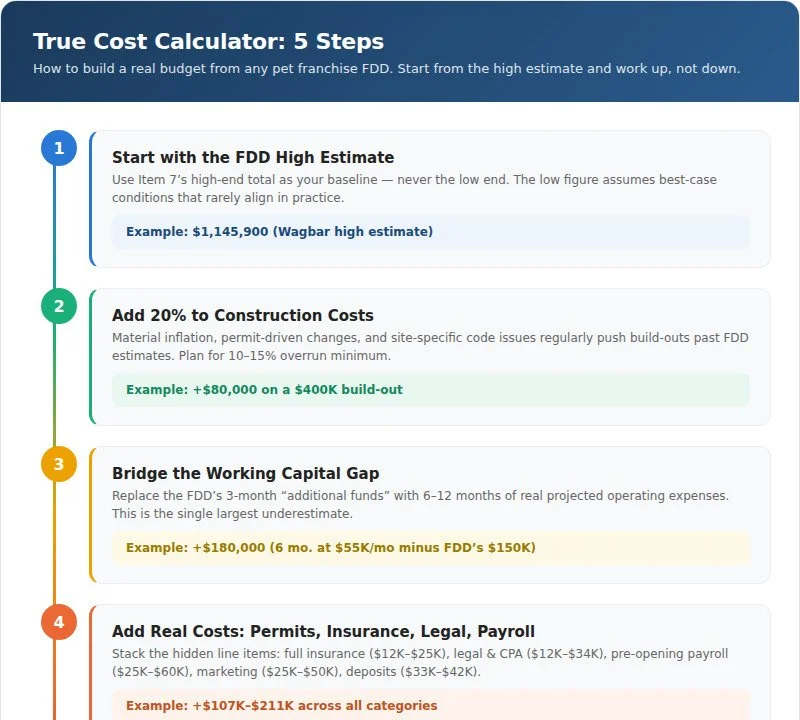
Here's how to model your real number for any pet franchise. Start with the FDD high estimate from Item 7. Add 20% to construction costs. Add the gap between FDD "additional funds" and 6–12 months of projected operating expenses. Add the real cost stack from permits, insurance, legal fees, technology, and pre-opening payroll listed above. Finally, add 10–15% of the running total as contingency.
Run this for any pet franchise FDD and you'll typically end up 20–40% above the published high end. That's not a flaw in the FDD. It's the difference between a regulatory disclosure and a working budget.
For a deeper look at what drives revenue once you're open, our breakdown of revenue streams at off-leash dog bars shows what to model on the income side.
Comparing Item 7 Tables Across Franchise Systems
The standardized format of Item 7 makes comparison between franchise concepts possible, but a few factors complicate straightforward apples-to-apples comparison.
Concept type drives cost structure. A home-based franchise will have negligible real estate and construction costs. A brick-and-mortar concept with outdoor infrastructure like a dog park bar will have substantial build-out costs but also a fundamentally different revenue model. Lower total investment doesn't automatically mean a better opportunity; it often just means less physical infrastructure and, frequently, less revenue potential.
Working capital estimates vary in methodology. Some franchisors model working capital based on three months of projected operating costs; others use six months. A smaller working capital figure in one FDD compared to another doesn't necessarily mean the business is easier to operate. It may just mean the estimate is more conservative.
The low end of the range may not be realistic for your market. The low figure in any Item 7 table represents the best-case scenario with the cheapest market, the most favorable site, and the most cooperative landlord. Buyers in major metros with high construction and lease costs should generally plan closer to the midpoint or upper end of the range.
Item 7 is always historical. The figures are based on costs the franchisor has observed in the past, typically the most recent franchise openings. Construction costs and commercial lease rates change. An FDD updated two years ago may have site cost estimates that don't reflect current conditions in your target market.
How Item 7 Fits Into the Broader FDD Review
Item 7 doesn't stand alone. To fully understand the investment picture for any franchise, you need to read it alongside several other items.
Item 5 covers initial fees, specifically the franchise fee and any other upfront payments made to the franchisor. This often overlaps with the franchise fee line in Item 7, but Item 5 gives more detail on what's included, whether any fees are refundable under certain conditions, and what happens if the deal falls through before opening.
Item 6 covers ongoing fees including royalties, marketing fund contributions, technology fees, and any other recurring payments owed to the franchisor. These don't appear in Item 7 because they're not startup costs, but they're essential for modeling your ongoing cash flow. Wagbar's royalty is 6% of adjusted gross sales with a 1% marketing fund contribution.
Item 19 is the Financial Performance Representation. Not all franchisors include one, and there are rules governing what they can and can't say. If an Item 19 is present, it gives you data on how existing locations have actually performed including revenue, sales, or other financial metrics the franchisor has chosen to disclose. This is what allows you to test whether the working capital estimate in Item 7 is realistic based on actual ramp-up performance.
Item 21 contains the franchisor's audited financial statements. This is where you evaluate whether the franchisor itself is financially stable. A financially distressed franchisor can't provide the support the franchise agreement promises.
Reading all four of these items together gives you a much more complete picture than Item 7 alone.
What Item 7 Tells You About the Wagbar Opportunity
For Wagbar, the $470,300 to $1,145,900 estimated investment range reflects the nature of the concept. It is a physical facility with outdoor infrastructure, a bar service component, and the need to attract and retain a membership base that drives recurring revenue.
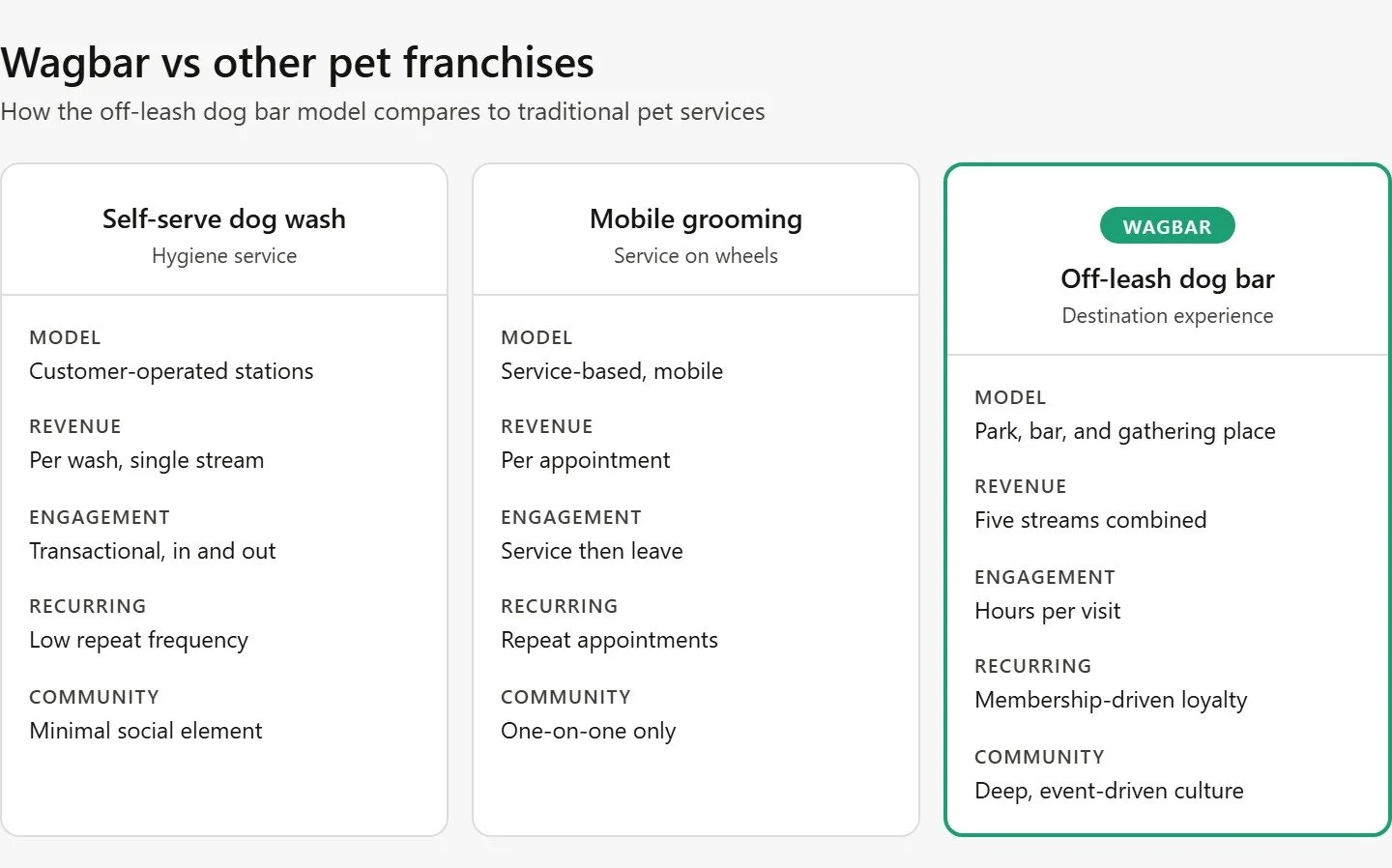
The investment is higher than a home-based pet franchise or a mobile grooming concept, but the comparison isn't meaningful in isolation. What matters is whether the revenue model can support the investment. Wagbar's dual revenue structure, combining membership-based park access and bar sales, is designed to generate income from two distinct streams, with the membership component providing predictable recurring revenue that many single-revenue-stream concepts can't match. The off-leash dog bar concept exists specifically because dog owners wanted something meaningfully better than a standard public dog park.
Wagbar's build-out process also includes a turnkey solution for the bar and bathroom infrastructure through a shipping container conversion system, which addresses one of the largest cost variables in the build-out with a more controlled, predictable approach than full custom construction. The container bar system shortens build timelines and reduces some of the construction variability that adds risk to typical restaurant builds.
The franchise fee of $50,000 includes licensing, training, access to the proprietary Opener app that guides the pre-opening process, and the one-week intensive training at Wagbar's Asheville, NC headquarters. Multi-unit buyers committing to three or more locations receive a 50% discount on the franchise fee, which affects how the Item 7 table reads for that scenario.
Real all-in costs for Wagbar franchisees typically land within or modestly above that range when they follow the budgeting approach above. The ones who get caught short are usually the ones who treat the FDD low number as a target. The ones who hit their targets treat the FDD high number as their floor and build up from there. Our franchise team walks every candidate through a true cost worksheet during diligence, not just the FDD numbers. We'd rather have one well-capitalized franchisee succeed than three under-capitalized owners struggle.
If you're researching specific markets, our pages for the Denver franchise opportunity and Atlanta franchise market walk through market-specific cost factors.
Red Flags When Reading Any Pet Franchise FDD
A few warning signs that the FDD numbers may understate true costs. Item 7's "additional funds" line covers fewer than three months of operating expenses. Item 20 shows a high turnover rate among recent franchisees. The franchisor restricts your ability to talk to current owners. Item 19 financial performance representations are missing or thin. And build-out estimates use unit pricing well below market rates for your region.
The ability to call existing franchisees is the single most useful diligence step you have. Most reputable franchisors will hand you a current list. Use it. Ask owners what they actually spent, not what the FDD said they'd spend.
The advantages of pet franchise ownership are real, but only if your capital plan is honest. Annual U.S. pet spending of $147 billion creates genuine opportunity (American Pet Products Association, 2024), and longer-term trends covered in our pet industry growth through 2030 outlook point to continued expansion. Capital adequacy is what separates the owners who capture that opportunity from the ones who get squeezed in month six.
For broader context on the pet industry economics behind these numbers, see our market breakdown. And if you want a head-to-head on different pet business structures, our dog business model comparison covers the trade-offs.

Questions to Ask About Any Item 7 Table
Before you treat any FDD's Item 7 as your budget, a franchise attorney should review the document and you should be able to answer these questions.
Are the cost estimates based on recent openings? If the most recent openings were in lower-cost markets and you're planning to open in a major metro, the estimates may not translate.
What's the basis for the working capital estimate? How many months does it cover? Does it assume any level of pre-opening membership sales or day-one revenue?
Are there costs specific to your target market that aren't captured in the table? Local zoning requirements, liquor licensing complexity, and site-specific construction challenges can add costs that no standardized table could predict.
What has the actual range of total investments been across recent openings? Franchisors who have been operating for several years often have real data on this, and some will share it in conversation with serious prospects.
Are the figures in the table consistent with what independent contractors and commercial real estate brokers in your market are quoting? Getting your own market-specific quotes before signing is part of responsible due diligence.
Using Item 7 to Build a Real Budget
The right way to use Item 7 is as a framework, not a final number. Start with the line items as categories, then replace the FDD's estimates with real figures from your actual market: a lease quote from a commercial real estate broker, construction estimates from contractors with experience in your area, equipment quotes from suppliers, and an honest assessment of how long your local liquor licensing process takes.
When your market-specific figures replace the FDD estimates, your total will either confirm that the investment is right for your situation or reveal gaps that need to be addressed before you can proceed responsibly.
That analysis should happen with professional support. A franchise attorney can flag anything in the document that differs from industry norms or creates unusual obligations. A CPA with franchise experience can stress-test your capital plan and help you think through how much reserve is genuinely adequate for your market and situation.
The full financing guide for pet franchise buyers covers how to structure funding once you've built that budget, including SBA loan programs, ROBS strategies, and the capital stack approach that most first-time franchise buyers use to bring the investment together. The dog franchise cost breakdown covers each major cost category in detail if you want to work through the individual line items before you request the FDD.
If you're ready to request Wagbar's current FDD or want to connect with the franchise team directly, the franchising page is the right starting point. Reviewing the complete document with qualified advisors is the appropriate next step for any serious prospect.
Frequently Asked Questions
What is Item 7 in a Franchise Disclosure Document?
Item 7 is the section of the FDD that lists a franchisor's estimated initial investment. It presents each cost category in a standardized table format with low and high estimates, payment timing, and who receives each payment.
Is the Item 7 investment range a guarantee?
No. The figures are estimates based on recent openings and the franchisor's experience. Your actual costs will depend on your specific market, site, lease terms, and local construction and licensing conditions.
Why does the FDD underestimate startup costs for pet franchises?
The FDD is a regulatory disclosure, not a project budget. Item 7 covers franchisor-known costs and uses averages that may not match your market. It under-counts working capital, local permitting variability, insurance stacking, and pre-opening payroll. Owners who use it as a planning floor rather than a ceiling tend to budget more accurately.
How much working capital should I have for a pet franchise?
Plan for 6–12 months of projected operating expenses on hand at opening, on top of your build-out and equipment costs. For most pet franchises, that's $200,000 to $500,000 in liquid reserves beyond what Item 7 estimates. SBA loan officers will often require similar reserves before approving financing.
What's the biggest hidden cost in opening a pet franchise?
Pre-opening payroll and pre-opening marketing combined. Most FDDs bury both in "additional funds" estimates that run $30,000 to $80,000, while real costs across the two often hit $70,000 to $120,000 for a properly staffed and marketed opening. Treating these as separate line items prevents the cash crunch many owners hit in months three and four.
How do I compare Item 7 tables across different franchise systems?
Use the standardized structure as a starting framework, but adjust for concept type, working capital methodology, and whether the estimates reflect current conditions in your specific market. Lower total investment doesn't automatically mean lower risk or a better opportunity.
What's the difference between Item 5 and Item 7?
Item 5 covers fees paid to the franchisor specifically. Item 7 covers the total estimated investment, including third-party costs like construction, real estate, and equipment. The franchise fee appears in both sections.
Can I finance startup costs above the FDD range?
Yes, in most cases. SBA 7(a) loans and conventional commercial lenders will fund total project costs that exceed FDD estimates, provided your business plan supports the numbers. The challenge is having enough equity injection (typically 20–30% of total project cost) and reserves to satisfy the lender's working capital requirements.
Should I include the franchise fee in my working capital calculation?
No. The franchise fee is a one-time pre-opening cost, separate from working capital. Working capital is the money you need to cover monthly fixed and variable operating expenses while revenue ramps. Mixing the two leads to the most common budgeting error new franchisees make.
Should I hire an attorney to review the FDD before signing?
Yes. The FTC requires franchisors to give prospective buyers at least 14 days to review the FDD before signing or paying any money. Using that time to have a franchise attorney review the document is standard practice and often reveals important details that non-lawyers miss.
How does Wagbar handle hidden cost transparency?
Our franchise team walks every candidate through a true cost worksheet during diligence, not just the FDD numbers. We'd rather have one well-capitalized franchisee succeed than three under-capitalized owners struggle. You can submit questions through our common franchise questions page or start the conversation directly through the Wagbar franchise opportunity page.
What Every Prospective Franchisee Should Remember About Item 7
FDD Item 7 initial investment tables exist to give you a clear, comparable picture of what entering a franchise system costs. Reading them correctly with attention to footnotes, the relationship between columns, and the broader FDD context is one of the most important skills a prospective franchisee can develop. But the FDD is a starting point, not a budget.
Build your true cost number by adding 6–12 months of working capital, real permitting and insurance costs, pre-opening marketing and payroll, and a 10–15% contingency reserve on top of the FDD high estimate. The franchisees who succeed are the ones who walk in with capital that matches reality, not the ones who plan to the FDD low number and hope for the best.
For anyone evaluating pet franchise investment decisions, the standardized format creates a useful starting point. Your real budget, built from real quotes and reviewed by real professionals, is what it becomes after that. If you'd like to walk through what a true-cost budget looks like for a Wagbar location in your market, the team is happy to share the worksheet our owners use.
Bottom TLDR: FDD Item 7 gives prospective franchisees a standardized table of every estimated startup cost, organized by category with low and high ranges and payment timing. Real pet franchise startup costs sit 20–40% above the FDD high estimate because deposits, working capital, marketing, and overruns rarely fit inside Item 7. Wagbar's published estimated initial investment of $470,300–$1,145,900 reflects real variation driven by site, market, and build-out conditions. Treat the FDD high number as your minimum, layer in 6–12 months of operating capital plus a 10–15% contingency, and call current franchisees to verify their actual opening costs before you commit.