

The Off-Leash Dog Bar Industry: Category Emergence, Growth, and Cultural Shift
Top TLDR: The off-leash dog bar industry took shape in the late 2010s, as operators blended fenced canine play areas with full bars. Wagbar opened in Asheville, North Carolina in November 2019 and helped establish the franchise model for the category. By 2024, USA Today's 10Best had named dog bars a national hospitality category. Aspiring operators should plan around safety standards, membership models, and third-place community design.
For most of the 20th century, dog owners had two separate options when they wanted to spend time outside the house with their pet. They could go to a public dog park, where the play was free but the amenities ended at a water spigot. Or they could go to a "dog-friendly" patio at a brewery or restaurant, where the dog stayed on a leash for hours and rarely got to interact with other dogs. The off-leash dog bar collapses those two options into one venue: a fenced, supervised play area combined with a full bar serving beer, wine, and other drinks. Dogs run free. Their people sit down. Both groups stay longer than they would at either format alone.
That structural change is what makes the off-leash dog bar concept a category rather than a feature. A dog-friendly bar is still a bar that happens to allow dogs. An off-leash dog bar is a hospitality format with its own physical layout, staffing model, vaccination requirements, and revenue mix. It is also recent enough that the category's history can still be traced through individual operators, and the rise of dog bars as a community trend has been documented in industry coverage over the past several years.
This page traces where the category came from, why it took off when it did, how many operators now work in it, what cultural shifts made it possible, and where it appears to be headed. Geographic patterns in where dog franchise concepts succeed help explain why some cities saw early operators while others are still untapped. Wherever specific Wagbar facts are cited, they are confirmed; broader industry observations describe what is publicly visible across operators in the United States.
Where the Off-Leash Dog Bar Category Started
The category formed at the intersection of two failing options for dog owners: the bare municipal dog park and the dog-tolerant bar patio. Public dog parks in most American cities offer fences and grass, but no shade structures, no seating beyond a bench or two, and no food or drink. Owners often leave after twenty or thirty minutes because there is nothing for them to do. Bar patios that accept dogs typically require leashes, do not check vaccinations, and offer no real space for dogs to socialize. Neither option lets a dog and its owner stay for an entire afternoon.
In 2015, Kendal Kulp had a frustrating experience at a traditional dog park in western North Carolina and started thinking about a venue that would fix both problems at once. He spent the next four years working through site selection, financing, and design with his father Kajur Kulp, who brought a background in creative design and project management. They opened the first Wagbar in Weaverville, just north of Asheville, in November 2019. The build was largely DIY, and the venue opened months before COVID-19 hit. The pandemic period turned out to be unusually well-suited to the format: the venue was outdoor, fenced, and built for distance, and it kept operating through the worst of 2020 and 2021. The full Wagbar founding story describes how the original site has stayed open since.

A handful of other independent operators were working on similar ideas around the same period. Cities like Austin, Charlotte, and Tampa each had at least one off-leash dog park bar by the early 2020s. Most of these operations were single-location independents, run by founders who had identified the same gap in their own market. The format was being invented in parallel rather than copied from one originator. What changed in the years after 2020 was that operators started franchising and other entrepreneurs started looking for a tested model rather than building one from scratch.
Why the Concept Emerged When It Did
Three large shifts in American dog ownership made the off-leash dog bar viable as a business in the late 2010s. First, the share of households with dogs kept rising. Second, the share of pet owners willing to spend on experiences rather than products grew sharply. Third, dog owners increasingly wanted to take their pets with them socially rather than leave them at home.
The American Pet Products Association reports that around 67% of U.S. households now own a pet, and dogs are by far the most common species. Pet spending in the United States passed $103 billion in 2020 and has continued growing, with more recent estimates putting total pet industry spending well above $147 billion. A 2023 Pew Research Center survey found that 97% of pet owners consider their pets' emotional well-being a top priority. Pet ownership is no longer a backyard arrangement; it is increasingly an indoor, social, family-member arrangement. That mindset translates directly into demand for venues where dogs are treated as guests rather than tolerated.
The same period saw the experience economy reshape adjacent hospitality categories. Craft breweries with food trucks replaced sit-down restaurants for many millennial diners. Self-pour taprooms, axe-throwing bars, and adult arcades all grew on the same logic: people want to do something while they drink, not just drink. A fenced, supervised play space for dogs fits cleanly into that pattern. The customer is paying for time and atmosphere, not just for a drink. Pet industry growth trends through 2030 over the same period show the same pattern across the broader category.
Demographics also helped. Millennial and Gen Z dog owners are statistically more likely to be without children, more likely to live in urban or first-ring suburban housing without yards, and more likely to view their dogs as primary companions. Those owners need a venue that does the work of a backyard, while still feeling like a place where their human friends would also want to meet up. The off-leash dog bar is the format that satisfies both halves.
How the Off-Leash Dog Bar Industry Has Grown
The category went from a handful of independent operators to a multi-state franchise format in roughly five years. Direct counts of operators are imprecise because the industry has no single trade group, but the growth pattern is visible in three places: franchise filings, geographic expansion, and category-level recognition by national publications.
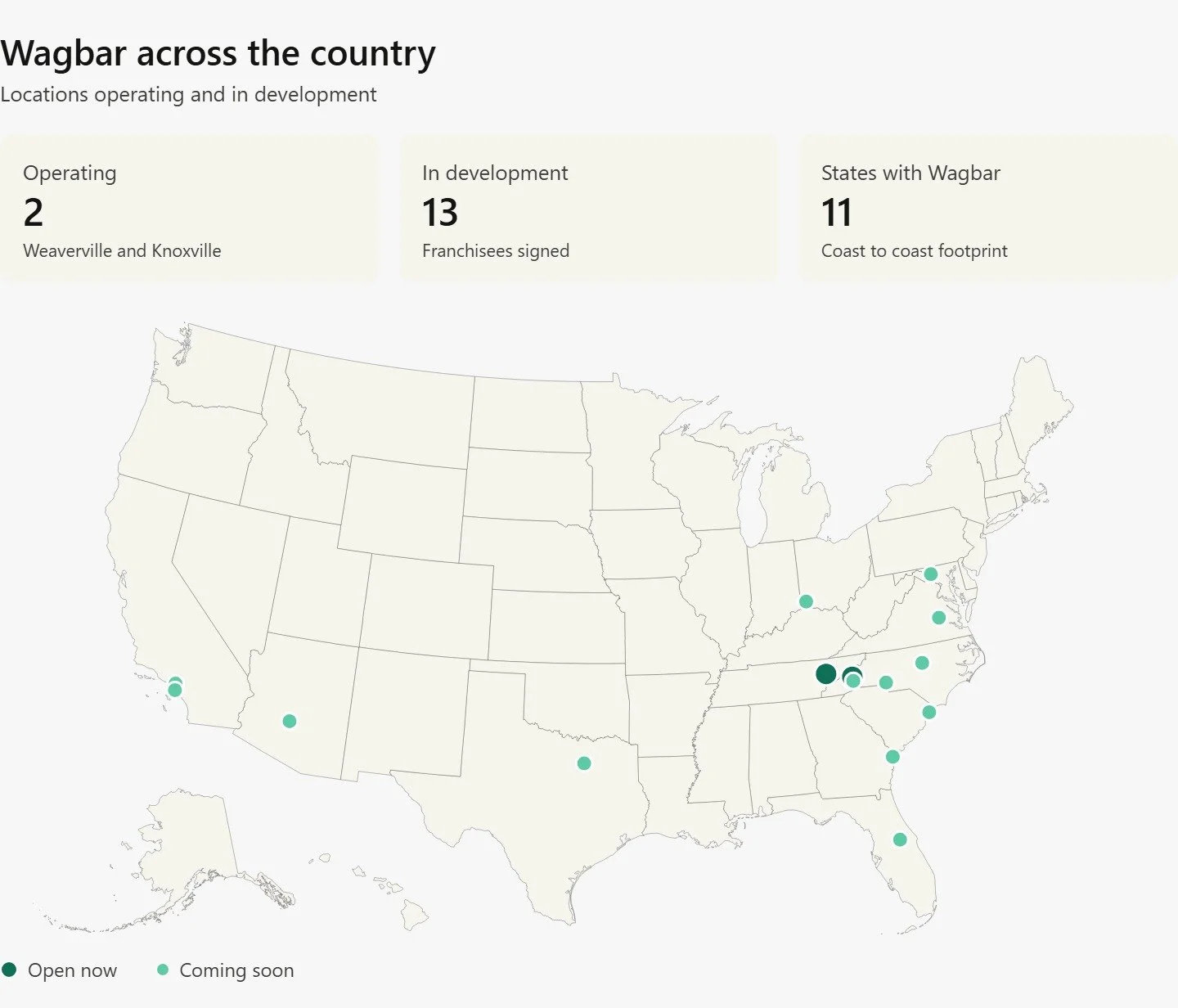
Wagbar provides one of the clearest examples of the franchise pattern. The company opened its flagship in 2019 with a single location, began offering franchises a few years later, and now has operators signed across more than a dozen markets. Confirmed franchisees include AJ Sanborn in the Richmond, Virginia area, Dianna in Phoenix, Jennifer in Los Angeles, Liz and Shelby in Knoxville, Brandi and Denise in Charlotte, and Matt and Taylor in Myrtle Beach. The Knoxville location, opening at the former Creekside Knox property, is set to be the second open Wagbar after Weaverville. Locations in development span North Carolina, South Carolina, Georgia, Texas, California, Virginia, Ohio, Maryland, Florida, and Arizona. The full Wagbar locations roster is published on the company site.
Other operators are running similar plays at smaller scale. Single-unit and two-unit independents in Sun Belt and mountain-west cities have been opening at an accelerating pace since 2022. Some are converting underused outdoor lots, others are taking over former event venues or breweries with large patios. The economic case is strong enough that early-stage operators rarely struggle to fill a space on opening weekend; the harder questions are zoning, liquor licensing, and sustained membership growth.
Outside attention from the press has tracked the same growth path. USA Today's 10Best published a national "Best Dog Bars" list in 2024, with Wagbar landing at #10. A national newspaper running a category-specific "Best Of" list is, in itself, evidence that the category exists in the public mind. Five years earlier, a "Best Dog Bars" list would not have had a credible field of nominees. Comparable lists now appear in regional publications across the country, and white space remains in mid-sized markets that have not yet been served.
From Transactional to Experiential: How Pet Services Changed
The older pet services economy was built around discrete transactions: buy food, buy a toy, drop the dog off, pick the dog up. Pet stores, grooming salons, kennels, training classes, and veterinary clinics all share that pattern. The owner hands the dog or the wallet over, gets a service or a product back, and leaves. The venue is not a place anyone lingers.
The off-leash dog bar inverts that pattern. The owner pays for time spent at the venue, with the dog, alongside other people. The dog is not being processed; it is participating. A Saturday afternoon at an off-leash dog bar might run three or four hours, include two or three drinks, a meal from a food truck, and conversation with several other dog owners the visitor has never met before. There is no service to pick up at the end. The visit itself is the product. That shift, from transactional to experiential, is the same one that drove growth in craft breweries, board game cafés, and self-pour taprooms during the same period.
Membership economics make the experiential model durable. Most off-leash dog bars sell some combination of day passes, monthly memberships, multi-visit punch passes, and annual memberships. Wagbar requires the dog to be at least six months old, spayed or neutered, and current on Rabies, Bordetella, and Distemper vaccinations. Free entry for all human guests over 18 keeps the social side of the venue accessible to people without dogs. The result is a customer base that returns weekly or more often, which is rare in a single-location hospitality business. Revenue streams for off-leash dog bars reflect this membership-plus-bar mix.
Third Places, Reimagined for Dog Owners
Sociologist Ray Oldenburg coined the term "third place" in 1989 to describe informal gathering spots distinct from home and work, where regulars meet, conversation runs across class lines, and the entry barrier is low. Coffee shops, neighborhood bars, barbershops, and front porches are the canonical examples. Third places have been in measurable decline in the United States for decades. The 2010s loneliness research, the post-2020 work-from-home shift, and the closure of community-anchor bars and diners have all left adults with fewer informal meet-up venues.
Off-leash dog bars fit the third-place definition unusually well. They are neutral ground, since no one hosts and no one is a guest. They are leveling, since every regular is just somebody with a dog. They have regulars who tend to know each other after a few visits. The conversation tends to start with the dogs, which gives strangers an easy on-ramp. Same-day attendance is open to anyone who can show vaccination paperwork. None of those features are accidental. They are the consequence of a venue built around dogs first, with humans as the secondary, longer-staying users.
The community dimension shows up in operator behavior. Most off-leash dog bars host weekly events: trivia nights, breed meetups, live music, food truck rotations, charity events for local rescues, and seasonal parties around holidays. Wagbar's flagship in Weaverville hosts trivia, open mic, breed meetups, and seasonal events such as the Bunny Bash and Memorial Day potluck. The events do double duty: they bring in non-dog-owning humans, and they give regular customers a reason to visit on slower weekday nights. Community building for dog-focused businesses is now a known operational discipline within the category.
The third-place framing also helps explain why the format has held up against substitutes. A patron could in principle take their dog to a friend's backyard, or to a public park with a six-pack, or to a bar that lets dogs sit on the patio. None of those options solves the same combination of social access, dog play, and predictable safety standards. The dog bar's third-place character is a function of the supervised, repeatable, vaccinated environment, not just the alcohol or the fence.
What's Next for the Off-Leash Dog Bar Category

The next phase of the category looks like consolidation, weather-readiness, and geographic spread into mid-sized markets. The early growth phase was driven by single-unit independents and one or two franchise systems. The next phase will likely be defined by multi-unit operators, both inside franchise systems and as regional independents.
Climate is one of the more interesting open problems. Most early dog bars launched in mild-weather Sun Belt markets where outdoor operation works year-round. Operators in colder climates are now testing covered patios, partial enclosures, heaters, and shipping-container bar structures that hold up to winter weather. Wagbar's container bar build-out solution, developed with a manufacturing partner, is one example of standardization aimed at reducing build time and weatherproofing the structure. Frederick, Maryland; Cincinnati, Ohio; and Long Beach, California sit at three different points on the climate map, and the operators in those markets will reveal what year-round economics look like outside the Carolinas.
Geographic spread is also pushing the category beyond major metros. Mid-sized cities of 250,000 to 750,000 residents are turning out to support viable single-unit operations, especially in markets with high dog ownership rates and strong craft brewery cultures. Knoxville, Richmond, Greenville, Savannah, and Asheville itself are all examples. The economic logic is straightforward: a viable off-leash dog bar needs roughly the same density of dog-owning households as a craft brewery needs of beer-drinking households, and there are far more such cities than there are operators currently serving them.
Crossover with adjacent hospitality categories is the third trend worth watching. Off-leash dog bars are starting to host private events, partner with rescue organizations on adoption days, run regular live music programming, and rotate food trucks rather than build kitchens. Each of those moves brings the format closer to a general-purpose neighborhood third place that happens to also be a dog park. The trends and facts about pet franchises suggest the category is following the same maturation curve as other experience-based pet businesses.
Frequently Asked Questions
When did the off-leash dog bar industry actually start?
Off-leash dog bars first appeared as independent operations in the mid-to-late 2010s. Wagbar opened in Weaverville, North Carolina in November 2019 and was an early mover in the category. Other independents in Austin, Charlotte, and Tampa were working on similar concepts around the same period. The franchise phase of the industry is more recent, mostly post-2022.
How many off-leash dog bars are there in the United States?
There is no central registry, so exact counts vary. As of 2026, several dozen off-leash dog bars operate across the country, with growth strongest in Sun Belt and mountain-west markets. Wagbar alone has more than a dozen locations in operation or development across ten states, and other franchise systems plus single-unit independents add to the total. Wagbar franchise opportunities reflect part of that pipeline.
What are the basic safety rules at an off-leash dog bar?
Most operators require proof of Rabies, Bordetella, and Distemper vaccinations on first visit. Dogs are typically required to be at least six months old and spayed or neutered. Trained staff supervise the play area at all times, and aggressive dogs can have their access revoked. Owners stay responsible for monitoring their own dogs, intervening when play turns rough, and cleaning up.
Is an off-leash dog bar the same as a dog park with a beer cart?
No. A dog park with a beer cart is a public park that occasionally allows alcohol service. An off-leash dog bar is a private, fenced hospitality venue with its own building, staffing, vaccination checks, membership system, and full bar service. The two formats look similar from a distance but have different liability profiles, revenue mixes, and customer expectations.
Can people without dogs visit?
Yes, at most operators. Wagbar charges nothing for human entry and welcomes all guests aged 18 and up, with or without a dog. The bar half of the format is meant to function as a normal social venue. Many regulars are dog-less friends and partners of dog owners, and the venues often host events such as trivia nights and live music aimed at that broader audience.
What does it cost to open an off-leash dog bar franchise?
Costs vary by operator and market, but are similar to other small-format hospitality concepts. Wagbar's published initial investment range is $470,300 to $1,145,900, including a $50,000 franchise fee, a 6% royalty on adjusted gross sales, and a 1% marketing fund contribution. Multi-unit commitments of three or more locations qualify for a 50% franchise fee discount. These figures appear in the franchise documentation and apply to U.S. operators.
Bottom TLDR
The off-leash dog bar industry has grown from a handful of independent operators in the late 2010s into a known hospitality category with multi-state franchise systems and national press attention. The shift from transactional pet services to experiential, third-place venues reflects broader changes in pet ownership and the experience economy. Operators evaluating the category should focus on membership economics, weather-ready build-outs, and the community programming that anchors the format.