

The Dog Park Bar Industry: Growth, Closures, and What's Actually Working in 2026

Top TLDR: The dog park bar industry has grown from roughly 5 venues in 2016 to an estimated 60 to 70 locations in 2026, but not every operator survives. Bar K's sudden closure of all three locations in July 2025 showed what happens when overhead outpaces revenue and enrichment programming takes a back seat to aesthetics. The models that are working run lean, beverage-focused operations with strong membership retention, structured enrichment programming, and active community ties. APPA projects pet spending will hit $192 billion by 2030. Morgan Stanley says $261 billion. The dog park bar category sits directly in the fastest-growing segment of that economy. Check the full industry breakdown below for venue counts, revenue benchmarks, regional patterns, and what comes next.
Ten years ago, the phrase "dog park bar" would have gotten you a confused look. Today it describes a category of business that is reshaping how dog owners socialize, how entrepreneurs think about pet services, and how cities plan for the growing population of urban dog owners who want more than a muddy fenced lot and a water fountain that barely works.
The dog park bar concept is straightforward. Combine a fenced, supervised off-leash play area for dogs with a licensed bar serving craft beer, wine, cocktails, and non-alcoholic drinks. Charge dogs for entry through memberships or day passes. Let humans in free. Host events. Build community. Repeat.
What is less straightforward is making it work as a business. The dog park bar industry in 2026 is a category in motion, with new venues opening every month, at least one major operator going under, and a handful of franchise models trying to prove the concept can scale nationally. This is a look at where the industry actually stands right now, what the numbers say, and what separates the operators who are growing from the ones who closed their doors.

How Many Dog Park Bars Are There in the US
Nobody publishes an official count. There is no trade association, no SIC code specific to "dog park bar," and no industry census. So we built an estimate based on what is publicly trackable.
As of mid-2026, we count approximately 60 to 70 dog park bars operating in the United States. That includes single-location independent operators, multi-unit brands, and franchise locations that have opened their doors to the public. It does not include venues that are in development, under construction, or announced but not yet open.
Independent single-location operators make up the majority. These are locally owned venues like The Dog Bar in St. Petersburg, FL, HopHounds Brew Pup in Mobile, AL, Unleashed Hounds and Hops in Minneapolis, Barkology in Buffalo, and dozens of others scattered across college towns, mid-size metros, and dog-obsessed neighborhoods. Most opened between 2018 and 2024.
Multi-unit brands include MUTTS Canine Cantina (operating locations in Dallas, Fort Worth, Allen, El Paso, and Austin with 19 total in development), Fetch Park (multiple Atlanta-area locations), Bark Social (Maryland), and Pups Pub (Orlando and Tampa). These brands are scaling through either franchise agreements or corporate expansion.
Franchise models with active expansion include Wagbar, which has 16+ franchise territories sold with two locations currently operating, and MUTTS, which has partnered with Fransmart for nationwide franchise development.
Recently opened venues in 2025 and 2026 include K9 Garden in St. Louis (which took over the former Bar K space), Macie and Milo's Brew Pup in Lexington, SC, BARk House Social in East Austin, and Idaho Pups and Ales in Meridian, ID. New openings are happening at a pace of roughly one to two per month nationally.
For context, the first wave of dog park bars emerged around 2013 to 2016, with MUTTS Canine Cantina (Dallas, 2013), Yard Bar (Austin, 2015), and Bar K (Kansas City, 2018) among the earliest. Wagbar opened its flagship location in Asheville, North Carolina in 2019. The category has roughly doubled since 2020, and the growth rate accelerated noticeably after the pandemic drove pet adoption and outdoor social spending.
The Growth Curve: 2016 to 2026
The timeline of the dog park bar industry tracks almost perfectly with three converging trends in American consumer behavior.
The pet spending boom. Americans spent $158 billion on their pets in 2025, up 3.7% from the prior year, according to the American Pet Products Association's 2026 State of the Industry Report. That number is projected to reach $165 billion in 2026. Ninety-five million US households own at least one pet. Dog ownership specifically expanded from 51% to 53% of households in 2025. The money is there, and it is growing.
The experience economy shift. Younger pet owners, especially millennials and Gen Z, increasingly spend on experiences rather than products. They want to bring their dogs along for those experiences rather than leaving them at home. A dog park bar lets them do both. Have a social outing and give their dog exercise and socialization at the same time. The same generational cohort that fueled the craft brewery boom is now fueling the dog park bar wave.
The craft beverage infrastructure. The explosion of craft breweries, cideries, and taprooms over the past 15 years created a consumer base that expects quality drinks in casual, non-traditional settings. Dog park bars slot naturally into that expectation. Most serve local craft beer alongside wine, hard seltzer, and cocktails. The beverage program does not need to be complicated to work.
Here is a rough timeline of how the category evolved.
2013 to 2016. The pioneers. MUTTS Canine Cantina opens in Dallas (2013). Yard Bar opens in Austin (2015). A handful of independent operators experiment with the model. Most are bootstrapped. Nobody knows what to call them yet.
2017 to 2019. The concept gets a name. Bar K opens on the Kansas City riverfront (2018) with a more ambitious vision. Full-service restaurant, large events, multiple revenue streams. Wagbar opens in Weaverville, NC (2019) with a leaner model built around a shipping container bar and 25,000 square feet of outdoor play space. The phrase "dog park bar" enters common use. Media coverage picks up. Livability, FSR Magazine, and USA Today start publishing lists and features.
2020 to 2022. Pandemic acceleration. COVID-19 creates a perfect storm for the category. Pet adoptions surge. Outdoor social venues become preferred over indoor spaces. Dog park bars, which are inherently outdoor and socially distanced, see massive demand. New openings accelerate. Fetch Park expands in Atlanta. Bark Social opens in Maryland. MUTTS begins franchising in earnest.
2023 to 2024. Expansion and pressure. The category grows but faces real-world headwinds. Inflation drives up construction, labor, and lease costs. Some operators who expanded aggressively during the pandemic find that post-pandemic consumer spending has shifted. Bar K, once considered the category leader, faces financial strain including a $298,000 unpaid rent lawsuit at its St. Louis location. MUTTS signs deals for 19 locations. Wagbar sells 16 franchise territories in 15 months.
2025 to 2026. Correction and continued growth. Bar K closes all three locations suddenly in July 2025. Off Leash, a full-service dog park restaurant in Alpharetta, GA, closes after less than six months. Meanwhile, new independent operators keep opening, franchise brands keep expanding, and the category matures. The venues that survive this period will define what the industry looks like for the next decade.
What Dog Owners Actually Want (and Why It Matters for This Category)
The dog park bar did not grow because entrepreneurs thought beer and dogs would be cute together. It grew because the consumer data was screaming for it.
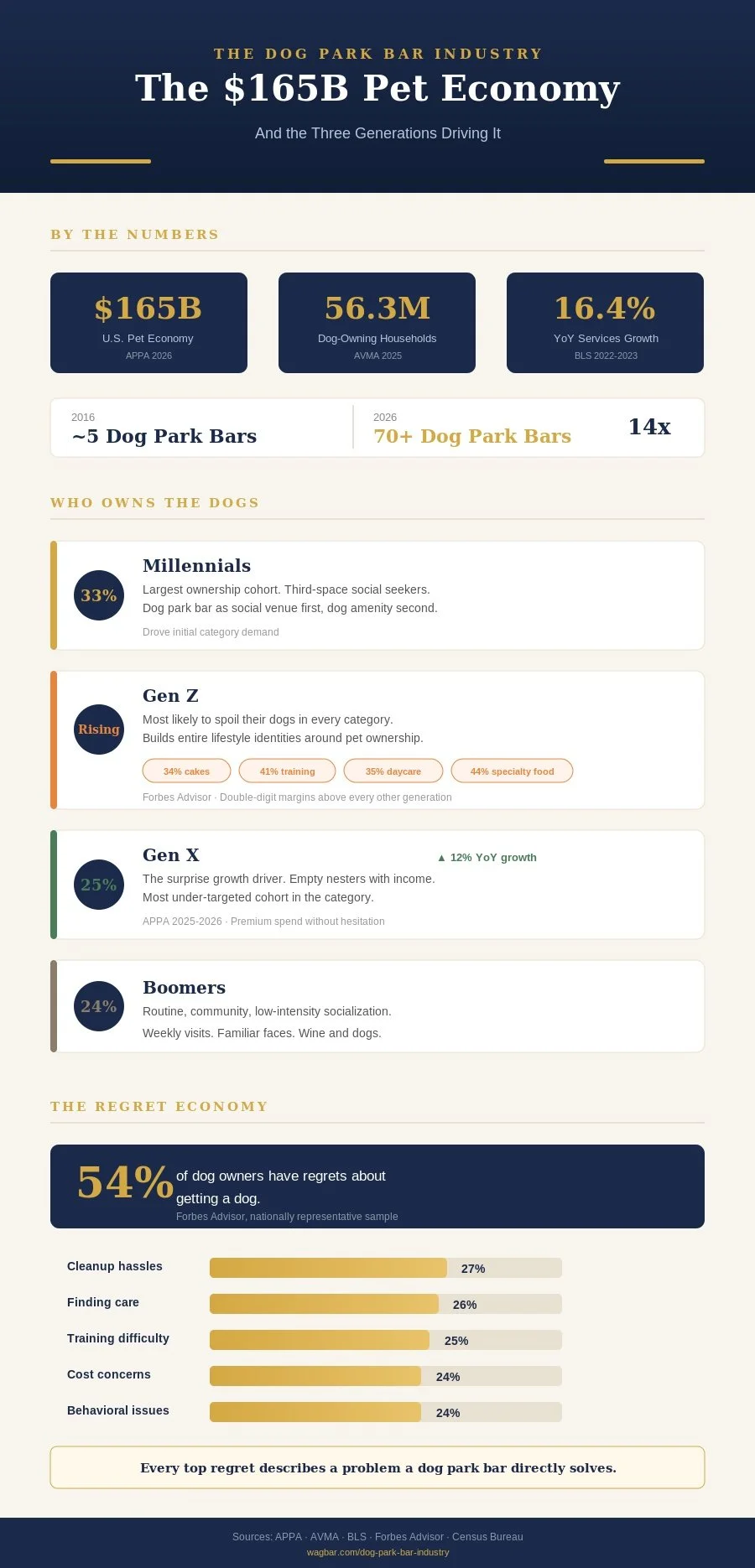
The AVMA reports 87.3 million dogs in the United States across 56.3 million households, averaging 1.6 dogs per dog-owning household. 97% of pet owners consider their pets family members. That is not a marketing stat. That is a structural shift in how Americans relate to animals, and it drives every spending decision in this category.
Pet ownership increases with income. 60% of households earning $80,000+ own pets. 63% of households earning $100,000+ own dogs specifically. These are not budget-constrained consumers. They are homeowners with disposable income who have already reorganized their lives around their animals.
The generational breakdown tells you who is walking through the door.
Millennials (33% of pet owners) are the largest ownership cohort. They treat the dog park bar as a social venue first and a dog amenity second. They are the ones posting Instagram stories of their golden retriever playing while they hold a craft IPA. They drove the initial demand for the category because they wanted third-space social experiences that included their dogs.
Gen Z is the most likely to spoil their dogs in every measurable category. 34% buy birthday cakes for their dogs. 39% buy presents. 41% invest in behavioral training. 35% use doggy daycare. 44% buy specialized pet food. These numbers exceed every other generation by double-digit margins (Forbes Advisor). Gen Z does not just own dogs. They build entire lifestyle identities around them. The dog park bar is the physical manifestation of that identity.
Gen X (25% of pet owners) is the surprise growth driver. APPA documented a 12% year-over-year increase in Gen X pet ownership in 2025 to 2026. The explanation is simple. Kids leave home. Income stays. The empty nest gets filled with dogs, and Gen X has the disposable income to spend on premium pet experiences without thinking twice. This is the cohort most operators are under-targeting.
And here is the data point that explains why this category exists more than any other. 54% of dog owners have regrets about getting a dog. That is Forbes Advisor, nationally representative sample. More than half of all dog owners have regrets. And the top regrets are not about the dog. They are about the infrastructure gap. 27% regret cleanup. 26% regret the difficulty of finding care. 25% regret training challenges. 24% regret cost. 24% regret behavioral problems. Every single one of those regrets describes a problem that a well-run dog park bar directly addresses.
Why Some Dog Park Bars Fail
The Bar K closure is the most instructive case study the industry has produced so far.
Bar K launched in Kansas City in 2018 with a two-acre outdoor dog park on the Berkley Riverfront. The concept was ambitious. A full-service restaurant, event spaces, satellite bars, and a large membership-based park. They expanded to St. Louis and Oklahoma City. They were named one of USA Today's best dog bars in 2024. They raised funding and hired a CEO to scale the brand.
Then, on July 29, 2025, they shut down all three locations with no warning. Employees learned about the closure through an internal app. Members with annual subscriptions received no refunds. The company cited "severe economic challenges" including inflation, labor costs, reduced consumer spending, and location-specific problems. In Kansas City, major construction projects had consumed parking and made the venue difficult to reach.
The pattern that emerges from Bar K and other closures points to a few consistent problems.
Over-investment in food service. Running a full kitchen inside a dog park bar dramatically increases complexity. You need kitchen staff, food safety compliance, inventory management, and equipment maintenance on top of everything required to operate a dog park and a bar. As FSR Magazine reported in April 2025, serving food on premises "complicates operations considerably, which is why many emerging dog bars are opting to only serve beverages and perhaps have rotating food trucks." The venues that avoid full-service kitchens and instead partner with food trucks or allow delivery have significantly lower operating costs and simpler compliance requirements.
Location access and lease costs. Bar K's Kansas City location was on the riverfront, which was appealing aesthetically but created vulnerability when construction disrupted access and parking. The St. Louis location carried a lease that apparently became unsustainable, evidenced by the unpaid rent lawsuit. Dog park bars need space, which means leases can be expensive. And unlike a restaurant that can be tucked into a strip mall, a dog park bar requires specific zoning, adequate lot size, and easy access for people carrying leashes and wrangling excited dogs.
Scaling too fast. Expanding from one location to three in different cities requires systems, capital, and management depth that most startups do not have. Bar K attempted to grow into a multi-city brand while still operating as a startup. They hired a CEO who left within months. Each new market introduced new zoning rules, new landlord relationships, new staff pools, and new customer acquisition costs. The revenue model for off-leash dog bars requires local density and repeat customers, which take time to build in each new market.
Membership pricing and retention. Dog park bars that depend heavily on membership revenue need to retain members month after month. When access becomes inconvenient (because of construction, weather, or location problems), members churn. When members churn faster than they are replaced, the business loses its financial floor. Bar K's decision to close without offering refunds to annual members suggests the cash reserves were already gone.
No enrichment differentiation. This one does not get discussed enough. Bar K and Off Leash both positioned themselves as hospitality-first concepts. Restaurant with a dog park. Bar with a fenced yard. The dog experience was secondary to the human experience. That is backwards. The venues that survive treat the dog experience as the core product and the bar as the complement. When your dog park is just a fenced area with no structured programming, no trained enrichment staff, and no behavioral standards beyond basic vaccination, you are competing with every free municipal dog park in your metro area. You need to give dog owners a reason to pay $35 to $55 a month, and "nicer fence" is not a reason.
Off Leash in Alpharetta, GA followed a similar trajectory. The concept was described as a "full-service restaurant and bar with a premium dog park." It closed after less than six months. The pattern holds. Higher operational complexity plus insufficient differentiation equals unsustainable burn rate.
What Successful Dog Park Bars Have in Common
The operators that are growing tend to share a specific set of characteristics. None of these are complicated, but together they create a model that is more resilient than the high-overhead alternatives.
Low Fixed Costs and Simple Operations
The most successful dog park bars run lean. They serve drinks, not dinner. They partner with food trucks rather than running kitchens. They use modular or container-based structures for the bar itself, which dramatically reduces buildout costs and timelines.
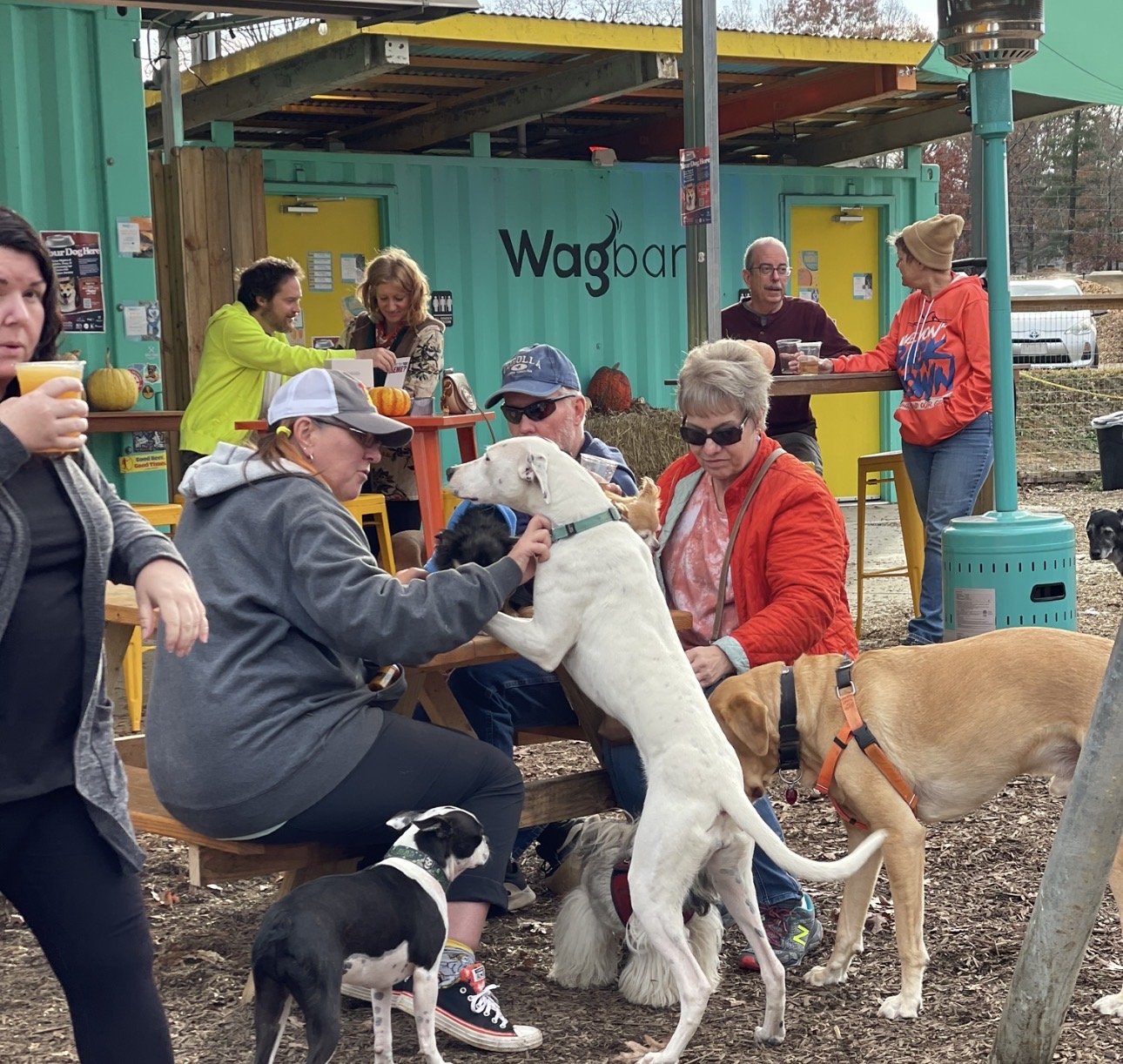
Wagbar's container bar system is a good example. The bar arrives substantially pre-built, which cuts construction time and contractor costs. MUTTS uses a similar approach with prefabricated 1,100-square-foot cantina structures that can be assembled in 10 to 12 weeks. This is not just a cost play. It is an operational simplification that keeps the staff focused on the two things that actually matter. Keeping dogs safe and pouring good drinks.
Recurring Membership Revenue
The membership vs. day pass model is the financial backbone of the category. Dog park bars that build a strong membership base create predictable recurring revenue that covers fixed costs regardless of weather, season, or foot traffic on any given day.
Most successful operators offer tiered pricing. Day passes for visitors and tourists, monthly memberships for regular locals, and annual memberships at a discount for committed members. The key metric is membership retention rate. Venues with strong community programming (trivia nights, breed meetups, live music, seasonal events) tend to retain members longer because the dog park bar becomes a weekly habit, not just an occasional outing.
Beverage-Focused Revenue
Bar revenue on a per-visit basis is where dog park bars make their margin. A customer who comes in with a $10 day pass and buys two $7 craft beers has generated $24 in a single visit. Multiply that across weekday evenings and packed weekend afternoons and the numbers work.
The drink menu does not need to be extensive. Local craft beer on draft, a selection of canned options, wine, hard seltzer, and a few cocktails covers the full range of customer preferences. Hot drinks and non-alcoholic options matter more than people think because they keep dog owners coming even when they are not in the mood for alcohol. The off-leash dog bar licensing requirements cover the regulatory side of beverage service, which varies meaningfully by state.
Community Building as a Business Strategy
This is the part that separates a good dog park bar from a great one. The venues that thrive do not just provide a space for dogs to play. They create a community that people want to belong to.
That means regular events. Weekly trivia, monthly breed meetups, holiday celebrations, live music, adoption events with local rescues. It means staff who know the regulars and their dogs by name. It means a social media presence that features the community, not just the brand.
Wagbar's Asheville flagship is a case study in community-driven success. It has been voted Best Pet Friendly Bar/Brewery at the Best of WNC Mountain Express awards multiple years running and landed on USA Today's 10Best Dog Bars list. That kind of recognition comes from the community, not from marketing spend. The social impact of dog-centric venues is real and measurable in retention rates, word-of-mouth referrals, and local media coverage.
Professional Dog Supervision
Every successful dog park bar employs staff specifically trained in group play dynamics. This is the single biggest differentiator from free public dog parks, where supervision is the owner's responsibility and incidents are common.
Trained staff monitor play continuously. They recognize warning signs before fights escalate. They enforce vaccination requirements and behavioral standards. They create the safe environment that justifies a membership fee and builds the trust that brings families back week after week. Venues that underinvest in this area, treating it as a cost center rather than a core feature, tend to have more incidents and worse retention.
Why Enrichment Is the Operational Edge
Here is what separates a dog park bar that lasts from one that closes in 18 months. The successful ones do not just let dogs run around in a fenced area. They run structured canine enrichment programming that gives every dog cognitive, sensory, social, and environmental stimulation during every visit.
This matters for three reasons.
First, it is what the science of canine enrichment says dogs actually need. Milgram's research at the University of Toronto demonstrated that dogs receiving consistent behavioral enrichment maintained cognitive function into old age while unstimulated dogs declined dramatically. Pop et al. showed enrichment increases BDNF (brain-derived neurotrophic factor) to near-young-dog levels. A dog park bar that provides real enrichment is not just entertaining dogs. It is maintaining their brain health. And dog owners who understand that will pay for it month after month.
Second, enrichment programming solves the retention problem that killed Bar K. When your dog park bar offers structured activities that change weekly, trained staff who adapt programming to each dog's needs, and measurable behavioral improvements that owners can see at home, you are selling outcomes, not access. A fence and a beer tap are commodities. Enrichment at Wagbar is a differentiated product. The member who watches their reactive dog learn to coexist calmly with other dogs over three months is not canceling that membership because it rained on Tuesday.
Third, enrichment drives the business metrics that matter. Dogs who receive structured social, cognitive, and sensory enrichment during visits are calmer, better socialized, and less likely to cause incidents. Fewer incidents mean fewer injury claims, lower insurance costs, and better online reviews. Better online reviews mean lower customer acquisition costs. Lower acquisition costs mean healthier unit economics. The enrichment investment pays for itself through operational improvements that show up on every line of the P&L.
The Wagbar enrichment model was built on this principle. The play environment is designed around the five categories of enrichment. Staff are trained to monitor and facilitate enrichment, not just supervise a yard. The result is a product that municipal dog parks and hospitality-first competitors cannot replicate, which is exactly what a sustainable business model requires.
Revenue Benchmarks and Unit Economics
Hard financial data on dog park bars is scarce because most operators are privately held and do not publish financials. But we can assemble a reasonable picture from franchise disclosure documents, industry reporting, and what operators have shared publicly.
Startup investment ranges vary significantly by model. Wagbar's franchise opportunity runs from approximately $470,000 to $1.1 million total, including a $50,000 franchise fee, 6% royalty, and 1% brand fund. MUTTS Canine Cantina's estimated initial investment ranges from $1.4 million to $1.7 million with a $40,000 franchise fee. Independent operators building from scratch can fall anywhere in that range depending on land costs, construction, and local permitting. The startup cost breakdown offers a structured approach to thinking through these numbers.
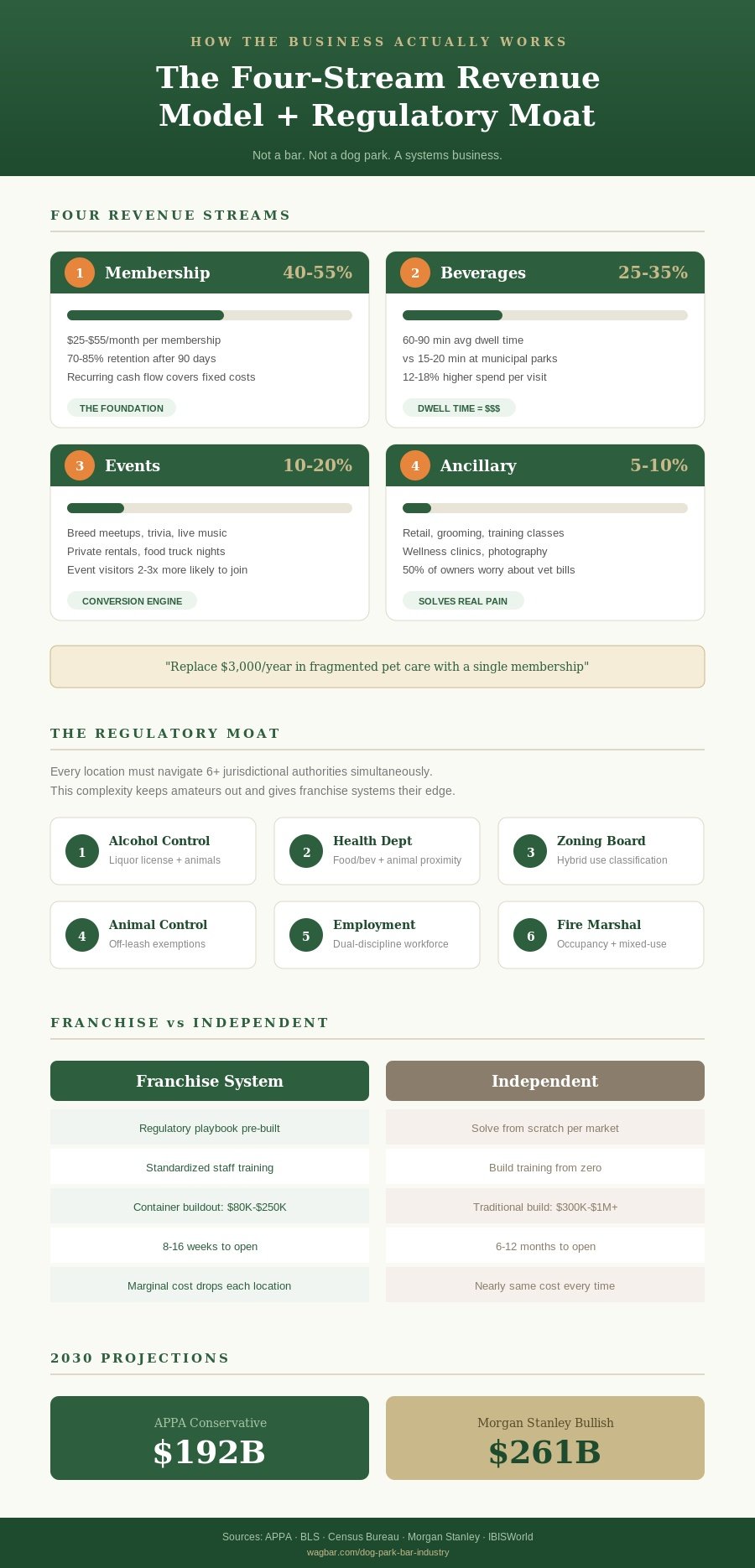
Revenue streams typically break down into three to four categories. Membership and day pass fees represent 30% to 50% of total revenue and serve as the most predictable stream and the foundation that covers base operating costs. Bar and beverage sales usually account for 35% to 50% of revenue and carry favorable cost of goods (typically 20% to 30%) compared to food-heavy models. Events, private parties, and merchandise fill in another 10% to 20%, with private event rentals being especially lucrative on weekday evenings and weekend mornings when regular traffic is lighter. Food truck partnerships generate modest revenue through either flat fees or percentage arrangements but more importantly keep customers on-site longer and increase bar spend per visit.
Labor costs are the biggest ongoing expense. Dog park bars need bartenders and park monitors at minimum. The staff training protocols include people who can both serve drinks and manage dogs safely, which is a specific skill set that not every hospitality worker possesses. BLS projects 11% employment growth for animal caretakers from 2024 to 2034, classified as "much faster than average." But the average pet care establishment employs just 6.9 people (Census Bureau). Franchise systems with standardized training protocols have a structural hiring advantage over fragmented independent operators competing for the same small labor pool.
Container-based bar construction adds another economic advantage. Shipping container buildouts cost $80,000 to $250,000 compared with $300,000 to $1,000,000+ for traditional commercial bar construction, and the timeline drops from 6 to 12 months to 8 to 16 weeks. When every location uses the same container specifications, brand consistency is built into the architecture.
Seasonality matters. Dog park bars in the Southeast, Sun Belt, and West Coast enjoy year-round operation. Venues in northern climates face reduced traffic in winter, which operators offset with heaters, covered areas, indoor spaces, hot beverages, and event programming.
The Regulatory Moat That Keeps Amateurs Out
Here is where the dog park bar stops being a cute idea and starts being a serious business with structural barriers to entry.
A single dog park bar location operates under six or more jurisdictional authorities simultaneously. Alcohol control board. Health department. Zoning board. Animal control. Employment regulation. Fire marshal. Sometimes more.
The venue needs a liquor license that accounts for animals on premises. Most state alcohol boards assume restaurants or bars, not hybrid concepts with enclosed off-leash areas. The physical separation requirements between alcohol service areas and dog play areas vary by state and often by local health department interpretation.
The venue needs a commercial off-leash exemption from state leash laws. Only Michigan and Pennsylvania have statewide leash requirements. The other 48 states delegate to municipalities, which means the legal analysis is different for every single location.
The venue needs anti-cruelty compliance for a business housing multiple dogs simultaneously. Staff training must cover breed-specific behavior signals, heat-stress recognition, fight-intervention protocols, and incident documentation. An employee who restrains a dog improperly can create criminal liability for the business.
The venue needs vaccination verification systems, parking lot protocols (32 states have laws about dogs left in vehicles), and insurance underwriting that covers both alcohol liability and animal-related incidents in a single policy.
This is not a compliance checklist. It is a competitive moat. Operators who master this complexity build a defensible position that casual competitors cannot replicate. And this is exactly why franchise systems are outpacing independents. An independent operator in a single market has to solve all of the above from scratch. A franchise system solves these problems once and deploys the playbook across markets.
Regional Expansion Patterns and Where the White Space Is
Dog park bars are not evenly distributed. The current concentration patterns reveal both where the concept works best and where the biggest growth opportunities exist.
Where dog park bars are concentrated. Texas leads the country in dog park bar density. MUTTS has multiple locations in DFW. Yard Bar operates in Austin. BARk House Social just opened in East Austin. The combination of warm weather, outdoor culture, high dog ownership, and relatively affordable commercial real estate makes Texas a natural hub.
The Southeast is the second strongest region. Wagbar's flagship and franchise expansion are anchored here, with locations in Asheville and Knoxville and franchise territories across the Carolinas, Georgia, and Virginia. Fetch Park has multiple locations in the Atlanta metro. The Southeast benefits from relatively long outdoor seasons, growing metros, and strong dog ownership rates.
Florida has several independent operators including Pups Pub (Orlando and Tampa) and The Dog Bar (St. Petersburg). The year-round warm weather is an obvious advantage, though summer heat requires shade infrastructure, misting systems, and pool features.
The Midwest is just starting. K9 Garden's opening in St. Louis, filling the space Bar K left behind, signals demand even after a high-profile failure. PG&J's in Louisville has built a strong following. Wagbar has a franchise territory in Cincinnati. But the Midwest remains under-served relative to population density and dog ownership.
The Northeast has the fewest dog park bars relative to its massive urban dog population. Park-9 Dog Bar in the Boston area and Dog Daze Social Club in DC are among the limited options. New York City, Philadelphia, and northern New Jersey represent enormous untapped markets. The challenge is real estate cost and availability, as the model requires significant outdoor square footage.
Where the white space exists. Denver has Skiptown but could easily support multiple venues given its dog ownership rates and outdoor culture. Wagbar has identified Denver as a target franchise market. Nashville, Portland, San Diego, and Seattle all have the right combination of dog-friendly culture, craft beverage scenes, and young professional populations, but limited or no dog park bar options.
Suburban markets in major metros are another frontier. The first wave of dog park bars concentrated in urban cores. But dog ownership is even higher in suburbs, lot sizes are more available, and commercial rents are lower. The best cities for dog franchise success emphasizes communities with median household incomes above $75,000, pet ownership rates above the national average, and existing pet service infrastructure.
Forbes Advisor ranks Colorado, Virginia, Georgia, Alaska, and Nevada as the top states for devoted dog owners. The best cities for pet owners (Tucson, Raleigh, Nashville, Wichita, Cincinnati) combine moderate cost of living, high pet-ownership rates, and outdoor cultures that favor dog park bar concepts. States with high dog-owner devotion scores and low existing venue density represent white space. The Northeast corridor, the Pacific Northwest, and large swaths of the Midwest have the demographic demand and the income levels but not the venues.
Where the Industry Is Heading by 2030
APPA's conservative projection places U.S. pet spending at $192 billion by 2030. Morgan Stanley's bullish alternative says $261 billion. BLS projects 11% animal-care employment growth through 2034. The global pet-friendly cafe market is growing at 7.6% CAGR through 2032, nearly four times GDP.
The dog park bar category in 2030 will look structurally different from 2026.
Franchise systems will dominate growth. Independent operators will continue opening, but the fastest growth will come through franchise systems that can replicate proven models across markets. The franchise approach solves the hardest problems facing independent operators. Site selection, buildout design, operational training, supply chain, and marketing systems. The franchise ownership model explains why this structure works particularly well for concepts with operational complexity.
The full-service restaurant model will keep struggling. The evidence from Bar K and Off Leash suggests that combining a full-service restaurant with a dog park creates more problems than it solves. Expect the winning formula to remain drink-focused. A great bar program, food truck partnerships for variety, and maybe a limited snack menu. The outdoor vs. indoor dog business comparison explores this operational trade-off in detail.
Indoor/outdoor hybrid venues will grow. Climate constraints limit the category in northern markets. The solution is hybrid venues with both indoor and outdoor play areas, climate control, and the ability to operate year-round. Park-9 in the Boston area already runs this model. Expect more purpose-built indoor/outdoor facilities as the concept moves north and west.
Enrichment programming will become the standard. The operators who treat the dog experience as their core product, not a backdrop for beer sales, will outperform. Structured enrichment programming, trained staff, and measurable behavioral outcomes will separate the venues that retain members at 80%+ from the ones that churn through customers and close within two years.
Technology will improve operations. Digital check-in systems, vaccination record management, membership apps, and capacity monitoring tools are already in use at the better-run venues. As the category matures, technology will handle more of the administrative burden, allowing staff to focus on what matters. Watching the dogs and serving the customers.
The category will consolidate. Right now the industry uses "dog park bar," "dog bar," "off-leash dog bar," "off-leash bar," "dog park and bar," and half a dozen other variations interchangeably. As the category matures and media coverage increases, a standard term will emerge. The search data suggests "dog park bar" is winning, but "dog bar" runs a close second. Either way, the category is moving from "interesting concept" to "established industry segment" in real time.
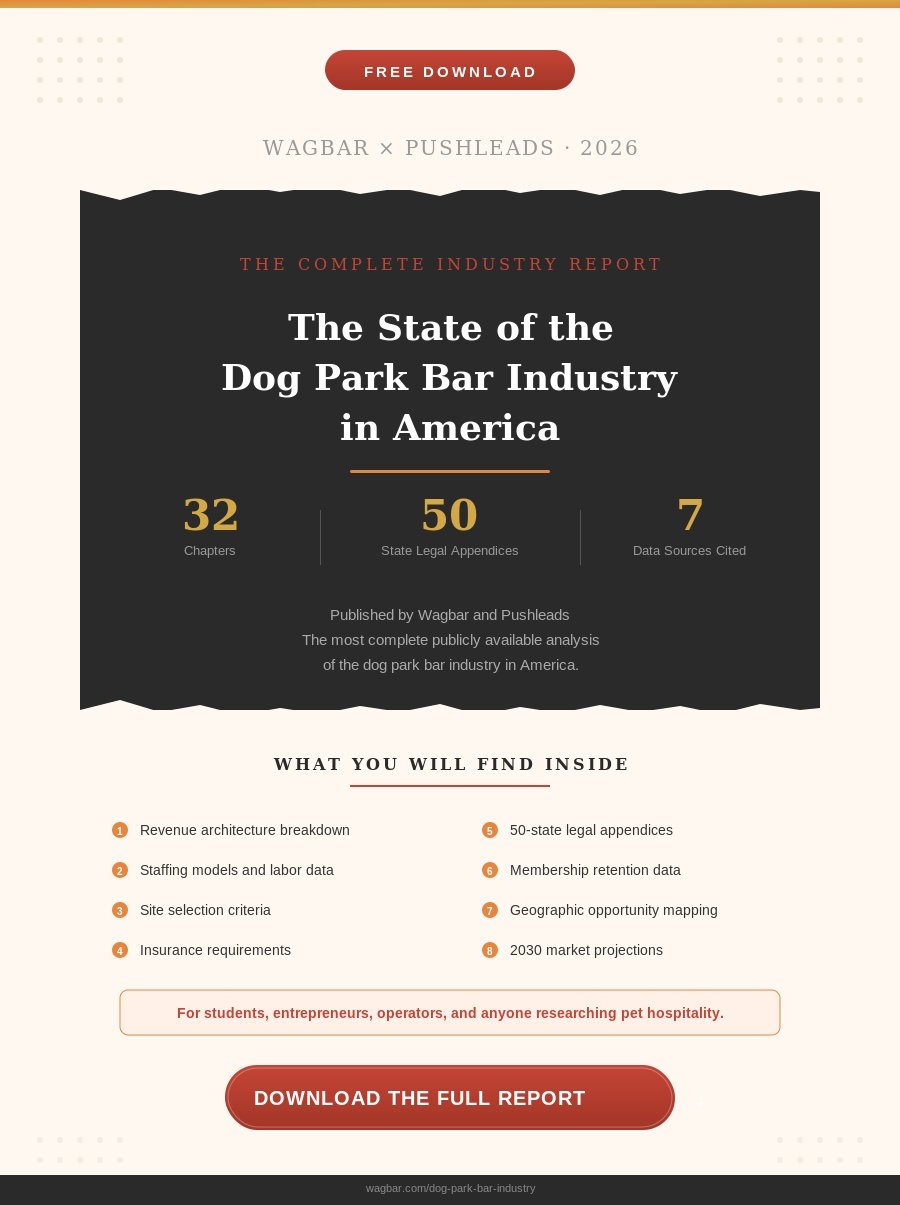
The Full Industry Report
Wagbar and Pushleads published a 2026 industry report covering everything in this overview and significantly more. 32 chapters. 50-state legal appendices for leash laws, anti-cruelty statutes, dogs-in-vehicles laws, outdoor dining regulations, and possession bans. Detailed breakdowns of revenue architecture, unit economics, staffing models, insurance requirements, site selection criteria, membership retention data, and geographic opportunity mapping.
If you are a student researching the pet-hospitality intersection, an entrepreneur evaluating this space, or an existing operator benchmarking your business, the full report is the most complete publicly available analysis of the dog park bar industry in America.
FAQs
How many dog park bars are there in the United States?
As of mid-2026, we estimate 60 to 70 dog park bars are currently operating in the US. This includes independent single-location operators, multi-unit brands like MUTTS Canine Cantina and Fetch Park, and franchise locations from brands like Wagbar. The number is growing by roughly one to two new openings per month.
Why did Bar K close?
Bar K permanently closed all three locations (Kansas City, St. Louis, and Oklahoma City) in July 2025. The company cited severe economic challenges including inflation, rising labor costs, reduced consumer spending, and location-specific problems. The Kansas City location was impacted by construction that limited access and parking. The St. Louis location had faced a $298,000 unpaid rent lawsuit.
How much does it cost to open a dog park bar?
Investment ranges vary by model. Wagbar franchise locations require an estimated total investment of $470,000 to $1.1 million. MUTTS Canine Cantina franchises range from $1.4 million to $1.7 million. Independent operators can fall anywhere in that range depending on land, construction, and local requirements. The biggest variable is whether the model includes a full-service kitchen, which adds significant cost and complexity.
Are dog park bars profitable?
The operators that run lean, beverage-focused models with strong membership bases report healthy margins. Dog business franchise performance depends on location, membership volume, bar revenue per customer, and labor efficiency. Venues that avoid full-service kitchens and maintain high membership retention tend to perform best. Venues that over-invest in food service or expand too quickly face higher risk of financial strain.
What is the difference between a dog park bar and a dog-friendly bar?
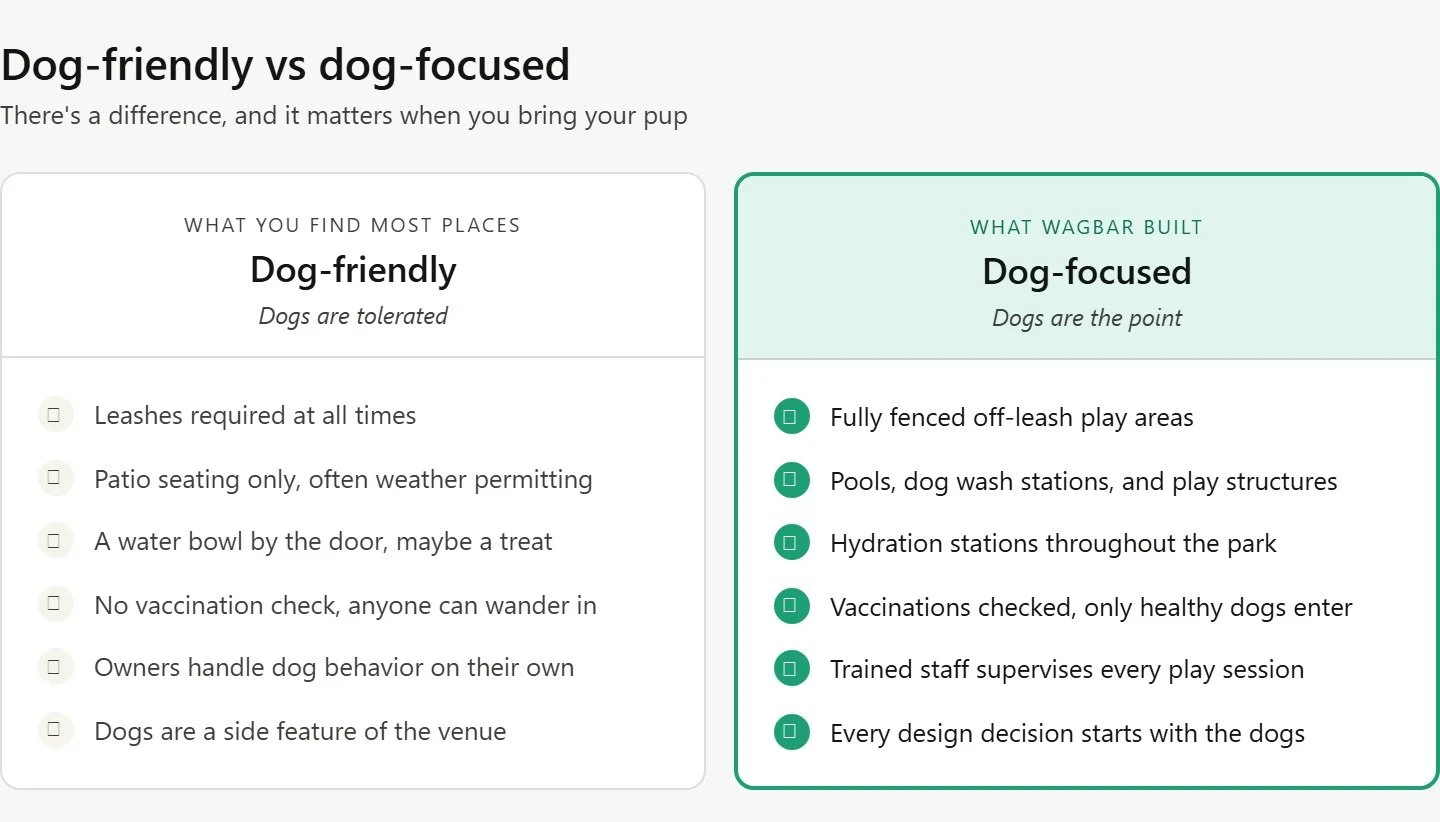
A dog park bar has a fenced, supervised off-leash play area where dogs can run freely. Dogs typically need vaccinations and a membership or day pass. A dog-friendly bar is a regular bar that allows dogs on a leash, usually on an outdoor patio. The experiences are fundamentally different in terms of what the dog gets out of it.
What makes Wagbar's model different from other dog park bar brands?
Wagbar uses a container bar system that arrives substantially pre-built, reducing construction costs and timelines. The model is beverage-focused without a full-service kitchen, which simplifies operations. The core differentiator is structured enrichment programming built on peer-reviewed canine cognition research, not just a fenced yard with a bar attached. Franchisees receive training and support, on-site opening assistance, and ongoing business reviews.
Which dog park bar franchise brands are currently expanding?
The two most active franchise brands are Wagbar, with 16+ territories sold and locations operating in Asheville, NC and Knoxville, TN, and MUTTS Canine Cantina, with locations in Texas and franchise development in Arizona, Colorado, and Kansas. Both brands are actively seeking franchisees in new markets.
Where are dog park bars most popular?
Texas and the Southeast US have the highest concentration. Florida, the Midwest, and California are growing. The Northeast remains significantly under-served despite having massive urban dog populations. Markets with high dog ownership, outdoor social culture, and craft beverage scenes tend to support dog park bars well.

Every Month a New One Opens: The Map Still Has Gaps and Yours Might Be One of Them
From 5 locations in 2016 to 70+ in 2026. From a novelty concept to a category inside the fastest-growing consumer economy in American retail. The dog park bar is not an experiment anymore. It is an industry with proven unit economics, franchise infrastructure, and a demographic tailwind that every major research firm projects will accelerate through the end of the decade.
The operators who built on research, enrichment, and operational discipline are growing. The ones who built on vibes and full-service kitchens are closing. The pattern is clear. The white space is real. The question is whether you will be the operator who fills it or the customer who wishes someone had.
Visit your nearest Wagbar location to see the model in person. Or explore what it takes to bring one to your market.
Bottom TLDR: The dog park bar industry grew from roughly 5 locations in 2016 to 60 to 70+ by mid-2026. The category sits inside a $158 billion U.S. pet economy (APPA 2025) projected to reach $165 billion in 2026. 56.3 million U.S. households own dogs (AVMA). 97% consider pets family. 54% of dog owners have regrets, and the top regrets (care, socialization, training) are exactly what a dog park bar solves. Bar K's closure of all three locations in July 2025 proved that over-investment in food service, aggressive scaling, and lack of enrichment differentiation are the primary failure patterns. The operators succeeding run lean, beverage-focused models with recurring membership revenue, structured enrichment programming, and genuine community ties. Six+ jurisdictional authorities govern each location, creating a regulatory moat that franchise systems are best positioned to navigate. APPA projects $192B in U.S. pet spending by 2030 (conservative). Morgan Stanley projects $261B (bullish). Geographic white space exists across the Northeast, Midwest, and Pacific Northwest. The full 32-chapter Wagbar/Pushleads 2026 industry report provides the complete analysis for entrepreneurs, students, and operators.
Sources
APPA (American Pet Products Association). State of the Industry Report, 2026. U.S. pet industry sales, projections, and demographic data.
U.S. Bureau of Labor Statistics. Consumer Expenditure Survey, 2023. Occupational Outlook Handbook, Animal Caretakers, 2024-2034 projections.
Forbes Advisor. Pet Owner Statistics and Spending Survey, 2024. Nationally representative sample.
U.S. Census Bureau. County Business Patterns, NAICS 812910, 2018-2023.
AVMA. 2025 Pet Ownership and Demographic Sourcebook.
Morgan Stanley. Pet Industry Market Projections, 2030.
Stratistics MRC. Global Pet-Friendly Cafes Market, 2025-2032.
FSR Magazine. "Are Dog Park Bars the Next Big Hospitality Trend?" April 2025.
IBISWorld. Dog Park Design Services Industry Report, 2026.