
The Dog Park Bar as a Third Place: How Off-Leash Bars Became Community Hubs
Top TLDR: Dog park bars have become genuine third places where strangers connect through their dogs, building real community in a way most adult social venues can't match. With 67% of U.S. households owning pets, off-leash bars like Wagbar tap into a built-in social network and give it a physical home. If you're looking for consistent in-person connection, showing up with your dog is one of the most effective ways to find it.
There's a term sociologists use for spaces that aren't home and aren't work: the "third place." Coffee shops, barbershops, community parks, local bars. These are the spots where people gather not out of obligation but because they want to be there, where regulars know each other by name and newcomers feel welcome almost immediately.
Dog park bars fit that definition almost too well.
In the last decade, off-leash bar concepts have grown from a quirky idea into a recognized category of community venue. Places like Wagbar have figured out something most businesses spend years chasing: a reason for people to show up consistently, stay longer than they planned, and leave knowing someone they didn't know before.
This isn't just a nice story. It's a social phenomenon worth understanding.

What Ray Oldenburg's "Third Place" Theory Actually Says
Ray Oldenburg was a sociologist who spent years thinking about why some neighborhoods feel alive and others feel hollow. His 1989 book The Great Good Place laid out what he called the "third place" concept: informal gathering spots that serve as the heart of community life, separate from home (first place) and work (second place).
His list of what makes a true third place is specific. The space has to be free or cheap to access. It should be welcoming to people of all backgrounds. The mood should be playful rather than serious. Conversation has to be the main activity. And crucially, there have to be regulars, people whose presence defines the character of the place.
Think about a great local diner, a barbershop where everyone knows everyone, a neighborhood bar where the bartender remembers what you drink. Those places do something that chain restaurants and big-box retail never can: they make people feel like they belong somewhere.
By Oldenburg's criteria, a well-run off-leash dog bar checks every box. Entry is affordable. The atmosphere is, by design, lighthearted. Conversation starts the moment two dogs approach each other. And the regulars? They're the ones whose dogs already know each other by name.
The Loneliness Problem That Dog Park Bars Actually Help Solve
In 2023, the U.S. Surgeon General issued an advisory declaring loneliness and social isolation a public health crisis (U.S. Surgeon General, 2023). According to that report, about half of American adults reported measurable loneliness, with younger adults faring particularly poorly despite being constantly connected online.
What's interesting is that the problem isn't a lack of technology or information. People have access to more social platforms than ever. The problem is a lack of low-stakes, recurring, in-person connection. The kind of connection that used to happen naturally when neighborhoods had gathering places.
A 2019 study published in the journal PLOS ONE found that people who visited "third places" regularly reported significantly higher levels of social satisfaction and had more close friends than those who didn't (Enns, Mayrhofer, et al., PLOS ONE, 2019). The researchers specifically noted that places with regulars and a sense of belonging made the biggest difference.
Dog park bars slot into this gap in a way that regular bars don't. Alcohol lowers inhibitions but doesn't give strangers something to talk about. Dogs do both. When your dog charges across a yard toward someone else's dog, a conversation starts whether you planned it or not. The dogs take care of the awkward introduction. The humans just have to show up.
According to data from the APPA, 67% of U.S. households owned a pet in 2023, and dogs remain the most popular choice by a wide margin. That's a huge slice of the adult population that already shares a common identity, common experiences, and common daily rhythms. Dog park bars tap directly into that existing community and give it a physical home.
How the Social Dynamics Actually Work
If you've spent time at a place like Wagbar, you've probably noticed something: the conversations start fast.
At a standard bar, most people arrive with their own group and mostly stay in it. There's a built-in social ceiling. But at an off-leash dog bar, the yard itself breaks that ceiling. Dogs don't respect social boundaries. A Golden Retriever will run straight into the middle of three strangers and suddenly all three people are laughing and swapping names. The dog did in thirty seconds what no amount of social courage could accomplish.
Dog owners also share something unusually specific: the daily reality of caring for another creature. You know their sleep schedule affects yours. You've picked up waste in the rain. You've canceled plans because your dog needed something. That shared experience creates an instant shorthand with other dog owners that most adult friendships take months to develop.
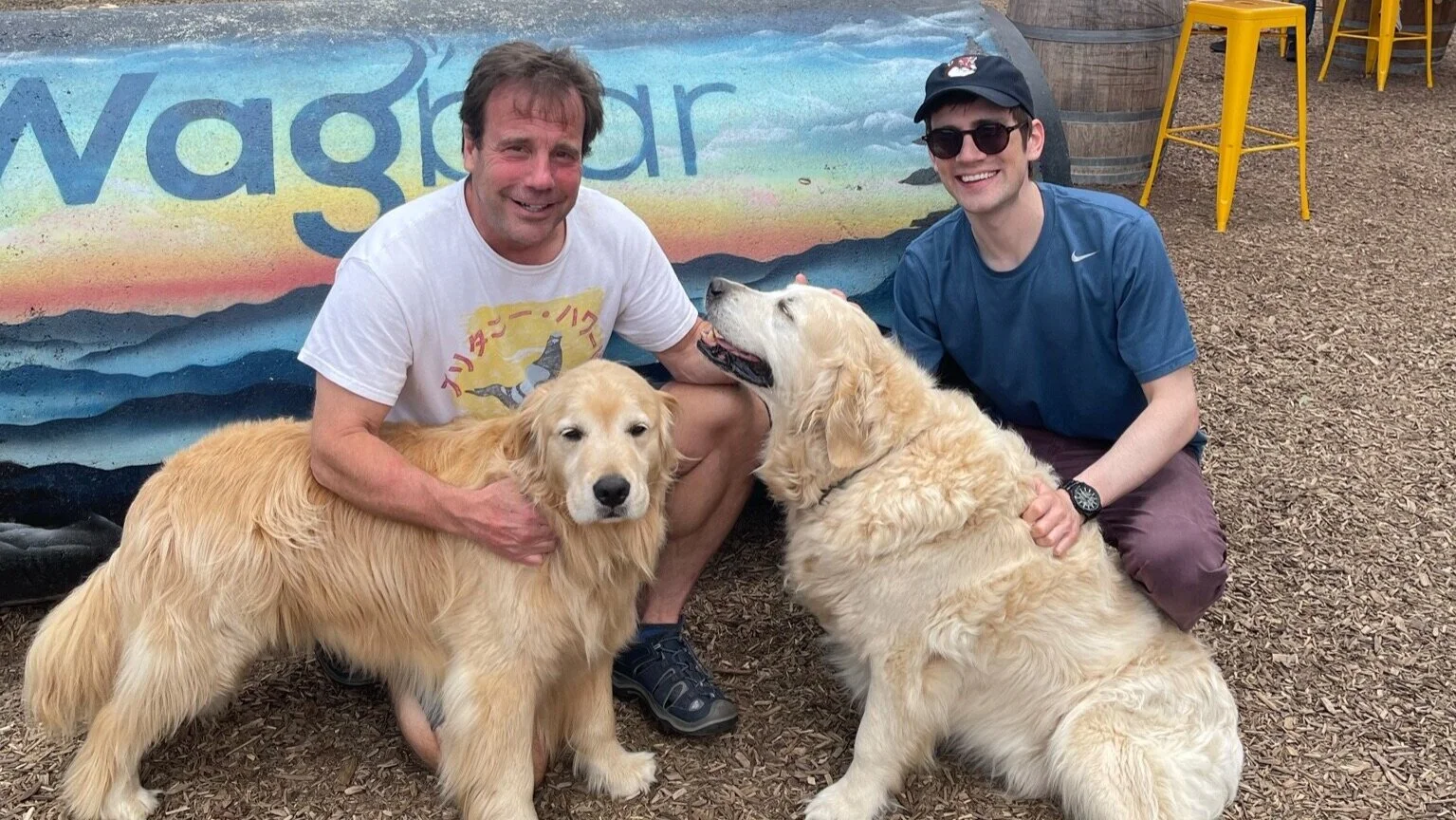
The regulars culture matters here too. At Wagbar's flagship location in Asheville's Weaverville area, the same faces show up at the same times on the same days. Staff learn names. Dog names often come first. People start tracking each other's dogs' progress, noticing when a shy rescue has finally come out of its shell, celebrating when a dog who used to hide behind its owner is now playing confidently in the middle of the yard. These are small things, but they're exactly the kind of accumulated, shared moments that build real social fabric.
For a practical guide on how to prepare your dog for this kind of environment, check out Wagbar's beginners guide to playing at the park. And if you're wondering how to read what's actually happening between dogs in the yard, Wagbar's dog body language guide is a useful starting point.
The Programming That Turns a Venue into a Community
A physical space can have great bones and still feel empty. What turns a dog park bar into a genuine community hub is programming: the recurring events that give people a reason to come back on specific days, the special occasions that become traditions.
Wagbar has built a programming calendar that reads less like a bar's events lineup and more like a neighborhood association's community calendar.
Trivia nights are a staple. Tuesday trivia at Wagbar runs from 6 to 8 PM. Dogs enter free after 5. It gives groups a reason to show up together, gives regulars a weekly ritual, and puts strangers in the same situation at the same time. Competitive games have a way of lowering social walls quickly.
Breed meetups are probably the most community-forward events on the calendar. Twice a month, Wagbar holds specific breed gatherings like the Poodles and Doodles meetup or the Smush Face Breed Meetup for bulldogs, Boston Terriers, and pugs. These aren't just cute marketing. For owners of specific breeds, finding other people who understand your dog's quirks, health tendencies, and personality is genuinely valuable. These events create micro-communities within the broader community.
Live music turns an ordinary evening into something to look forward to. Wagbar has featured rotating local artists and an open mic on Wednesday nights, hosted by Billy Litz. Live music draws people who might not come otherwise, introduces them to the venue through a different lens, and creates the kind of ambient, relaxed energy that makes conversations feel natural.
Dog adoption events are perhaps the highest expression of Wagbar's community identity. Hosting adoptions isn't a marketing exercise. It's a direct expression of care for the local animal community, and it draws people who love dogs deeply, exactly the kind of people who become long-term regulars.
Holiday events and seasonal programming like the Bunny Bash in spring or the Memorial Day potluck give the community annual touchstones. When you've attended the same event for two or three years running, you've started to feel like you belong to something that has continuity.
For more on dog socialization and behavior in group settings, Wagbar has a dedicated resource that explains what's actually happening when dogs play together and why it matters.
What Wagbar Members Say
The reviews that show up for Wagbar aren't primarily about the drinks or the facilities, though those get mentioned. What people consistently lead with is the feeling of the place.
Chris S. wrote: "Such a cool spot. Based around a shipping container that serves a good selection of drinks, with two pretty large open areas that hosts plenty of bar-style and bench seating, rotating food trucks, and plenty of sweeeet puppies. Ours absolutely loved it."
Adam A. put it directly: "I remain amazed how few of these dog bars there are. It's such an obvious concept: create an enjoyable spot to imbibe your favorite beverage while your dog(s) get to run around and enjoy themselves. Wagbar is an excellent example of the potential. Friendly staff, great selection of local beers, beverages, snacks and food in a very nice setting."
Drew B. noted something specific about the staff: "The staff is very attentive to breaking up any roughhousing so you and your pup can enjoy in peace. All dogs are checked for vaccine requirements and you feel very secure."
Miller W. described bringing his dog Sage for her first-ever dog park visit: "My pup Sage's first time at a dog park and I wanted it to be a good experience for myself and her, and boy did Wagbar knock the tennis ball outta the park."
What's consistent across these reviews is the sense of being genuinely welcomed, in a space where both you and your dog can be fully relaxed. That's not a vibe you manufacture. It's something that builds over time through consistent attention to safety, good programming, and real staff who care about the place.
Why Dog Park Bars Matter for Cities and Neighborhoods
This isn't just about the individual experience. When third places function well, they change the character of a neighborhood.
Research on urban planning and public health consistently shows that communities with more informal gathering spaces have lower rates of social isolation, stronger civic participation, and better mental health outcomes for residents (Lund, Journal of Planning Education and Research, 2002). The physical presence of a place where people can just show up without a formal reason does something to the social texture of an area.
Cities are full of places designed for transactions. Stores, restaurants, services. Even most bars have a commercial logic that shapes the experience: buy something, sit down, leave. Third places invert that logic. The point isn't the transaction. The point is the time spent there.
Dog park bars also solve a specific urban dog owner problem. According to a 2022 study from the American Veterinary Medical Association (AVMA, 2022), dogs in urban environments are significantly more likely to have socialization deficits than dogs in suburban or rural areas, primarily because they have fewer opportunities for consistent off-leash interaction with other dogs. Wagbar and venues like it directly address that gap, creating regular access to the kind of socialization that helps dogs stay behaviorally healthy.
That matters to neighborhoods too. Well-socialized dogs create well-socialized dog owners who feel comfortable in shared public spaces. It's a positive feedback loop.
For anyone thinking about what this kind of business could mean for their own community, the Wagbar franchising page has information on what it takes to bring this model to a new city. There are already locations opening or announced in Knoxville, Richmond, Myrtle Beach, Cincinnati, and beyond.
The Regulars Are the Product
Here's the thing about third places that's easy to miss: the business itself isn't really the product. The regulars are.
A new bar can have great drinks and a nice patio. But it doesn't have the guy who shows up every Tuesday with his Bernese Mountain Dog and somehow knows everyone. It doesn't have the two women who met six months ago when their dogs started playing together and now coordinate their visits. It doesn't have the staff member who remembers that one dog was nervous on its first visit and now watches it run confidently through the middle of the yard.
Those things take time. They require a space that's consistent, safe, and genuinely welcoming over months and years. They require programming that gives people recurring reasons to show up. And they require an environment where dogs are as much a part of the social fabric as their owners.
That's what Wagbar has built in Weaverville, and it's what new locations are working to replicate in cities across the country. The physical space is the container. The community is what fills it.
Understanding dog park behavior and group play dynamics helps owners make the most of every visit, and it deepens the experience once you start recognizing the recurring personalities in the yard, both canine and human.
Frequently Asked Questions
What is a "third place" and why does it apply to dog park bars?
A third place is a sociologist's term for an informal gathering spot that isn't home or work, somewhere people go because they want to, where regulars form and community builds over time. Classic examples include coffee shops, barbershops, and neighborhood bars. Dog park bars meet every criterion: low-barrier entry, a playful atmosphere, built-in conversation starters through the dogs, and a regulars culture that develops over months of consistent visits.
Do you have to bring a dog to visit Wagbar?
No. Wagbar is open to all guests 18 and older, with or without a dog. Human entry is free. The off-leash park section requires dogs to meet vaccination and age requirements, but the social area is open to everyone. Some of the most consistent regulars don't have dogs of their own but love being around them.
What vaccinations are required for dogs at Wagbar?
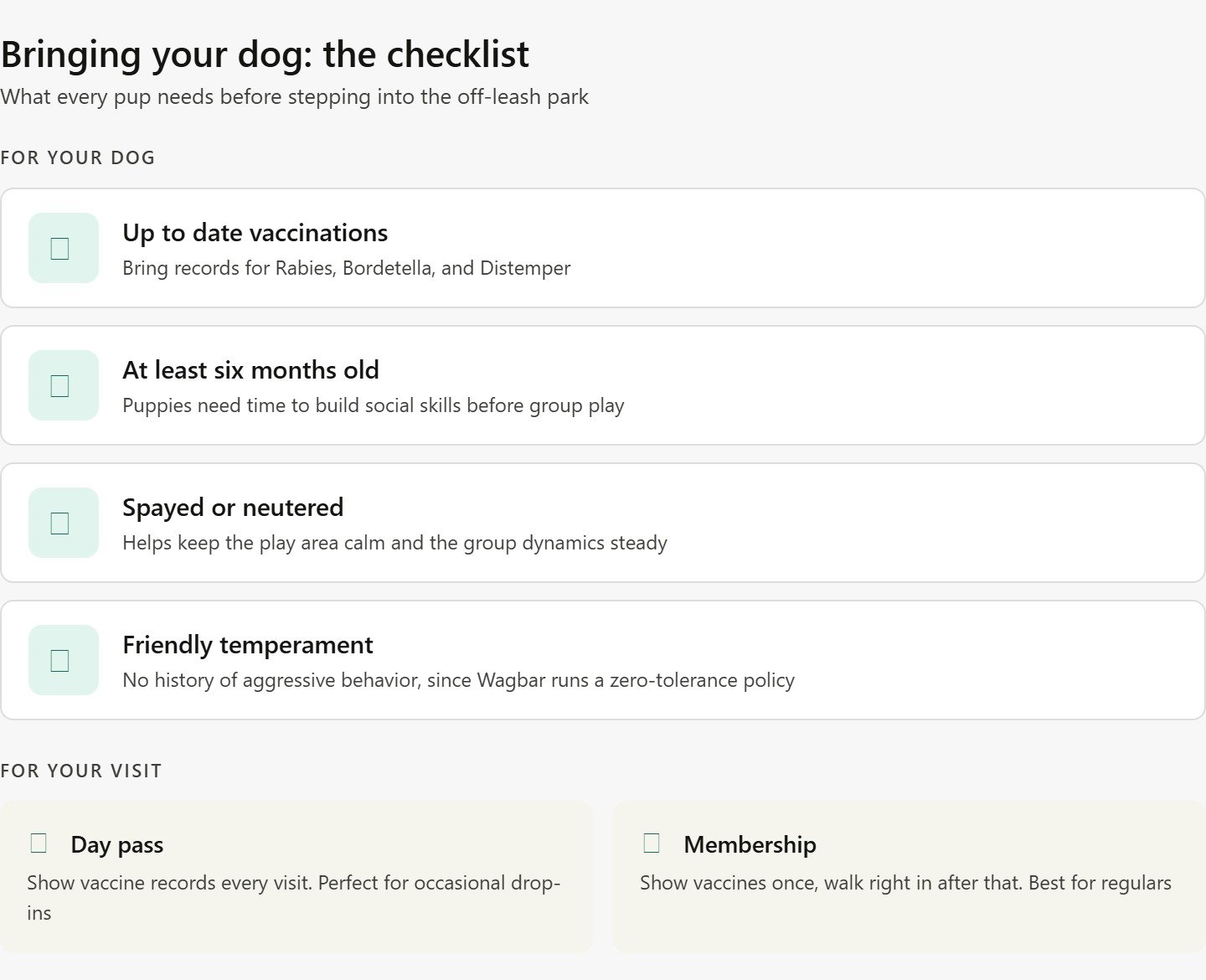
Dogs must be up to date on Rabies, Bordetella, and Distemper vaccinations. They must also be at least 6 months old and spayed or neutered. Proof of vaccinations is required on each day pass visit; members only need to provide it on their first visit. You can find full details on the Wagbar FAQ page.
What kind of events does Wagbar host?
Wagbar's programming typically includes weekly trivia nights, recurring breed meetups, live music nights, open mic nights, dog adoption events, food truck nights, holiday celebrations, and seasonal events. Specific schedules vary by location and season. Check your local Wagbar's social media for current events.
How does Wagbar handle aggressive dogs or difficult situations?
Wagbar has a zero-tolerance policy for aggressive behavior from both dogs and humans. Trained staff monitor the off-leash area and intervene when needed. Dogs with a history of aggression are not permitted to become members. If any issue arises, guests are asked to report it to staff immediately, and the situation is addressed directly.
What does an off-leash dog bar do for a dog's social development?
Regular exposure to off-leash social environments with other dogs builds confidence, reduces anxiety, and teaches dogs how to read and respond to other dogs' body language. This is especially important for urban dogs who have fewer opportunities for this kind of interaction. See Wagbar's dog socialization guide for more on how this works.
Are there Wagbar locations outside of Asheville?
Yes. Wagbar started in Weaverville, NC (North Asheville area) and has been expanding through franchising. Locations are currently open or announced in Knoxville, TN, Richmond, VA, Myrtle Beach, SC, Cincinnati, OH, Dallas, TX, and more. Visit the Wagbar locations page for the current list.
Can I host a private event at Wagbar?
Some Wagbar locations offer private event space. It's suitable for birthday parties, corporate gatherings, and other group events. Contact your local Wagbar directly or visit their location page for specifics on availability and booking.
Summary
Dog park bars have become genuine third places because they solve a specific gap in modern social life: they give adults a recurring, low-pressure reason to show up somewhere and talk to people they didn't know. Dogs act as icebreakers that no app or event format can replicate. Regular programming like trivia nights, breed meetups, and live music turns casual visitors into regulars, and regulars into a community. For cities facing real challenges around social isolation, venues like Wagbar aren't just fun. They're functional.
Bottom TLDR: The dog park bar as a community hub works because dogs remove the awkward part of meeting strangers, and regular programming turns one-time visitors into long-term regulars. Places like Wagbar function as third places in the truest sense: spaces people return to not out of obligation, but because they want to. If your city doesn't have one yet, that's a gap worth paying attention to.