

Tertiary vs. Secondary Markets for Pet Franchise Investment: Where the Money Often Is

Top TLDR: Secondary and tertiary markets consistently outperform large metros for pet franchise investment when you account for site costs, operating expenses, and competitive density. A market of 200,000-600,000 residents with strong dog ownership and limited off-leash infrastructure often offers better returns than a 3-million-person metro where land costs alone push total investment toward the ceiling. Start your market search one tier below the obvious choices.
The instinct most franchise candidates follow is to target the biggest market they can reach. More people means more potential members, which means more revenue. The logic seems airtight -- until you run the actual numbers on what it costs to open in a primary market versus a secondary or tertiary one.
For an off-leash dog park bar, where the footprint requires 1-2 acres of commercial land and the revenue model depends on recurring membership, the math often flips. The off-leash dog park bar concept doesn't scale with population the way a consumer product does. It scales with the density of the right kind of consumer within a specific drive radius -- and that consumer exists in markets of all sizes.

The Assumption That Doesn't Hold Up
Here's what most franchise candidates assume: more population equals more customers equals more revenue. That's partially true. But it ignores the other side of the equation entirely.
Primary markets -- the 15-20 largest U.S. metros with populations above 2 million -- come with corresponding costs. Commercial land costs two to four times what it costs in a well-chosen secondary market. Labor rates run higher. Lease rates run higher. Permitting timelines run longer. Franchise candidates who anchor on primary markets often find themselves at the top of the $470,300-$1,145,900 total investment range before they've opened a single membership.
This information is not intended as an offer to sell, or the solicitation of an offer to buy, a franchise. It is for information purposes only. An offer is made only by Franchise Disclosure Document (FDD). Currently, the following states regulate the offer and sale of franchises: California, Hawaii, Illinois, Indiana, Maryland, Michigan, Minnesota, New York, North Dakota, Oregon, Rhode Island, South Dakota, Virginia, Washington, and Wisconsin. If you are a resident of, or wish to acquire a franchise for a Wagbar to be located in one of these states or a country whose laws regulate the offer and sale of franchises, we will not offer you a franchise unless and until we have complied with applicable pre-sale registration and disclosure requirements in your jurisdiction. Wagbar Franchising LLC, (828) 554-1021, 7 Kent Place, Asheville, NC, 28804
Secondary and tertiary candidates, meanwhile, often land in the middle or lower portion of the same range -- with a comparable or stronger consumer base for the specific membership product they're selling. The regional patterns in pet spending show that premium pet service spending is not concentrated in the largest metros. It's distributed widely across markets of all sizes.
How Market Tiers Are Defined
For this analysis, the tiers work roughly like this:
Primary markets are metro statistical areas with populations above 2 million -- the nation's largest cities and their suburbs. Think Dallas, Phoenix, Los Angeles, Atlanta, Philadelphia. High consumer base, high competition, high operating costs.
Secondary markets range from 500,000 to 2 million people. These include cities like Richmond VA, Knoxville TN, Greenville SC, Savannah GA, and Colorado Springs CO. Established infrastructure, recognizable consumer culture, meaningfully lower land and labor costs than primary markets.
Tertiary markets sit between 150,000 and 500,000 people. Asheville NC, Myrtle Beach SC, Frederick MD, and similar markets fall here. These markets can look thin on paper but often carry surprisingly high household incomes and dog ownership rates -- particularly in markets that attract outdoor-oriented, college-educated, younger residents.
The right question isn't "which tier is best?" It's "which tier produces the best ratio of customer density to site cost for this specific concept?" For an off-leash dog bar, the answer is often secondary, and sometimes tertiary.
The Real Estate Math
The clearest argument for smaller markets is land. A 1.5-acre commercial parcel in a suburban corridor of a secondary market might lease at $8,000-$15,000 per month. The equivalent in a primary market can run $25,000-$50,000 per month or more, in markets where usable 1-2 acre parcels near residential density exist at all.
That difference compounds across your full investment period. A franchisee in a well-chosen secondary market can potentially recoup their site investment faster not because they're running higher revenue, but because they're running dramatically lower site costs against a comparable (or only modestly smaller) member base.
This is one of the least-discussed advantages in pet franchise investment analysis. The conversation usually centers on revenue potential, which skews toward large markets. The conversation should center on net returns after site costs, which often skews toward smaller ones.
Dog Ownership Doesn't Cluster in Big Cities
One of the most durable misconceptions in pet franchise evaluation is that dog ownership concentrates in large coastal metros. The data tells a different story.
According to the American Pet Products Association, the highest rates of dog ownership in the United States are found in the South, the Mountain West, and smaller Midwest markets -- not in the dense urban cores of the Northeast and Pacific Coast. Markets like Nashville, Richmond, Knoxville, and Greenville consistently outperform coastal primary markets on dog ownership rates as a percentage of households.
This matters because pet franchise investment returns are driven by the concentration of dog-owning households within your trade radius, not by total metro population. A market of 400,000 where 52% of households own a dog gives you more potential members within a 7-mile drive than a market of 2 million where 35% of households own a dog but those households are spread across 500 square miles.
The ratio is what matters, not the headline number.
Membership Models Perform Differently in Smaller Markets
An off-leash dog bar is a recurring-membership business at its core. Members pay monthly or annually to bring their dogs as often as they want. That revenue model has a specific relationship with market type that works in favor of secondary and tertiary locations.
Word of mouth moves faster in tighter communities. In a market of 250,000-500,000 people, a new business that creates genuine community becomes a known institution within 12-18 months. Dog owners in those markets have fewer competing entertainment options for their pets, which concentrates social activity around the places that exist. In a primary market, you're one of hundreds of novel concepts competing for attention.
Membership renewal rates run higher when the location is genuinely the only option. If your members have three off-leash social venues to choose from, churn is a constant pressure. If your location is the only well-run off-leash bar concept in a 30-mile radius, renewal is almost automatic for members who regularly use the service.
Community events build loyalty faster. The breed meetups, trivia nights, and seasonal celebrations that drive revenue beyond base memberships work better when you're building a single recognizable community rather than serving a fragmented urban audience. Smaller markets concentrate that loyalty into a tighter, more consistent member base.
First-Mover Advantage Is Still Real in Most Markets
Primary markets have absorbed a first wave of premium pet service concepts. Off-leash indoor facilities, dog-friendly breweries, and upscale boarding operations exist in most large metros. That doesn't eliminate the opportunity, but it does require differentiation from existing players.
In the right secondary or tertiary market, the off-leash dog bar concept is genuinely new. There may be public dog parks and dog daycares, but the social, off-leash, beverage-service model often hasn't arrived yet. Being first in a market where the demographic is ready for it builds the kind of institutional loyalty that's hard to displace even if a competitor eventually enters.

Identifying that window -- a market with the right demographic profile and no existing direct competition -- is one of the key exercises in evaluating a pet franchise market. Secondary and tertiary markets are where that window stays open longest.
Where Wagbar's Own Network Points
Wagbar itself was founded in Weaverville, North Carolina -- a small community in the Asheville metro area. That market has a population of roughly 500,000 and sits firmly in the secondary-to-tertiary range. It worked not despite its size but partly because of it.
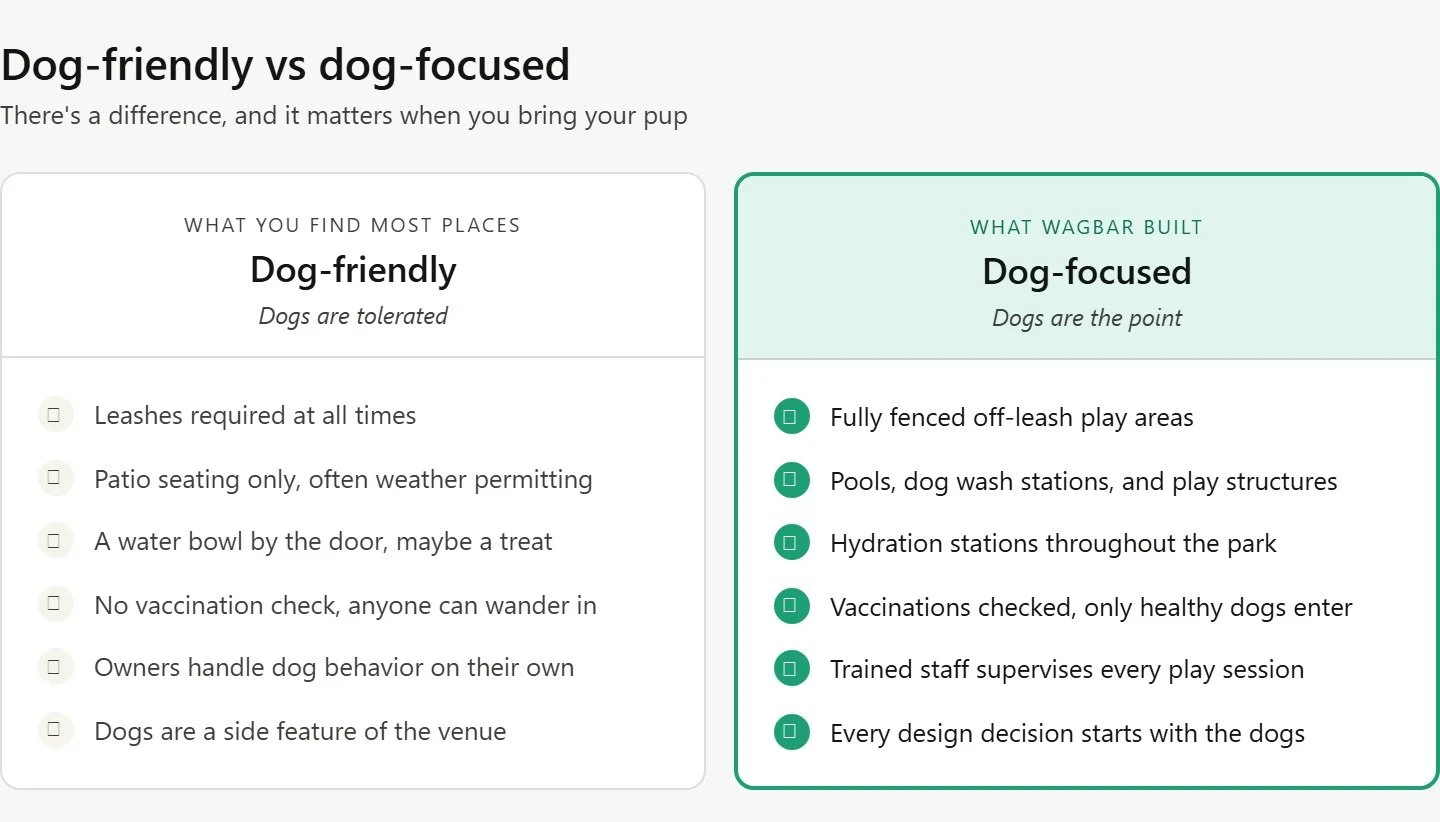
The franchise network that has developed since reflects the same pattern. Knoxville, Tennessee is an 870,000-person metro -- secondary. Myrtle Beach, South Carolina is a tertiary market with a seasonal tourism population that significantly expands demand. Richmond, Virginia is a 1.3-million-person secondary metro. Savannah, Georgia is a tertiary market that punches above its weight on income and dog ownership demographics.
The Wagbar locations in development in Los Angeles and Phoenix do represent primary market entries. But the brand's track record, and the markets where franchise candidates have committed first, point strongly toward the secondary tier as the core opportunity. Reviewing the best markets for a dog franchise shows that many of the strongest-performing demo profiles belong to metros well below 2 million people.
What Makes a Good Secondary or Tertiary Market
The market characteristics that make a secondary or tertiary location work for a pet franchise investment aren't dramatically different from what works at any market size. The difference is that smaller markets are more likely to hit those characteristics cleanly without the cost penalties of a larger one.
Strong dog ownership rates -- ideally 48% or higher of households. Secondary and tertiary markets in the South, Mountain West, and college-influenced metros often exceed this threshold.
Median household income above $70,000 within the primary trade area. This isn't exclusive to large metros; many secondary and tertiary markets with outdoor-oriented, college-educated populations clear this bar comfortably.
Available 1-2 acre commercial parcels at lease rates that support the business model. In most secondary markets and virtually all tertiary ones, this commercial real estate exists without the scarcity premium of primary markets.
No existing direct off-leash bar competition. In secondary and tertiary markets, this condition is still met in a large majority of cases. In primary markets, it's increasingly rare.
A local social scene that welcomes outdoor hospitality. Craft brewery culture, dog-friendly restaurant patios, and active outdoor recreation indicate a population that already behaves like an off-leash dog bar's target member.
When a Primary Market Does Make Sense
This analysis isn't a blanket argument against primary markets. Some primary markets still offer genuine opportunity for the right franchisee profile.
The argument for a primary market entry makes more sense when: the candidate controls or owns the real estate (eliminating the lease cost variable), the specific submarket within the metro is demographically strong and geographically isolated enough to build membership without competing against a fragmented citywide audience, and the franchisee has the capital cushion to absorb a slower path to break-even at higher operating costs.
The Wagbar Los Angeles franchise, for example, is a primary market entry backed by a franchisee with deep local knowledge of the specific community she's building in. That local knowledge is what makes a primary market entry work. The full franchise development process includes site selection support that helps both primary and secondary market candidates identify the specific submarket or parcel that fits the model.
Frequently Asked Questions

What population does a market need to support a viable off-leash dog bar?
There's no hard floor, but a metro statistical area of 200,000-250,000 people is generally the lower practical threshold, provided dog ownership rates are strong and a viable 1-2 acre site is available. Markets below that size may lack the sustained membership depth to support recurring revenue. Markets of 300,000-800,000 with strong dog culture tend to be the sweet spot.
Do secondary markets have lower revenue potential than primary markets?
Usually yes on an absolute revenue basis, but that's the wrong metric. Return on invested capital is the number that matters, and secondary markets often produce stronger returns because they require less capital to enter. The ratio of net revenue to total investment is frequently better in a well-chosen secondary market than in a premium primary market with equivalent demographics. The broader pet industry market data shows that premium pet spending is distributed across markets of all sizes, not concentrated in the largest ones.
Is the Myrtle Beach market really viable given its seasonal population?
Yes -- Myrtle Beach is a useful illustration of why standard population metrics miss part of the story. The permanent resident base provides year-round membership demand. The seasonal tourist population adds incremental revenue during peak months. Tourism-anchored tertiary markets often show revenue patterns that outperform their year-round population alone would predict.
How do I find the right secondary or tertiary market to target?
The four-signal validation process -- demand signals, supply signals, real estate availability, and regulatory conditions -- applies equally to any market size. What changes in smaller markets is that demand signals (dog ownership rates, income) often look stronger relative to the population, real estate signals are more favorable, and supply signals (limited existing off-leash competition) are more likely to show an open market. Start with the demographic data at the ZIP code level in markets you know or can access.
Bottom TLDR
The most attractive secondary and tertiary markets for pet franchise investment combine adequate dog-owning household density with available 1-2 acre commercial sites, manageable operating costs, and no direct off-leash competition. Wagbar's existing franchise network -- with locations in Knoxville, Myrtle Beach, Asheville, and Richmond -- is itself concentrated in secondary and tertiary markets for exactly these reasons. Run the site-cost math on a smaller market before dismissing it.