

State-Specific FDD Registration: What Franchise Buyers in Regulated States Need to Know

Top TLDR: Fourteen states require franchisors to register their FDD with a state regulatory agency before offering or selling franchises to residents of those states. For pet franchise buyers in California, New York, Virginia, and the other 11 registration states, this means additional legal protections and state-specific contract modifications on top of the federal baseline. Confirm current registration in your state before any formal discussions begin, and work with a franchise attorney licensed in your jurisdiction.
Most prospective franchise buyers know the FDD exists. Fewer realize that in 14 states, the FDD isn't just something the franchisor has to give you — it's a document the state government has to approve before the franchisor can legally offer you a franchise. If you live in one of those states, or plan to open a franchise there, the transaction works differently, the protections are stronger in some specific ways, and the timeline can be longer.
This page explains which states regulate franchise sales, what registration actually means in practice, what additional protections those states provide, and what prospective franchise buyers in California, New York, Virginia, and other regulated states specifically need to understand before beginning the process. This is educational content, not legal advice. The requirements in regulated states are complex enough that every buyer in those states should work with a franchise attorney who has specific experience with that state's law.
The Federal Baseline and Why States Added Their Own Rules
The Federal Trade Commission's Franchise Rule requires franchisors to provide a complete FDD to every prospective franchisee at least 14 calendar days before signing any agreement or paying any money — anywhere in the United States. That baseline applies in all 50 states.
Fourteen states determined that the federal rule wasn't enough protection on its own. They added pre-sale registration requirements: before a franchisor can offer or sell a franchise to a resident of that state, or for a franchise location in that state, the FDD must be filed with and approved by a state regulatory agency. The franchisor can't simply prepare the document and hand it to a prospect — they have to go through a formal registration process that includes state review, and they cannot offer franchises in that state until registration is active.
The 14 registration states, per Wagbar's own franchise disclosure language, are: California, Hawaii, Illinois, Indiana, Maryland, Michigan, Minnesota, New York, North Dakota, Oregon, Rhode Island, South Dakota, Virginia, Washington, and Wisconsin.
If you are a resident of any of these states, or plan to open a franchise location in any of them, the franchisor must have completed the applicable state registration before any franchise can legally be offered to you. This protects you — but it also means you may need to confirm the registration is current and active before proceeding.

What Registration Actually Means
State franchise registration is not an endorsement. When a state approves an FDD for registration, it does not mean the state has reviewed the franchise system for quality, profitability, or suitability for your investment. The disclaimer on Wagbar's California-registered FDD says it plainly: state registration "does not constitute approval, recommendation or endorsement by the Commissioner of Financial Protection and Innovation nor a finding by the Commissioner that the information provided herein is true, complete and not misleading."
What registration does accomplish: it requires the franchisor to submit the FDD to state regulators for review, gives those regulators the authority to require corrections or additional disclosures if the document doesn't comply with state requirements, and creates a formal record of the franchise offering in that state. Some states use registration to require franchisors to make specific modifications to their documents — additional financial assurance provisions, state-specific disclosures, or modifications to certain contract terms that conflict with local law.
It also gives buyers in registered states a documented starting point. You can verify that the franchisor's registration is current, confirm when it was last renewed, and in some states access copies of the registered FDD through state regulatory databases.
California: The Most Scrutinized Registration State
California has the most well-known and broadly applied franchise investment law in the country. The California Franchise Investment Law (CFIL) has governed franchise sales in the state since 1971 and has served as a model for several other states' programs.
The California Department of Financial Protection and Innovation (DFPI) handles franchise registrations. Before a franchisor can offer or sell a franchise in California — to a California resident, or for a location in California — the FDD must be registered with the DFPI. Registration must be renewed annually.
What California adds that the federal rule doesn't:
California requires franchisors to provide financial assurance in some cases — either proof of adequate working capital or a surety bond — demonstrating the franchisor has financial capacity to fulfill its pre-opening obligations to franchisees. This is particularly relevant for newer or smaller franchise systems.
California restricts certain provisions that are standard in franchise agreements in other states. Most notably, California does not enforce post-term non-compete clauses in franchise agreements. Under California Business and Professions Code Section 16600, non-compete agreements are largely void — which means California franchisees generally have more freedom to pursue related business activities after their franchise relationship ends than franchisees in most other states.
California also restricts certain termination and non-renewal provisions, requires that termination be for "good cause," and gives franchisees specific rights to cure most defaults before termination can proceed.
For California prospects evaluating a pet franchise opportunity, these protections are meaningful. Wagbar's FDD carries California registration. Confirm with the franchise team that registration is current before proceeding, and work with a California-licensed franchise attorney who understands the CFIL's specific requirements.
New York: Registration With a Focus on Disclosure Completeness
New York's franchise registration falls under the New York Franchise Sales Act, administered by the Attorney General's office. New York's registration focus is primarily on disclosure completeness and accuracy — the AG's office reviews the FDD to confirm it meets New York's disclosure standards and that the information provided is not materially misleading.
New York-specific requirements include a cover page that complies with state format rules and certain provisions about how the FDD is delivered and acknowledged. Like California, New York requires registration renewal and has provisions that restrict certain contract terms that conflict with state law.
New York doesn't have a statutory good-cause termination requirement like California, but it does have protections around renewals and transfers that are worth understanding specifically. New York franchisees also have protections under the state's general consumer protection statutes that can apply in franchise contexts.
For prospective buyers in the New York metro area — including people considering a franchise for communities in the greater New York region — confirming current New York registration with the franchise team is part of the initial due diligence step.
Virginia: Registration in Wagbar's Expanded Home Region

Virginia's Retail Franchising Act, administered by the State Corporation Commission, requires registration before franchise offers can be made to Virginia residents or for Virginia locations. Given that Wagbar has an established franchisee in the Richmond, Virginia area — AJ Sanborn, who transitioned from a 20-year financial services career to open his Wagbar location — Virginia registration reflects a real and active market for the brand.
Virginia's registration requirements follow the standard registration-state pattern: annual renewal, state review of the FDD, and specific Virginia addendum provisions that may modify certain terms for Virginia franchisees. Virginia has good-cause termination protections similar in structure to several other registration states, which require the franchisor to show legitimate grounds for termination rather than terminating at will.
For buyers considering franchises in Richmond, Northern Virginia, or other parts of the state, Virginia registration means an additional layer of state oversight beyond the federal disclosure baseline. Work with a Virginia-licensed franchise attorney, and verify current Virginia registration status with the Wagbar franchise team before beginning formal discussions.
The Other Eleven: What They Share and Where They Differ
Beyond California, New York, and Virginia, the other 11 registration states — Hawaii, Illinois, Indiana, Maryland, Michigan, Minnesota, North Dakota, Oregon, Rhode Island, South Dakota, and Washington — each have their own franchise investment statutes with their own procedural requirements, renewal timelines, and state-specific addenda.
What they share: all require registration before franchise offers, all require annual or periodic renewal, and all give state regulators authority to require disclosure modifications or additional provisions. Many include good-cause termination protections and restrictions on certain contract terms that would otherwise be enforceable under general contract law.
Where they differ significantly:
Minnesota and Indiana have among the broader buyer protections in the registration-state group, with strong good-cause termination requirements and specific rights around renewal.
Illinois has extensive financial assurance requirements and examines FDDs closely for the franchisor's financial health — the Item 21 review is taken seriously in Illinois registration, which means financially weaker franchisors face additional scrutiny. For anyone doing an FDD Item 21 financial statements review, the Illinois standard is worth understanding.
Maryland has specific provisions around the timing of FDD delivery that differ slightly from the federal standard — confirm with your attorney how Maryland's requirements interact with the standard 14-day federal window.
Washington has both registration requirements and specific franchise relationship protections under the Washington Franchise Investment Protection Act that go beyond what most other registration states require.
Oregon and Michigan have notable provisions around good-cause termination and transfer rights that are franchise-buyer-friendly relative to the baseline agreement terms you'd typically see.
The practical implication of all of this: if you're in any of the 14 registration states, the generic franchise agreement you're reviewing may include a state-specific addendum that modifies certain terms for your jurisdiction. Read the addendum as carefully as the main agreement — and make sure you have a franchise attorney licensed in your state, not just a generic franchise attorney, because state-specific law matters here.

What Non-Registration States Mean for Buyers
If you're in one of the 36 non-registration states — states like Georgia, Texas, Florida, Tennessee, North Carolina, South Carolina, or Colorado — the FDD is still legally required and the federal disclosure protections fully apply. You're simply not in a state where the government has pre-reviewed and approved the document.
That doesn't mean you're unprotected. The federal FTC Franchise Rule applies uniformly. The 14-day review window is the same. Your franchise attorney can still review the FDD and franchise agreement, you can still call franchisees from the Item 20 list, and you can still insist on any negotiated modifications that the franchisor is willing to make.
What it means practically: there's no state regulatory database to check for registration status, no state-specific addendum in your franchise agreement (though some franchisors include protective provisions voluntarily), and no state regulator reviewing the FDD's content for completeness before it reaches you.
For buyers in non-registration states, the burden of due diligence is more entirely on you and your professional advisors — which is the same argument for thorough FDD review in any state, just without the additional state-level backstop.
How to Verify Registration Status
If you're in a registration state and you've received an FDD, confirm that the registration in your state is current before proceeding. This is a simple step that's sometimes overlooked.
Ask the franchise development team directly: is your FDD currently registered in my state? Ask to see the state registration number or confirmation. In many registration states, you can also verify active registrations through the state regulatory agency's public database.
Registration that has lapsed — because the franchisor missed an annual renewal, because they're in the process of updating the document with a material amendment, or because they haven't yet completed registration in a state where they're expanding — means they legally cannot offer you a franchise until it's current. An experienced franchisor will have current registrations in all applicable states, but lapsed registrations do occur, particularly for growing systems moving into new states.
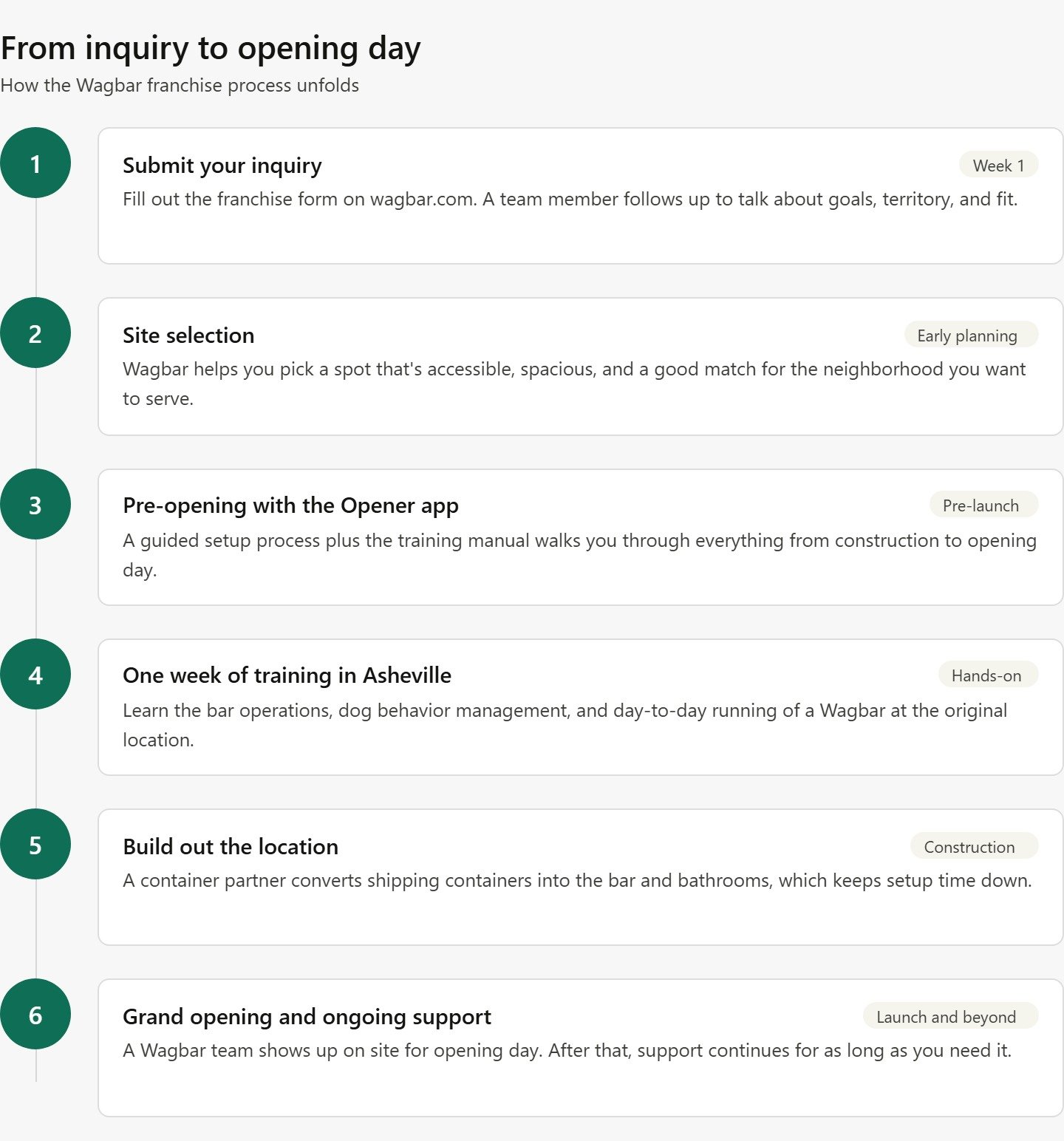
For Wagbar, California registration is confirmed per the franchise materials. Virginia is an active market with a current franchisee. For other registration-state buyers, confirm state-specific registration status directly with the franchise team. The Wagbar franchising page is the right contact point for that conversation.
What This Means for Your Due Diligence Process
Registration-state buyers have a somewhat different due diligence checklist than non-registration-state buyers. Beyond the standard FDD review steps covered in the complete FDD reading guide, add these steps:
Confirm current registration in your state. Verify that any state-specific addendum to the franchise agreement has been attached and reviewed. Confirm that your franchise attorney is licensed in your state and has specific experience with that state's franchise investment law. Ask the franchisor what modifications, if any, their agreement includes specifically for your state.
For California buyers in particular: understand clearly what the CFIL's non-compete protections mean for your situation post-exit, and confirm that the agreement's California addendum reflects current California law. For Virginia buyers: confirm that the Virginia SCC registration is current and ask specifically about the good-cause termination provisions in the Virginia addendum.
The complete guide to what lenders look for on franchise loan applications is also relevant for registration-state buyers because lenders review the state registration status as part of their FDD analysis. Current registration in your state is a positive signal in the lending process.
Frequently Asked Questions
Does state registration mean the franchise is a safe investment?
No. State registration means the FDD has been filed with and reviewed by the state regulatory agency for compliance with that state's disclosure requirements. It does not mean the state has evaluated the business model, the financial projections, or whether the franchise is a good investment for any particular buyer.
What happens if I sign a franchise agreement in a registration state where the FDD wasn't registered?
Signing without a valid state registration in a registration state creates legal exposure for the franchisor and may give you grounds to rescind the franchise agreement. This is exactly why franchisors in these states take registration compliance seriously — violations carry significant legal consequences.
My state is not one of the 14 registration states. Am I less protected?
Federal protections still fully apply. The FTC Franchise Rule, the 14-day review window, and all 23 FDD disclosure requirements are the same in every state. Registration states have additional protections on top of that federal baseline, not instead of it.
Do I need a franchise attorney licensed in my state specifically?
For registration-state buyers, yes — the state-specific law creates nuances that require state-specific legal expertise. For non-registration-state buyers, a franchise attorney doesn't need to be licensed in your state to review the FDD, but it helps if they have experience with how your state's general contract and business laws interact with franchise agreements.
How do I know if a state addendum applies to my franchise agreement?
Ask the franchisor directly. If you're in a registration state, the franchise agreement should include an addendum or rider with state-specific provisions. If it doesn't, that's something your attorney needs to flag immediately.
The State Layer Matters
Understanding state-specific FDD registration isn't the most exciting part of pet franchise due diligence, but it's the part that can meaningfully affect your legal protections, your post-exit flexibility, and the timeline of your transaction. If you're in one of the 14 registration states — and Wagbar has active and expanding presence in several of them — knowing how your state's rules interact with the standard franchise disclosure process puts you in a better position before the first document crosses your desk.
Bottom TLDR: State-specific FDD registration in the 14 regulated states — including California, New York, and Virginia — means the FDD has been reviewed by a state agency before you receive it, and your franchise agreement will include state-specific addenda modifying certain terms. California's non-compete protections, Virginia's good-cause termination requirements, and state-specific financial assurance rules vary significantly across registration states. Work with a franchise attorney licensed in your state and verify active registration status before proceeding.