

Pet Industry Franchises: Your Guide to Opportunities in the $147 Billion Market
Top TLDR: Pet industry franchises span from traditional grooming and retail to innovative experience-based concepts like off-leash dog park bars, serving the recession-resistant $147+ billion U.S. pet market. Investment requirements range from $75,000 for mobile services to over $1 million for comprehensive facilities, with off-leash dog park bar franchises typically requiring $470,300-$1,145,900. Success depends on matching franchise concepts to local market demographics, pet ownership rates, and existing competition while selecting franchisors offering comprehensive training and ongoing support. Evaluate multiple operating locations and speak with current franchisees before committing to any franchise opportunity.
The pet industry continues its explosive growth, with American pet owners spending over $147 billion annually on their furry companions. This recession-resistant market has created diverse franchise opportunities beyond traditional pet stores, from mobile grooming services to innovative concepts like off-leash dog park bars. Whether you're passionate about animals or seeking a stable business investment, understanding the landscape of pet industry franchises helps you identify which model aligns with your goals and community needs.
The Pet Industry Franchise Landscape
Pet industry franchises span far beyond the pet store model most people envision. Today's market includes grooming services, training facilities, pet sitting networks, veterinary care, and experience-based concepts that combine pet services with social environments. The shift reflects changing pet owner priorities—67% of U.S. households now own pets, and these owners increasingly view their animals as family members deserving premium experiences and care.
The strongest growth appears in service-based franchises rather than product-focused retail. Mobile grooming services, daycare facilities, and training centers meet the practical needs of busy pet owners while building recurring revenue through membership models. Meanwhile, innovative concepts like Wagbar's off-leash dog park and bar franchise represent the experience economy's expansion into pet services, where socialization and community building drive customer loyalty.
Traditional Pet Franchise Models
Traditional pet franchises built their success on product sales and basic services. Pet supply stores offered one-stop shopping for food, toys, and accessories, while grooming franchises provided essential hygiene services. These models work particularly well in suburban markets with sufficient population density to support foot traffic and repeat customers.
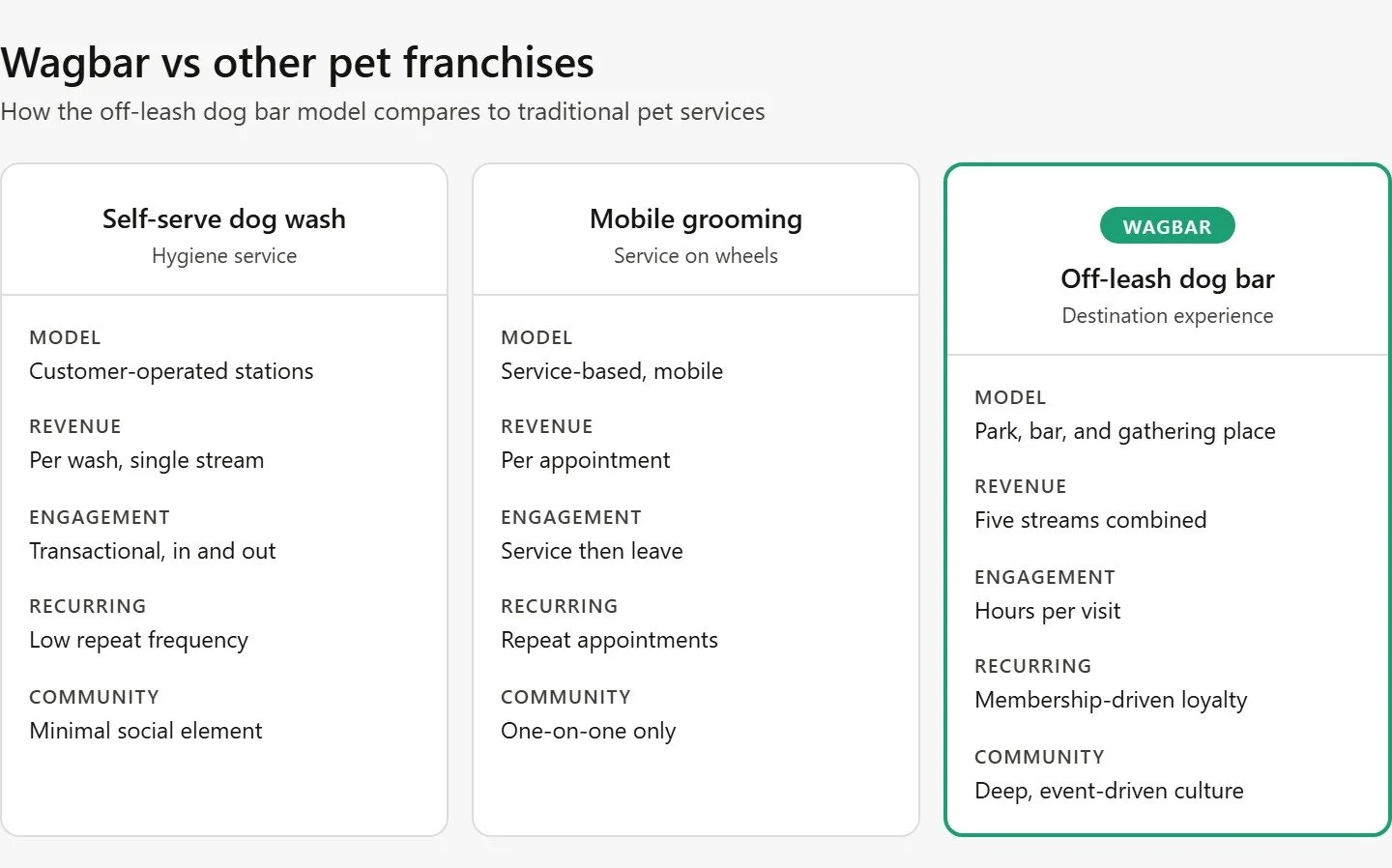
Self-service dog wash franchises emerged as a lower-investment alternative to full-service grooming. These facilities provide equipment and space while customers handle the actual bathing, creating a cost-effective middle ground. However, traditional dog wash franchises face limitations in revenue potential since they depend solely on per-use transactions rather than building ongoing relationships.
Pet sitting and dog walking franchises connect independent contractors with pet owners needing care services. The franchise provides the marketing platform, vetting systems, and technology infrastructure while individual service providers handle the actual pet care. This model scales efficiently but requires constant attention to quality control and contractor management.
Experience-Based Pet Franchises
The newest category of pet franchises focuses on creating experiences rather than selling products or basic services. Dog park bars, pet cafes, and activity-based facilities recognize that modern pet owners seek social experiences they can share with their animals. These concepts transform pet care from a chore into an enjoyable activity worth paying premium prices to access regularly.
Off-leash dog park bars like Wagbar combine secure play areas for dogs with bar environments where owners socialize while their pets exercise and interact. This dual-appeal model creates higher per-visit revenue than traditional dog parks while building community that drives membership retention. The off-leash dog bar concept demonstrates how experience-based franchises differentiate themselves in crowded markets.
Training and enrichment facilities offering specialized classes, agility courses, and behavioral services attract owners seeking more than basic obedience training. These franchises position themselves as lifestyle brands rather than service providers, creating emotional connections that justify higher pricing and generate word-of-mouth marketing.
Evaluating Pet Franchise Opportunities
Smart franchise selection starts with honest assessment of your interests, skills, and local market conditions. Passion for animals matters, but business acumen determines success. Consider whether you want to work directly with pets daily, manage teams providing pet services, or operate facilities where pet care happens under your oversight.
Financial requirements vary dramatically across pet franchise categories. Mobile grooming operations might require $100,000-$150,000 in startup capital, while comprehensive facilities combining multiple services can demand investments exceeding $500,000. The franchise investment for off-leash dog park bars typically ranges from $470,300 to $1,145,900 including the franchise fee, build-out, and initial operating capital.
Territory protection and market saturation directly impact your potential success. Strong franchisors limit the number of locations in specific geographic areas, ensuring each franchisee has sufficient customer base. Research existing pet service providers in your target location—if the market already supports multiple grooming salons, training facilities, and daycare centers, you'll need a differentiated concept to attract customers.

Location Factors for Pet Franchises
Real estate requirements separate viable pet franchise locations from unsuitable ones. Traditional retail franchises need high-traffic shopping centers with adequate parking and visibility. Experience-based concepts like dog parks require larger parcels with proper zoning for outdoor activities and potential alcohol service. Mobile franchises eliminate real estate concerns entirely but require strategic service territory planning.
Demographics matter more than raw population numbers. Areas with higher median incomes, younger populations, and high pet ownership rates support premium pet services better than lower-income markets where price sensitivity limits spending. Cities like Atlanta demonstrate ideal conditions with median household income around $77,655, 32% of residents holding bachelor's degrees, and strong pet ownership culture.
Zoning and regulatory compliance can make or break pet franchise locations. Some municipalities restrict commercial dog facilities through noise ordinances, waste management requirements, or outright bans in certain zones. Alcohol service adds another regulatory layer requiring appropriate licenses and compliance with local laws. Research local regulations thoroughly before committing to specific locations.

Training and Support Systems
Comprehensive training programs distinguish professional franchisors from those simply selling territories. Quality training covers not just operational procedures but also pet behavior, customer service, marketing strategies, and financial management. Expect both classroom instruction and hands-on training at existing locations to prepare for your opening.
Ongoing support determines your long-term success more than initial training. Look for franchisors offering regular business reviews, marketing assistance, technology updates, and access to a network of fellow franchisees. The best franchise systems function as partnerships where corporate success depends on franchisee profitability, creating aligned incentives for providing meaningful support.
Technology infrastructure increasingly separates successful franchises from struggling ones. Point-of-sale systems, customer relationship management platforms, scheduling software, and member portals should integrate seamlessly to reduce administrative burden while improving customer experience. Ask potential franchisors to demonstrate their technology stack and explain how updates and improvements get deployed to franchisees.
Revenue Models and Profitability
Understanding revenue streams helps you evaluate franchise potential realistically. Traditional pet retail generates income through product sales with relatively thin margins requiring high volume. Service-based franchises create better margins but depend on efficiently scheduling appointments to maximize revenue per hour of operation.
Membership and subscription models provide the strongest foundation for sustainable profitability. Recurring revenue from monthly or annual memberships creates predictable cash flow while reducing marketing costs for customer acquisition. Experience-based franchises often combine membership revenue with per-visit fees and additional revenue streams like beverage sales to maximize returns.
Labor costs represent the largest controllable expense in most pet franchises. Operations requiring skilled staff like grooming or training face higher labor costs and recruitment challenges than those needing less specialized employees. Consider whether you'll work in the business daily, hire managers to oversee operations, or find middle ground where you maintain active involvement while building a team.
Market Trends Shaping Pet Franchises
The pet industry's premiumization continues accelerating as owners demand higher quality products and services. Basic pet care no longer satisfies most owners—they seek organic foods, specialized training, enrichment activities, and social experiences. Franchises positioned to deliver premium offerings with justified pricing capture this trend's benefits.
Convenience drives purchasing decisions more than ever. Mobile services, extended hours, online scheduling, and streamlined processes attract time-starved pet owners willing to pay premium prices for convenience. Franchises simplifying pet ownership responsibilities while maintaining high service quality find receptive markets.
Community building has emerged as a competitive advantage beyond traditional service delivery. Pet owners seek belonging and connection with fellow animal lovers, creating opportunities for franchises that facilitate these relationships. Events, social media engagement, member recognition programs, and shared spaces where pet owners interact build loyalty transcending transactional relationships.
Competitive Analysis
Research existing competitors before committing to pet franchises. Visit local pet stores, grooming salons, training facilities, and other pet service providers to evaluate service quality, pricing, customer satisfaction, and market gaps. Talk with pet owners in your target market about their current solutions and unmet needs.
National franchise competition varies by category. Pet retail faces intense competition from online retailers and big-box stores squeezing independent operators. Service franchises enjoy better protection since customers prefer local providers for grooming, training, and care services. Experience-based concepts like dog park bars operate in relatively uncontested markets with limited direct competition.
Differentiation determines success in crowded markets. Understand what makes your potential franchise unique—superior service quality, innovative technology, better facilities, stronger community building, or novel concepts unmatched by competitors. Clear differentiation justifies premium pricing while attracting customers away from established competitors.
Due Diligence Process
Serious franchise evaluation requires substantial research beyond reviewing marketing materials. Request and thoroughly analyze the Franchise Disclosure Document (FDD), which provides detailed information about fees, obligations, legal history, and financial performance. Consult with franchise attorneys and accountants to understand the legal and financial implications before signing anything.
Talk with existing franchisees to learn about their experiences. Ask about training quality, ongoing support, profitability, challenges they've faced, and whether they'd choose the same franchise again. Franchisors should provide contact information for current franchisees—reluctance to facilitate these conversations raises red flags.
Visit multiple operating locations unannounced to observe real customer experiences. Watch how staff interacts with customers and pets, evaluate facility cleanliness and maintenance, assess customer volume and satisfaction, and note operational details that franchise marketing materials might gloss over. Direct observation reveals realities that interviews and documents can't capture.
Steps to Opening Your Pet Franchise
Beginning your franchise journey starts with self-assessment and market research. Clarify your goals, evaluate your financial capacity, research your target market, and narrow potential franchises to serious candidates. This preliminary work might take several months but prevents expensive mistakes from premature commitments.
After selecting a franchise, expect 6-18 months from signing the franchise agreement to opening day. This timeline includes site selection, lease negotiation, permitting, construction, equipment installation, hiring, training, and pre-opening marketing. Wagbar's training process exemplifies comprehensive preparation covering site development, staff training, and operational systems.
Grand opening execution makes crucial first impressions on your community. Coordinate with your franchisor on marketing campaigns, community outreach, soft opening periods for testing systems, and launch events attracting initial customers. Strong openings build momentum that carries businesses through the challenging early months while establishing your reputation.
FAQ
What makes pet industry franchises good investments? Pet industry franchises benefit from recession-resistant demand since pet owners prioritize animal care regardless of economic conditions. The $147+ billion U.S. pet market continues growing as pet ownership increases and owners spend more on premium services. Successful franchises combine this stable demand with proven business models and training reducing risks compared to independent startups.
How much does it cost to open a pet franchise? Pet franchise investments range from $75,000 for mobile services to over $1 million for comprehensive facilities. Typical costs include franchise fees ($25,000-$50,000), real estate (lease deposits and improvements), equipment, initial inventory, working capital, and professional fees. Off-leash dog park bar franchises like Wagbar require investments between $470,300-$1,145,900 for complete facilities with bars and outdoor play areas.
Do I need pet industry experience to own a pet franchise? Pet industry experience helps but isn't required for most franchises. Strong franchisors provide comprehensive training covering pet behavior, service delivery, customer relations, and business operations. Your business management skills, customer service abilities, and genuine interest in animals matter more than prior pet industry involvement. Successful franchisees often come from diverse backgrounds including corporate careers, retail management, and other service industries.

A dog ready for Wagbar Holiday
What's the difference between traditional and experience-based pet franchises? Traditional pet franchises focus on transactional services like grooming, retail sales, or basic dog walking. Experience-based franchises create social environments where pet care combines with owner enjoyment, such as dog park bars, training facilities with community events, or pet cafes. Experience-based models typically command higher prices, build stronger customer loyalty, and generate recurring membership revenue compared to transaction-focused alternatives.
How do I choose the right pet franchise for my market? Start by analyzing your local market's demographics, existing pet services, and gaps in available offerings. Consider median household income (higher incomes support premium services), pet ownership rates, and lifestyle preferences. Match franchise concepts to market conditions—urban areas suit mobile services and compact facilities while suburban markets support larger destination concepts. Visit competing pet businesses to understand pricing, service quality, and customer satisfaction before committing to specific franchises.
The pet industry's continued growth creates opportunities for entrepreneurs seeking stable businesses aligned with their passion for animals. Whether you choose traditional service models, mobile concepts, or innovative experience-based franchises, success depends on matching your interests and skills to market needs while selecting franchisors committed to supporting your success through comprehensive training and ongoing assistance.
Bottom TLDR: Pet industry franchises offer entrepreneurs stable opportunities in the growing $147+ billion market, with models ranging from traditional services to experience-based concepts creating social environments for pets and owners. Investment requirements vary significantly by franchise type, requiring thorough due diligence including FDD analysis, franchisee interviews, and unannounced location visits before selecting the right opportunity for your market. Match franchise selection to your local demographics, existing competition, and personal interests while prioritizing franchisors demonstrating comprehensive training programs and meaningful ongoing support systems. Begin with honest self-assessment and detailed market research to identify franchises offering the strongest potential for sustainable profitability in your target location.