

Pet Grooming Franchise vs. Dog Park Franchise: Which Investment Makes More Sense Right Now

Top TLDR: A pet grooming franchise and a dog park franchise serve the same customer but operate on completely different business models. Grooming generates appointment-by-appointment revenue with strong gross margins and a faster breakeven, while a dog park franchise like Wagbar builds recurring membership income with no e-commerce competition. If recurring revenue and community-building matter to you as an investor, request Wagbar's FDD and compare it directly against grooming franchise disclosures.
Both pet grooming franchises and dog park franchises attract investors who want to build a business around the pet industry. They're in the same broad category, and they benefit from the same macro tailwind: Americans spending more on their dogs every year. But they operate on completely different business models, require different skills, and expose investors to different risks.
This comparison looks at both options side by side on the metrics that actually matter before you sign anything: investment cost, revenue model, margin structure, staffing requirements, competitive positioning, and long-term trajectory. The goal is to give you a clear picture of where each model performs well and where it falls short, so you can match the right investment to your situation.
What Each Business Actually Is
Before comparing numbers, it helps to be precise about what you're comparing.
A pet grooming franchise is a service business. Revenue comes from appointments: baths, haircuts, nail trims, teeth brushing, and add-on treatments. Customers book sessions, a groomer performs the service, and the customer pays per visit or through a prepaid package. The business depends on a physical space, equipment, licensed groomers, and a consistent flow of bookings.
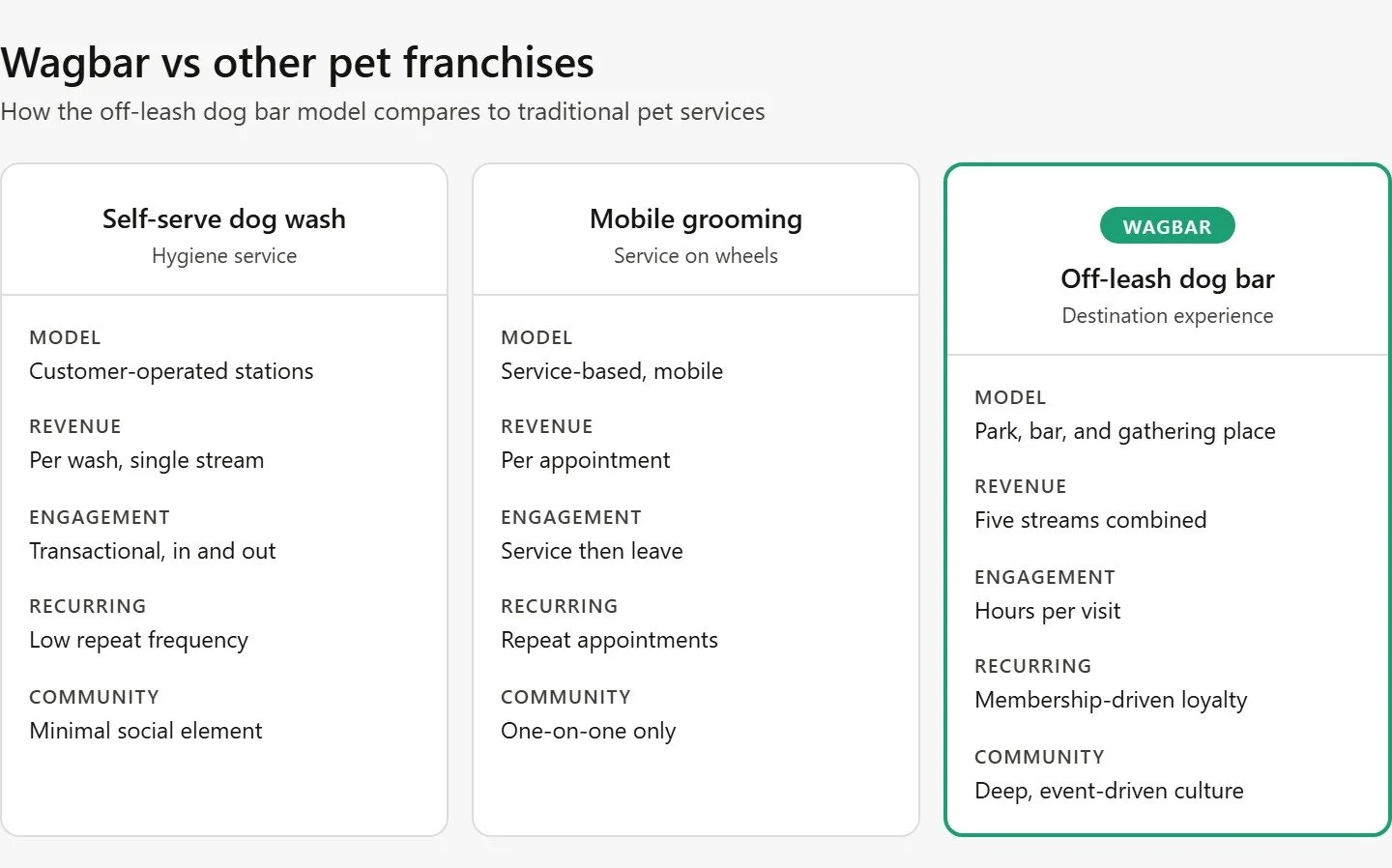
A dog park franchise like Wagbar is an experience and hospitality business. Revenue comes from dog park memberships, day passes, and food and beverage sales at a bar serving human guests while their dogs run off-leash. The physical infrastructure is different: a fenced outdoor dog park, a bar area, and the licensing required to serve alcohol. The customer relationship is also different. Members pay recurring fees for ongoing access rather than booking individual appointments.
These are not variations on the same concept. They're different businesses that happen to serve dog owners.
Investment Costs: What You're Getting Into
Pet grooming franchise cost:
Established pet grooming franchise concepts typically require total investments in the range of $150,000 to $500,000. That range is driven primarily by real estate costs in your target market, build-out requirements for the grooming space, equipment, and the working capital needed during the ramp-up period.
The franchise fee for grooming concepts generally runs from $20,000 to $60,000. Royalty structures are typically 5% to 9% of gross sales. Some concepts charge flat monthly fees instead of percentage royalties, which can be advantageous in high-revenue markets.
Grooming studios generally require 1,500 to 3,000 square feet of retail-facing space. Location quality matters: visibility, parking, and proximity to dense residential neighborhoods with high dog ownership rates drive the booking volume that makes the business work.
Dog park franchise (Wagbar) cost:
Wagbar's total investment range is $470,300 to $1,145,900, with a $50,000 franchise fee, 6% royalty on adjusted gross sales, and a 1% marketing fund contribution. Multi-unit operators receive a 50% discount on franchise fees starting at the third unit.
The higher end of that range reflects markets where outdoor real estate, fencing, bar build-out, and licensing infrastructure push costs upward. The lower end is achievable in markets where suitable space is more accessible and build-out is more straightforward.
(All investment figures are illustrative. Prospective franchisees must review the current Franchise Disclosure Document for complete and verified investment information.)
At first glance, grooming looks like the lower-cost option, and for most markets it is. But the cost comparison matters less than the revenue model comparison, because what you can earn relative to what you spend is the actual metric that determines whether an investment makes sense.
The pet store franchise cost guide breaks down investment ranges across all five major pet business models in more detail.
Revenue Models: Where the Money Comes From
This is where the two concepts diverge most significantly.
Pet grooming franchise revenue:
Grooming revenue is appointment-by-appointment. A dog comes in, gets groomed, and the owner pays. The average grooming ticket varies by market and service type, but a typical full-service groom for a medium to large dog runs $60 to $120. Some concepts layer in retail product sales alongside grooming services to add a secondary revenue stream.
The key constraint is throughput. A single grooming station can complete four to six full grooms per day, depending on dog size and service complexity. A studio with four stations and consistent booking is doing 16 to 24 grooms daily, which at an average ticket of $80 generates $1,280 to $1,920 in daily gross revenue. Monthly, that's a range of roughly $28,000 to $42,000 at full capacity.
That's a viable business. The challenge is that every dollar of that revenue requires a transaction. If a groomer calls out sick, three appointments get cancelled or rescheduled. If a client cancels last-minute, that slot often goes unfilled. Revenue is real but fragile.
Dog park franchise revenue:
Wagbar generates revenue from three streams simultaneously: memberships, day passes, and food and beverage.
The membership layer is the most important distinction. Members pay a recurring monthly or annual fee for unlimited access. Once a dog owner joins, that revenue continues regardless of how often they visit on any given week. A location with 300 active members at a monthly membership rate generates a floor of predictable recurring income before a single day pass is sold or a single beer is poured.
Day passes capture visitors who haven't converted to membership yet, guests, and occasional visitors. Food and beverage serves human guests at the bar during their visit. Beverage margins run higher than grooming service margins because there's no skilled labor cost for each transaction and no supply chain complexity comparable to managing grooming chemicals, shampoos, and tools.
The combination means Wagbar's revenue model is more layered and more resistant to single-point disruption. A slow Tuesday doesn't erase the membership revenue already collected. A no-show doesn't cost a revenue slot the way it does in an appointment-based business.
For a deeper look at how this revenue model is structured, Wagbar's revenue streams overview covers the multi-stream model in detail.
Gross Margins: What Each Business Actually Keeps
Gross margin is the percentage of revenue left after direct costs. It's the foundation of everything else in the financial model because it determines how much is available to cover fixed costs and generate owner income.
Pet grooming gross margins:
Grooming is a high-gross-margin service business. Labor is the primary cost, and it's variable. You pay groomers for the work they do. Supplies (shampoo, tools, drying equipment) are a smaller line item. When staffed efficiently, a grooming studio typically runs gross margins of 50% to 65%.
After fixed costs including rent, royalties, insurance, and overhead, net operating margins for well-run grooming studios tend to fall in the 15% to 25% range. That's a solid profitability profile for a service business at this investment level.
Dog park franchise gross margins:
Wagbar's blended gross margin across its three revenue streams reflects a different cost structure. Membership revenue has very low marginal cost. Once the infrastructure is in place, adding a member costs little. Beverage revenue carries margins typical of a well-run bar. Day pass revenue has minimal direct cost as well.
The primary cost drivers are staffing for park monitoring and bar service, facility maintenance, and alcohol inventory. The overall gross margin profile is favorable, and the recurring membership component adds a level of income stability that the appointment model doesn't provide.
Staffing: What Running Each Business Looks Like Day to Day
Staffing is where grooming franchises have their most significant operational vulnerability, and it's worth being direct about it.
Grooming franchise staffing:
Professional groomers are in consistent short supply across most US markets. The Bureau of Labor Statistics projects steady demand growth for animal care workers, but the pipeline of trained groomers hasn't kept pace. Franchise grooming concepts that train their own staff have a structural advantage, but training takes time and newly trained groomers require supervision before working independently.
High turnover among grooming staff is common in the industry and directly disruptive to revenue. A grooming studio that loses a key groomer mid-week faces immediate scheduling gaps, customer calls, and potential relationship damage if clients take their dogs elsewhere during the disruption. Managing this risk is a genuine and ongoing operational responsibility for grooming franchise owners.
Dog park franchise staffing:
Wagbar's staffing model centers on park monitors who ensure safety and enforce vaccination requirements, and bar staff who handle beverage service. These roles require less specialized training than professional grooming and draw from a broader labor pool. Bar and hospitality experience is common and transferable.
That doesn't mean staffing is without challenges. Consistent customer-facing staff who know the regulars and their dogs contribute to the community feel that drives membership retention. But the structural fragility of a business that depends on a narrow pool of highly skilled specialists isn't present in the same way.

Wagbar requires all dogs entering the park to be current on rabies, Bordetella, and distemper vaccinations, be at least six months old, and be spayed or neutered. Enforcing these standards consistently is part of the daily operations and contributes to the safety and experience quality that justifies membership pricing.
Competitive Environment: What You're Up Against
Pet grooming competition:
Pet grooming is competitive but not saturated in the way pet retail is. Independent groomers operate in virtually every market. PetSmart and Petco both operate grooming salons inside their retail locations. Mobile grooming services are growing. The competitive set in most markets is fragmented rather than dominated by any single player.
Franchise grooming concepts compete primarily on consistency, quality, and convenience. A well-branded, well-located grooming franchise with trained staff and reliable booking systems can build a loyal client base in most markets. The category doesn't face the same e-commerce disruption that pet retail does because grooming is fundamentally a service that requires physical presence.
Dog park bar competition:
The off-leash dog park bar category is newer and less crowded nationally. Some markets have independent dog bars or off-leash venues, but the branded franchise format with consistent standards is not yet ubiquitous. Being an earlier entrant in a market is a genuine advantage for brand recognition and community building.
Free public dog parks exist in most markets and are the most common competitor to think about. The distinction is the combined social experience: a public dog park doesn't have a bar, doesn't have trained monitors, doesn't enforce vaccination standards, and doesn't create the community membership dynamic that Wagbar does. They're related but they're not actually the same product.
The dog park reviews and market context page provides useful background on the competitive picture in specific markets.
Which Investor Profile Fits Each Model
The right investment depends heavily on the person making it, not just the numbers on a spreadsheet.
Grooming franchise investors tend to have operational or retail management backgrounds, comfort with service business scheduling and staff management, and genuine interest in the day-to-day execution of a high-appointment-volume business. Some grooming franchise owners are groomers themselves who want to build a business around their skill. Others manage the business and hire the technical staff.
Dog park franchise investors tend to come from backgrounds in finance, sales, hospitality, or corporate management. They're drawn to the community-building dimension of the concept and are motivated by the business model as much as the category. Wagbar's franchisee roster reflects this: AJ Sanborn in Richmond came from 20 years in financial services; Dianna in Phoenix combined IT sales and restaurant experience; Jennifer in Los Angeles left corporate life for a business she cared about.
Neither profile is better. But the mismatch between investor background and business type is one of the more predictable causes of franchise underperformance. The animal franchise opportunities overview covers the full range of pet franchise categories and what tends to work for different investor types.
Which Makes More Sense Right Now
The honest answer is: it depends on what you're optimizing for.
If you want a lower total investment, faster breakeven, and a well-established service model with a strong margin profile, a pet grooming franchise is worth serious consideration. The staffing challenges are real but manageable with good systems and a deliberate approach to training and retention.
If you want recurring revenue, a community-building concept immune to e-commerce competition, and a business model that's growing into an underserved category, a dog park bar franchise like Wagbar deserves equal consideration despite the higher investment threshold.
The most important step in either direction is the same: get the FDD, review Item 7 for investment details and Item 19 for financial performance data, and call the existing franchisees whose contact information is listed in that document. What they tell you about actual performance versus projections is worth more than any marketing material.
The franchise investment guide covers the specific questions that matter most at the evaluation stage for this type of investment.
Frequently Asked Questions
Is a pet grooming franchise more profitable than a dog park franchise?
Grooming franchises typically reach profitability faster given lower startup costs and a well-understood margin structure. Dog park bar concepts have a more complex ramp-up tied to membership growth but generate recurring revenue once membership is established. Profitability in both cases depends heavily on location, execution, and market conditions. Review Item 19 of each franchisor's FDD for available earnings data.
What is the franchise fee for a pet grooming business?
Pet grooming franchise fees typically range from $20,000 to $60,000 depending on the specific concept. Wagbar's franchise fee is $50,000. The franchise fee is only one component of total investment. Build-out, equipment, real estate deposits, and working capital are typically larger cost drivers than the fee itself.
Can I run a dog park franchise semi-absentee?
The semi-absentee question depends on how you define it and how you build your management team. Wagbar provides training and operational systems designed to be run by a general manager, which gives investors some flexibility in how hands-on they are daily. During the launch period and ramp-up phase, more direct involvement tends to correlate with better early results. Discuss this directly with Wagbar's franchise team and existing owners for a realistic picture.
Do grooming franchise owners need grooming experience?
Not necessarily. Many grooming franchise concepts are designed to be owner-operated without the owner being a groomer. The franchisor trains staff and provides systems for managing a grooming business. That said, operational fluency with the service, specifically understanding quality, timing, and what your staff is doing, matters for managing the business effectively even if you're not handling dogs yourself.
What is Wagbar's model for handling dog safety?
Wagbar requires all dogs to be current on rabies, Bordetella, and distemper vaccinations, be at least six months old, and be spayed or neutered before entering the park. Human entry is free for guests 18 and older. Wagbar is a day-use concept and does not offer boarding. These standards are enforced at entry and are core to the safety and experience quality that supports membership retention. The dog health and safety overview covers these protocols in detail.
Bottom TLDR: Choosing between a pet grooming franchise and a dog park franchise comes down to your investment size, risk tolerance, and how you want the business to generate income. Grooming offers a proven service model with solid margins and lower startup costs. A dog park franchise like Wagbar offers recurring membership revenue, multi-stream income, and a category with less competition. Review Item 19 of each FDD and call existing franchisees before making a final decision.
FDD Disclaimer: All Wagbar investment figures cited on this page are illustrative estimates only. Prospective franchisees must receive and review the current Franchise Disclosure Document before making any investment decisions. Nothing on this page constitutes an offer to sell a franchise.