

Pet-Friendly Social Spaces and the Future of the Bar Industry
Key Takeaways
Pet-friendly social spaces are outperforming traditional bars because they deliver what drinks alone cannot: a genuine reason to be somewhere, recurring behavioral demand from dogs, and community that forms naturally rather than requiring engineering. The off leash dog bar format is positioned to grow as urban dog ownership stays high and consumer preference for experience-led leisure continues. Find your nearest Wagbar at wagbar.com/our-locations to see what the future of the bar industry looks like today.
The bar industry has a problem it has been slow to name. Traffic is declining among the demographic groups that historically sustained it. Younger adults drink less than their predecessors did at the same age. Remote work has dissolved the after-work happy hour as a cultural institution in many cities. Chain concepts struggle to differentiate, and independent bars face rising costs with flattening revenue.
Meanwhile, dog ownership is at historically high levels, the pet services sector is one of the fastest-growing consumer categories in the country, and the demand for social spaces that actually mean something to the people who use them has never been stronger.
Pet-friendly social spaces — and specifically the off leash dog bar format — represent the most compelling answer the bar industry has produced to these pressures. Not because dogs are a novelty draw, but because they solve a structural problem: they give people a specific reason to be somewhere together, a reason to stay, and a reason to come back.
This piece looks at the forces reshaping the bar industry, why pet-friendly social spaces are positioned to benefit, and what the next decade of this category is likely to look like.
What Is Happening to the Traditional Bar
Alcohol consumption in the United States has been trending down among adults under 35 since approximately 2010. A 2023 Gallup survey found that 62% of American adults reported drinking alcohol, down from a high of around 67% in the early 2000s. Among adults aged 18-34, the decline has been steeper than average, driven by a combination of wellness culture, increased awareness of alcohol's health effects, and a broader preference for experiences over intoxication.
This trend is not fatal to the bar industry, but it does mean that businesses built entirely around alcohol consumption as the primary value proposition are operating against a structural headwind. The venues that have held up best — breweries with taprooms, cocktail bars with distinctive concepts, spots with strong event programming — have one thing in common: they offer a reason to be there beyond the drink.

The industry research firm CGA has documented consistent outperformance by concept-driven on-premise venues over undifferentiated ones. The bar that does one thing well, serves a specific community, and gives people something to show up for consistently outperforms the generic neighborhood spot that relies on proximity alone.
Pet-friendly social spaces fit this model exactly — and then exceed it, because the dogs provide what most concept bars cannot engineer: a genuine, warm reason for strangers to connect that does not depend on alcohol at all.
The Pet Ownership Backdrop
The market context behind the dog bar category is significant. According to the American Pet Products Association (APPA), 67% of U.S. households own a pet, with dogs the most popular choice. Total U.S. pet industry spending reached approximately $147 billion in 2023, up from $103 billion in 2020. The services and experiences segment — which includes venues like Wagbar — is the fastest-growing portion of that market.
Dog ownership surged during 2020 and 2021, and those dogs are now adults with owners who have built their social lives and daily routines partly around their pets. For urban dog owners especially, the question of where to take a dog that also works as a social space for the owner has become more pressing as the market for premium pet experiences has grown.
This is the demand backdrop the off leash dog bar category is filling. The pet industry growth trends and projections cover the trajectory in detail. The broad point is that the pet services market is large, growing, and increasingly oriented toward experiences rather than products — exactly the segment where dog bars sit.
For more on how this spending shift creates the market conditions the bar industry cannot replicate with traditional concepts, the dog owners spend more on experiences piece covers the data and the mechanism.
Why the Pet-Friendly Social Space Model Works Where Others Have Struggled
Most attempts by the bar industry to adapt to changing consumer preferences have taken one of two forms: adding food, or adding events. Both help at the margins. Neither solves the underlying problem, which is that a bar without a specific reason to be there feels interchangeable with every other bar without a specific reason to be there.
A pet-friendly social space, built correctly, is not interchangeable with anything. It is the only place in your neighborhood where you can take your dog off leash, watch them run and play with other dogs, and spend two hours in a genuinely relaxed, socially rich environment. There is no substitute for it if the experience is what you are after.
The off leash dog bar format in particular has structural advantages that most entertainment and hospitality concepts cannot access.
It creates its own social friction reduction. Dogs remove the barrier to conversation between strangers. In a standard bar, meeting someone new requires initiative from at least one party. In an off leash dog park, both parties' dogs are already playing together. The conversation happens because the dogs set it up. This dynamic persists every visit, which is why dog bar regulars consistently describe a social environment that feels easier and warmer than almost any comparable venue.
It generates recurring attendance through behavioral demand. A dog that gets regular off-leash socialization starts to anticipate it. Owners of dogs that have become regulars at a specific park describe the dog showing visible excitement on the way there. This behavioral demand from the dog gives the owner a reason to return on a consistent schedule that has nothing to do with mood, social plans, or whether they feel like going out. The dog wants to go. That is a recurring attendance driver no standard bar concept has access to.
It supports multiple revenue streams. A standard bar earns from beverage sales. An off leash dog bar earns from dog entry fees, memberships, bar sales, events programming, and in many cases private event rentals. The membership model in particular creates predictable recurring revenue that is largely decoupled from the variability in daily traffic that affects standard hospitality businesses.
The revenue streams for off-leash dog bars breaks down how these income sources interact and what makes the model resilient across seasons and economic conditions.
The Non-Alcohol Dimension
One of the underappreciated advantages of the pet-friendly social space format is that it does not require alcohol to deliver its primary value. The social experience, the dog's exercise and enrichment, the community connection — these happen whether a visitor orders a beer, a sparkling water, or a coffee.
This matters in a market where declining alcohol consumption is a real headwind for drink-centric concepts. A dog bar does not lose its reason to exist when a visitor chooses not to drink. The experience that brought them is still fully intact.
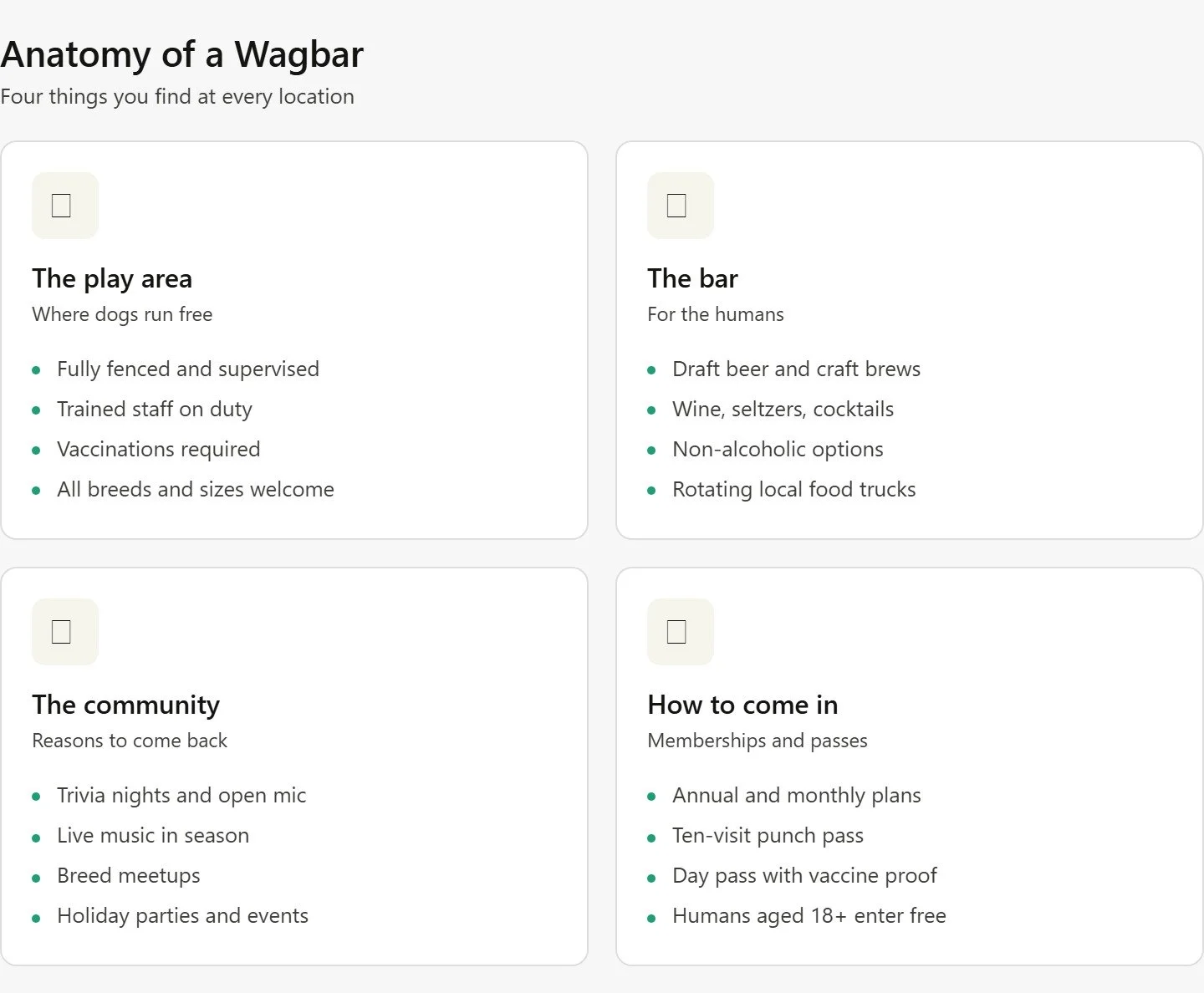
Wagbar reflects this directly. The bar at every location serves craft beer, wine, cider, hard seltzer, non-alcoholic options, coffee, and hot drinks. No one is expected to drink alcohol, and the value proposition does not depend on it. This is categorically different from a bar's relationship to its product. The drink at Wagbar is an amenity, not the point.
This structural independence from alcohol consumption makes the pet-friendly social space format unusually well-positioned for the wellness-oriented consumer segment that the traditional bar industry has struggled to retain.
What the Next Decade Looks Like for This Category
The off leash dog bar category is still in early expansion relative to the addressable market. Wagbar, founded in Asheville, North Carolina in 2019 by Kendal and Kajur Kulp, is the most established brand in the space — with locations in Weaverville/North Asheville, Knoxville, Dallas, Los Angeles, Long Beach, Richmond, Charlotte, Cary, Greenville, Myrtle Beach, Savannah, Cincinnati, Frederick, Orlando, and Phoenix. That list is significant for a concept that is only a few years into national franchising. But the number of U.S. cities that could support this format is much larger than the number currently served.
Several forces will drive expansion over the coming decade.
The supply shortfall. In most U.S. cities, the number of managed off-leash social venues with beverage service is zero. The demand exists — urban dog owners are there, the willingness to spend on enrichment services is documented — but the supply has not caught up. This creates a first-mover advantage in most markets for franchisees who move early.
Continued urbanization and remote work persistence. Urban dog ownership continues to grow. Remote work has expanded the portion of the week that urban dog owners spend with their pets and has increased the demand for social venues that work during weekday hours, not just evenings and weekends. Dog bars are well-suited to this pattern: they work on a Tuesday afternoon as well as they work on a Saturday.
The community premium. As social isolation has become a recognized public health concern, consumer willingness to pay for spaces that reliably deliver connection has increased. Pet-friendly social spaces offer this in a way that is structurally built in. The community forms as a side effect of the space working correctly, not as a marketing goal that has to be engineered separately. For more on how this dynamic functions at the membership level, the piece on building community around your dog covers the mechanics in detail.
Franchise scaling. The Wagbar franchise model allows the concept to reach new markets without requiring corporate capital expenditure in each location. Owner-operators who know their local communities can build the specific crowd and culture that makes each Wagbar location distinctive, while the brand and operational framework ensures consistency in safety, experience quality, and brand positioning. The Wagbar franchising page has details on the model and investment structure.
The Bar Industry's Best Path Forward
The traditional bar is not going away. But the formats within the broader bar and hospitality industry that will grow fastest over the next decade are those that give people something the standard venue cannot: a specific community, a reason built into the concept to return, and a value proposition that survives the long-term decline in average alcohol consumption.
Pet-friendly social spaces check all three. The dogs generate the community. The dogs generate the recurring attendance. And the social and experiential value of the space works independently of the bar component.
This is not a novelty format that will peak and fade. The conditions driving it — high dog ownership, demand for genuine social connection, preference for experience spending, urban dog owners without adequate alternatives — are durable. The dog bar community and social connection research backs this with data on why these spaces meet real needs that are not going away.
The off leash dog bar is the best answer the bar industry has produced to its own structural challenges. It just did not come from inside the bar industry. It came from a dog owner in Asheville who wanted somewhere better to take his dog.
To see what this looks like in your city, find a Wagbar location at wagbar.com/our-locations. If your city does not have one yet and you want to be the person who builds it, the franchising page is the right starting point.
Frequently Asked Questions
Are dog bars just a trend, or is the format here to stay?
The format has structural staying power for reasons that have nothing to do with novelty. Dogs create recurring attendance demand, dissolve social barriers between strangers, and generate community naturally. These properties do not expire. The category is early, but the conditions driving its growth — high urban dog ownership, demand for genuine social connection, shift from alcohol-centric entertainment — are long-term forces, not temporary ones.
How do pet-friendly social spaces handle the non-drinker market?
Better than traditional bars. The primary value proposition — off-leash play for dogs, community for owners — exists entirely independently of alcohol consumption. Non-alcoholic options are available at all Wagbar locations, and the social experience works identically whether a visitor is drinking beer, coffee, or sparkling water. This makes dog bars more inclusive and less exposed to declining alcohol consumption trends than drink-first concepts.
What markets are best suited for this format?
Markets with high urban dog ownership rates, active outdoor culture, and demonstrated preference for experience-led leisure spending tend to perform strongest. The best cities for dog franchise success covers the demographic factors in detail. Mid-size cities with strong local culture and large metros with dense dog owner populations both work well.
How is this different from a dog-friendly patio at a regular bar?
Fundamentally different in the thing that matters most: the off-leash environment. A dog on a leash at a patio is tolerated. A dog off leash at Wagbar is the point. The off-leash dynamic is what creates free movement for dogs, spontaneous dog-to-dog interaction, and the social catalyst effect that dissolves barriers between owners. A leashed dog on a patio produces none of these effects. For more on what makes the off-leash format specifically valuable, the off leash dog bar overview covers the full experience.
Summary
Pet-friendly social spaces represent the most structurally durable answer the bar industry has found to declining average alcohol consumption and the demand for venues that mean something. Dog bars generate recurring attendance through behavioral dog demand, produce community as a side effect of their design, and earn from multiple revenue streams that traditional bars cannot access. If you want to bring this format to your market, the Wagbar franchise model is available at wagbar.com/franchising.
