

Pet Franchise ROI: Which Offers the Best Return?

Top TLDR: Pet franchise ROI ranges from 15-40% annually for facility-based concepts requiring $500K-$3M investment to 50-150% for service-based models with $50K-$150K investment, though absolute dollar returns favor higher-investment franchises that generate $200K-$500K owner income versus $50K-$150K for lower-investment alternatives. Service franchises like dog training and mobile grooming typically reach break-even in 6-15 months with 35-50% profit margins, while facility-based concepts like daycare require 18-36 months with 25-35% margins but generate higher absolute profits once established. Calculate ROI using cash-on-cash return measuring actual invested capital rather than financed amounts, factoring owner compensation replacement, break-even timeline, and exit value potential to determine which franchise type aligns with your financial goals and risk tolerance.
Return on investment represents the single most important metric evaluating franchise opportunities, yet most prospective franchisees struggle comparing ROI across different business models with vastly different investment requirements, revenue potential, and operational characteristics. A low-cost pet franchise generating $75,000 annual profit from $75,000 investment delivers 100% ROI. A premium facility generating $300,000 profit from $1.5 million investment delivers 20% ROI. Which represents the better opportunity?
The answer depends on your available capital, desired absolute income level, risk tolerance, and timeline expectations. Percentage returns and absolute dollar returns tell different stories about franchise attractiveness. Understanding how to calculate, compare, and interpret ROI across diverse pet franchise opportunities separates informed investors from those making six-figure commitments based on marketing materials and gut feelings.
This guide breaks down profit margins and time to profitability across major pet franchise categories, providing frameworks for calculating meaningful ROI that accounts for opportunity cost, owner compensation, and realistic performance expectations rather than optimistic franchisor projections.

Understanding ROI components in franchise businesses
Calculating true cash-on-cash returns
Most franchise ROI calculations oversimplify by comparing annual profit to total investment. This approach misleadingly inflates returns when franchises are heavily financed through loans. True cash-on-cash return measures profit against actual capital you invested, not borrowed funds you're repaying with interest.
Calculate cash-on-cash ROI using this formula: (Annual Net Profit / Actual Cash Invested) x 100. If you invest $100,000 cash and borrow $400,000 to fund a $500,000 franchise generating $150,000 annual profit, your cash-on-cash return is 150% ($150,000 / $100,000), not 30% ($150,000 / $500,000). However, debt service reduces actual profit, so subtract annual loan payments from profit before calculating returns.
This distinction matters enormously when comparing franchises with different capital structures. Lower-investment franchises typically require less financing, keeping more profit as actual return rather than servicing debt. Higher-investment franchises leverage debt amplifying returns if profits exceed borrowing costs but crushing returns if revenue underperforms projections leaving you paying debt from other income sources.
Factor owner compensation into ROI calculations by adding back the salary you'd earn in alternative employment. If you quit a $80,000 corporate job to run a franchise generating $100,000 profit, your real return is $20,000 plus the value of entrepreneurship (flexibility, equity building, control). Many franchisees accept lower initial cash returns in exchange for building business equity and lifestyle benefits impossible in employment.
Accounting for time to profitability
Break-even timelines dramatically affect realized returns and risk. A franchise breaking even in 8 months begins generating returns from month 9 forward. One requiring 24 months break-even burns capital for two years before any return materializes. Even if both eventually generate identical annual profits, the faster break-even substantially outperforms because you're earning returns sooner and reducing risk exposure to market changes.
Calculate annualized ROI accounting for ramp time: If a franchise costs $100,000, takes 18 months reaching $75,000 annual profit, and you sell after 5 years for $225,000, your total return is $412,500 profit over 5 years (3.5 years x $75,000 + $225,000 sale price) representing 82.5% annualized return. Compare this to a franchise costing $100,000, breaking even in 6 months, generating $60,000 annually, and selling for $180,000 after 5 years: total return is $450,000 (4.5 years x $60,000 + $180,000) representing 90% annualized return despite lower annual profits.
Working capital requirements during ramp periods substantially affect realized returns. Budget 6-12 months operating expenses beyond initial investment for any franchise. Undercapitalized franchisees burn through reserves before reaching profitability, forced to inject additional capital or close businesses, destroying returns. Conservative financial modeling assuming slower-than-projected growth protects against this common failure mode.
Comparing percentage returns to absolute dollar returns
Investors face fundamental trade-off between percentage returns and absolute dollars. Lower-investment franchises typically deliver higher percentage returns but lower absolute income. Higher-investment franchises deliver lower percentage returns but higher absolute income. Neither approach is inherently superior—the right choice depends on your situation.
A $75,000 training franchise generating $75,000 owner income represents 100% return—excellent percentage-wise but perhaps insufficient income if you need $150,000 annually supporting your lifestyle. A $750,000 daycare facility generating $200,000 owner income represents 27% return—lower percentage but higher absolute income and potentially more aligned with income needs. Evaluate franchises against your actual financial requirements, not just attractive ROI percentages.
Consider scaling potential when evaluating returns. A single low-investment franchise generating high percentage returns may not be replicable without investing in multiple territories. A single high-investment franchise generating lower percentage returns may produce sufficient absolute income from one location, eliminating need for multi-unit expansion. Factor both current returns and growth capital requirements into decision frameworks.
Service-based franchise ROI profiles
Dog training franchises: 50-100% returns
Dog training franchises typically require $50,000-$150,000 investment including franchise fee, training, equipment, and working capital. Operating costs remain low with home-based models: marketing, insurance, vehicle expenses, and minimal equipment. Profit margins typically run 40-55% once you're covering your own time investment.
Typical first-year revenue reaches $75,000-$150,000 for committed owner-operators, generating $30,000-$75,000 profit after expenses. This represents 40-75% first-year return on a $75,000 investment. Year two revenue typically grows to $125,000-$200,000 as reputation builds and referrals increase, generating $50,000-$100,000 profit representing 65-133% annual return.
Break-even typically occurs within 6-12 months as initial clients complete training programs and begin referring friends. Speed to profitability stems from minimal overhead, high gross margins, and relationship-driven growth requiring modest marketing investment once initial client base develops. The primary limit is your personal capacity delivering training sessions before needing to hire additional trainers.
Scaling requires building trainer teams, which reduces margins but increases revenue capacity. Mature multi-trainer territories can generate $300,000-$500,000 revenue with $100,000-$175,000 owner profit, though this requires moving from service delivery to business management—a transition not all hands-on trainers enjoy or excel at executing.
Mobile grooming: 40-80% returns
Mobile grooming franchises require $100,000-$180,000 investment per van including vehicle, equipment, franchise fee, and working capital. Each van generates $150,000-$250,000 annual revenue with single groomer operating 30-40 appointments weekly. Variable costs (groomer wages if not owner, supplies, fuel, maintenance) typically consume 45-55% of revenue leaving 45-55% gross margins.
Owner-operator vans generate $65,000-$125,000 annual profit representing 65-125% return on $100,000 investment. Break-even typically occurs within 6-12 months as appointment schedules fill to 20-25 appointments weekly supporting full-time operations. Growth happens through adding additional vans and groomers, effectively replicating the initial investment for each additional unit.
Multi-van operations see margins compress to 30-40% as owner transitions from groomer to manager, but revenue scales proportionally. Three vans generating $150,000 each with 35% margins produce $157,500 total profit from $300,000 investment representing 52% return—lower percentage than single owner-operated van but higher absolute income and more defensible business with team coverage and capacity.
The primary risk involves vehicle dependency and weather impacts in some climates. Mechanical failures or seasonal slowdowns during extreme weather directly affect revenue, requiring reserves managing cash flow variability. However, the convenience premium supports pricing power and customer loyalty reducing churn compared to facility-based grooming.
Pet sitting and dog walking networks: 30-60% returns
Pet care service franchises require $40,000-$125,000 investment for franchise fee, technology, marketing, and working capital. The contractor-based model keeps overhead low—you're matching pet owners with independent sitters/walkers through technology platforms rather than employing staff directly. Your margin comes from the difference between what clients pay and what contractors receive, typically 35-45% of gross service revenue.
Mature territories generate $200,000-$400,000 gross revenue with franchisee retaining $70,000-$160,000 after paying contractors. On $85,000 investment, this represents 82-188% return. However, first-year revenue typically reaches only $75,000-$150,000 as you build contractor networks and client bases, generating $25,000-$60,000 profit representing 30-70% initial return.

Break-even typically occurs within 9-15 months. The primary challenge involves recruiting and retaining reliable contractors in tight labor markets. Turnover requires constant recruitment and training, and quality inconsistencies damage reputation making client retention difficult. Successful franchisees excel at contractor management, creating cultures where sitters feel supported and valued despite independent contractor status.
Scaling happens through expanding geographic service areas or adding complementary services like dog training or grooming. Some franchisees operate multiple territories treating each as separate business unit with dedicated contractor pools. ROI remains attractive but requires strong systems managing larger contractor networks and quality control across expanded operations.
Facility-based franchise ROI profiles
Dog daycare and boarding: 20-35% returns
Daycare and boarding franchises require $500,000-$1.5 million investment for real estate, buildout, equipment, and working capital. Monthly overhead runs $30,000-$60,000 covering rent, utilities, insurance, and staffing before any revenue. Revenue comes from daily daycare ($30-$50 per day), overnight boarding ($50-$80 per night), and ancillary services like grooming and training.
Mature facilities generate $800,000-$2 million annual revenue with 30-40% EBITDA margins, producing $240,000-$800,000 annual profit. On $1 million investment, this represents 24-80% return. However, break-even typically requires 18-30 months as you build regular daycare client bases providing foundation revenue while boarding remains variable based on travel seasons.
The investment concentration creates risk—one location represents your entire capital commitment. Poor site selection, unexpected competition, or neighborhood demographic shifts can permanently impair returns. However, successful locations build strong community connections and recurring revenue creating defensible businesses with attractive exit multiples of 3-5x EBITDA.
Real estate decisions fundamentally impact returns. Leased facilities reduce initial investment but create ongoing rent expense consuming 8-12% of revenue. Purchased real estate increases initial investment but builds equity and eliminates rent, often improving long-term returns even with higher upfront costs. The right choice depends on market conditions and available capital.
Off-leash dog park bars: 35-50% returns
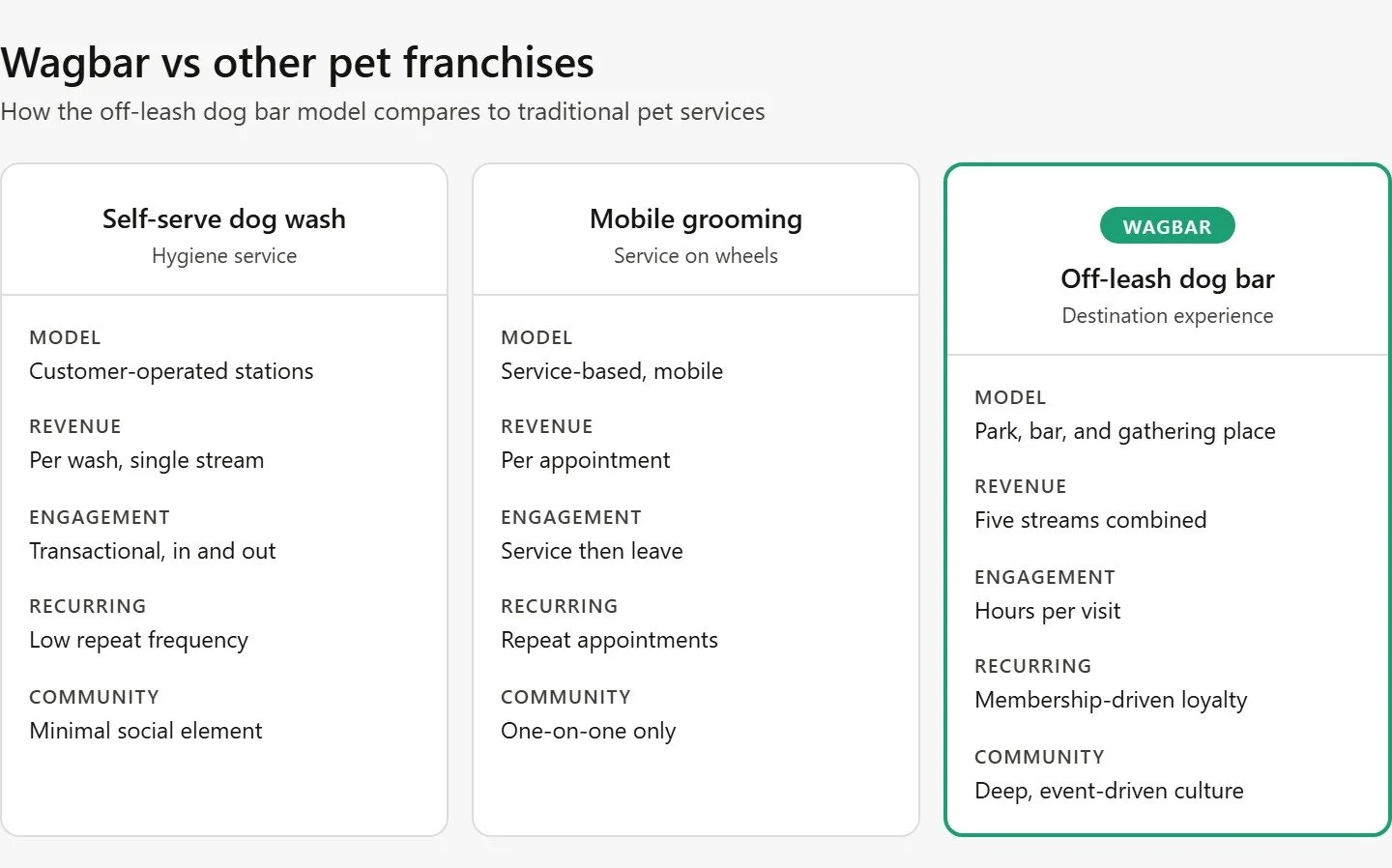
Off-leash dog park bar franchises like Wagbar require $470,000-$1.15 million investment for real estate, container bar systems, fencing, landscaping, and working capital. The unique model combines membership revenue (monthly recurring), day pass fees, beverage sales, and event rentals creating diversified income streams reducing dependence on any single revenue source.
Target mature-location revenue runs $600,000-$1.2 million annually with 35-45% EBITDA margins generating $210,000-$540,000 annual profit. On $750,000 average investment, this represents 28-72% return—attractive given the facility-based nature and multiple revenue streams. Break-even typically occurs within 18-24 months as membership bases build to 300-500 members while day passes and beverage sales grow.
The experiential nature creates strong community loyalty and differentiation from commodity competitors. Members develop friend groups and routines around regular visits, creating retention rates exceeding 80% annually. The beverage component provides premium margins unavailable to traditional dog parks while memberships create predictable cash flow unusual in hospitality businesses.
Location selection matters enormously—successful dog-focused community venues require affluent demographics, high pet ownership, limited off-leash alternatives, and craft beverage appreciation. Weak locations struggle building sufficient membership density supporting financial targets. Strong locations become neighborhood destinations with waiting lists and expansion opportunities into additional territories.
Retail pet stores: 15-25% returns
Retail pet supply franchises require $550,000-$1.2 million investment for real estate, inventory, fixtures, and working capital. Monthly overhead runs $40,000-$80,000 covering rent, inventory, utilities, and staffing. Revenue comes primarily from product sales with typical gross margins of 30-40% on products, plus service revenue from grooming, self-serve dog washes, and classes carrying higher margins.
Average stores generate $1.5-$2.5 million annual revenue with 12-18% net margins after all expenses, producing $180,000-$450,000 annual profit. On $850,000 average investment, this represents 21-53% return. Break-even typically requires 24-36 months as inventory turns establish and customer bases build—longer than service franchises due to working capital tied up in inventory and lower margins requiring higher sales volumes.
E-commerce competition pressures margins on commodity products, forcing stores toward higher-margin specialty items, services, and expertise-based selling. Successful locations position as neighborhood pet resources with knowledgeable staff and community involvement rather than competing on price against online retailers and big-box stores. Service revenue (grooming, training, events) increasingly drives profitability as product margins compress.
Exit multiples typically run 2-3x EBITDA—lower than pure service businesses reflecting inventory management complexity, e-commerce threats, and location dependency. However, established stores in strong locations with loyal customer bases and diversified revenue streams command premium valuations to strategic buyers seeking immediate presence in specific markets.
Factors affecting franchise ROI beyond business model
Market selection and territory demographics
Location fundamentally determines revenue potential and achievable margins. Regional pet spending patterns vary dramatically—affluent suburban markets with high pet ownership, household incomes exceeding $75,000, and limited quality competition support premium pricing and strong demand. Lower-income rural areas may have high pet ownership but lack willingness or ability paying premium pricing, suppressing margins and requiring higher transaction volumes achieving target revenues.
Population density affects customer acquisition efficiency. Dense urban and suburban markets support cost-effective digital marketing and allow servicing more customers per hour for mobile services. Sparse markets require more expensive acquisition and limit daily appointment capacity due to drive time between customers. Evaluate demographics, competition, and geographic characteristics in your specific territory before committing to any franchise regardless of system-wide averages.
Owner involvement and management capability
Owner-operator franchises delivering services directly generate highest margins but limit revenue to personal capacity. Semi-absentee models require hiring, training, and managing teams—adding overhead but enabling scaling beyond personal limits. Your management capabilities, desire for direct involvement, and ability to attract and retain quality staff dramatically affect realized returns.
Many franchisees underestimate the skills gap between performing services and managing service businesses. Technical competence in dog training or grooming doesn't automatically translate to business management, staff development, financial oversight, and strategic planning. Franchisees who honestly assess capabilities and invest in developing weaknesses outperform those assuming passion for animals automatically creates business success.
Execution quality and operational excellence

Franchise systems provide blueprints, but franchisee execution determines actual results. Two franchisees in identical territories with identical investment can generate dramatically different returns based on customer service quality, marketing consistency, operational efficiency, and financial discipline. The best pet franchises provide solid foundations, but franchisee capabilities determine whether potential becomes reality.
Treat franchising as buying proven systems and support, not guaranteed returns. Franchisors can't make unmotivated franchisees successful or force proper execution. Operators who follow systems diligently, invest in staff development, maintain quality standards, and persistently market their services typically achieve or exceed franchisor projections. Those who cut corners, ignore systems, or expect passive returns typically underperform regardless of franchise quality.
Maximizing your franchise ROI
Accelerating time to break-even
Every month shaved from break-even timeline increases lifetime returns by generating profit sooner. Accelerate break-even through pre-opening marketing building launch momentum, aggressive initial customer acquisition even at lower margins, impeccable service quality generating referrals and reviews, and tight expense management during ramp periods. Many franchisees drift during initial months assuming business will naturally develop—proactive, systematic customer acquisition separates fast and slow growers.
Focus early marketing on high-value activities generating actual customers rather than awareness-building that feels productive but doesn't drive revenue. For local service businesses, neighborhood canvassing, partnership development with complementary businesses, strategic social media targeting specific demographics, and referral incentive programs outperform broad awareness campaigns in early stages when cash flow is tightest.
Optimizing operations for profitability
Profit margins separate mediocre from excellent franchise returns. Small margin improvements compound dramatically over years. Reduce cost of goods sold through efficient ordering and inventory management, minimize labor costs through proper scheduling and productivity systems, negotiate favorable vendor terms leveraging franchise system relationships, and eliminate waste in all operational processes.
Many franchisees accept vendor pricing and operational inefficiencies as fixed costs. Successful operators constantly seek improvements: renegotiating contracts annually, testing scheduling optimization reducing labor hours without compromising service, implementing technology automating manual processes, and analyzing which services or products generate highest margins then emphasizing those offerings.
Planning strategic exits
Exit strategy affects long-term returns as much as operating income. Franchise resales typically command 2-4x annual EBITDA depending on business type, growth trajectory, and market conditions. A franchise generating $100,000 annual profit sold for $300,000 after 5 years produces much higher total return than one generating $120,000 annual profit but selling for only $200,000 due to documented operational issues or market concerns.
Position franchises for maximum exit value throughout ownership: maintain impeccable financial records, document all operational systems and procedures, build business around systems rather than owner personality, develop strong staff reducing transition risk, and keep facilities and equipment well-maintained. Buyers pay premiums for turnkey businesses they can step into with confidence rather than fixer-uppers requiring substantial investment and expertise to stabilize.
Conclusion: Aligning ROI expectations with investment goals
Pet franchise ROI varies dramatically across business models, investment levels, and operator capabilities. Service-based franchises typically deliver 50-150% annual returns on $50,000-$150,000 investments but require direct owner involvement initially and generate lower absolute income. Facility-based franchises deliver 20-40% returns on $500,000-$1.5 million investments but generate higher absolute profits and support semi-absentee ownership once established.
Neither approach is universally superior—the right franchise depends on your available capital, income requirements, desired involvement level, risk tolerance, and timeline. Calculate comprehensive ROI accounting for opportunity cost of capital and lost wages, time to profitability and break-even timelines, owner compensation replacing employment income, exit value potential, and intangible lifestyle benefits or costs of ownership.
Avoid chasing headline ROI numbers without understanding calculation methods and assumptions. Request Item 19 financial disclosures from franchisors showing actual franchisee performance, interview 10+ current franchisees understanding realistic ranges of outcomes, model conservative scenarios assuming below-average performance, and verify projected margins align with reported results from comparable businesses.
The pet industry's growth trajectory supports strong returns for well-selected franchises in appropriate markets with competent execution. However, franchise ownership rewards disciplined operators who follow systems, manage finances professionally, and persistently market their services more than those expecting passive returns from brand name and franchisor support alone. Align investment decisions with realistic return expectations and honest assessment of your capabilities, capital, and commitment level achieving the financial outcomes you require.
Bottom TLDR: Pet franchise ROI ranges from 50-150% for service franchises ($50K-$150K investment, 6-15 month break-even, $50K-$150K annual profit) to 20-40% for facility franchises ($500K-$1.5M investment, 18-36 month break-even, $200K-$500K annual profit), with percentage returns inversely correlated to investment level while absolute dollar returns increase with investment size. Highest returns come from owner-operated service businesses with minimal overhead like dog training (40-55% margins) and mobile grooming (45-55% margins), while facility-based concepts like daycare (30-40% margins) and retail stores (12-18% margins) generate lower percentage returns but higher absolute income once established. Calculate cash-on-cash ROI using actual invested capital rather than total financed amounts, factor break-even timeline into annualized returns, and compare projected performance to Item 19 FDD data and current franchisee interviews ensuring realistic expectations before committing to any opportunity.