

Pet Franchise Investment Comparison: Dog Parks, Grooming, Boarding, Training, and Retail

Key Takeaways
Comparing pet franchise categories side by side shows major differences in total investment, royalty structure, revenue potential, and competitive density. Dog park and bar concepts like Wagbar occupy a distinct position in the market: higher entry cost than mobile grooming or training franchises, but with recurring membership revenue, a licensed bar, and a social experience that traditional pet service businesses simply don't offer. If you're evaluating pet franchise investment options, the business model matters as much as the price tag.
Why the Pet Industry Is a Serious Franchise Market
Pet ownership has fundamentally changed in the past decade. According to the American Pet Products Association, Americans spent more than $147 billion on their pets in 2023. That number has climbed every year for three decades without exception, including through the 2008 financial crisis and the COVID-19 pandemic. What was once a discretionary spending category now behaves more like a household staple.
That spending pattern has made the pet industry one of the most attractive sectors for franchise investment. Franchisors across dog grooming, boarding, training, retail, and experiential concepts have all expanded aggressively, each with a different value proposition and financial structure.
But not all pet franchises are built the same. The five main categories differ significantly on investment range, ongoing fees, competitive saturation, target customer, and how revenue is actually generated day to day. Anyone seriously evaluating this space should understand those differences before committing capital.
The Five Main Pet Franchise Categories
The pet franchise market breaks down into five primary segments: dog park and bar concepts, professional grooming, boarding and daycare, dog training, and retail. Each serves a different customer need and carries a different risk and reward profile.
Dog park and bar concepts are the newest category and the smallest in terms of unit count. They combine off-leash play space with a licensed bar, creating a recurring social destination rather than a transactional service stop.
Grooming franchises range from mobile van operations to full-service salons. They're among the most established categories with multiple national brands competing for the same customers.
Boarding and daycare facilities require significant real estate and operate on daily or overnight capacity. They're capital-intensive to build but tend to produce high weekly revenue when full.

Training franchises offer some of the lowest entry costs in the pet space, often operating in leased retail or client homes. The service is relationship-driven but doesn't typically produce recurring revenue on its own.
Pet retail includes food, supplies, accessories, and health products. Franchise retail concepts compete in a category where Amazon and big-box stores set the price ceiling, which creates ongoing margin pressure.
Investment Range by Category
Total initial investment is the first number most prospective franchisees look at, but context matters. A lower number doesn't automatically mean lower risk or faster return. What you're buying for that investment, and how the business model generates ongoing revenue, determines whether the economics actually work.
Dog Park and Bar Concepts
Wagbar's total initial investment ranges from $470,300 to $1,145,900, with a $50,000 franchise fee. The wide range reflects differences in real estate, site preparation, and whether a location requires new construction versus a conversion. The model includes a near-turnkey bar build-out using converted shipping containers, which reduces construction complexity and timeline.
The royalty structure is 6% of adjusted gross sales, with 1% contributed to the Wagbar marketing fund. For franchisees who commit to three or more units, the franchise fee carries a 50% multi-unit discount. The investment figures above are informational; prospective franchisees should review the official Franchise Disclosure Document for complete details.
Professional Grooming Franchises
Mobile grooming franchises typically start between $100,000 and $200,000 for a single van setup, making them among the most accessible entry points in the pet franchise market. Full-service grooming salons run higher, often $150,000 to $400,000 or more depending on buildout and market. Royalty rates in the grooming segment generally run between 5% and 10% of gross sales.
The trade-off for lower entry cost is that grooming is appointment-driven and time-capped. A single groomer can handle a finite number of dogs per day, which puts a ceiling on revenue without adding staff or vehicles. You can learn more about how grooming franchises compare to experiential models in this breakdown of pet service business types.
Boarding and Daycare Franchises
Boarding and daycare is one of the most capital-intensive categories. Total investment for a mid-sized facility typically runs $750,000 to $2 million or more when you factor in real estate, indoor/outdoor runs, safety systems, climate control, and staffing requirements before opening. Royalty fees generally range from 6% to 10%.
The appeal is high daily transaction volume when capacity is full. A well-located, well-run boarding facility can generate consistent revenue, but the break-even point is further out and the operational complexity is significant. Staffing turnover is a persistent challenge in this segment.
Dog Training Franchises
Training franchises offer some of the lowest barriers to entry in the industry. Total investment typically runs between $80,000 and $250,000, depending on whether the model uses mobile trainers, leased space, or a fixed training facility. Royalty fees range from 5% to 12%.
Revenue depends heavily on trainer capacity and client retention. Group classes generate more revenue per hour than private sessions but require consistent enrollment to be worthwhile. The best training franchises pair their service with membership models or ongoing programs to create recurring revenue streams.
Pet Retail Franchises
Specialty pet retail has been the most challenged category over the past decade. National chains like PetSmart and Petco, combined with Amazon's reach into pet food and supplies, have compressed margins significantly. Franchise retail investments typically start at $150,000 and can exceed $500,000 for a full-service store. Royalty fees usually run 4% to 8%.
Retail concepts that focus on premium or specialty products (raw diets, supplements, locally sourced treats) have held up better than general merchandise, but competitive density in most urban markets is high. Understanding regional pet spending patterns is especially important when evaluating retail viability in a given market.
Side-by-Side Comparison
Category Typical Investment Range Franchise Fee Royalty Rate Revenue Model Dog Park and Bar (Wagbar) $470,300 - $1,145,900 $50,000 6% Memberships, day passes, bar sales, events Mobile Grooming $100,000 - $200,000 $20,000 - $40,000 5% - 10% Per-appointment services Grooming Salon $150,000 - $400,000+ $25,000 - $50,000 6% - 10% Per-appointment, add-ons Boarding and Daycare $750,000 - $2,000,000+ $40,000 - $60,000 6% - 10% Daily/overnight capacity Dog Training $80,000 - $250,000 $15,000 - $35,000 5% - 12% Classes, private sessions Pet Retail $150,000 - $500,000+ $20,000 - $45,000 4% - 8% Product sales
Investment ranges are approximate and based on publicly available franchise data. Consult each franchisor's current Franchise Disclosure Document for accurate figures.
Competitive Density: Where the Market Is Crowded
One of the most important inputs for any franchise investment decision is how many competitors are already serving the same customer. Competitive density affects customer acquisition cost, pricing power, and long-term growth potential.
Grooming is one of the most saturated segments in pet franchising. Multiple national brands compete in most mid-sized and major markets, and independent groomers often undercut on price. Customer loyalty tends to be moderate because switching costs are low.
Boarding and daycare is similarly competitive in most urban markets, though the capital barrier to entry keeps new competition from appearing constantly. The challenge is that large operators with multiple locations have significant cost advantages in staffing and marketing.
Dog training has a high concentration of independent operators, and franchise concepts compete against YouTube tutorials, online programs, and local trainers with strong reputations. The product is harder to differentiate at scale.
Pet retail is the most competitively challenged of the five categories, with digital competitors setting pricing expectations that brick-and-mortar operators struggle to match.
Dog park and bar concepts occupy a nearly uncrowded category. The format is still early-stage, which creates both a market development challenge and a genuine first-mover opportunity. Wagbar was awarded the #10 spot on USA Today's 10 Best Dog Bars list, and the brand's presence across multiple states reflects growing consumer demand with limited direct competition.
Recession Resilience Across Pet Franchise Categories
The pet industry's overall resilience through economic downturns is well-documented, but not every pet business model shares equally in that resilience.
Essential services like grooming and veterinary care tend to hold up better during contractions. Pet owners may delay discretionary grooming appointments but generally maintain basic care. Boarding and daycare can feel the impact of reduced travel and tighter discretionary spending, since those services often correlate with family vacations.
Retail is the most exposed to consumer spending shifts. When budgets tighten, pet owners shift toward lower-cost food alternatives or buy online where discounting is common. Franchise retailers in the mid-tier have a harder time competing on price and may struggle to justify premium positioning.
The dog park and bar model is an interesting case. The membership structure builds in predictability: a subscriber who pays monthly is more likely to continue using the space than a customer who books one-off appointments. Social experience spending has also shown stronger recession resilience than many analysts expected, particularly in categories that serve as affordable local outings compared to more expensive entertainment alternatives.
The experience economy positioning of off-leash dog bar concepts reflects a broader shift in how consumers allocate leisure spending. People consistently report that experiences create more lasting satisfaction than product purchases, and Wagbar sits at the intersection of pet ownership and social gathering, a combination that serves multiple spending motivations simultaneously.
Transactional vs. Experiential: Why the Business Model Matters
The distinction between transactional and experiential pet businesses is not just philosophical. It has direct implications for revenue predictability, customer lifetime value, and competitive defensibility.
Transactional models (grooming, boarding, training, retail) generate revenue when a specific service is rendered or a product is purchased. Revenue depends on transaction frequency and average ticket. Customer retention depends on service quality and convenience, and switching costs are low.
Experiential models (Wagbar) generate revenue through memberships that create recurring monthly income, day passes that function as low-commitment entry points, bar and beverage sales that extend visit length and revenue per visit, and hosted events that bring in additional guests.
The membership layer is particularly significant. A Wagbar location with a solid membership base generates predictable monthly revenue independent of appointment booking or product inventory. Members become community regulars rather than occasional customers, which affects both revenue stability and word-of-mouth growth.
Franchisees like AJ Sanborn in Richmond, Virginia came from a 20-year financial services career specifically because the Wagbar model offered a business structure he respected. Dianna, who opened in Phoenix after years in IT sales, was drawn to the combination of community building and a business concept with a built-in social draw. Jennifer in the Los Angeles area chose Wagbar because it aligned personal passion with a differentiated business structure.
None of them chose a traditional service franchise because the combination of community, recurring revenue, and market differentiation pointed them toward the off-leash dog bar model. Their backgrounds represent the range of people who find this model worth the higher entry investment.
Staffing and Operations Complexity
Every franchise category carries operational demands, but they differ in meaningful ways.
Grooming and training franchises are relatively lean on staff, especially mobile concepts where one or two people can run a full schedule. The complexity is personal skill-based: grooming quality and training effectiveness depend on practitioner expertise.
Boarding facilities require around-the-clock staffing during operating hours and can run 24-hour operations during peak travel seasons. Managing dog behavior in group settings, maintaining sanitation standards, and controlling staff turnover are ongoing challenges. Detailed operational resources on staffing and operations for off-leash dog businesses are available for operators evaluating this model.
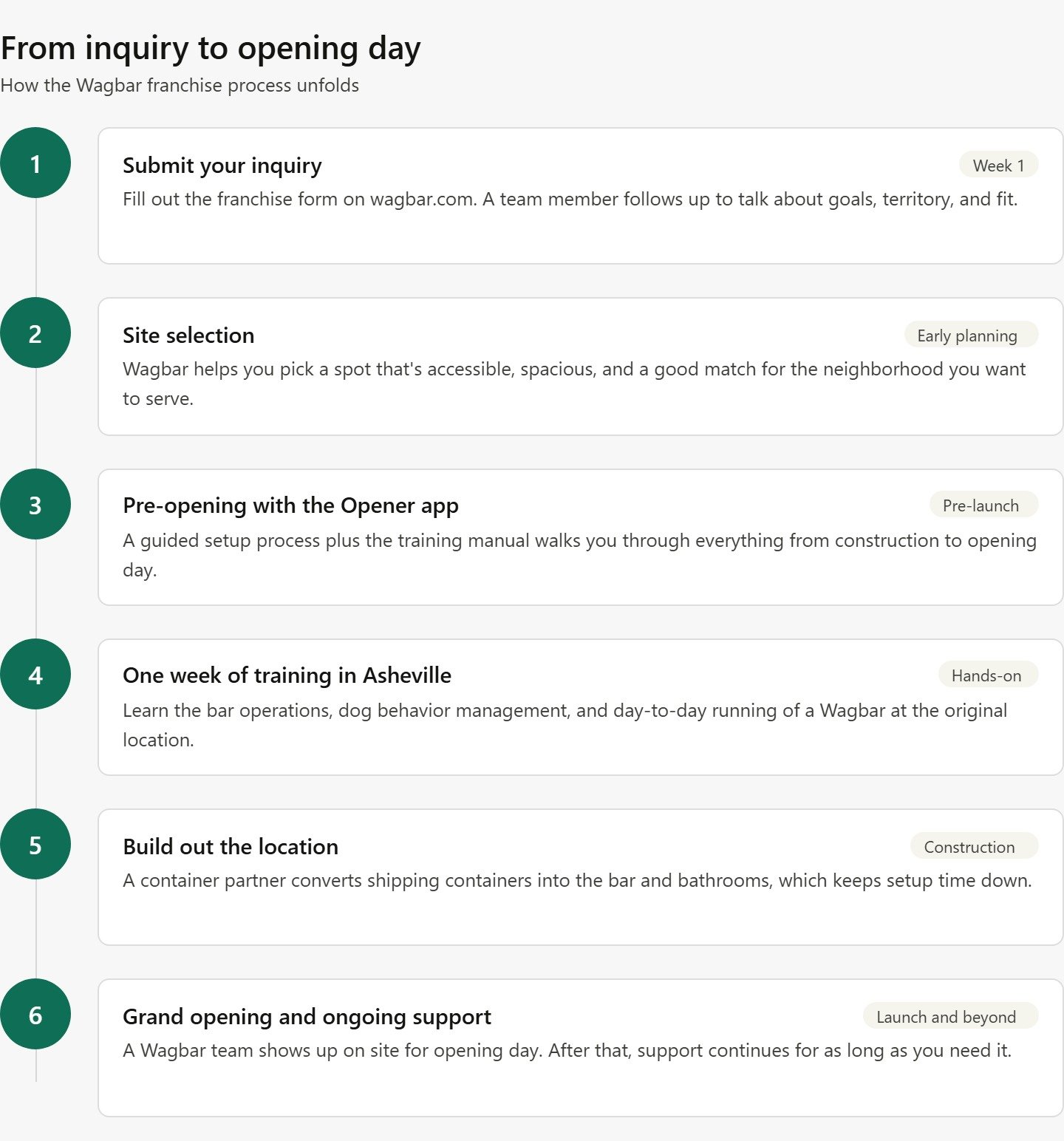
Wagbar's model requires staff who are comfortable with both dog behavior and bar service, a combination that isn't a typical hire but also isn't difficult to train. The franchise's one-week intensive training at Asheville headquarters covers dog behavior management, bar operations, staff training protocols, and marketing. The proprietary Opener app provides structured pre-opening guidance to keep franchisees on track before they ever unlock the doors.
Retail operations require inventory management, vendor relationships, and category expertise that many service-oriented entrepreneurs find less engaging than hands-on customer interaction.
Target Market and Location Criteria
Where a franchise works depends heavily on who it serves and how many of those customers live nearby.
Grooming franchises serve pet owners who value convenience and consistent quality. Mobile units need dense residential areas with pet-owning households. Salons need foot traffic or accessible parking.
Boarding and daycare targets dual-income households with dogs where regular daytime care or travel boarding is a practical need. Proximity to residential neighborhoods and easy highway access (for boarding) matters significantly.
Training franchises work in almost any suburban or urban market with a pet-owning population. The customer base is broad, but so is the competition.
Retail locations need significant foot traffic or anchor tenant proximity to drive walk-in volume. Strip mall and shopping center locations work better than standalone storefronts in most markets.
Dog park and bar concepts require more specific site criteria: enough outdoor space for off-leash play, proper zoning for both a park and alcohol service, and a demographic mix that includes dog owners with disposable income and an appetite for social experiences. Understanding best cities for dog franchise success helps narrow the site selection process significantly.
Markets with strong pet ownership rates, active outdoor culture, and an established bar or brewery scene tend to perform well for Wagbar. College towns and tech corridors have shown particular fit with the concept because they combine high young-adult pet ownership with social spending habits.
Legal and Compliance Considerations by Category
Each pet franchise category carries its own regulatory environment, and prospective franchisees should understand what they're signing up for before committing.
Grooming franchises require state licensing for groomers in many states, liability insurance for animal handling, and business licensing. Mobile units add vehicle maintenance and DOT regulations depending on the state.
Boarding facilities face the most complex regulatory environment of the traditional categories. State animal welfare laws, local zoning, noise ordinances, and specific kennel licensing requirements vary widely. A boarding facility that passes inspection in one county may face different standards five miles away in a different jurisdiction.
Training franchises are less regulated than boarding but may require professional certifications depending on the state and the specific techniques used. Liability coverage for behavioral incidents is essential.
Retail operations face product safety regulations, particularly for food and supplement categories. If a retailer sells raw meat products, food safety compliance adds another layer.
Dog park and bar concepts combine alcohol licensing requirements with dog park regulations, making the legal preparation more complex but also creating a higher barrier to competition once established. The complete legal guide for pet businesses covers licensing and compliance essentials across these categories.

Frequently Asked Questions
What is the best pet franchise to invest in?
There's no single right answer because "best" depends on your capital, operating experience, and target market. Grooming and training offer lower entry costs but typically lower revenue ceilings. Boarding generates high revenue but requires significant real estate and staffing. Dog park and bar concepts like Wagbar require more upfront investment but offer recurring membership revenue, multiple income streams, and a differentiated position in an undercrowded market.
How much does it cost to open a pet franchise?
The range is wide. Mobile grooming franchises can start around $100,000. Dog training concepts often fall between $80,000 and $250,000. Grooming salons run $150,000 to $400,000+. Pet retail spans $150,000 to $500,000+. Boarding and daycare can exceed $2 million for full buildout. The Wagbar investment range is $470,300 to $1,145,900. Consult each brand's Franchise Disclosure Document for current verified figures.
Are pet franchises recession-proof?
The pet industry as a whole has shown consistent growth through economic downturns for three consecutive decades, but individual categories are affected differently. Service-based models with membership revenue tend to be more resilient than retail or high-ticket boarding. Experiential concepts that serve as affordable local outings have also shown stronger retention during economic stress.
What royalty fees do pet franchises typically charge?
Royalty rates across pet franchise categories typically fall between 5% and 12% of gross or adjusted gross sales. Wagbar charges 6% of adjusted gross sales, plus a 1% marketing fund contribution. Rates vary by brand, category, and what services are included in the fee structure.
How do experiential pet franchises differ from service-based ones?
Service-based franchises (grooming, boarding, training) generate revenue at the point of transaction. Experiential models like dog park bars generate revenue through memberships, pass sales, beverage purchases, and events. The membership layer creates predictable recurring income, which is less common in traditional pet service franchising.
What should I evaluate before choosing a pet franchise?
Key factors include total investment and how it aligns with your capital, the royalty and fee structure, competitive density in your target market, the revenue model (transactional vs. recurring), franchisor support during opening and operations, and whether the concept has genuine market differentiation. Understanding the full spectrum of pet franchise types before committing to one category is worth the research time.
Summary
Choosing a pet franchise comes down to more than the lowest entry price. Grooming and training are accessible but revenue caps quickly. Boarding demands capital and complex staffing. Retail faces persistent digital competition. Dog park and bar concepts like Wagbar require more upfront investment but offer recurring membership revenue, multiple income streams, and a genuinely uncrowded market. For investors who want differentiation alongside community, that combination is worth the closer look.
Investment figures for Wagbar are provided for informational purposes only. Prospective franchisees should review the current Franchise Disclosure Document for complete, verified financial details. Figures for competing franchise categories are approximations based on publicly available information and may not reflect current FDD disclosures.