

Pet Boarding Franchise vs. Off-Leash Dog Park Bar: A Business Model Breakdown
Top TLDR: Pet boarding franchises and off-leash dog park bars both serve dog owners, but they are different businesses in every way that matters. Boarding requires 24-hour staffing, overnight care, and event-driven revenue tied to owner travel. Wagbar is a day-use concept with recurring membership income, no overnight operation, and no boarding. Review both FDDs and talk to existing owners before deciding which model fits your life.
Investors researching pet franchise opportunities frequently compare boarding and dog park concepts in the same breath. Both involve dogs, both require physical space, and both serve the same broad market of dog owners who want a place to bring their animals. The similarity stops there.
Pet boarding franchises and off-leash dog park bar franchises like Wagbar are built on fundamentally different premises, serve different customer needs, require different infrastructure and licensing, and carry different risk profiles. The confusion between them is understandable, but it can lead investors to compare incompatible options or overlook the category that actually fits their situation.
This page breaks down both models on the variables that determine whether an investment makes sense: what the business does, what it costs to open, how it generates revenue, what running it looks like operationally, and where each model is headed competitively.
What Each Business Actually Provides
The difference starts with what the customer is buying.
Pet boarding franchises provide overnight or extended-stay care for dogs whose owners are traveling, working long hours, or otherwise unable to be home with their pets. The customer's primary need is a safe place for their dog to stay when they can't be there. Boarding is, at its core, a childcare analogy applied to dogs. The dog is deposited, cared for, and picked up later.
Boarding facilities operate around the clock. Staff must be present overnight. Feeding schedules, medication management, and behavioral monitoring continue whether or not it's convenient. Many boarding concepts layer in add-on services: daycare, grooming, training, and enrichment activities that generate additional revenue during the stay. But the boarding itself requires 24-hour staffing.

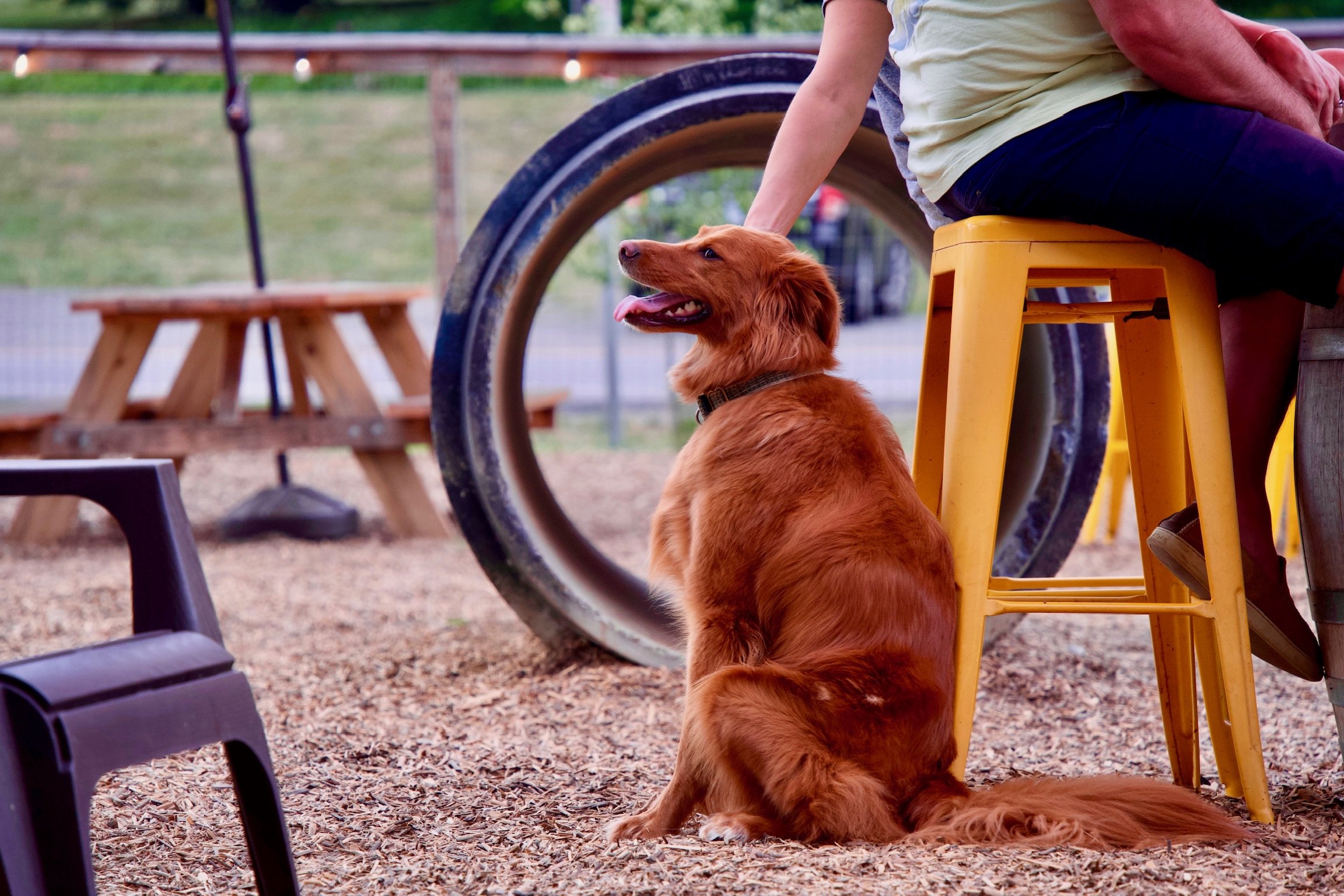
Off-leash dog park bars like Wagbar provide a social experience, not a care service. The dog owner is present the entire time. Dogs play off-leash in a fenced environment while their owners enjoy a bar experience alongside them. Wagbar is a day-use concept. Dogs go home at the end of every visit. There is no overnight stay, no around-the-clock care, and no staffing requirement for the hours the facility is closed.
That distinction is the root of most of the operational, financial, and lifestyle differences between these two models.
Investment Costs: What You'll Actually Spend
Pet boarding franchise investment:
Boarding franchises are among the more capital-intensive concepts in the pet category. The overnight requirement means you need sufficient space to house multiple dogs safely, separate areas for different temperaments, dedicated sleeping quarters, outdoor runs, and staff facilities. Real estate requirements are typically 3,000 to 8,000 square feet or more, and the build-out must meet local zoning and animal care regulations that vary significantly by state and municipality.
Total investment ranges for boarding franchise concepts typically run from $300,000 to over $1,000,000, depending on market, facility size, and the scope of services included. Larger full-service facilities with daycare, grooming, and training add-ons sit at the higher end. Leaner boarding-focused concepts can come in closer to the lower bound in more accessible markets.
Franchise fees for boarding concepts generally run from $25,000 to $75,000. Royalty structures typically range from 5% to 8% of gross revenue.
Wagbar (off-leash dog park bar) investment:
Wagbar's total investment range is $470,300 to $1,145,900, with a $50,000 franchise fee, 6% royalty on adjusted gross sales, and a 1% marketing fund contribution. Operators opening three or more units receive a 50% discount on franchise fees starting at the third location.
The investment is driven primarily by real estate and build-out: the fenced outdoor dog park area, the bar and beverage service infrastructure, and the licensing required to serve alcohol in your market. Markets where suitable outdoor space is more accessible and build-out costs are lower sit toward the bottom of the range. Higher-cost markets push upward.
(All figures are illustrative. Prospective franchisees must review the current Franchise Disclosure Document for complete and verified investment information.)
At the top end, these ranges overlap. At the bottom end, some boarding concepts are accessible at lower total investment. But the cost comparison matters less than the revenue model and operating structure, because what you're committing to in terms of daily operations is dramatically different between these two models.
For a broader side-by-side of investment ranges across all major pet franchise categories, the pet franchise investment guide covers the full spectrum.
Revenue Models: Where Each Business Earns
Boarding franchise revenue:
Boarding revenue is primarily transactional and event-driven. A dog owner books a stay, the dog stays for the booked period, and the owner pays. Average nightly boarding rates in most US markets run from $40 to $75 per dog per night, with premium concepts in higher-cost markets reaching above that range. Add-on services like grooming, training sessions, or enrichment packages generate incremental revenue per stay.
Revenue in boarding follows the owner's travel calendar, which creates predictable seasonal patterns but also real volatility. Holiday periods like Thanksgiving, Christmas, and summer vacation generate high demand that fully booked facilities can't always capture. Off-peak periods require deliberate programming to sustain occupancy and revenue.
There's no recurring revenue model in traditional boarding. Each stay requires a new booking decision. Customer retention through a positive experience is critical, but there's no membership structure that generates income between visits.
Wagbar revenue:
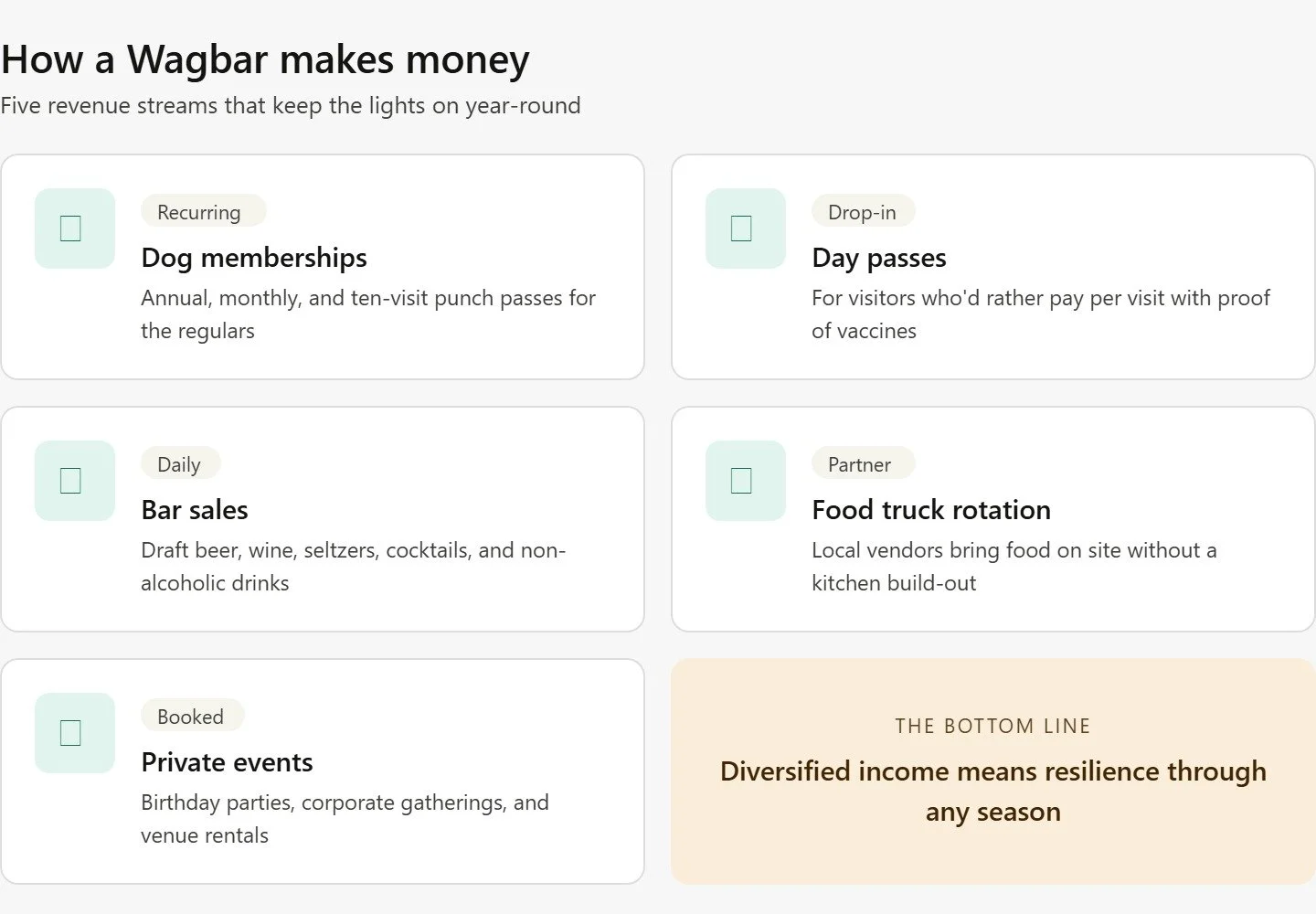
Wagbar generates revenue from three simultaneous streams: memberships, day passes, and food and beverage.
The membership layer is the most important difference. Members pay recurring monthly or annual fees for unlimited access. That revenue continues regardless of how often a member visits in a given week or whether they visit at all. A Wagbar location with 300 active members has a floor of predictable recurring income before a single day pass is sold or a drink is poured.
Day passes capture first-time visitors and occasional guests who haven't converted to membership. Food and beverage generates hospitality-style margins alongside the park revenue. The combination creates a layered revenue structure that doesn't depend on any single transaction type.
Boarding competes for the customer when they travel. Wagbar competes for the customer's regular routine. These are different market positions, and the recurring membership model has significant implications for revenue predictability and long-term financial planning.
The Wagbar revenue model overview explains how these three streams work together and what the financial implications look like over a full operating year.
Operations: What Running Each Business Looks Like
This is where the difference between these models is most visceral for franchise owners.
Running a boarding franchise:
Boarding is a 24-hour business. Dogs need feeding, medication, monitoring, and care overnight, which means staff must be present around the clock every single day the facility is open. Staffing a boarding operation requires at minimum one or two overnight employees at all times, which is a fixed labor cost that exists whether the facility is at 80% capacity or 10% capacity.
The complexity extends beyond staffing. Boarding facilities manage multiple dogs simultaneously with different behavioral profiles, feeding schedules, and sometimes medical needs. A dog fight, an illness, or an emergency at 2 AM requires immediate staff response. Regulatory compliance with animal care standards, local zoning, and health requirements is ongoing and jurisdiction-specific.
This doesn't mean boarding franchises can't be run well. They can, and many operate successfully across the country. What it means is that the operational profile requires genuine commitment to a model that doesn't stop when you leave for the day. For investors who want a business that can be run with a well-trained manager overseeing daily operations, boarding presents more complexity than some other models.
Running a Wagbar:
Wagbar is a day-use business with no overnight component. The facility opens, dogs and owners visit, the bar operates during visiting hours, and the facility closes. Staff go home. There is no overnight monitoring, no around-the-clock care requirement, and no emergency response obligation during closed hours.
Day-to-day operations center on park monitoring for safety and entry standard enforcement, beverage service and bar operations, membership management, and the general customer experience that drives retention and referrals. These are manageable operational categories with clear systems and training behind them.
Wagbar requires all dogs entering the park to be current on rabies, Bordetella, and distemper vaccinations, be at least six months old, and be spayed or neutered. Human entry is free for guests 18 and older. These entry standards are enforced at the gate and are fundamental to the safety and experience quality that justifies membership pricing.
The training Wagbar provides to franchisees reflects this operational structure. The pre-opening digital platform guides operators through the setup process, and the in-person training week in Asheville, North Carolina covers dog behavior management, bar operations, staff training, and local marketing. The franchise training overview details what that preparation covers.
Competitive Environment for Each Model
Pet boarding competition:
The pet boarding category is competitive and fragmented. Independent boarding facilities operate in most markets. Large chains like Camp Bow Wow and PetSmart's PetsHotel brand have substantial national footprints. App-based services like Rover and Wag connect dog owners directly with individual sitters and dog walkers, providing a lower-cost alternative to facility boarding that has taken meaningful market share, particularly for routine or short-duration needs.
Franchise boarding concepts compete primarily on facility quality, safety standards, and the consistency that a branded system provides over an independent operator. The competitive case for a franchise over an independent boarding kennel is real, but the market is not without pressure from both above (chains) and below (app-based alternatives).
Dog park bar competition:
The branded off-leash dog park bar category is newer and less crowded. Public dog parks serve a related function but are a genuinely different product: no bar, no vaccination enforcement, no trained monitors, no membership community. A municipal off-leash area is not a substitute for Wagbar any more than a public gym is a substitute for a gym membership with classes and a community.
Independent dog bars exist in some markets. Wagbar's franchise system provides branded standards, operational training, and ongoing support that independent operators typically don't have. Being among the first branded concepts in a given market is a real advantage for community recognition and membership growth.
The broader market comparison is worth noting as well. Boarding competes with app-based services that didn't exist ten years ago and continue to grow. Dog park bars don't have a meaningful app-based competitor because what they provide is inherently social, physical, and in-person. The competitive trajectory points in different directions for these two models.
The dog park market review provides context on what the competitive picture looks like in specific US markets.
Which Investor Profile Fits Each Model
Boarding franchise investors typically have backgrounds in operations, animal care, or service business management. They're comfortable with 24-hour operational responsibility, genuinely enjoy the animal care environment, and are prepared for the staffing and regulatory complexity that overnight care requires. Some boarding franchise owners have veterinary or shelter backgrounds. Others come from general business management and build teams with the necessary expertise.
Dog park bar investors typically come from finance, corporate management, hospitality, or sales. They're drawn to the community-building dimension and the recurring revenue model. They want a business that creates a gathering place rather than delivering a care service. Wagbar's franchise owners reflect this pattern.
AJ Sanborn in Richmond, VA spent 20 years in financial services and made his decision specifically around the recurring membership revenue structure. Liz and Shelby in Knoxville, TN came from finance and sales backgrounds to build a location in a market they knew well. Dianna in Phoenix, AZ combined IT sales and restaurant industry experience, a natural fit for the hospitality side of the concept.
For a broader view of what kinds of investors succeed across the full pet franchise category, the animal franchise opportunities overview covers the range.
Frequently Asked Questions
Does Wagbar offer boarding services?
No. Wagbar is a day-use concept. Dogs visit with their owners, play off-leash in the park, and go home at the end of the visit. There is no overnight stay, no boarding service, and no care provided in the owner's absence. This is a fundamental design choice that shapes the entire operational and financial model.
Is a boarding franchise more expensive to open than a dog park bar?
The ranges overlap at the upper end. Boarding franchises typically run $300,000 to over $1,000,000 in total investment. Wagbar's range is $470,300 to $1,145,900. Specific costs depend on your market, real estate conditions, and the scope of services. Both require significant capital. The more important question is what you get for that investment in terms of revenue model, operational complexity, and competitive positioning.
How does Wagbar's recurring membership differ from boarding's per-stay model?
Wagbar members pay a monthly or annual fee for unlimited access. That revenue continues regardless of visit frequency. Boarding revenue requires a new booking decision each time, tied to the owner's travel schedule. The membership model creates a predictable revenue floor; the boarding model creates revenue that depends on events outside the business's control.
What are the overnight staffing requirements for a boarding franchise?
Boarding facilities require staff to be present overnight every day the facility operates. The specific staffing ratio depends on facility size, local regulations, and the number of dogs in care at any given time. This is a fixed operational cost that exists at low occupancy as well as high occupancy, and it's one of the primary drivers of the 24-hour operational complexity that distinguishes boarding from day-use concepts.
What should I compare in the FDD before choosing between these models?
Review Item 7 for the full estimated investment breakdown, including working capital requirements. Review Item 19 for any financial performance disclosures the franchisor provides. Pay specific attention to staffing costs in boarding concepts. Overnight labor is a significant fixed expense that doesn't always appear prominently in marketing materials. Contact existing franchisees from both systems and ask specifically about operational demands, first-year surprises, and whether the day-to-day reality matched their expectations. The franchise due diligence guide walks through the full evaluation process.
Bottom TLDR: The confusion between a pet boarding franchise and an off-leash dog park bar franchise like Wagbar is common, but the business models are not comparable. Boarding is overnight care requiring around-the-clock staffing and booking-based revenue. Wagbar is a day-use experience business generating recurring membership income with no overnight component. Before committing to either, request the FDD, review Item 19, and speak with existing franchisees.
FDD Disclaimer: All Wagbar investment figures cited on this page are illustrative estimates only. Prospective franchisees must receive and review the current Franchise Disclosure Document before making any investment decisions. Nothing on this page constitutes an offer to sell a franchise.