

Outdoor Pet Franchise: The Complete Guide to Dog Park and Recreation Business Opportunities
Top TLDR: An outdoor pet franchise combines off-leash dog recreation with beverage service in a shared social space, making it one of the fastest-growing categories in the pet industry. Wagbar pioneered this model in 2019 and has since expanded to markets across the U.S. through franchising. If you're evaluating an outdoor pet franchise opportunity, start by reviewing the Franchise Disclosure Document and requesting a discovery call to understand site requirements and total investment.
The pet industry doesn't stand still. What started as basic boarding kennels and grooming shops has grown into a $147 billion market (American Pet Products Association, 2023) where dog owners expect more than a quick service transaction. They want experiences. They want community. And increasingly, they want spaces where their dog can actually run.
That shift created a new category: the outdoor pet franchise. It's a concept built around off-leash recreation, social atmosphere, and a business model that generates revenue from multiple sources at once. This guide covers what defines the category, why outdoor beats indoor for both dogs and owners, how the numbers work, and what it takes to open a location.
What Is an Outdoor Pet Franchise?
An outdoor pet franchise is a business that gives dogs a fully fenced, supervised, off-leash play environment while their owners socialize, enjoy food and beverages, and participate in community events. The defining features are outdoor space, off-leash access, and a social hospitality component layered on top.
This separates the category from pet boarding facilities, grooming shops, and even traditional indoor dog parks. A boarding facility is transactional and oriented around the owner's absence. An outdoor recreation franchise is built around the owner's presence and participation. The dog plays. The owner relaxes. Both come back.
The category is still early. Wagbar, founded in Asheville, North Carolina in 2019, is widely recognized as the original off-leash dog park and bar franchise, having built the concept from a single flagship location into a national franchise network spanning markets from Richmond, Virginia to Los Angeles, California.

Why Outdoor Beats Indoor for Dog Socialization
This isn't just an aesthetic preference. The behavioral science is clear.
Dogs are descended from animals that covered large territories, and their exercise and social needs reflect that. According to the American Kennel Club, adequate off-leash running and unstructured social play are among the most effective tools for reducing anxiety, reactivity, and destructive behavior in domestic dogs. Confined indoor play areas often create higher arousal states simply because space is limited and dogs can't disengage from one another easily.
Outdoor environments offer several documented advantages. Dogs can self-regulate social interaction by moving away from high-pressure encounters. They can run at full speed, which is critical for medium and large breeds. Natural surfaces including grass, dirt, and gravel reduce joint stress compared to concrete. And sensory variety, including ambient sounds, wind, and varied terrain, supports cognitive enrichment in ways that climate-controlled indoor rooms simply can't replicate.
The owner experience matters equally. Indoor dog parks often feel like holding areas. Outdoor settings with comfortable seating, shade, open sightlines, and bar service create a place people genuinely want to spend two hours. That's not a small distinction for a membership-driven business, where repeat visits and annual renewals are the financial foundation.
For more on why dogs benefit from open-space socialization, Wagbar's dog socialization and behavior hub covers the research in detail.
Revenue Models in Outdoor Pet Recreation
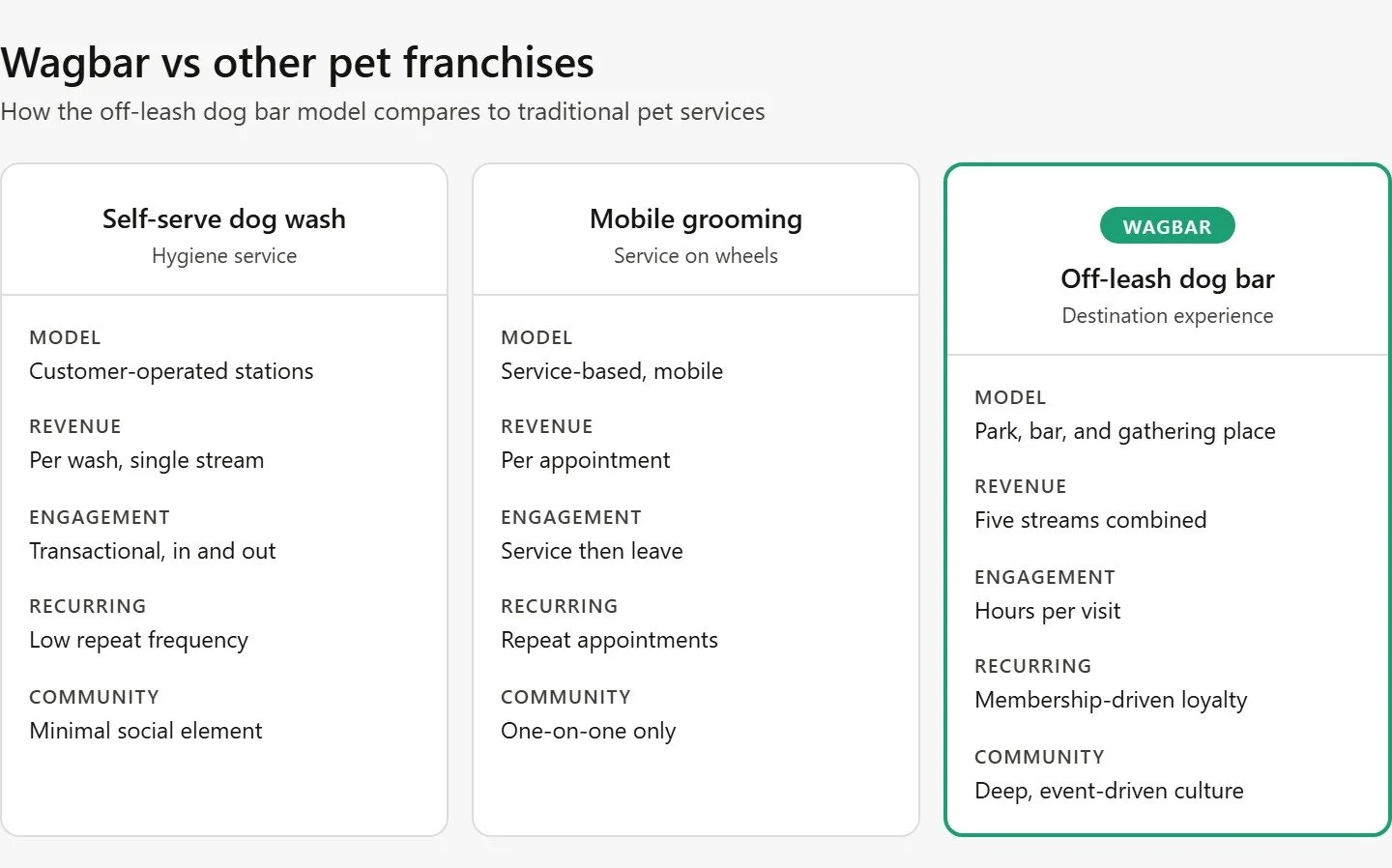
One of the most compelling aspects of the outdoor pet franchise model is that it doesn't depend on a single revenue stream. That's a meaningful structural advantage over most pet service businesses.
Day passes are the baseline entry point. A guest pays a per-visit fee for their dog, shows proof of vaccinations, and accesses the off-leash park. Day passes convert casual visitors into potential members and generate immediate revenue without a long-term commitment.
Memberships are where recurring revenue comes from. At Wagbar, membership is tied to the dog, not the human, which means multi-dog households purchase multiple memberships. Members don't need to show vaccination records on repeat visits, which removes friction and increases visit frequency. Memberships are typically offered in monthly, annual, and punch-pass formats, giving guests flexibility while generating predictable income for the operator.
Beverage service is what separates this concept from a traditional dog park. Draft beer, craft brews, cocktails, seltzers, wine, and non-alcoholic options are available while owners watch their dogs play. This transforms what would otherwise be dead time, sitting and watching, into active consumption. Beverage margins are strong, and the environment creates extended dwell time that traditional food and beverage venues can't manufacture without a performance or entertainment element.
Events layer on top of these foundations. Wagbar locations have hosted breed meetups, trivia nights, live music, holiday parties, food truck partnerships, and community potlucks. Events drive incremental attendance, generate social media content, and reinforce the community identity that sustains long-term membership retention.
Private event rentals offer another channel for select locations. A fully fenced outdoor space with bar access is a genuinely unusual and attractive venue for birthday parties, corporate outings, and other gatherings where bringing your dog isn't an afterthought but the point.
You can dig deeper into how each of these channels performs in Wagbar's revenue streams overview.
The Market for Outdoor Pet Recreation
The numbers behind pet spending explain why this category is attracting serious investment.
The American Pet Products Association pegged total U.S. pet industry spending at $147 billion in 2023, up from $136.8 billion in 2022. Pet services, the segment that includes recreation and experiential businesses, is the fastest-growing slice of that market. According to the APPA, pet services spending grew 14% in a single year.
Dog ownership rates support the demand side. Approximately 66% of U.S. households own a pet, and dogs are the most common pet in American homes (American Pet Products Association, 2023). Ownership skews younger: millennials are now the largest cohort of dog owners, and they consistently outspend other generations on pet services and experiences (American Pet Products Association, 2023).
The experience economy adds another layer. Research published in the Journal of Consumer Research has consistently shown that consumers derive more sustained satisfaction from experiential spending than from product purchases. The outdoor pet franchise sits exactly at the intersection of these trends: it's experiential, it's pet-centered, and it's social.
Recession resilience is a relevant factor for franchise investors as well. Pet spending contracted only modestly during the 2008 financial crisis and recovered quickly. Dog ownership rates have trended upward through every recent economic downturn. Owners treat their dogs as family members, and spending behavior reflects that.
For a broader picture of where the industry is headed, Wagbar's pet industry growth trends analysis covers the data through 2030.
Site Selection: Space, Climate, and Zoning
Site selection is one of the most consequential decisions in opening an outdoor pet franchise. Get it right and you have a natural advantage. Get it wrong and no amount of operational excellence will overcome it.
Space requirements are non-negotiable. An outdoor off-leash dog park needs enough room for dogs to run and disengage from social encounters when needed. A park that's too small creates chronic overstimulation, which produces behavior problems and leads to poor customer experience and membership cancellations. The bar and seating area need adequate square footage to serve as a genuine gathering space, with sightlines to the dog park so owners feel present and connected.
Climate considerations are more manageable than they initially appear. The most common concern prospective franchisees raise is seasonality in northern markets. This is addressable. Many Wagbar locations operate in markets with genuine winters, and the operational strategy, including appropriate shelter structures, heating elements, and programming changes by season, keeps year-round visitation viable. Wagbar's franchise site at wagbar.com/franchising addresses cold-climate operations directly.
Zoning and regulatory requirements vary significantly by municipality. An outdoor venue serving alcohol requires a liquor license, which involves local regulatory approval. Dog parks may have specific zoning classifications depending on the city. Sites near residential neighborhoods may have noise or hours-of-operation constraints. Prospective franchise owners should expect to work through these layers early in the site evaluation process, and Wagbar's support system includes guidance navigating them. Wagbar's zoning and regulations guide for pet businesses provides a useful starting framework.
Demographics matter as much as real estate metrics. The strongest markets for an outdoor pet franchise share a recognizable profile: higher household incomes, strong pet ownership rates, active outdoor culture, and a social scene that supports community-oriented businesses. College towns and tech-corridor markets have performed particularly well for Wagbar franchisees because they combine young professional demographics with discretionary spending and community identity. Wagbar's market demographics guide goes deeper on what makes a city a strong fit.
Operational Requirements Unique to Outdoor Concepts
Operating an outdoor pet franchise differs from a traditional food and beverage business in several important ways.
Dog screening and behavior management require trained staff who can read canine body language and intervene before minor tension becomes a conflict. Wagbar requires all dogs to be up to date on vaccinations, at least six months old, and spayed or neutered. Dogs with documented aggression history are not admitted. These aren't bureaucratic barriers; they're the operational infrastructure that keeps the experience safe and the community intact. Wagbar's guide on dog park behavior and group play dynamics covers this in detail.
Dual liquor and pet licensing adds complexity to the compliance picture. Staff training must span both hospitality standards and dog behavior fundamentals. Liability insurance requirements differ from either a pure bar or a pure dog park.
Maintenance cycles for outdoor environments are intensive. Turf or natural surface management, drainage, fencing inspection, cleaning protocols, and weather-related upkeep all require consistent attention. The build-out approach matters: Wagbar's turnkey shipping container bar solution reduces the structural complexity of the hospitality side, allowing operators to focus operational energy where it's most needed.
Seasonal programming keeps visitation consistent across the calendar. A location that relies entirely on warm-weather foot traffic without a programming strategy will see sharp revenue troughs. The most successful Wagbar operators build event calendars that create reasons to visit year-round, independent of weather. Breed meetups, trivia nights, holiday parties, and food truck partnerships are examples that work across seasons and generate social media content that sustains community interest between visits.
Staffing for an outdoor pet franchise is a legitimate challenge in most markets. The skill set is unusual: staff need to be comfortable around dogs of all sizes and temperaments, capable of managing group dynamics in the park, trained in responsible alcohol service, and engaged enough to contribute to community-building. Wagbar's training program covers all of this. Operational guidance on this front is available in the staffing and operations resource.
Wagbar as the Category Pioneer
Wagbar was founded in 2019 by Kendal Kulp and his father Kajur after Kendal had a genuinely bad experience at a conventional dog park. The insight wasn't complicated: dog parks didn't have to be utilitarian, anxious spaces. They could be enjoyable for the humans too.
The flagship Weaverville location outside Asheville, North Carolina, proved the concept. Wagbar earned recognition as one of USA Today's top 10 dog bars in the country and has won Best of WNC awards multiple times, including first place for Pet Friendly Bar and Brewery three years running. The brand built its reputation not through heavy marketing but through community, events, and genuine word of mouth.
Franchise development began with the recognition that the model traveled. Wagbar franchisees have come from backgrounds including financial services, IT sales, corporate management, and animal behavior, showing that passion for dogs and community matters more than prior hospitality experience.
Current franchise partners include AJ Sanborn in Richmond, Virginia, who spent 20 years in financial services before opening Wagbar. Dianna in Phoenix brought years of IT sales experience and a background in the restaurant industry. Jennifer in Los Angeles, who grew up wanting to be a veterinarian, opened her location after a long corporate career. A mother-daughter team in Knoxville, Tennessee, whose backgrounds span finance, sales, and animal behavior, is among the most recent additions to the network.
The investment range for a Wagbar franchise is $470,300 to $1,145,900, which includes the $50,000 franchise fee along with site build-out, equipment, and launch costs. Ongoing royalties are 6% of adjusted gross sales, with a 1% contribution to the Wagbar marketing fund. For franchisees committing to three or more units, the franchise fee for additional locations is discounted by 50%. All figures are informational; prospective franchisees should consult the official Franchise Disclosure Document for complete details.
Wagbar's pet franchise opportunity page and main franchising page are the appropriate starting points for anyone exploring this seriously.
FAQ
What makes an outdoor pet franchise different from a traditional dog park?
A traditional dog park typically operates as a free municipal amenity with no supervision, no admission revenue, and no hospitality component. An outdoor pet franchise is a private, commercially operated business with controlled access, trained staff, vaccination requirements, bar service, and a recurring membership model. The revenue structure, the guest experience, and the operational requirements are fundamentally different.
Do outdoor dog park franchises work in cold climates?
Yes. Wagbar operates locations in markets with genuine winters. Cold-weather operations require appropriate structural accommodations including covered areas and heating elements, along with seasonal programming adjustments. The franchise support system includes guidance for cold-climate markets specifically. Year-round viability is achievable with the right site design and operating strategy.
What is the total investment required to open a Wagbar outdoor pet franchise?
The estimated total initial investment for a Wagbar franchise ranges from $470,300 to $1,145,900, including the $50,000 franchise fee. The range reflects variability in site costs, construction, and local regulatory requirements. These figures are informational; the Franchise Disclosure Document contains complete, binding investment details.
How do outdoor pet franchise owners generate revenue in multiple ways?
Revenue comes from dog day passes, monthly and annual memberships, beverage sales, private event rentals, and ticketed community events. The combination of recurring membership income and per-visit spending creates a more stable financial base than single-revenue-stream pet businesses.
What kind of site is required for an outdoor pet franchise?
A viable site needs sufficient acreage for a fully fenced off-leash dog area, a bar and seating structure, parking, and perimeter space. Sites must support a liquor license and may require specific zoning classifications for commercial animal recreation. Demographics matter as much as real estate metrics: the strongest markets combine higher household incomes, active outdoor culture, and strong dog ownership rates.
What prior experience do Wagbar franchise owners typically have?
Wagbar's franchisee network includes people from financial services, IT sales, corporate management, and animal behavior backgrounds. Prior hospitality experience is not required. Wagbar's training program, which includes a week of intensive hands-on instruction at the Asheville headquarters plus on-site opening support, is designed to prepare operators who come from outside the industry.
Is an Outdoor Pet Franchise Right for You?
The outdoor pet franchise category exists at a genuinely favorable intersection. Pet spending is growing. Experience-economy preferences favor social, activity-based businesses. Dog ownership rates remain high across income levels and generations. And the model itself, memberships plus day passes plus beverage service plus events, generates revenue from multiple channels simultaneously.
The operating complexity is real. Site selection requires care. Dual licensing adds layers. Staff training spans two different skill sets. These aren't obstacles that should discourage a serious buyer, but they are factors that deserve honest evaluation.
Wagbar has built the systems, training, and operational support to help franchisees work through them. If you're considering an outdoor pet franchise and want to understand what the process looks like from inquiry to grand opening, the franchising page is the right place to start. You can also review what current franchise owners looked for before investing in the investment guide for off-leash dog bar franchises.
Bottom TLDR: An outdoor pet franchise gives dogs off-leash space to run while generating revenue through memberships, day passes, and beverage service, a more durable model than single-service pet concepts. Wagbar, the original outdoor pet franchise founded in 2019, offers a total investment range of $470,300 to $1,145,900 with a $50,000 franchise fee and support systems built for franchisees from non-hospitality backgrounds. Start by reviewing the FDD and requesting a discovery call at wagbar.com/franchising.