

Off-Leash Dog Bar vs. Public Dog Park: Safety, Supervision, and What You Actually Get
Top TLDR: Off-leash dog bar vs. public dog park comes down to one structural difference: supervision. Off-leash dog bars verify vaccinations, screen behavior at the gate, and keep trained staff inside the play area. Public dog parks are free but unsupervised, with no checks on who walks in. If your dog matters too much to gamble, pick the supervised format.
An off-leash dog bar offers staff-supervised play with verified vaccinations and behavior screening; a public dog park is a free, unsupervised fenced lot with no entry checks.
The supervision gap drives most safety differences: dog fights, bite injuries, and disease exposure are far more common in unsupervised settings.
Behavior screening at the gate keeps reactive, intact, or unsocialized dogs out of off-leash dog bars in a way public parks structurally cannot.
If your dog is sensitive, young, recovering, or simply matters too much to risk, the supervised format is worth the day pass.
Two Doors, Two Different Outcomes
You have a dog with energy to burn and a free Saturday afternoon. The two real options most cities offer are a public dog park or an off-leash dog bar. The signs at both gates say "off-leash play." What happens after the gate closes behind you is not the same.
Most owners go to a public dog park first because it's free and close. Many of those owners eventually walk into a Wagbar or a similar off-leash dog bar and have a moment of "oh, this is what dog social time was supposed to feel like." The difference isn't the fence. It's everything that happens because of who's watching, what got through the gate, and what your dog can actually do once inside.
This piece compares the two formats on the things that matter once you're past the parking lot: safety, supervision, behavior screening, barrier frustration, and what you really get for the time you spent.
What "Unsupervised" Actually Means at a Public Dog Park
Public dog parks are unsupervised by design. The city pays for the fence, the bag dispenser, and the basic maintenance. They don't pay for staff. That's the trade for keeping the gate free.
In practice, this means several things. Nobody is screening dogs at the entrance. Nobody is breaking up rough play before it tips into a real fight. Nobody is asking the guy in the corner to put down his phone and watch his dog. Nobody knows how many dogs are inside or who they belong to. If a serious bite happens, you call 911 and trade contact info with the other owner like a fender bender, except your dog might need an emergency vet visit and weeks of recovery.

The American Veterinary Medical Association notes that unsupervised dog parks carry meaningful risk of injury, disease transmission, and behavioral setbacks for dogs still building social skills. Trainers tend to be even more direct. Many recommend skipping public dog parks entirely for puppies, adolescent dogs in their fear stages, and any dog with a sensitive temperament.
The lack of supervision changes the dogs themselves. Dogs read human attention. When the adults in a space are paying attention, dogs match that energy. When the adults are scrolling, dogs ramp up. The same group of dogs that would play normally with a calm adult watching can spiral into chaos when nobody is. Our dog park behavior breakdown walks through exactly how group dynamics shift based on who's watching.
What Supervision Actually Looks Like at an Off-Leash Dog Bar
At an off-leash dog bar, staff are inside the play area with the dogs the entire time. They aren't at a desk. They aren't behind the bar. They're walking the yard, watching body language, noting which dogs came in together, and stepping in when something starts to look off.
Trained Wagbar staff at the Weaverville flagship read body language for a living. They know what a stiff tail means versus a loose one. They see the difference between play and prey. They know which dogs are regulars, which are first-time visitors, and which combinations don't mix well. When two dogs start escalating, staff redirect them before either one commits to a real bite.
This isn't theoretical. Watch a busy yard at any Wagbar location for an hour and you'll see a dozen small interventions you'd never notice as a customer. A staff member walking past two dogs who are starting to stare each other down. A redirect with a toy. A request for a specific dog to take a water break. None of it looks dramatic. That's the point.
The result shows up in the injury rates. Off-leash dog bars track incidents because they have to. Most go years between serious bites. Public dog parks have no central reporting because there's nobody to report to. Trauma vet techs in any major city will tell you which days of the week generate the most dog-fight ER visits. Saturday afternoon at the busy public park leads the list every time.
Behavior Screening: Who Gets Through the Gate
This is the structural difference most owners don't notice until it bites them. Off-leash dog bars screen the dogs that come in. Public dog parks don't.
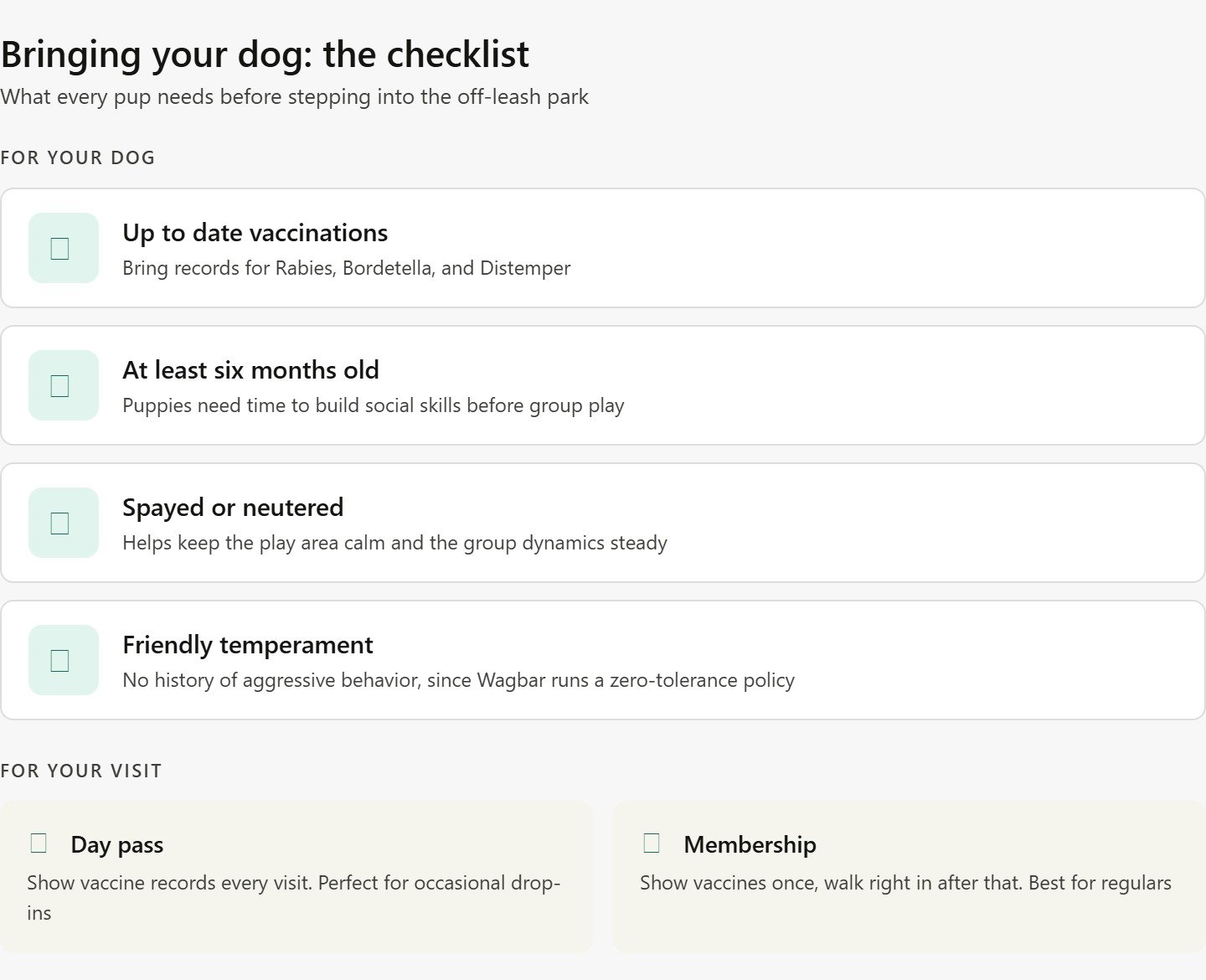
At Wagbar, every new dog goes through a process before entering the play yard. Vaccination records get verified. Spay or neuter status is confirmed for adult dogs. The owner signs a waiver. New dogs get a behavior introduction so staff can see how they handle being approached, having other dogs around, and basic stress. Dogs that show clear aggression or extreme fear at intake don't get cleared for the main yard.
After the first visit, the screening continues. Members who break rules get warnings. Dogs that start a fight more than once lose membership. Owners who refuse to leash up at the gate get asked to leave. The community is curated, not random.
Public dog parks have no version of this. Anyone can walk up. Vaccination is theoretical. Spay or neuter status isn't checked. A dog that just attacked another dog last week at this same park can show up again today and there's no system to keep them out. The owner who lets their dog bully smaller dogs every visit is welcomed back every visit.
The implications add up. At an off-leash dog bar, the dogs around your dog have at least met a baseline of socialization, vaccination, and owner responsibility. At a public dog park, the dog next to yours might be an unneutered three-year-old male with no recall, an unvaccinated rescue still working through fear-based aggression, or a dog whose owner watched four other fights happen and didn't think any of them were a big deal. You don't know. The format doesn't tell you. Our dog park fight prevention page covers what to watch for if you're going in without that screening layer.
Barrier Frustration: The Hidden Public-Park Problem
Barrier frustration is a behavior issue that public dog parks make worse and off-leash dog bars actively prevent. It happens when a dog can see another dog but can't reach them, like through a fence or on a leash. The frustration builds, the dog amps up, and the next on-leash dog they meet gets bark-lunged because the pattern is now wired in.
Public dog parks are barrier-frustration generators. The fence runs along sidewalks and streets. Dogs inside the park spot dogs being walked outside the park. They run the fence line, barking. The dogs on the leashes outside react back. After enough trips, the dog inside the park learns that seeing another dog through a fence means it's time to lose your mind. That dog now reacts to every leashed dog you walk past on a regular street.
Worse, the entry layout at most public dog parks has dogs already inside crowding the gate when new dogs arrive. The new dog gets surrounded the second the second gate opens. Some dogs handle this fine. Many don't. The ones that don't can develop entry aggression that follows them into every future park visit.
Off-leash dog bars solve both problems. Wagbar's double-gated entry includes a holding area where the new dog can settle before joining the main yard. Staff direct other dogs away from the gate so the entry isn't a mob scene. The fence lines are interior, with no on-leash sidewalk traffic running parallel. The structural setup that creates barrier frustration at public parks doesn't exist at the dog bar version of the format.
If your dog has any leash reactivity already, this matters more, not less. Sending a leash-reactive dog to a chaotic public park usually makes the reactivity worse. Sending the same dog to an off-leash dog bar with a controlled entry, screened pack, and staff oversight often does the opposite. The dog body language decoder helps owners read whether their dog is trending up or down through the visit.
Vaccination and Health: Real Enforcement vs. Honor System
Public dog parks ask for vaccinations on a sign. They don't check.
Most cities have an ordinance requiring a current rabies tag and core vaccinations for dogs using public off-leash areas. Almost no city checks at the gate, because there's nobody at the gate. The result is that some percentage of dogs at any public park are unvaccinated, under-vaccinated, or carrying a parasite the owner doesn't know about. Kennel cough, giardia, and parvo all move through unsupervised dog populations faster than most owners realize.

Off-leash dog bars enforce vaccination at intake and at renewal. At Wagbar, the basic requirement covers rabies, distemper combination (DHPP), and bordetella. Many locations also require negative fecal tests and current flea and tick prevention. Records get reviewed before entry, not assumed. The dog health and safety practices at Wagbar page lists the full protocol.
The difference shows up in disease incidence. Owners and vets in any market will tell you the same story: kennel cough outbreaks at unsupervised public parks happen regularly. Outbreaks at well-run off-leash dog bars happen rarely, and when they do, they're contained quickly because the operator has every member's contact info and can notify everyone the same day.
For puppies, this matters most. A fully vaccinated puppy at an off-leash dog bar is in an environment where every other dog is also vaccinated. A fully vaccinated puppy at a public park is sharing space with whatever showed up. The puppy socialization timeline explains why this difference matters during the critical 3 to 16 week window.
What You Actually Get for Your Time
Strip away the marketing language and ask the practical question: when you walk back to your car after a one-hour visit, what did you actually get?
At a public dog park, you typically get:
Some unsupervised exercise for your dog, weather permitting
A constant low-grade attention requirement to keep your dog safe
A weather-dependent visit with no indoor backup
Zero infrastructure for your own comfort: no bathroom, no shade structure, no seat that isn't a splintered bench
Whatever interaction you have with whichever owners happened to show up
A drive home where you mentally replay every close call
At an off-leash dog bar, you typically get:
Same off-leash exercise for your dog, with the safety layer of trained supervision
The ability to actually relax instead of monitoring constantly
Climate control: indoor seating in cold rain, shade structures in summer, warming areas in winter
A real seat, food and drinks, and bathrooms that work
A built-in social layer where you meet other dog owners through repeat visits
Programming on most nights of the week: trivia, music, breed meetups
The total time investment is similar. The cost is different. The recovery from the visit is night and day. Owners walk out of public dog parks tired in the bad way (vigilance fatigue) and out of off-leash dog bars tired in the good way (social battery drained, dog asleep in the car). A Wagbar membership makes this swap economically reasonable for anyone going more than once a week.
When the Public Dog Park Is Still the Right Call
This isn't a case for abandoning public dog parks. They serve a real purpose and a lot of dogs do well at them. Some scenarios where the public park is the right pick:
You have a well-socialized adult dog with a long history of safe play, you've scouted a specific park during a specific time slot when the regulars are predictable, you're going for 20 to 30 minutes of fast exercise, and you don't need to be relaxed yourself. The off-peak weekday morning at a well-maintained suburban park can be genuinely good. So can a 7 AM Saturday before the weekend crowd shows up.
You should also stick with the public park option when budget is the real constraint and skipping is the alternative. A public park visit beats no exercise. Just go in eyes open: keep your dog on a long lead at first to see who else is there, leave at the first sign of trouble, and skip the days that look chaotic. Our off-leash training checklist helps you decide whether your dog is ready to go.
When the Off-Leash Dog Bar Is the Right Call
The off-leash dog bar is the better pick whenever the stakes are higher. Some specific cases:
Your dog is a puppy or young adult still building social skills. Send them to the screened, supervised environment, not the open-gate version. Your dog has had any past incident at a public park. The cleaner restart happens in the supervised format. Your dog is sensitive, recovering from surgery, or otherwise needs space to choose its own pace. Off-leash dog bars usually have separate calm areas. Your dog matters too much to gamble with strangers.
You also pick the off-leash dog bar when you yourself want a real outing. A meal with friends. A trivia night. A way to see other adults in your city without leaving your dog behind or rushing back. The format makes adult social life and dog exercise the same activity. Public parks make them mutually exclusive. The Wagbar locations page shows where to find the closest one to you.
Frequently Asked Questions
Are off-leash dog bars actually safer than public dog parks?
Yes, in measurable ways. Behavior screening at the gate keeps reactive and unvaccinated dogs out. Trained staff inside the play area redirect rough play before it escalates to bites. Vaccination requirements are enforced rather than posted. The same dog has a meaningfully lower bite risk and disease exposure at a supervised off-leash dog bar than at an unsupervised public park, especially during peak hours.
Why don't public dog parks have staff?
Cost. Public parks are funded by city budgets that already stretch across many other services. Staffing every dog park even part-time would cost millions in mid-sized cities. The trade-off the system makes is to keep the gate free and let the format run on owner self-policing. The result works for some dogs and badly for others.
Can my reactive dog go to an off-leash dog bar?
It depends on the type of reactivity. Leash reactivity that disappears off-leash often does well at off-leash dog bars because the controlled entry and supervised pack reduce the triggers. Dog-on-dog aggression with a bite history is generally not appropriate for any off-leash group setting. The dog socialization and behavior hub covers the difference and what to work on first.
What happens if my dog gets into a fight at an off-leash dog bar?
Staff intervene quickly, typically within seconds, using techniques designed to separate dogs without injuring either one. The dogs are then assessed and the owners get a debrief. Depending on what happened, the instigator may be asked to leave for the day or have their membership reviewed. Compare this to a public park, where you're the only person responsible for stopping the fight, and you may be doing it alone.
Do I have to drink alcohol to go to a dog bar?
No. Most off-leash dog bars sell soft drinks, kombucha, coffee, and non-alcoholic beer alongside the regular menu. Plenty of regulars come for the dog play and the social environment without ordering anything stronger than a soda. The bar is the social hub but not the requirement.
Is a Wagbar membership worth it?
For owners going more than four to six times a month, yes. The math works out to a couple dollars per visit, which is less than the gas you'd spend driving to a free public park across town. For occasional visits, day passes work fine. The membership page shows the current pricing options.
Final Word
The public dog park does one thing well: it gives dogs a free place to run when no other option is available. That's a real service and a lot of dogs benefit from it. What it does not do is keep your specific dog safe from whatever else walked through the gate that morning.
The off-leash dog bar fixes the structural gaps. Staff watch the yard. The pack is screened. Vaccinations are real. Barrier-frustration triggers are designed out of the layout. You also get a seat, a drink, and a community. The price difference is small. The risk difference is large. For most regular dog owners in most situations, the supervised format is worth the swap.