

Off-Leash Dog Bar vs. Doggy Daycare: Drop-Off Care vs. Stay-and-Play Social Venues

Top TLDR: Off-leash dog bar vs. doggy daycare is a comparison between two completely different services. A doggy daycare is drop-off care where staff supervise your dog while you're at work. An off-leash dog bar is a stay-and-play venue where you remain on site with your dog while you both socialize. Use daycare for your work hours and the dog bar for your social hours.
An off-leash dog bar is a stay-and-play venue where you remain with your dog; a doggy daycare is a drop-off facility where staff care for your dog while you're away.
Owners are required to be present at off-leash dog bars. Daycares require owners to be absent (you drop them off and pick them up).
The two formats solve different problems: daycare covers your work day, the dog bar covers your social hours.
A typical dog owner uses both. Daycare for the workday, off-leash dog bar for the evening or weekend visit.
The Confusion at the Door
A first-time visitor walks up to a Wagbar location, opens the gate, and asks the staff at the front: "How long can I leave him here for?" The staff smiles, because they get this question a lot. The answer is: you don't leave him. You're staying too.
This catches a lot of dog owners off guard. The market has trained people to think of "place where my dog plays with other dogs" as a drop-off service. Doggy daycares have been around for decades and most cities have several. An off-leash dog bar is a different model entirely. It's a stay-and-play social venue where the owner is part of the visit, not an absent customer who comes back later.
This piece clears up the confusion, lays out what each format actually is, and helps you decide which one belongs in your week. Spoiler: most dog owners benefit from using both for different reasons.

What Is Doggy Daycare?
Doggy daycare is a drop-off facility where staff supervise your dog for the day while you do something else. The classic use case is the workday. You drop your dog off at 7:30 AM on your way to the office and pick them up at 6 PM after work. In between, your dog plays with other dogs, naps in a crate or bunkroom, eats a midday meal you packed, and does whatever the daycare's daily routine includes.
The facility is built for the dog and the staff. You see the lobby and maybe a glassed-in observation area. The actual play yards, kennel rooms, and feeding zones are in the back. Owners are not in the play yard at any point. The staff-to-dog ratio is set by state regulation in most cases, often somewhere between one staff member per 10 to 15 dogs.
Pricing typically runs $25 to $50 per day depending on the city and the facility. Most daycares offer 5-day or 10-day packages at a discount. Some offer monthly unlimited memberships for owners who use it daily. Vaccination requirements are strict. Spay or neuter is usually required. Many daycares require a temperament evaluation before the first full day.
The format works well for the problem it solves: dogs need supervision and stimulation while their owners are at work. A confined dog left alone for 10 hours a day in an apartment is going to develop behavior issues. Daycare prevents that. The dog comes home tired, socially stimulated, and ready to be a normal house dog for the evening. Our work-life balance with dogs resource covers when daycare is the right fit and how to schedule it.
What daycare doesn't offer: a place for you to spend time with your dog. The whole point is your absence. You're paying staff to be the dog's primary contact for the day. When you pick up at 6 PM, your dog has had their social hours. You go home and they nap.
What Is an Off-Leash Dog Bar?
An off-leash dog bar is a stay-and-play venue. You arrive with your dog. You stay with your dog. You both leave at the same time. The model centers on you and your dog being at the same place at the same time, doing different things in the same space.
The typical visit at a Wagbar location goes like this. You check in at the gate, where staff verify vaccinations and your membership or day pass. You walk into the fenced play yard. Your dog runs off to join the pack. You walk over to the bar, order a beer or a soda, and grab a seat where you can see the yard. You stay for an hour, maybe two. You watch your dog play. You meet other dog owners. You order another drink. You leave when you're ready, with your dog at your side.
The staff inside the play yard are watching the dogs the whole time, but you are the dog's primary person. They come check in with you. They lay near you when they need a break. They follow you to the door when you decide to leave. The visit is a shared activity, not a drop-off.
The bar side of the venue is real. Wagbar locations serve beer, wine, and non-alcoholic options. Most have food trucks several days a week. The Weaverville flagship runs trivia on Tuesdays, open mic Wednesdays, and breed meetups, music, and themed events most weekends. The events are for the humans. The yard is for the dogs. The two run in parallel on the same property.
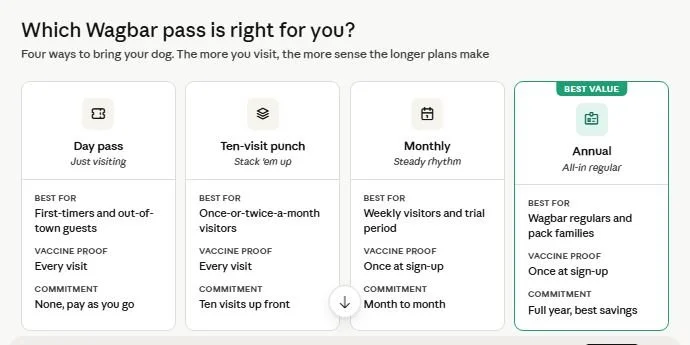
Pricing is per visit, not per day. Day passes typically run $5 to $15. Monthly memberships at most locations work out to $2 to $5 per visit for owners going more than once a week. Plus whatever you spend at the bar. The total cost looks more like a beer at a brewery than a day of paid care.
The Owner-Presence Difference Is the Whole Point
This is the structural distinction. Daycare requires owner absence. Off-leash dog bars require owner presence. One model assumes you're not there. The other model assumes you are.
This shapes everything else. At a daycare, the dogs see staff as their primary attachment for the day. The yard layout, the schedule, the supervision style all assume staff are running the show. At an off-leash dog bar, the dogs see their owners as the anchor. The yard is set up for owners to sit nearby and watch. Staff are present to handle group dynamics, but the dog's main person is the one who walked them in.
This matters for a few reasons. First, it changes the dog's stress profile. Some dogs do great in the daycare model. Others get stressed by the separation, the unfamiliar adults, and the long hours. Those dogs do better in the stay-and-play format because their person is right there. Second, it changes what the visit teaches. Daycare teaches the dog to function without their owner around. Stay-and-play teaches the dog to socialize with their owner present, which translates better to other shared activities like camping, hiking, or just having friends over.
Third, the owner-presence model means you actually see what your dog is like in a social setting. A lot of owners have never watched their dog play with other dogs. The daycare staff send a report card. You take their word for it. At an off-leash dog bar, you watch it happen. You see who your dog plays well with, who they avoid, and how they behave when other dogs get pushy. The dog body language decoder becomes practical, not theoretical, because you're watching the body language in real time.
Cost Comparison: Per Visit vs. Per Day
The two formats price differently and the comparison only makes sense in context.
Doggy daycare typically charges $25 to $50 per full day, with discounts on multi-day packages. A 10-pack runs around $200 to $400. Monthly unlimited daycare runs $400 to $800 in most markets, designed for owners using it most weekdays. The unit is the day, and the day includes 8 to 10 hours of care.
An off-leash dog bar charges per visit, where a visit is typically 60 to 120 minutes. Day passes run $5 to $15. A Wagbar membership is in the same range monthly as a single week of daycare, but covers unlimited visits with you and your dog together.
The hourly math is misleading because the two models aren't priced for the same purpose. Daycare is paying for staff hours covering your dog while you work. The off-leash dog bar is paying for venue access for your social time with your dog. They're not competing services any more than a hotel is competing with a restaurant just because both involve buildings and customers.
The right way to think about it: daycare is a workday service that costs roughly what it costs to be at the office. The off-leash dog bar is a leisure venue that costs roughly what it costs to be at any decent neighborhood bar. You don't choose between them. You use them on different days, for different reasons.
When Each Format Fits
Each format has a clear use case. Use daycare when:
You're at work for 8 to 10 hours and your dog can't be home alone that long. You're traveling for the day. You have appointments stacked. Your dog is young and doesn't do well with extended alone time. You're recovering from an injury or surgery and can't do the morning walk. You have a high-drive dog that destroys the house when crated all day. The daycare covers the absence.
Use an off-leash dog bar when:
You want to spend time with your dog and other adults at the same time. Your dog needs exercise and you also want a beer. You're meeting friends and your dog is welcome. You moved to a new city and want to meet other dog owners. You had a long week and the choice is between staying home alone or going somewhere with your dog. The off-leash dog bar covers your social hours, with the dog as a participant.
A common weekly rotation looks like: daycare Monday, Wednesday, and Friday for the office days. Off-leash dog bar visit Friday evening or Saturday afternoon. Public dog park or hike on Sunday morning. Each format does its part. The dog gets variety. The owner doesn't burn out paying for daycare on weekends or paying for venue access during work hours. Our urban dog ownership resource maps out a sample schedule.
Which One Builds Better Social Skills?
Both formats build social skills if they're well run. They build different ones.
Daycare teaches your dog to handle a long, structured day with other dogs while you're absent. The dog learns to read group play, share space, eat near other dogs, and rest in a busy environment. Good daycares actively manage these patterns and rotate dogs into appropriately matched groups. By the end of a few months of regular daycare, most dogs have a baseline of group manners.
Off-leash dog bars teach a different skill set. The dog learns to socialize with you present, which is the harder lesson for a lot of dogs. Many dogs are great at daycare but struggle the second their owner is in the room because they don't know how to disengage from their person. Stay-and-play visits at an off-leash dog bar fix this. The dog learns that owner-present doesn't mean owner-focused. They can play with other dogs while you're 30 feet away at the bar. That skill carries into hikes, friend visits, parties, and other shared environments.
Puppies benefit most from the combined approach. Daycare during work hours fills the puppy socialization timeline with structured peer time. Off-leash dog bar visits on evenings and weekends layer in owner-present socialization. By the time the puppy is a year old, they have both skill sets. The dog socialization hub covers the developmental stages and what each contributes.
The Misconception We Want to Clear Up
The single most common misconception about off-leash dog bars is that they're upscale daycare. They are not. You cannot drop your dog off at Wagbar and come back in three hours. The staff will not babysit your dog while you go run errands. The venue does not function without you in it.
This isn't a policy choice the venue is being strict about. It's the entire business model. The yard, the supervision style, the bar, the events, all assume the owner is on the property. Removing the owner removes the purpose. The dog bar isn't a service for your dog. It's a venue for both of you.
If you need drop-off care, the right answer is a doggy daycare. There are good ones in every major market. The off-leash dog bar isn't competing with them and isn't trying to be one. The two formats are complements, not substitutes.
Frequently Asked Questions
Can I leave my dog at an off-leash dog bar while I run errands?
No. Off-leash dog bars require the owner to be present the entire visit. You cannot leave the property and come back. If you need to leave your dog while you do something else, that's what doggy daycare is for. The two formats are separate services with different rules.
What's the difference between dog bar staff and daycare staff?
Daycare staff are the primary caregivers for your dog all day. They feed, exercise, supervise, and manage your dog's needs while you're absent. Off-leash dog bar staff are pack supervisors who manage group dynamics in the yard while owners stay with their own dogs. The daycare model puts staff in the parent role. The dog bar model keeps you in that role.
Can I bring my dog to an off-leash dog bar after daycare?
Yes, and a lot of regulars do exactly this. They pick up from daycare on Friday afternoon and head straight to the dog bar for an hour before going home. The dog already had their group time at daycare. The bar visit is the bonus social time with you. It works well as long as the dog isn't already exhausted.
Do off-leash dog bars accept the same dogs as daycares?
Mostly, yes. Both formats require current vaccinations, generally require spay or neuter for adult dogs, and exclude dogs with bite histories. The screening at off-leash dog bars usually includes a behavior introduction. Daycare evaluations are similar. A dog that passes daycare evaluation is usually fine at an off-leash dog bar, though the owner-presence requirement does change the social setup for some dogs.
Is one safer than the other?
Both can be safe with good supervision. Off-leash dog bars have an additional safety layer because the owner is on site and can intervene immediately if their own dog is involved in something. At daycare, you're trusting staff to handle every situation without you. Both formats screen for vaccination and behavior. Both have trained staff watching dog interactions. The biggest safety variable is the operator, not the format.
Can puppies use an off-leash dog bar?
Yes, once they're fully vaccinated, usually around 16 weeks. Puppies under that age aren't allowed at most off-leash dog bars because they can't safely interact with the general dog population. Once vaccinated, the supervised stay-and-play environment is one of the better socialization settings during the critical developmental window.
Does Wagbar offer drop-off care for special events?
No. Wagbar locations are stay-and-play venues only. The model doesn't accommodate drop-off in any form. For drop-off care, owners should contact a local doggy daycare or boarding facility. The Wagbar FAQ page covers this and other common questions about how the venue works.
Final Word

The two formats look similar from the outside because both involve dogs playing in a fenced area under supervision. They're built for completely different purposes. Doggy daycare is drop-off care for your work hours. An off-leash dog bar is a stay-and-play venue for your social hours.
Most dog owners benefit from using both. Daycare during the week so the dog isn't alone all day. Off-leash dog bar on evenings and weekends so you and the dog can do something together. Neither format replaces the other. Trying to use one as a substitute for the other usually disappoints both of you.
If you've been thinking of an off-leash dog bar as fancy daycare, swap the framing. It's a bar with a dog yard attached, where you and your dog are both customers. Walk in expecting to stay for an hour with a beer, and the format makes immediate sense. Visit a Wagbar location near you and try it. Most owners realize after one trip that they wanted this all along, they just didn't have the right name for it.
Bottom TLDR: The off-leash dog bar vs. doggy daycare question doesn't actually require a choice. Daycare is drop-off care for the workday; an off-leash dog bar is a stay-and-play venue for evenings and weekends. Most dog owners benefit from using both formats for the different problems each one solves. Pair them through the week and your dog gets full coverage without burning out either service.