

Off-Leash Dog Bar Etiquette: The Unwritten Rules That Keep Play Safe

Top TLDR: Off-leash dog bar etiquette goes beyond posted signage. Watch your dog instead of your phone, step in early before tension escalates, don't crowd the entry gate, read the room before your dog joins a group, and head home before your dog hits their wall. These habits keep play safe for everyone. Adopt them on your first visit and you'll fit in immediately with the regulars.
Why "Unwritten Rules" Matter Beyond the Posted Ones
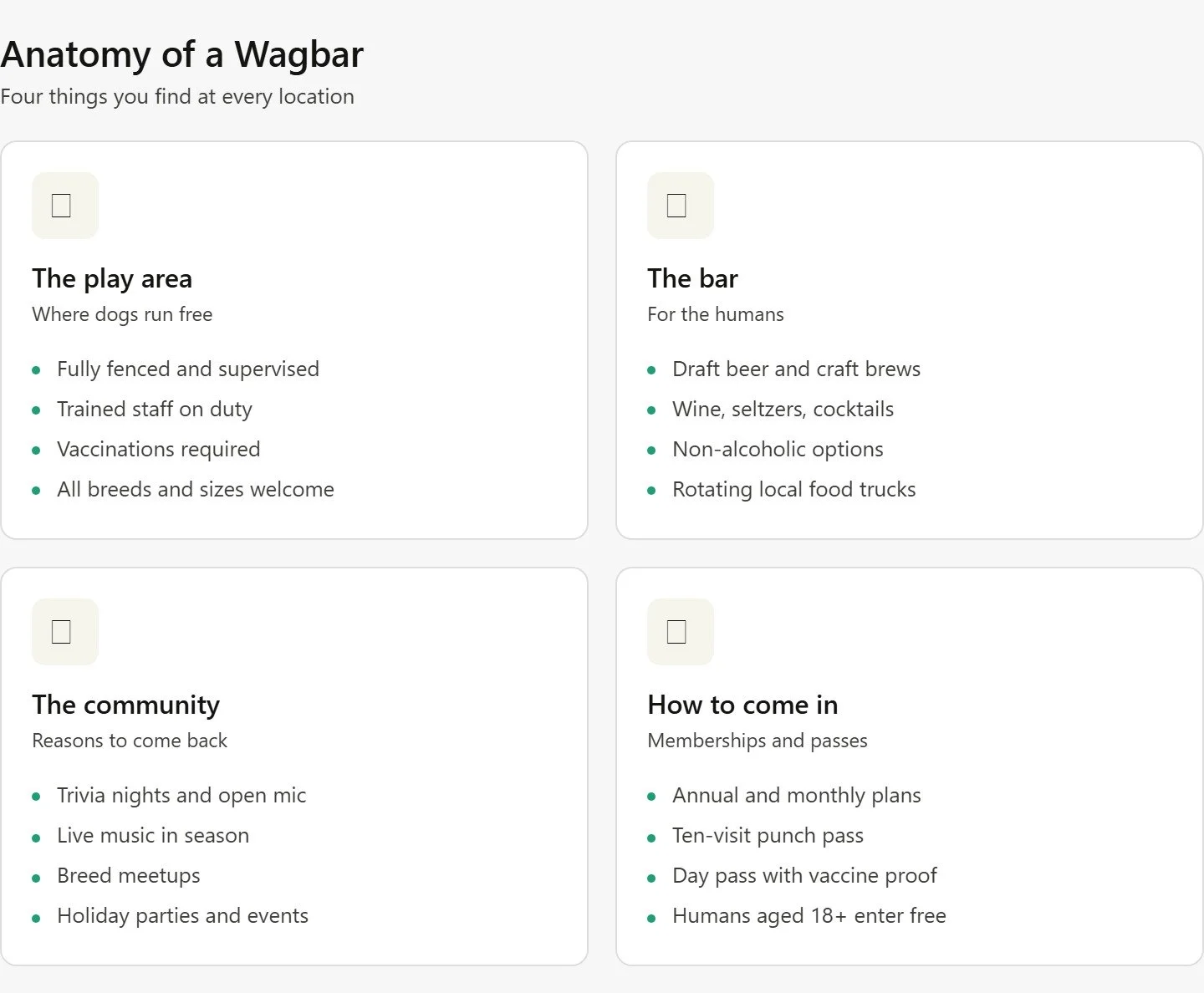
Every Wagbar location posts the same baseline rules. Watch your dog. Pick up after them. Step in if they're not playing nicely. Skip the toys and treats inside the play area. These are the floor, not the ceiling. The posted Wagbar rules and code of conduct handle the legal and operational baseline. The unwritten rules are what regulars actually do, and they're the difference between a smooth visit and one that ends with two owners frowning at each other across the fence.
The reason this matters: in any shared off-leash space, group safety depends on hundreds of small choices owners make every minute. Where you stand. What you watch. When you call your dog off. Whether you let your dog rush the gate when a new arrival comes in. None of that is posted on a sign. All of it shapes whether the place stays calm or tips into a problem.
This page collects the unwritten norms that make the off-leash dog bar work. They're not Wagbar-specific. They apply at any well-run off-leash setting, and they get easier with practice.
Watch Your Dog, Not Your Phone
The single most-broken unwritten rule. You're at a bar with friends, you're catching up, your phone buzzes. The dog is fine for now. Then you look up and your dog has been mounted by another dog for thirty seconds, or has cornered a smaller dog at the fence, or is swallowing something they pulled out of a planter.
The rule is simple: your dog is your job while you're inside the play area. You can have a drink, you can chat, you can look at your phone for thirty seconds at a time. But your eyes need to come back to your dog every minute or so. Wagbar staff supervise the floor, but they have twenty other dogs to track. You have one.
A useful habit: every time you take a sip of your drink, scan the yard for your dog first. Spot them, watch their body for five seconds, then go back to whatever you were doing. The total scan takes ten seconds and catches most issues before they become real ones. If you want a deeper read on what to actually watch for during those scans, the dog body language decoder covers the specific cues.
Step In Early, Not When It's Already a Fight
Most "fights" at off-leash spaces could have been redirects three minutes earlier. The unwritten rule among regulars is to interrupt small tensions before they grow.
What that looks like: if your dog and another dog are getting locked into a stiff stare, walk between them and call your dog. If a play session is escalating into pinning that doesn't reset, separate them for thirty seconds. If your dog is the one being mobbed by three other dogs and starting to look stressed, walk into the cluster, call your dog, and move them to a quieter area.
Owners who wait until something has gone fully wrong are the ones whose dogs end up in actual conflict. Owners who interrupt early have the calm dogs everyone wants their dog to play with. Reading the warning signs that precede dog conflicts makes the early intervention skill click faster.
The flip side of this rule: don't overcorrect. Healthy play looks rough sometimes. Wrestling, body-slamming, mock-biting, growling can all be normal. The thing to watch is reciprocity (do both dogs come back for more?) and reset behavior (do they pause, shake off, and re-engage?). If yes, leave it. If one dog is consistently trying to escape and the other isn't reading the signal, step in.
Don't Crowd the Gate When New Dogs Arrive
The entry zone is the highest-stress spot in any off-leash setting. New dog walking in. Pack of resident dogs running over to investigate. Smells, sounds, sometimes barking. It's the moment most likely to produce a snap.

The unwritten rule: if your dog tends to rush the gate, call them off when you see a new arrival. Stand between your dog and the gate if you have to. Some regulars actively walk their dog to the far end of the yard when a new arrival is happening, just to give the new dog a moment to acclimate without a welcoming committee of fifteen.
If you're the one entering, the polite move is to wait inside the inner gate for a moment before unclipping the leash. Let your dog look around. Let the resident pack come and go. Then unclip and walk in. This reduces the rush effect and lets your dog enter on their own terms.
The gate area is also where leashes catch on each other, where dogs trip owners, and where kids would get knocked down (which is part of why Wagbar is 18+). Treat it like a busy intersection. Move through it deliberately.
Read the Room Before Your Dog Joins a Group
The off-leash dog bar isn't one play group. It's usually two or three loose clusters of dogs doing different things. A high-energy chase group. A wrestling pair. A group sniffing at the perimeter. A few dogs lying down with their owners. Each cluster has its own energy.
The unwritten rule: don't drop your dog into any cluster without watching the cluster for thirty seconds first. Your high-energy bouncer doesn't belong in a cluster of older dogs lying in the shade. Your shy beagle doesn't belong in a chase group with three boxers running flat-out. Match your dog to the cluster that fits their style.
This isn't always possible. Sometimes there's only one cluster, and your dog either joins or hangs back. But when there are multiple, picking the right one is half the visit. The deeper group play dynamics primer walks through how to read what's happening in any given cluster.
If your dog joins a cluster and the energy doesn't fit, don't force it. Call your dog, move to a different part of the yard, and try a different group later.
Don't Help Yourself to Other Dogs Without Asking
This one trips up a lot of dog people. You see a beautiful dog, you walk over, you reach out to pet them. Unwritten rule: ask the owner first.
Some dogs are working through anxiety. Some dogs don't like strangers leaning over them. Some are fine with quick pats but get over-faced if hugged. Some have just had a hard week. The owner knows. You don't.
A simple "Can I say hi to your dog?" is the standard. If the owner says yes, great. If they hesitate or say "she's a little shy," respect that. Crouch down sideways, let the dog approach you, keep your hand low and open. Don't lean over. Don't hug. Don't get in their face for a selfie.
The same rule applies to giving treats, even if you're carrying them for your own dog. Don't feed someone else's dog without explicit permission. Allergies, training programs, food aggression, behavior plans, there are a hundred reasons an owner doesn't want random treats handed to their dog.
The Three-Second Rule for New Greetings
When two dogs meet for the first time, the polite norm is short. Three seconds of sniffing, then both owners take a step back and let the dogs decide what happens next.
Why three seconds: dogs that are tense often hold a posture for longer than three seconds before snapping. A short greeting lets both dogs gather information without escalating into a stand-off. After the brief sniff, you'll see the natural outcome. They wander off together, they ignore each other, or one of them moves away clearly. All three are fine.
Long, intense, head-to-head greetings are where most first-meeting trouble starts. Owners often hold their dogs in place "to be friendly," not realizing the dogs have already exchanged information and want to disengage. Forcing the meeting longer than the dogs want it creates pressure that has to resolve somewhere.
Three seconds, step back, watch what happens. The norm has become standard among trainers for a reason. The socialization and behavior fundamentals cover the why behind the rule.
Apologize Without Drama When Your Dog Messes Up
Dogs are dogs. Every dog who's ever been to an off-leash space has had at least one bad moment. Your dog will too. Maybe they steal a stick from another dog. Maybe they jump on someone's leg. Maybe they get into a quick scuffle that ends in three seconds.
The unwritten rule: apologize cleanly, check on the other party, and move on. "My bad, is your dog OK?" is the entire script. Don't over-explain. Don't get defensive. Don't try to argue that your dog "was just playing" if the other dog clearly wasn't. Don't pretend it didn't happen.
The flip side: if someone else's dog has a bad moment with yours, accept their apology and move on. Don't lecture. Don't make a scene. Don't post about it on the local neighborhood Facebook group. Off-leash spaces work because everyone extends grace to everyone else's dog. The day you hold someone's dog accountable for a five-second blip is the day you don't get the same grace yourself.
If something more serious happens, like an actual bite, that's different. Tell staff, exchange information, and follow the standard procedures. But for ordinary scrapes and ruffled fur, the script is short and graceful. If you're new to the off-leash bar setting and unsure what counts as a normal blip versus something to flag, the beginner's primer on dog play at Wagbar gives a baseline for what regulars accept and what they don't.
Don't Coach Other People's Dogs
The most well-meaning version of bad etiquette: telling someone else how to handle their dog.
You see a dog doing something you don't like. The owner is right there. The temptation is to step in with advice. "You should call him off when he does that." "She's giving you a calming signal, you're not reading it right." "He needs more exercise before you bring him here."
Unwritten rule: don't. Even if you're 100% right. Even if you're a trainer. Even if the situation seems obvious to you. Coaching another owner is almost always taken as judgment, even when it's offered with good intentions. The owner gets defensive, the conversation goes sideways, and now there's tension in the yard.
The exception: if there's an immediate safety issue and the owner clearly hasn't seen it. "Hey, your dog is at the gate" is fine. "Your dog just took a bone behind the bench" is fine. Quick, factual, helpful. But save the training advice for someone who explicitly asks.
If the issue is your own dog being affected, handle your dog, not theirs. Move your dog away. Call them out of the interaction. You have authority over your own dog, not anyone else's. Regulars who become repeat visitors through a Wagbar membership tend to build relationships over time, and that's the rare situation where advice goes over well, when there's already a friendship behind it.
Leave Before Your Dog Hits Their Wall
The hardest unwritten rule for new visitors. Dogs at off-leash bars get tired before owners think they should. The dog is having a great time, then in fifteen minutes they're overstimulated and starting to make bad decisions. Snapping at things they wouldn't normally snap at. Mounting dogs they were getting along with. Picking fights with the gate.
The rule: watch for the wall and leave before you hit it. Signs include shorter attention span, faster recovery into agitation, less interest in calling back to you, getting weirdly fixated on one specific thing, or starting to pant heavily and refuse water.
Forty-five minutes to an hour is the sweet spot for most dogs at most visits. Two hours is too long for most. The visits that end well are the ones that end ten minutes before the dog wants them to, not ten minutes after. The off-leash readiness checklist covers the stamina and self-regulation skills that determine how long any given dog can handle.
A useful habit: set a soft timer on your phone for forty-five minutes after you arrive. When it goes off, take stock of your dog's state. If they're still good, give them another fifteen. If they're starting to wear down, head out.

Owner-to-Owner Etiquette at the Bar
The "bar" half of the off-leash dog bar has its own social norms. They mostly mirror any neighborhood bar, with a few additions specific to this setting.
Don't dominate the conversation about your dog. Everyone here loves their dog. Yours isn't more interesting than anyone else's, even if you think it is. Trade stories, ask about other dogs, share pictures. Don't deliver monologues.
Don't drink past your ability to handle your dog. Wagbar serves a full bar with beer, wine, cider, and non-alcoholic options, and most visits are casual. But your dog's safety depends on you being alert. Two beers in two hours is fine for most adults. Six is not.
If you bring friends who don't have dogs, brief them. Tell them not to approach other dogs without asking, not to feed dogs, not to scream when something exciting happens. New visitors who don't know dog culture can rattle the whole yard if they treat it like a regular bar.
Tip the staff. They're checking vaccinations, supervising play, breaking up tension, picking up after dogs whose owners didn't, and serving drinks. The job is harder than it looks.
Pick up after your dog every single time. This isn't optional, and it isn't unwritten, but it's worth saying. The yard stays nice because everyone does this. The day half the regulars stop is the day the place stops being nice.
Frequently Asked Questions
What do I do if I see another dog being aggressive and the owner isn't paying attention?
Tell a staff member. Don't try to handle it yourself, and don't approach the dog. Wagbar staff are trained to step in, and they'd much rather know about a brewing issue than hear about it after a fight. Pointing them in the direction of the dog and the owner is the cleanest move.
How do I tell another owner their dog is bothering mine without starting an argument?
Be brief and factual. "Your dog keeps following mine and mine isn't into it. Could you call him?" That's the whole script. Don't editorialize. Don't make it about training. Most owners will respond fine to a polite, direct request.
Is it OK to bring a friend who doesn't have a dog?
Yes. Wagbar welcomes humans 18 and over with or without dogs. Just brief any first-time visitors on the basics: don't approach unfamiliar dogs without asking, don't feed dogs, don't run or shout in ways that might startle the pack. Most visitors pick it up fast.
Should I let my dog meet every dog at the park?
No. Some dogs aren't interested. Some are working through training. Some have had a long day. Let your dog approach who they want and let them ignore who they don't. A dog who's politely uninterested in another dog is being well-mannered, not rude. The reactive dog training basics cover when distance matters more than meeting.
What's the best time to visit if I want a quieter setting for a first visit?
Mid-week mornings are usually calmest. Weekends afternoons are busiest. If you're working on your dog's tolerance for crowds, start with the quieter times and build up.
My dog accidentally knocked over a kid's drink at the bar. What's the right move?
Apologize, offer to replace it, move on. Drinks get spilled, dogs are dogs, the regulars have all been there. A quick "Oh man, my bad, let me grab you another" handles it.
Bottom TLDR
Off-leash dog bar etiquette is mostly about attention, timing, and respect for other people's dogs. Watch your dog instead of your phone, step in before tensions escalate, keep new greetings to three seconds, and head home before your dog hits their wall. Apologize cleanly when your dog messes up, and don't coach other people's dogs. These habits keep the yard calm and welcoming for everyone.