

Multi-Unit Pet Franchise Financing: How the Math Changes When You Buy Three Locations

Top TLDR: Multi-unit pet franchise financing lets buyers commit to three or more locations in exchange for lower per-unit franchise fees — Wagbar's 50% discount reduces each location's fee from $50,000 to $25,000, saving $75,000 total across three units. Lenders evaluate liquidity, net worth, and management capacity at the full three-unit scale. Review the FDD and work with an SBA-preferred lender experienced in multi-unit franchise applications before committing.
Most people who research pet franchise ownership are thinking about one location. That makes sense — starting with a single unit is how most franchise owners begin, and working through the process for the first time is genuinely complex. But a meaningful segment of prospective buyers come in with a different question: what changes if I commit to three locations from the start?
The answer is: quite a bit. The capital requirements are obviously larger, but the per-unit cost structure can look different, the financing options available to multi-unit buyers expand, and the operating economics shift in ways that single-unit analysis misses. For Wagbar specifically, buyers who commit to three or more locations qualify for a 50% discount on the franchise fee — a structural incentive that changes the fee math on day one.
This page walks through what multi-unit pet franchise financing actually involves: how the fee savings work, what lenders look for in a multi-unit application, how operational leverage affects the long-term picture, and what hypothetical scenarios illustrate the difference between single and multi-unit approaches. All financial projections and scenarios below are clearly labeled as hypothetical and illustrative only. Real results depend on specific market conditions, site performance, and individual execution. Consult the current FDD and qualified professional advisors before making any investment decision.
The Fee Structure Difference: What the 50% Discount Actually Means
At Wagbar, the initial franchise fee for a single location is $50,000. For buyers who commit to opening three or more units simultaneously, that fee drops to $25,000 per location — a 50% reduction.
On three locations, that's a difference of $75,000 in franchise fees alone: $150,000 total versus $75,000 total. That's not a trivial number. It doesn't reduce the build-out, real estate, or working capital requirements for each location — those costs stay site-specific — but it lowers the upfront franchise fee component of the overall capital stack by half.
Why do franchisors offer multi-unit discounts? Committing to multiple units gives the franchisor higher confidence in the buyer's seriousness, increases brand presence in a market more quickly, and reduces the per-deal administrative cost of onboarding. For buyers, the discount is an acknowledgment that multi-unit commitment carries its own risk — the obligation to open multiple locations on a defined schedule — and the reduced fee compensates for that.
The fee discount is not the only reason multi-unit ownership can make financial sense, but it's the most concrete and immediate difference in the cost structure.

Total Investment: Three Locations vs. One
Understanding the capital requirements for a three-unit commitment requires applying Wagbar's investment range across multiple locations. The estimated initial investment range per location, per publicly available franchise information, is $470,300 to $1,145,900. These are FDD-sourced estimates; actual costs vary by site, market, and construction conditions.
Hypothetical illustration only: If each of three locations costs approximately $650,000 (a midpoint figure used here for illustration purposes only — not a projection or guarantee), the raw three-location total would be approximately $1,950,000 before applying any financing structure. With the multi-unit franchise fee discount reducing per-location fees from $50,000 to $25,000, the three-location franchise fee total is $75,000 rather than $150,000, representing $75,000 in savings against the hypothetical total.
These figures are illustrative only. A buyer's actual investment will depend on real lease terms, real construction quotes, and real site conditions in each market. No two locations cost the same amount to open.
What multi-unit buyers are really doing is committing to a larger total capital deployment in exchange for lower per-unit entry cost and, over time, potential operating efficiencies that a single location can't achieve.
How Lenders Look at Multi-Unit Applications Differently
Financing a single pet franchise and financing three locations involve different lender conversations. The principles overlap, but multi-unit applicants face both additional scrutiny and, in some respects, additional opportunity.
The qualification bar is higher. Lenders evaluating a multi-unit SBA application want to see personal liquidity sufficient to cover 10–20% equity injection across all three locations, not just one. Net worth requirements rise proportionally. Credit standards are the same, but the scale of the request means any blemish on the credit profile gets examined more carefully.
Phased development structures are common. Most multi-unit franchise agreements don't require all locations to open simultaneously — they establish a development schedule: location one within a certain window, location two within the next, location three after that. Lenders can structure financing to align with that timeline, with initial funding covering the first location and subsequent tranches triggered by development milestones. This spreads the capital deployment and reduces the pressure of raising the full multi-unit investment before the first location is even open.
Existing performance data changes the conversation. A buyer who has already operated location one for 18 months and wants to fund locations two and three is in a materially different position than someone applying for all three before any doors have opened. Lenders can see actual revenue, actual membership growth, and actual expense performance — which replaces the uncertainty of projections with real data. Buyers who are successful with their first location often find the conversation with lenders for subsequent units is significantly easier.
SBA multi-unit lending follows the same programs. SBA 7(a) loans remain the most common financing vehicle for franchise buyers across single and multi-unit applications alike. The eligibility criteria are the same — 680+ credit, adequate liquidity, documented management experience, complete FDD — but the loan amounts are larger and the underwriting timeline may extend accordingly. For a deeper look at how SBA programs work in the franchise context, the pet franchise financing guide covers the full structure.
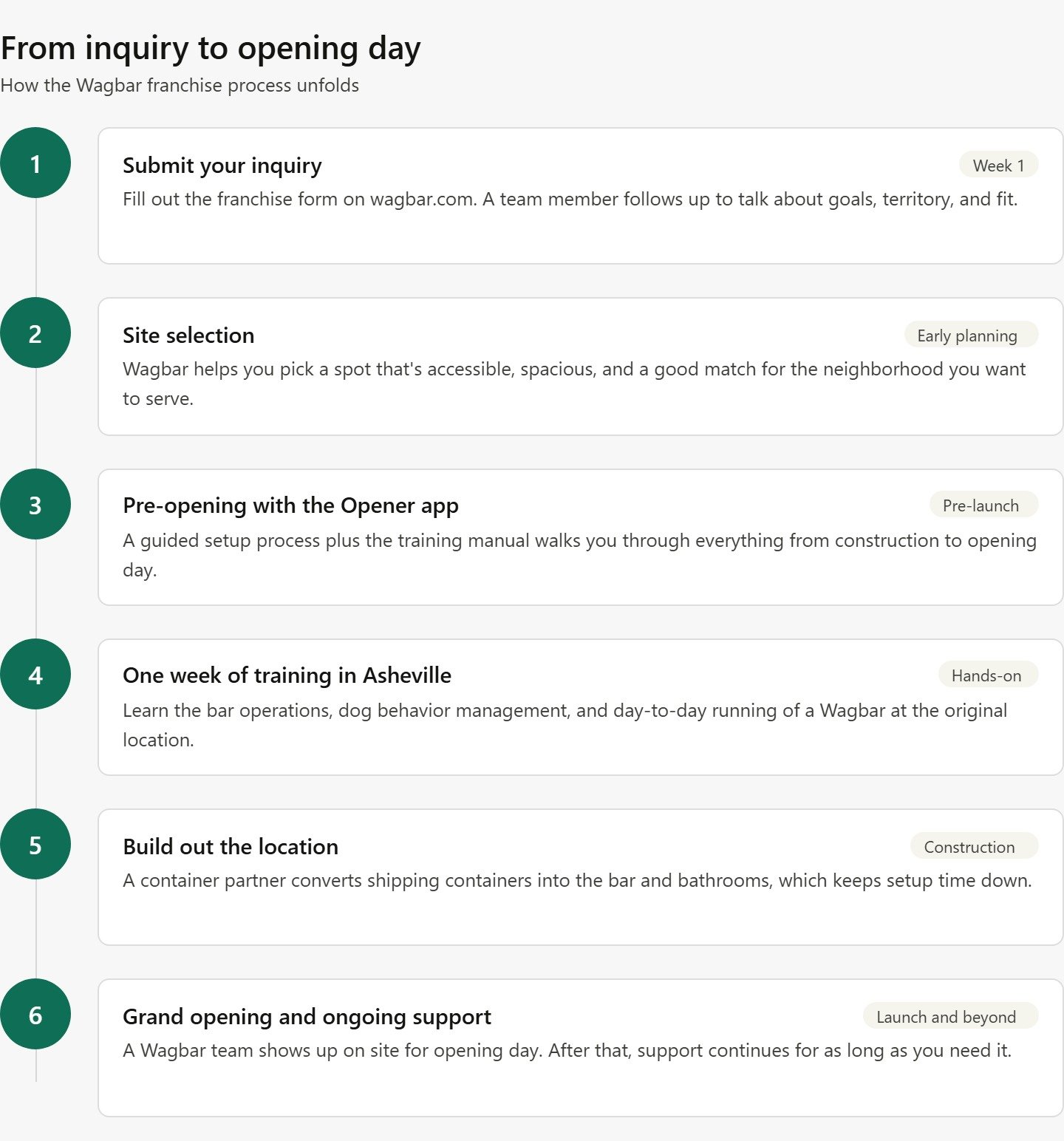
Operational Leverage: Where the Multi-Unit Case Gets Interesting
The fee savings are real and immediate. The operational leverage argument is longer-term and depends on execution — but it's often a bigger factor in why experienced business operators choose multi-unit over single-unit investment.
Shared management infrastructure. A single-location operator typically runs everything personally or with a small management team. A three-location operator, if staffed thoughtfully, can share a general manager, a marketing function, a bookkeeper, and administrative overhead across multiple revenue-producing locations. The incremental staffing cost to add a second or third location is usually lower than the cost of the first.
Brand presence compounds in a market. Three Wagbar locations in adjacent submarkets of a metro area — say, three neighborhoods in a growing mid-size city — reinforce each other. Members who live near location one know about location two. Local marketing spend reaches members across all three. Brand recognition builds faster than it would through one location alone.
Membership economics strengthen. Wagbar's membership model — which includes monthly and annual memberships alongside daily and punch passes — means a meaningful portion of revenue is predictable and recurring. A buyer managing three locations can develop membership promotions, referral programs, and retention strategies that cover all three simultaneously. The membership base becomes a shared asset.
Vendor and supplier relationships. A multi-unit operator purchasing beverage inventory, equipment, and supplies across three locations may have more negotiating leverage than a single-unit buyer. This varies by supplier and geography, but it's a real operating advantage that accumulates over time.
None of these advantages appear in a fee table or a single-year financial projection. They're the compound effects of running a system at scale rather than in isolation — and they're part of why experienced franchisors incentivize multi-unit commitment.
Hypothetical Break-Even Scenarios: Single vs. Three Units
The following scenarios are purely hypothetical and illustrative. They use assumed figures to demonstrate how the math structure differs between single and multi-unit ownership. They are not projections, guarantees, or representations of actual Wagbar performance. All figures should be treated as illustrative only, and prospective buyers should build their own projections from real market data with the help of a CPA.
Hypothetical single-unit scenario: Assume a total investment of $650,000 (illustrative midpoint, not a projection). Assume monthly adjusted gross sales of $40,000 once the location reaches stable operation. Royalty at 6% of AGS = $2,400/month. Marketing fund at 1% of AGS = $400/month. Assume monthly operating costs (lease, labor, COGS, utilities, misc.) of $30,000. Hypothetical monthly operating income before owner compensation and debt service: approximately $7,200. Break-even at this hypothetical operating income level would require the initial capital to be serviced over a multi-year period. All figures illustrative only.
Hypothetical three-unit scenario with multi-unit discount: Assume each of three locations costs $650,000 to open (same illustrative figure). Total hypothetical investment: $1,950,000. Franchise fee savings from multi-unit discount: $75,000 (three locations at $25,000 each vs. $50,000 each). Assume the same hypothetical operating income of $7,200/month per location once each reaches stable operation. Combined hypothetical monthly operating income across three locations: approximately $21,600. Shared management overhead savings (hypothetical): assume $3,000–$5,000/month in combined administrative costs that don't triple with each new location. Adjusted hypothetical combined operating income: $24,600–$26,600/month.
The three-unit scenario requires three times the capital, but the combined operating income from three mature locations, with shared overhead, produces a hypothetical return on the total investment that may compare favorably to three sequential single-unit investments made separately — where the fee discount and shared overhead don't apply.
Again, these are illustrative scenarios built from assumed figures. They are not projections of actual Wagbar performance, and no specific ROI or break-even timeline is implied.

The Multi-Unit Commitment: What You're Actually Signing Up For
Multi-unit franchise agreements include a development schedule with binding obligations. If you commit to three locations, you're agreeing to open them within specified timeframes. Missing those milestones can trigger penalties, territory loss, or contract remedies depending on the agreement terms.
This is the risk side of multi-unit ownership that the fee discount acknowledges. You're accepting more obligation in exchange for the better entry terms. That tradeoff is rational for buyers who have the capital, the management capacity, and the market conviction to execute — and it's worth thinking through carefully for buyers who aren't certain about all three.
The right question isn't just "can I afford three locations?" It's also: do I have the infrastructure to open and operate three locations within the development timeline? Do I have management bandwidth, or a plan to build it? Are the three markets I'm targeting genuinely strong for this concept?
Understanding what the concept looks like from the inside before committing is worth the time. The off-leash dog bar investment guide covers the due diligence questions that apply regardless of how many units you're considering.
Structuring the Capital Stack for Three Locations
Multi-unit buyers typically layer multiple capital sources rather than relying on any single funding channel. The most common structure for a three-location pet franchise commitment involves some combination of the following.
SBA 7(a) loans can cover multiple locations if structured correctly, either through a single large loan or through phased lending tied to the development schedule. Lenders who work with multi-unit applications understand this structure, and choosing a lender with SBA Preferred Lender Program status and documented franchise experience is especially important at this scale.
Personal equity — cash savings, liquidated investment accounts, or ROBS (Rollover for Business Startups using retirement funds) — covers the equity injection component required by the lender. For three locations, that injection requirement is proportionally larger, which is why liquidity is one of the first qualification filters lenders apply.
Seller financing and franchisor programs are less common for this concept type but worth understanding through the FDD. Item 10 of the FDD covers any financing the franchisor offers or arranges.
Home equity and other secured borrowing are used by some multi-unit buyers to supplement SBA loans, particularly for the down payment component. These carry their own risk profile and should be evaluated carefully with an advisor.
The right capital stack for a specific buyer depends on their personal financial situation, their target markets, their development timeline, and current lending conditions. A CPA with franchise experience and a franchise attorney should both be involved in that conversation before any commitments are made.
Frequently Asked Questions
Does Wagbar's 50% multi-unit discount apply to the full investment or just the franchise fee?
The 50% discount applies to the initial franchise fee ($50,000 reduced to $25,000 per location). Build-out, real estate, equipment, and working capital costs remain site-specific and are not subject to the fee discount.
Can I finance all three locations through a single SBA loan?
It depends on loan size, lender, and deal structure. Some SBA lenders structure multi-unit franchise loans as a single facility; others work in tranches tied to a development schedule. An SBA-preferred lender with franchise experience can walk you through the options for your specific situation.
What happens if I can't open all three locations on the development schedule?
This is governed by the franchise agreement itself. Consequences of missed development milestones vary by franchisor and should be reviewed carefully with a franchise attorney before you sign. Understanding the remedies in the agreement is part of responsible due diligence.
Does multi-unit ownership require more management experience than single-unit?
Lenders and franchisors both evaluate management capacity for multi-unit applications. Prior business management, operations leadership, or franchise ownership experience all count. The franchisor's training program addresses the operational side; lenders focus on your track record of managing people and financial performance.
Is multi-unit ownership appropriate for a first-time franchisee?
It depends on the buyer's capital, management experience, and market conviction. Some first-time franchise buyers go directly to multi-unit; others prefer to prove the concept with one location before expanding. Both paths are valid. What matters is that the decision is grounded in an honest assessment of your financial position and operational capacity.
When Multi-Unit Makes Sense — and When It Doesn't
Multi-unit pet franchise financing makes sense when the capital is genuinely available, the management infrastructure can support it, the target markets are well-chosen, and the buyer understands what the development schedule commitment actually means. The fee savings are real, the operational leverage is real, and the long-term compound effect of running a system at scale rather than as a single unit is real.
It doesn't make sense when the multi-unit commitment stretches capital so thin that any single underperforming location creates a cascade risk across the others, or when management bandwidth isn't there to actually run three locations well.
The question worth spending time on is which scenario actually applies to your situation — not which scenario sounds better on paper.
If you're at the stage of evaluating the pet franchise opportunity in detail, the Wagbar franchising page is where you request the FDD and connect with the franchise team. The full investment structure — including the multi-unit discount terms — is disclosed in the FDD, and reviewing that document with a franchise attorney is the right next step for any serious multi-unit prospect.
Bottom TLDR: Multi-unit pet franchise financing changes the cost structure through fee discounts, shared management overhead, and compound membership economics that single-unit analysis misses. Wagbar's 50% franchise fee discount for buyers committing to three locations reduces the franchise fee total from $150,000 to $75,000. Structure your capital stack with phased SBA financing tied to your development schedule, and have a franchise attorney review the development timeline obligations before signing.