

Multi-Unit Franchise Growth: Scaling from One Dog Bar to a Regional Portfolio

Top TLDR: Multi-unit franchise growth lets dog bar owners scale recurring membership revenue, apply proven systems across new markets, and qualify for Wagbar's 50% franchise fee discount at three or more units. The path from one location to a regional portfolio requires operational depth, a management layer, and deliberate market selection. Map your regional territory before you sign your first agreement to capture the multi-unit discount from the start.
The first location is the hardest part. You figured out site selection, built a team, learned the operational rhythms, and turned a concept into a community people actually show up for. That experience is worth something beyond the revenue it generates. It's the foundation for everything that comes next — and for Wagbar franchisees who think regionally from the beginning, the path from one location to a portfolio isn't just possible. It's the plan.
Multi-unit franchise growth means deliberately building presence across a region — multiple markets, multiple membership bases, and the kind of scale that makes the business something bigger than any single location can be on its own. This page is for the person who is already thinking that way, or who wants to understand what that path looks like before they commit to their first location.
Why the Dog Bar Model Is Built for Multi-Unit Expansion
Not every franchise concept rewards expansion the way Wagbar does. Some businesses are so owner-dependent — so tied to one person's relationships or daily presence — that opening a second location doubles the complexity without proportionally increasing the return. Dog bar franchises work differently.
The recurring membership model is the foundation. A franchisee with two or three active locations is not just running three businesses — they're running three membership bases that each generate predictable monthly revenue. The community aspect means loyal members return on their own, without being driven back by constant marketing or owner outreach. That kind of revenue compounds naturally as a portfolio grows.
The operational systems also transfer. A franchisee who has already learned how to hire and train dog park staff, manage beverage programs, run member communications, and handle the day-to-day of an off-leash dog bar doesn't have to reinvent those systems for a second location. They apply what works. The second location benefits from the first location's learning curve.

Regional brand recognition builds on itself, too. When Wagbar opens in Richmond and then expands to a second Virginia market, the first location's community becomes awareness for the second. Members mention it to friends. People who have visited one location look for the next one when they move or travel. That compounding brand presence is something a single location can never achieve on its own.
The Multi-Unit Discount: What It Actually Means
Wagbar's franchise structure includes a 50% discount on the franchise fee for owners who commit to opening three or more units. The standard franchise fee is $50,000. At three or more units, that fee drops to $25,000 per location.
For an owner planning a three-location regional portfolio, the math is straightforward: committing to three units at the discounted fee saves $75,000 compared to three separate single-unit agreements at full fee. That's capital that stays in the business rather than going toward entry costs.
This isn't a small-print clause. It's a deliberate structural incentive for owners who are ready to think at scale. Wagbar grows faster when franchisees commit to regional coverage, and franchisees who commit early capture the fee advantage before their markets fill in.
The total estimated investment per location remains $470,300 to $1,145,900 depending on site, buildout, and local factors — the discount applies to the franchise fee component specifically. Anyone evaluating a multi-unit commitment should model the full investment across all planned locations and work through the financing structure with a lender who has experience with franchise portfolios.
These figures are illustrative and subject to the FDD. This is not an offer to sell a franchise. Contact franchising@wagbar.com for full details.
Thinking Regionally from the Start
There's a meaningful difference between a franchisee who opens one location and later considers expanding versus one who maps a regional strategy from the beginning. The second approach produces better outcomes — better site selection, better market sequencing, and better use of the multi-unit discount.
Regional thinking means asking the right questions before the first location opens:
Which markets in the region have the demographics that support this model — higher-income households, strong pet ownership rates, active social scenes, and communities where people spend on experiences rather than things? The market analysis behind successful dog franchise positioning is the same work that informs where a second and third location should go.
How far apart should locations be? Close enough to share brand recognition and marketing reach. Far enough that each location serves a distinct membership base without overlapping too directly. Regional franchisees who plan their location map thoughtfully avoid the internal competition that can result from placing locations too close together.
How will the regional portfolio be managed? A single owner-operator running three locations needs a different operating structure than one running a single location. Management layers, site managers, and clear operational systems aren't optional at scale — they're what makes the portfolio sustainable.
What Changes When You Go from One Location to Three
Running one location means being present every day. You know every regular by name. You're in the park when it opens and you're closing it at night. That works at one location, and it's often how the best franchisees build the community that makes their first location great.
Three locations require something different. You can't be everywhere at once, so the business has to work without your constant presence. That means:
Site managers who own their location's performance. A regional franchisee needs managers at each location who can run the day-to-day, handle staffing issues, and make real-time decisions without calling the owner for every question. Hiring and developing that management layer is one of the most important investments a growing franchisee makes.
Systems that don't depend on institutional memory. Everything that works at location one needs to be written down and teachable before location two opens. Member onboarding, staff training, maintenance schedules, vendor relationships — all of it needs to live in documentation, not just in the owner's head.
Financial visibility across the whole portfolio. A regional franchisee needs to see P&L data from all locations regularly — not just at tax time. Understanding which locations are performing well and which need attention requires organized, frequent reporting. This is also what lenders and potential buyers want to see if the portfolio ever comes up for sale.
Brand consistency across markets. Every Wagbar location holds vaccination requirements, maintains safety protocols, and operates to the same standards that make the brand what it is. Building strong community programs consistently across multiple locations is what makes regional brand identity work — and what protects the value of the whole portfolio.
The Franchisees Already Doing This
Wagbar's network includes owners who came to the concept with exactly this kind of regional ambition.
AJ Sanborn brought 20 years in financial services to his decision to open in Richmond, Virginia. His background in finance isn't incidental to his franchise success — it's the analytical foundation that lets him think about the business as a long-term investment, model expansion scenarios, and make decisions based on data rather than intuition alone. His story as Richmond's Wagbar franchisee is one of deliberate career transition into a concept he believed in.
In Knoxville, Liz and Shelby brought a mother-daughter partnership with roots in finance, animal rescue, and community leadership. Shelby is pursuing her Animal Behavior certification. Together they're building a location rooted in genuine expertise and community connection — the kind of foundation that supports future expansion when the time is right.
Dianna came to Phoenix from IT sales with restaurant industry experience alongside it. Jennifer came to Los Angeles from a corporate career driven by a lifelong passion for animals. These aren't people who stumbled into franchise ownership. They chose it deliberately, and the range of professional backgrounds across the Wagbar network reflects the reality that running a dog bar well requires both business discipline and genuine enthusiasm for the community it creates.
What a Regional Portfolio Looks Like After Five Years
This is where it's worth being honest about what the path actually involves — not a pitch, just the real picture.
In year one, the first location is all-consuming. Site buildout, team hiring, member enrollment, community building, and the constant refinements that come from actually running the business. Getting a first location to the point where it runs reliably without the owner's daily involvement is a 12-to-18-month project for most franchisees.
Year two is when the operational foundation either holds or reveals its gaps. Franchisees who documented systems, built a stable team, and grew their membership base in year one have the platform to think about what's next. Those who spent year one in daily firefighting mode typically need more time before adding complexity.
A second location, for a franchisee who's ready, brings a different kind of learning. Different market, different community dynamics, different staff — but the same systems applied with more confidence. The ramp to profitability at a second location is often faster than the first because the owner already knows what works.
By the time a third location opens, the franchisee is running a business with real operational depth. Three membership bases, three communities, three streams of recurring revenue, and a regional presence that none of those locations could achieve independently.
The profit margin dynamics that shape long-term outcomes for dog franchise owners are a function of how the business is run — not just what the concept is. Franchisees who build deliberately, document obsessively, and expand when they're ready consistently reach different outcomes than those who scale before the foundation is solid.
Who Multi-Unit Ownership Is Right For
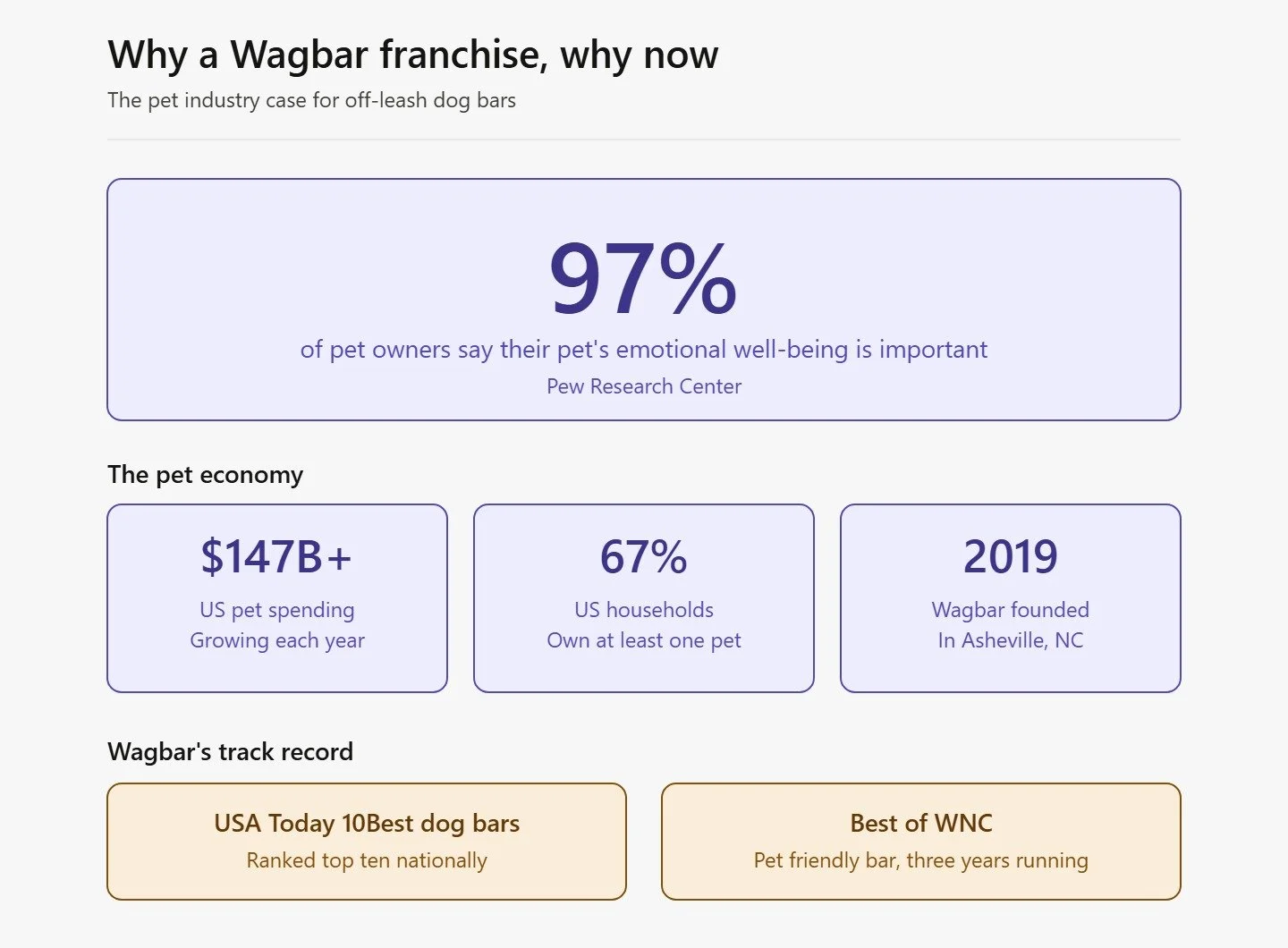
Multi-unit ownership isn't for everyone, and it's worth being clear about that. Some franchisees open one location and run it brilliantly for ten years with no desire to do anything else. That's a legitimate and valuable outcome.
The owners who thrive at multi-unit scale tend to share a few things: a genuine interest in building systems and teams, comfort with managing through others rather than doing everything personally, and the financial capacity to invest across multiple locations without overextending. They also tend to have mapped the regional opportunity clearly before committing — they know which markets they want and why, rather than adding locations reactively.
If you're evaluating the dog bar franchise opportunity and you already think you want three locations someday, that's worth telling Wagbar upfront. The multi-unit discount exists for franchisees who commit to regional scale from the beginning, and the conversation about market territory, location sequencing, and capital planning is different — and more valuable — when that's the stated goal from day one.
Visit wagbar.com/franchising to start the conversation.
Frequently Asked Questions
How does the 50% multi-unit fee discount work?
Wagbar offers a 50% reduction on the franchise fee for owners who commit to opening three or more units. The standard franchise fee is $50,000; the discounted rate for multi-unit commitments is $25,000 per location. The discount applies to the franchise fee component of the total investment. Full details are in the FDD.
Do I have to open all three locations at once to qualify for the multi-unit discount?
No. Multi-unit commitments typically involve opening locations in a phased sequence rather than simultaneously. The commitment is to the number of locations, not to a simultaneous opening schedule. The specific terms of how phased multi-unit agreements work are detailed in the franchise agreement.
What happens if my first location underperforms — am I still obligated to open additional locations?
Multi-unit franchise agreements typically include provisions for performance benchmarks and circumstances under which additional unit obligations can be modified. The specific terms vary by agreement. This is exactly the kind of question a franchise attorney should review before you sign any multi-unit commitment.
How should I think about market selection for a regional portfolio?
Start with the same demographic criteria you'd apply to a single location — income levels, pet ownership rates, outdoor and social culture, and the density of your target customer. Then add the regional lens: locations that are geographically proximate enough to share brand recognition but distinct enough to serve different membership bases. The demographic analysis behind dog franchise success is a practical starting point.
Is it common for franchise owners to expand from one location to multiple?
Yes, across the franchise industry broadly. The International Franchise Association estimates that multi-unit operators account for more than half of all franchise locations in the United States. In categories with strong recurring revenue and operational systems that transfer well, like membership-based pet services, the economic incentives for multi-unit ownership are particularly clear.
What financing options exist for multi-unit franchise expansion?
SBA loans are the most common financing vehicle for franchise acquisitions, including multi-unit portfolios. Lenders who specialize in franchise lending will evaluate the performance of existing locations as part of the underwriting for additional units — clean financials at the first location directly affect the terms available for the second. Some franchisees also use a combination of SBA financing and equity from their operating business to fund expansion.
Bottom TLDR
Multi-unit franchise growth in the dog bar space compounds recurring membership revenue across locations while spreading operational systems and brand recognition across a region. Wagbar offers a 50% franchise fee discount for owners committing to three or more units, reducing the fee from $50,000 to $25,000 per location. If you are planning to expand, declare that intention early so market territory, location sequencing, and capital planning can be structured from the beginning.
This page is for informational purposes only and is not an offer to sell or buy a franchise. Investment figures are illustrative and subject to the Wagbar Franchise Disclosure Document (FDD). Financial scenarios referenced are hypothetical. Consult a franchise attorney and financial advisor for advice specific to your situation. Wagbar Franchising LLC, (828) 554-1021, 7 Kent Place, Asheville, NC, 28804.