

How Off-Leash Dog Bars Run: Operations, Safety, and Regulatory Overview
Top TLDR: Off-leash dog bars run on three connected systems: vaccination and behavioral screening at the entry point, two-layer supervision combining staff and owner attention, and operational infrastructure covering insurance, zoning compliance, sanitation, and incident response. Wagbar locations follow a model built around fenced yards, trained staff, posted rules, and integrated bar service. Anyone considering a visit, an investment, or starting a similar business should understand how these layers work together.
The Daily Operating Pattern of an Off-Leash Dog Bar
Most off-leash dog bars run on a predictable daily cadence. Doors open mid-morning to early afternoon depending on location and season. Staff arrive 60 to 90 minutes before opening to walk the yard, pick up overnight debris, refill water stations, set up the bar, and run through any pre-shift coordination. Wagbar locations typically operate seven days a week, with hours varying by season and the demands of each market.
The early hours after opening are usually the calmest. A handful of dogs, owners settling in for coffee or a morning beer, the staff getting their first read on the day's energy. As the afternoon progresses, traffic builds. By mid-afternoon on weekends, a busy Wagbar location may have 30 to 50 dogs in the yard at peak.
The closing pattern reverses the morning. Last call gets announced, the yard empties, owners leash up, staff walk the yard a final time to pick up trash, refill water for any remaining dogs, and clear the bar. After close, deeper cleaning begins. The whole arc is repeatable, and that repeatability is part of what makes the model work.
This pillar covers how the business actually runs across that daily arc. The off-leash dog bar concept page introduces the format from a customer angle. This piece looks at the operational systems behind it.
The Staffing Model: Who's Watching the Yard
Every well-run off-leash dog bar has staff dedicated to yard supervision. The exact title varies (yard staff, dog ambassadors, park supervisors, sometimes just "the team"), but the function is the same. They're the trained set of eyes that watches the dogs while owners are also watching their own dogs.
A typical Wagbar shift has multiple staff members on the floor. One or two work the bar. One or two work the yard. On busy days the count goes up. The yard staff rotate through the space, watching play patterns, checking in with new arrivals, picking up after dogs whose owners didn't, and reading body language across the active groups.
The skill set required for yard staff is specific. They need to read dog body language quickly. They need to know the difference between healthy rough play and trouble. They need to handle the social side, greeting regulars, helping new visitors with the check-in process, and de-escalating with humans as well as dogs. They train on this. Wagbar's dog park behavior dynamics reference covers many of the patterns staff are trained to spot.
The staffing ratio matters. An operation that puts one person on a yard with 40 dogs is going to miss things. An operation that staffs to actual capacity has someone within visual range of every cluster of dogs at all times. The math behind this is part of why off-leash bars charge entry fees: staff costs are real and continuous, and they're what makes the format safe.

Vaccination Verification: The Entry-Point Safety Layer
The first safety layer happens at check-in. Every off-leash dog bar that runs a credible operation requires proof of certain core vaccinations before any dog enters the play area. Wagbar requires three: Rabies, Bordetella, and Distemper. Plus the dog must be at least six months old, spayed or neutered.
The verification process is human and documented. A staff member checks the dog's records on the owner's phone or a printout, confirms the dog's name matches, confirms the dates are current, and confirms the dog at the gate is the dog on the records. This isn't a formality. The screening is part of why an off-leash bar is safer than an unsupervised dog park, where any dog can wander in regardless of vaccination status.
For first-time visitors, this check happens at every visit until they sign up for a membership. Members keep records on file and just have to update them when boosters happen. That dramatically speeds up entry for regulars.
The vaccinations themselves cover specific risks. Rabies is the legal baseline almost everywhere. Bordetella protects against the bacterial cause of kennel cough, which spreads quickly in shared dog environments. Distemper is a serious viral disease that affects multiple body systems. The full Wagbar health and safety standards document the medical baseline and why each vaccination is required.
What about dogs without complete records? They don't enter. Operations that bend on this for a regular customer or a dog that "looks fine" are taking on risk for every other dog in the yard. The standard exists for a reason, and credible operations hold to it.
Behavioral Screening at Check-In
Vaccination verification is one half of the entry-point safety layer. Behavioral screening is the other.
Wagbar's policy is that dogs with no history of aggressive behavior are accepted as members. Dogs that exhibit extreme or repeated aggressive behavior are asked to leave and may have memberships revoked. This isn't applied at sign-up only. It's an ongoing standard. A dog who comes in for a first visit and shows aggressive behavior won't be granted a membership, and a member dog that develops a problem can be removed.
The screening at check-in is observational. Staff watch how a dog enters the gate, how they react to the resident pack, how their owner handles them. Most issues show up in the first three to five minutes. Stiff body language, fixated staring, repeated lunging at other dogs through the inner gate, refusing to settle: these are early signals that a dog isn't a fit for that day's environment, regardless of intent.
Owners help too, often without realizing. The questions a staff member might ask informally during check-in (Has your dog been to a busy off-leash space before? How does your dog handle other dogs in close quarters? Are there any specific triggers we should know about?) help build a basic profile in the first few minutes. Owners who answer honestly help everyone, including their own dog. Reading the warning signs that precede dog conflicts gives a sense of what staff are watching for at the entry point and beyond.
The line between "reactive" (a behavior pattern that can be worked with) and "aggressive" (intent to harm) matters here. Reactive dogs can sometimes do well at quiet hours with careful handling. Aggressive dogs can't. The screening exists to draw that line in real time.
The Two-Layer Supervision Model: Owner Plus Staff
Once a dog has cleared the entry checks and is in the yard, supervision becomes a layered system. Both layers matter, and both are necessary.
Owner supervision is the first layer. The owner knows their dog best. They know their dog's body language tells, their dog's tolerance for play intensity, their dog's specific triggers. The posted rules at every Wagbar require owners to keep eyes on their dog and physically intervene if their dog isn't playing nicely. Owners who scroll their phones for fifteen minutes at a time are breaking the model that makes the venue safe. The complete dog park etiquette and safety reference goes deep on what active owner supervision actually looks like.
Staff supervision is the second layer. Staff catch what individual owners miss. They see across all the active groups simultaneously. They notice patterns building between dogs whose owners haven't seen each other. They step in early when something starts going sideways. The two layers compensate for each other's blind spots. An owner who knows their dog perfectly might not notice a third dog approaching a tense interaction. A staff member tracking the whole yard might not pick up on a subtle stress signal a specific dog is showing.
The combined model works because neither layer alone is sufficient. Unsupervised dog parks rely entirely on owner supervision, and the cracks show. Supervised but rules-free spaces rely entirely on staff, and the cracks also show. Off-leash dog bars get both, and the combination is part of why they're a credible model.
What happens if an owner clearly isn't supervising? Staff intervene. Politely the first time, more directly the second. An owner who consistently ignores the supervision norm gets reminded that the rules apply to them. The membership and entry standards are enforced equally for humans and dogs.
Incident Response Protocols
Even with strong screening and supervision, incidents happen. Most are minor. Two dogs have a brief vocal exchange. A dog gets into a planter. An owner's drink gets knocked over by a passing tail. The infrastructure for handling these is in place at every credible off-leash bar.
Minor incidents. Staff intervene calmly, separate dogs if needed, check both dogs, check both owners, and move on. No paperwork, no escalation. Most days have a few of these and they don't change the rest of the visit.
Moderate incidents. A snap that doesn't break skin, a brief scuffle that staff or owners quickly separate, an overwhelmed dog that needs to be removed from a group. Staff document the time, the dogs involved, and the resolution. Owners are checked in with directly. If a dog repeatedly shows the same behavior, the membership team may follow up.
Serious incidents. Bites that break skin, fights that require physical separation, injuries that need vet attention. These trigger a formal incident report, exchange of information between owners involved, and follow-up to determine whether the dog can return. Wagbar staff are trained on the steps and the documentation that follows.
The formal incident response system isn't optional. Insurance carriers require it. Consistent application of the policies protects the operation and protects every other dog and owner using the space. Operations that handle serious incidents informally are accumulating risk that catches up to them.
The flip side of incident response is a clear standard for what triggers a permanent removal. Wagbar's policy is that dogs with extreme or repeated aggressive behavior are asked to leave. That standard isn't applied capriciously. It exists so the rest of the dogs in the yard can use the space safely. Staff training on the body language decoder for canine communication signals is core to recognizing escalation patterns early enough to prevent incidents in the first place.
Insurance and Liability Structure
Running an off-leash dog bar requires multiple layers of insurance coverage that go beyond what a typical bar or restaurant carries.
General liability. Standard coverage for slips, falls, and incidents on the premises. Off-leash bars typically carry higher limits than equivalent-sized restaurants because the dog component adds risk vectors a normal bar doesn't have.
Animal-related liability. Specific coverage for incidents involving animals. Dog bites, dog-to-dog injuries, allergic reactions, and similar events. The market for this insurance is specialized and the costs vary widely by location and operator history.
Liquor liability. Standard for any establishment serving alcohol. The bar service component of an off-leash bar carries the same coverage requirements as any other licensed establishment.
Property and equipment. Standard coverage for the buildings, fencing, container bar setup if applicable, water systems, and other physical infrastructure.
Workers' compensation. Required by law in most jurisdictions for staff. Yard staff in particular are exposed to physical risks (being knocked over by running dogs, occasional bite risk, repetitive picking up of waste in various weather) that the policy needs to cover.
Owners and visitors also typically sign waivers acknowledging the risks of an off-leash environment. These waivers don't eliminate operator liability, but they document that visitors understood the venue's nature when they entered. The combined coverage and waiver structure is what makes the business model insurable. Anyone considering a similar operation should review the pet business legal essentials covering licensing, insurance, and compliance before drafting their plans.
Zoning and Regulatory Requirements
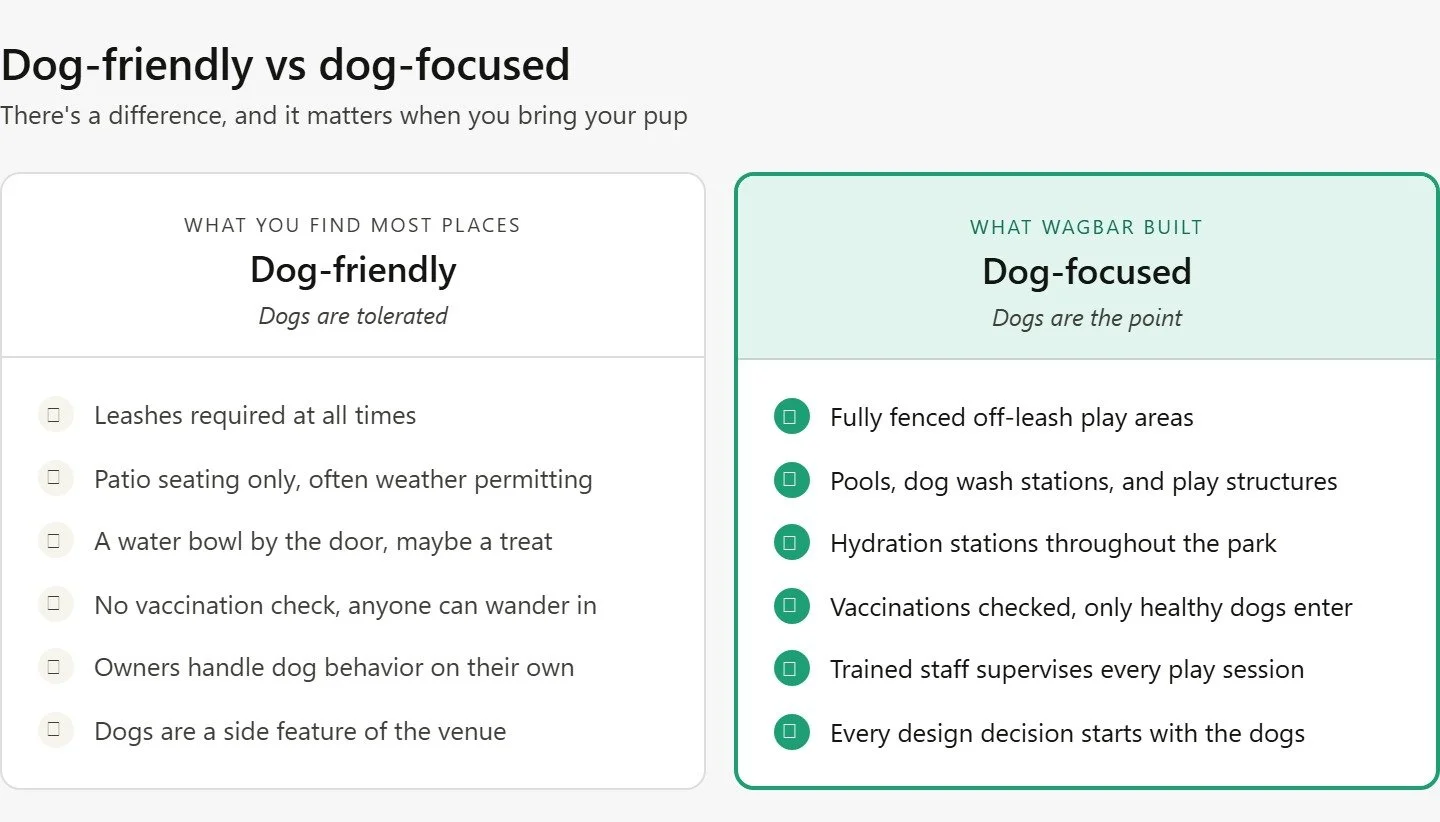
Off-leash dog bars sit at the intersection of multiple regulatory frameworks, and the zoning side is often the hardest part of opening one.
Local zoning ordinances. Most municipalities have separate zoning categories for restaurants, bars, kennels, dog daycares, and dog parks. An off-leash dog bar combines elements of several. Operators have to work with local zoning authorities to confirm the use is permitted, sometimes requiring a variance, special-use permit, or conditional-use permit. The process can take months and varies dramatically by jurisdiction.
Health department oversight. Any operation serving food and beverages falls under the local health department. Off-leash bars often have unusual permit requirements because of the combined animal-and-food-service nature. Staff training, sanitation standards, food preparation areas (typically separated from the dog yard), and waste handling all get inspected.
Animal control regulations. Some jurisdictions have specific rules about commercial dog facilities, including minimum yard size per dog, fencing height, separation between play areas, and noise limits. These often determine whether a specific property can host the operation at all.
Liquor licensing. A bar serving alcohol requires the standard liquor license for that jurisdiction, plus any special conditions related to the dog component. Some states or cities have language specifically addressing how alcohol service interacts with animal-permitted spaces.
Building codes and accessibility. Standard for any commercial space, with the additional consideration that the operation needs to be accessible to humans while also accommodating dogs.
The combined regulatory picture varies enormously by location. The zoning and regulations for pet businesses by state and city compliance reference covers the patterns and gives prospective operators a starting reference for what to research locally. Anyone interested in opening one of these businesses should expect this part of the work to take longer than they think.
Health Department Compliance and Sanitation Standards
The health department side of an off-leash dog bar deserves its own treatment because the standards are often stricter than for a typical bar.
Food and beverage handling. Same as any restaurant or bar. Trained staff, certified kitchen if food is prepared on-site (versus food trucks), proper temperature controls for any prepared items, separation between food prep and animal areas.
Water systems. Dog water stations need to be cleaned and sanitized regularly. Wagbar locations typically have multiple water points throughout the yard, and each has a published cleaning schedule.
Waste handling. Dog waste accumulates fast in an off-leash environment. Staff pick up throughout the day, owners are required to pick up after their dogs, and waste collection bins are emptied frequently. The waste itself goes into commercial-grade collection systems separate from regular trash.
Bathroom facilities. Standard for the human side, with the additional consideration that sinks and bathrooms see heavier-than-usual traffic from owners washing up after handling their dogs.
Air quality. Outdoor venues are easier here. Indoor or partially indoor venues require ventilation that handles both the food service requirements and the higher animal density.
Cleaning supplies. Pet-safe cleaning products throughout the yard. Standard food-safe products in the bar and food service areas. Storage and use protocols documented.
Health inspections happen on the same schedule as any food-service venue, often with extra attention to the animal-related elements. Operations that maintain consistent records across daily, weekly, and monthly cleaning tasks have an easier time at inspection. The broader dog health and wellness fundamentals cover why these sanitation standards matter for the dogs themselves, not just for compliance.
Cleaning Schedules and Yard Maintenance
The yard is the operational heart of the business and the most visible part of how the operation either works or doesn't.
Daily cleaning. Staff walk the yard at opening and closing, picking up any waste, debris, or items left behind. Water stations get refilled and wiped down. Common surfaces (benches, tables, gate handles) get wiped. The bar gets standard end-of-shift cleaning.
Multiple-times-daily walks. During peak hours, yard staff walk continuous loops picking up after dogs whose owners didn't notice or didn't get to it fast enough. This is part of the supervision rotation and part of the cleanliness standard.
Weekly deep cleaning. Detailed cleaning of bathrooms, food prep areas if applicable, water systems, fencing inspection, gate hardware checks, signage updates.
Monthly maintenance. Yard surface check (artificial turf, gravel, decomposed granite, or whatever the surface material is). Drainage system check. Fence integrity inspection along the entire perimeter. Equipment inspection for benches, shade structures, water stations.
Seasonal maintenance. Heater and fan service for covered patios. Snow and ice management in cold-climate locations. Misters or shade structures in hot-climate locations. Surface treatment depending on yard material.
Annual review. Pest control review (especially for any insect or rodent issues that might affect dogs). Surface replacement or refresh as needed. Major equipment overhaul. Documentation review for compliance with all applicable regulations.
The cleaning schedule isn't glamorous and customers don't usually see most of it. But a yard that smells off, has standing waste, or has unsafe surfaces is a yard that loses regulars fast. The cleaning standard is what holds the customer experience together over time. Across the Wagbar locations network, the cleaning standard is one of the things that's consistent regardless of which yard you visit.
Bar Service Compliance and Alcohol Liability
The bar side of the operation has its own set of requirements that overlap and sometimes conflict with the dog side.
Standard alcohol service requirements. Trained bartenders, ID checking, monitoring intoxication, refusing service to anyone over the limit. Same as any other licensed establishment.
18-and-over policies. Wagbar locations are 18+, both because of the alcohol service and because the off-leash environment isn't appropriate for children. The age limit is enforced at the bar and at the gate.

Pacing and supervision. Owners with dogs in the yard are responsible for those dogs. An owner who's had too much to drink can't safely supervise their dog, and that's a problem in an off-leash environment. Staff are trained to flag situations where an owner's drinking is interfering with their ability to track their dog.
Last call and closing patterns. Standard alcohol service shutoff times, plus the additional layer of getting all the dogs leashed and out of the yard before final close.
Non-alcoholic options. A real bar with real options for designated drivers and people who don't drink. Wagbar serves beer, wine, cider, and hard seltzer alongside coffee, soda, hot drinks, and water. The non-alcoholic options aren't an afterthought.
Outside food allowance. Wagbar allows outside food, which simplifies some of the food-service compliance because the venue isn't always responsible for what's eaten on the premises. Food trucks rotate at most locations on a published schedule.
The bar component generates real operating revenue, but it also generates real compliance overhead. The integration of alcohol service with an animal-permitted space is rare enough that operators often have to negotiate specific terms with their liquor licensing authority. From the customer side, the integrated bar-and-yard model is simplified by Wagbar membership options that bundle yard access with the bar service experience over the long term.
Emergency Procedures and Coordination With Local Services
Every credible off-leash dog bar has documented emergency procedures, and staff are trained on them.
Medical emergencies for humans. Standard first aid and CPR-trained staff. Clear path for emergency services. Phone access at the bar. AED on premises in many locations.
Medical emergencies for dogs. Knowledge of nearby emergency vet hospitals. Owner contact protocols (since most members provide emergency contact information at sign-up). Basic understanding of when to call for vet help versus when to recommend the owner take their dog directly.
Severe weather. Tornado warnings, severe thunderstorms, extreme heat warnings, extreme cold warnings. Each has a documented response. Sometimes the response is to close the yard temporarily. Sometimes it's to move dogs and humans to covered areas. Staff are trained on what triggers what response.
Fire response. Standard for any commercial building. Fire extinguishers, evacuation routes, posted procedures. The yard adds the complication of getting dogs leashed and out safely.
Lost dog. A dog that gets out of the yard gets a coordinated staff response. All staff are notified, the property and surrounding area are searched, the dog's owner is supported through the process. The fenced design makes this rare, but the procedure exists.
Off-hours coordination. Local police, animal control, and emergency services know the operation exists and where it is. Some operators establish proactive relationships so that response in an emergency is faster.
The emergency procedures aren't theoretical. Most off-leash bars run through tabletop exercises periodically, with staff walking through "what if" scenarios. Wagbar's franchising training program covers emergency response protocols as part of the standard operations curriculum new franchisee teams complete.
Frequently Asked Questions
What's the difference between an off-leash dog bar and a dog daycare?
A dog daycare is a service where dogs are dropped off for the day under staff supervision while owners go to work. An off-leash dog bar is a venue where owners stay with their dogs and supervise them while also enjoying food and drinks. The supervision model is fundamentally different. Daycares take full responsibility for dogs while owners are absent. Off-leash bars share supervision between staff and owners who are present.
How is an off-leash dog bar different from a regular dog park?
A regular dog park is typically unsupervised, free to enter, and accepts any dog whose owner brings them. An off-leash dog bar is staff-supervised, charges entry, requires verified vaccinations and behavioral screening, and combines the off-leash space with bar service for owners. The supervision and screening are what distinguish the model.
Are off-leash dog bars legal in all states?
Legality varies by state and locality. Most states permit the model with appropriate licensing, but specific rules around alcohol service in animal-permitted spaces vary. Some jurisdictions require specific permits beyond the standard liquor license and food service license. Anyone interested in opening one should consult local authorities for the rules that apply in their target area.
What happens if a dog bites someone at an off-leash bar?
The exact response depends on the severity. Minor nips that don't break skin are usually documented and handled between owners with staff support. Bites that break skin trigger a formal incident report, exchange of contact information between owners, possible animal control involvement, and a determination about whether the biting dog can return. Insurance coverage and waivers come into play for medical costs and any liability questions.
How do off-leash dog bars handle high-arousal play that looks rough?
Healthy rough play includes wrestling, body slamming, mock biting, and growling, and dogs reciprocate (both come back for more). Staff are trained to distinguish this from actual conflict. They watch for reciprocity, body language, and the ability of dogs to take breaks and reset. When play crosses from reciprocal to one-sided or arousal levels become unsafe, staff step in.
What kind of training do off-leash dog bar staff get?
Training typically covers dog body language, group play dynamics, breaking up scuffles safely, customer service, vaccination verification, alcohol service compliance, food handling if applicable, and emergency response. Wagbar specifically runs an intensive training program at the Asheville flagship location that covers all of these for new franchisee teams.
Are there age limits for dogs at off-leash dog bars?
Most credible operations require dogs to be at least six months old. The age requirement gives the dog's vaccinations time to provide protection and gives behavioral maturity time to develop. Wagbar requires six months as a minimum, with no upper age limit beyond what the individual dog can comfortably handle.
Do off-leash dog bars have to disclose incidents to potential customers?
Disclosure requirements vary by jurisdiction. Some states require operators to maintain incident records for inspection. Patterns of incidents at a specific location can show up in health department records, animal control records, or insurance industry data. Operators that handle incidents transparently and improve their protocols afterward tend to have lower long-term incident rates than those who don't.
How do off-leash dog bars price their entry fees?
Pricing models vary. Most charge a daily fee for non-members (often in the $5 to $15 range) and offer monthly, annual, or visit-pack memberships at meaningful discounts. The fee covers staff supervision, yard maintenance, water systems, and the screening process.
Can I open an off-leash dog bar of my own?
The model is replicable but operationally complex. Anyone considering opening one should research zoning, insurance, alcohol licensing, staff training, and the specific local regulatory environment thoroughly. Several existing operators including Wagbar offer franchise opportunities that bundle the operational systems with training and ongoing support. The ultimate starting reference for off-leash dog bar businesses walks through what's involved.
Bottom TLDR
How off-leash dog bars run comes down to layered safety systems. Vaccination and behavioral screening at the gate, two-layer supervision combining staff and owners in the yard, documented incident response, broad insurance coverage, alignment with local zoning and health regulations, and ongoing sanitation. Anyone visiting one of these venues for the first time, or considering opening one, should understand how these layers connect to make the model work.