

From Active Duty to Pet Franchise Owner: How Military Backgrounds Translate to Operations

Top TLDR: Going from active duty to pet franchise owner is a natural transition because military service builds the exact competencies franchise systems reward: disciplined execution of operating procedures, team management under accountability, logistics fluency, and the ability to build community quickly. The gap between military structure and civilian business is real but bridgeable. Study the Wagbar operations manual the same way you studied field doctrine, and the foundation transfers directly.
The civilian career market tends to undervalue what military service actually produces. Leadership, logistics, systems thinking, the ability to train people under time pressure, and the instinct to build cohesion in a group of people who did not choose each other. These are not soft skills. They are operational competencies that civilian organizations pay consultants to install and rarely get as well as they get them from someone who has been doing it since their first duty assignment.
Franchise ownership is one of the few civilian career paths where those competencies have a direct, measurable application. Not as metaphor. Not as a resume line item. As the actual daily work of running a physical business that depends on systems, teams, and community.
This page examines how going from active duty to pet franchise owner translates at the operational level, where the skills carry, where the transition creates real friction, and how veterans who understand both sides of that picture tend to open stronger.
The Transition Moment: Why Franchise Fits After Service
Every veteran who has gone through TAP (Transition Assistance Program) knows the exercise: translate military experience into civilian language for a resume. Staff NCO becomes operations manager. Platoon leader becomes team lead. The problem is that the civilian equivalents almost never describe a job with comparable scope, consequence, or complexity. The translation undersells what actually happened.

Franchise ownership does not require a translation. The job is recognizably similar to military leadership in structure. You have a doctrine to follow, which is the operations manual. You have a team to lead and develop. You have resources to manage, vendors to coordinate, and a physical environment to maintain at a standard. You have customers who depend on you to deliver a consistent experience, and a franchisor who expects accountability to brand standards.
Veterans who own a pet franchise are not starting from a blank page. They are applying a framework they already have to a new mission set. That is a meaningfully different starting position than a first-time business owner with no prior leadership experience.
Standard Operating Procedures vs. the Franchise Operations Manual
Military units run on SOPs. Every task that matters has a documented procedure, and one of the primary jobs of leadership is ensuring those procedures are followed consistently even when conditions are inconvenient. The value of the SOP is not that it covers every possible situation. It is that it establishes a baseline from which variations can be evaluated and deviations can be corrected.
Franchise systems work identically. The operations manual is doctrine. It covers how the business runs, what standards apply, how customers should be treated, how safety is maintained, and what the brand experience looks and feels like across every location in the system. A franchise owner who treats the operations manual as optional produces inconsistent results. A franchise owner who executes it with discipline produces the results the system was designed to deliver.
Veterans who spent years enforcing SOPs and getting their teams to internalize rather than just comply with procedures have practiced the most critical franchise competency. The translation is not metaphorical. It is structural. The document changes, the context changes, and the stakes are different, but the cognitive framework is the same.
Where veterans sometimes have an advantage over civilian first-time operators: Many civilian franchise owners struggle with the psychological shift from autonomous independent business thinking to operating within a defined system. Veterans typically do not have that struggle. Following a well-designed system and improving its execution is not a constraint to someone with a military background. It is a familiar mode of operation.
Wagbar's training and support program introduces franchisees to the operational framework through the proprietary Opener app before training even begins in Asheville, which mirrors the pre-mission briefing format veterans already know.
Leading a Civilian Team After Leading a Unit
Military leadership is structured, hierarchical, and backed by clear authority. When a sergeant gives direction to their soldiers, the authority structure is understood by everyone in the room. Civilian teams do not work this way, and this is the adjustment that catches the most veterans off guard in their first six months of franchise ownership.
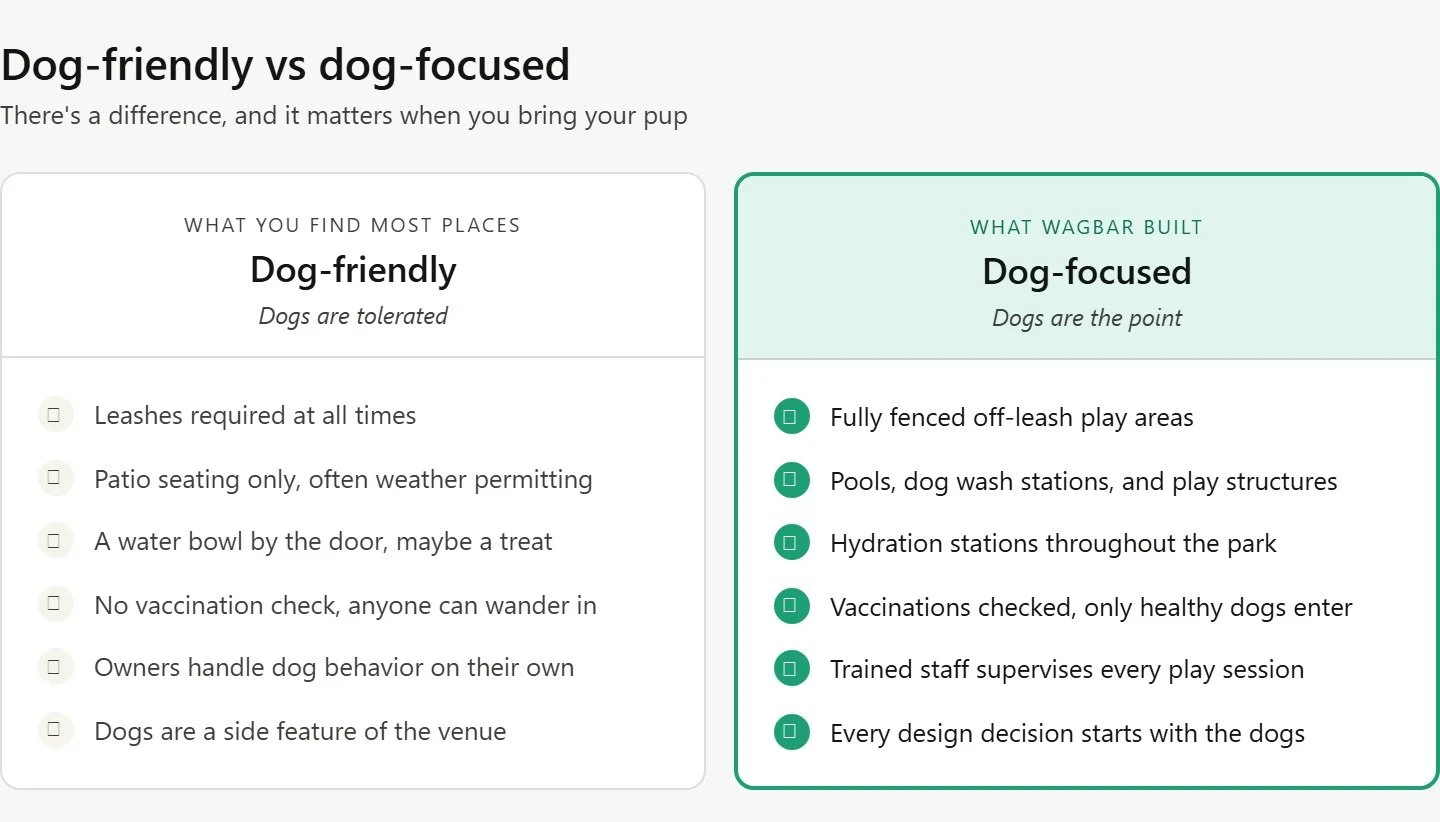
Your staff at an off-leash dog bar are part-time workers, hospitality employees, and dog enthusiasts. They are not subordinates. They are adults who chose this job, who can leave for another job, and whose performance depends significantly on how you communicate, recognize, and develop them rather than on formal authority alone. This is not a lesser form of leadership. It is a different application of the same underlying skill set, and veterans who adapt their style find it clicks relatively quickly.
What carries directly from military leadership: The habit of setting clear expectations, establishing accountability for performance, creating a culture where standards are non-negotiable, and investing in the development of people who show potential. Those practices work in a civilian team just as well as they work in a military unit. The tool is the same. The operating environment is different.
What needs to adapt: The communication register. Civilian employees respond to coaching language rather than command language. The same message lands differently depending on how it is delivered, and a veteran who can read that difference and adjust their approach will get more out of their team than one who relies on the authority signal that worked in uniform.
The quarterly business review process at Wagbar gives franchise owners a structured cadence for reviewing their operations alongside the franchisor team, which mirrors the command review and AAR culture veterans are already practiced in.
Logistics Thinking in a Physical Venue Business
Running a physical location with staff, inventory, equipment, and a maintenance schedule is logistics work. Veterans who managed supply chains, coordinated unit logistics, or spent time in any support MOS have been practicing the underlying skill set of physical operations management for years.
Vendor coordination is a version of supply chain management. Knowing when to order beverages, what inventory levels to maintain, which vendors are reliable and which require closer monitoring, and how to handle a supply disruption without degrading the customer experience are all logistics problems. Veterans who managed MTOE accountability, coordinated LOGPACS, or ran any form of supply or maintenance operation have relevant experience.
Facilities management is a version of unit maintenance standards. Keeping an off-leash dog park in safe, clean, functional condition requires the same habit pattern that military maintenance culture instills: regular inspections, preventive action rather than reactive repair, and holding the standard even when it is inconvenient. The specific tasks are different, but the discipline of maintaining equipment and environment to a defined standard is transferable.
Scheduling is resource allocation. Matching staff coverage to expected customer volume, adjusting for seasonal variation, and making smart decisions about when to run lean versus when to maintain full coverage are exactly the kind of resource allocation decisions veterans make when they manage staffing for operations.
Understanding how revenue streams at an off-leash dog bar behave across memberships, day passes, and beverage sales helps veterans build a revenue model that their logistics and staffing decisions can be aligned against.
Safety Culture in an Off-Leash Environment
Military service creates a safety culture that most civilian workplaces cannot match. The habit of conducting threat assessments before entering an environment, identifying risks before they become incidents, and maintaining situational awareness during operations is deeply ingrained in veterans who have served in any capacity. That habit is directly applicable to running an off-leash dog park.
Dog behavior monitoring requires the same situational awareness as physical security. A staff member watching the off-leash play area is doing a version of force protection work: scanning the environment, identifying early warning signs before they escalate, and intervening before a minor situation becomes a serious one. Veterans trained in physical security, perimeter management, or force protection have intuitive competency here.
Vaccination verification is a compliance protocol. Wagbar requires proof of Rabies, Bordetella, and Distemper vaccinations on entry, with spayed and neutered dogs who are at least six months old. Enforcing this requirement every single visit, without exception, regardless of whether the member is a regular or a first-timer, is the same discipline as enforcing access control to a secured area. Veterans who have stood post, checked credentials, or managed access control understand why protocols apply to everyone.
Zero-tolerance standards do not require apology. Military culture is comfortable with non-negotiable standards. A dog that exhibits aggression leaves. A customer who becomes confrontational with staff is asked to go. Maintaining those standards without hedging is something veterans handle more naturally than many civilian operators who may feel awkward enforcing rules. Wagbar's dog health and safety protocols document the specific standards that every location maintains consistently.
Building Community: From Unit Cohesion to Member Base
One of the less-discussed military skills that transfers most strongly to franchise ownership is the ability to build genuine community among people who did not necessarily choose each other. Every military unit is assembled from whatever assignments the personnel system delivers. Making that group function as a team, feel invested in each other, and show up for each other is a leadership discipline that veterans develop over years.
An off-leash dog bar is a community business. Members who come back week after week do so in part because of how the space makes them feel. The staff who know their dogs' names. The owner who is present and engaged rather than absent in the back office. The events that give regulars a reason to be there on a Tuesday rather than just a Saturday. These are community-building behaviors, and veterans who have built unit cohesion across deployments, training cycles, and duty stations have done harder versions of this work already.
The Wagbar model rewards owner presence. Unlike a passive investment, this is a business where the owner's engagement directly affects the member experience and therefore retention. Veterans who are accustomed to leading from the front, being visible to their team, and staying connected to what is actually happening at the ground level will find this mode of ownership natural.
Building a membership base from day-pass visitors is the primary financial objective of Year One, and the relationship-building skills veterans bring are among the most effective tools for driving that conversion.
Where the Learning Curve Is Steeper
Honest skills transfer analysis requires acknowledging where the military-to-franchise transition is harder, not just where it is easier. Veterans who anticipate these gaps are better prepared to address them.
Financial literacy and P&L management. Unless your MOS or rating was in finance, comptroller, or logistics management, you may not have significant experience reading a profit and loss statement, managing cash flow against a budget, or making business decisions from financial data. This is not a disqualifying gap. It is a learnable skill. SBDC counseling, accounting software, and a good franchise CPA can close this gap quickly, but you need to know it is there.
Civilian workforce expectations. Covered in the leadership section, but worth restating as a gap specifically: the relationship between employer and employee in a civilian business is different from the relationship between leader and subordinate in a military unit. Retention, compensation, culture, and communication all work differently. Veterans who have managed civilian contractors or worked in joint environments with civilians sometimes have a head start here. Those who have spent their entire career in a purely military environment may need to develop a new register.
Patience with slow feedback loops. Military operations often have relatively clear success and failure signals within a defined timeframe. Business outcomes are gradual, sometimes ambiguous, and rarely provide the clean after-action assessment that military culture produces. A slow membership month is not a failed mission. It is data. Veterans who can hold their analytical instincts while a longer-arc pattern develops tend to make better franchise decisions than those who need faster resolution.
The Year One cash flow picture covers the financial patience required in the early operating phase and why adequate working capital reserves are more important than any individual metric in the first six months.
Frequently Asked Questions

Do you need prior hospitality or pet industry experience to run a Wagbar franchise?
No. Wagbar's training program is designed to be accessible to franchisees who are new to both the pet industry and bar operations. The one-week training in Asheville covers dog behavior management, bar operations, staff development, and marketing. Veterans who can learn complex doctrine quickly, which is most veterans, will find the training format familiar and manageable. Prior experience helps but is not a prerequisite.
Is the Wagbar training format compatible with military learning styles?
The Opener app provides structured, milestone-based pre-opening guidance before the Asheville week begins, similar to pre-mission preparation. The in-person training week is compressed, intensive, and hands-on. Veterans accustomed to field training exercises, pre-deployment workups, or technical schools will recognize the format immediately. The information density and pace are consistent with military professional development rather than civilian corporate training.
How does running an off-leash dog bar compare to running a military unit in terms of team size?
Most Wagbar locations operate with between four and ten staff members depending on volume and shift structure. This is roughly equivalent to a small team or section in military terms. The management complexity is lower than commanding a platoon in operational terms, but the civilian workforce dynamics mean that straightforward authority-based management techniques are less effective. The result is a team management challenge that rewards coaching and communication skills.
What does the franchisor support system look like after opening?
Wagbar provides ongoing support that includes marketing assistance, operational guidance, quarterly business reviews, and access to the franchisee network. The structure mirrors the support relationship between a unit and its higher headquarters: the franchisor sets standards, provides resources, and reviews performance, while the franchisee is responsible for execution on the ground. This structure is familiar to veterans and is designed to work the same way whether you are in your first year or your fifth. The Wagbar franchising page is the starting point for detailed information on the full support structure.
What is the biggest mistake veterans make when they transition into franchise ownership?
Treating the first year as a mission with a defined success condition rather than a process with a longer arc. Veterans are trained to accomplish objectives within defined timeframes. Business ramp-up does not work that way. Membership growth, operational refinement, and staff development all take longer than a deployment cycle, and success in Year Two often depends on decisions made in Year One that did not produce immediate visible results. Veterans who build patience for the longer arc alongside their operational discipline tend to outperform those who apply military urgency to timelines that require a different pace.
Bottom TLDR: Going from active duty to pet franchise owner works when veterans apply their strongest military skills directly: SOP execution, team accountability, logistics planning, and community building. The places where the transition gets harder, civilian workforce expectations and financial literacy, are the gaps worth addressing before opening day. Work with an SBDC counselor, review the FDD carefully, and treat the training week in Asheville as seriously as any pre-mission briefing.