

Franchise Business Models Compared: Service vs. Experience vs. Retail

Top TLDR: Franchise business models differ structurally: service franchises earn per transaction and are labor-constrained; retail franchises earn per purchase and face e-commerce pressure; experience franchises earn from multiple concurrent streams and build competitive moats through community. When comparing franchise business models, experience concepts serving genuine behavioral needs, like off-leash dog bars, combine the strongest retention mechanics with recession-resilient demand.
Choosing a franchise category is one of the most consequential decisions an investor makes before signing anything. And yet a lot of prospective franchisees spend more time comparing individual brands than they do understanding the structural differences between the business model types those brands represent.
Service franchises, experience franchises, and retail franchises operate by fundamentally different mechanics. They generate revenue differently, retain customers differently, respond to economic conditions differently, and require different operator skill sets. Understanding those differences before evaluating specific opportunities saves considerable time and significantly reduces the risk of backing the wrong category for your goals and circumstances.
Service Franchises: The One-Transaction Model
Service franchises are the most common category in franchising. Dog grooming, lawn care, auto detailing, cleaning services, tutoring centers, and fitness studios with appointment-based models all fall here. The defining characteristic is that revenue is generated by performing a task for a customer.
The mechanics are straightforward. A customer needs something done. They book an appointment or place an order. The service is performed. They pay. That's the transaction, and without a new transaction, there's no new revenue. The business earns what it can actively deliver.
This model has genuine advantages. Service franchises often have lower build-out costs because they don't require large commercial spaces or complex infrastructure. Many are mobile or home-based, which reduces overhead. They're also relatively easy to understand operationally, and the path from opening to cash flow is often shorter because the product doesn't require customers to change their habits to use it.
The structural limitation is the ceiling on revenue. A service business can only generate income while actively serving customers, and it can only serve as many customers as its staff and time allow. Labor is the primary constraint. On slow days, fixed costs continue while revenue drops to zero. There is no revenue floor unless the business has recurring service contracts.
In the pet category, service franchises like dog grooming, dog training, and mobile pet care are well-established. They serve real needs, but they're also competing in commoditized markets where price and convenience tend to dominate customer decisions. The competitive moat is thin.

Retail Franchises: The Inventory Model
Retail franchises generate revenue by selling physical products. Pet supply stores, specialty pet food retailers, and accessory boutiques fit here. The customer comes in looking for something specific, buys it, and leaves. Like service franchises, this is a transaction-per-purchase model, but with inventory management added to the operational complexity.
Retail franchises can achieve economies of scale that service businesses can't. A store that sells the same product to fifty customers in an hour doesn't require fifty separate labor investments. Margin potential exists when supply chains are managed well and the product mix is right.
The challenges in retail are well-documented, particularly since the acceleration of e-commerce. Online competitors can often undercut on price and offer a wider selection than any physical location can stock. This has put significant pressure on retail franchises in categories where the products are available elsewhere, including pet supplies. National pet retail chains have faced this pressure directly over the past decade.
Retail franchises also require significant working capital tied up in inventory, and the customer relationship tends to be transactional and low-frequency. A customer who buys dog food at a retail location may or may not return next month. There's little structural mechanism for building the kind of emotional connection that drives loyalty and advocacy.
Experience Franchises: The Relationship Model
Experience franchises are the category that has grown most significantly over the past decade, and for structural reasons that go beyond trend. The defining characteristic is that the product is time well spent in an environment, rather than a task completed or a product handed over.
Escape rooms, entertainment complexes, fitness concepts built around community, and off-leash dog bars all fall in this category. Customers pay to be in an environment, and the value they receive is the experience of being there: the social connection, the enjoyment, the sense of belonging.
This distinction drives different economics at every level of the business. Revenue doesn't require a separate labor transaction for every dollar earned. Multiple customers can generate revenue simultaneously in the same venue without additional marginal cost. A bar serving twenty customers at once doesn't require twenty separate service transactions. The experience is collective by nature, and the economics scale accordingly.
More important than the revenue structure is the relationship structure. Experience franchises build emotional connections with customers in ways that service and retail franchises structurally cannot, because the product is the feeling customers leave with, not the outcome they received. According to research published by Harvard Business Review, customers who have strong emotional connections to a business visit more often, spend more per visit, and are far less likely to switch to a competitor even when price or convenience alternatives exist.
Experiences are also harder to replicate online. A service business can be disrupted by an app that delivers the same service at lower cost. A retail business can be undercut by an e-commerce platform with better selection and faster shipping. An experience venue cannot be moved to a digital format without losing the thing that makes it valuable.
Where the Dog Bar Concept Sits in This Framework
The off-leash dog bar sits firmly in the experience franchise category, but with a structural feature that strengthens the model beyond most experience concepts: it addresses a genuine behavioral need rather than just a leisure preference.
A customer who visits an escape room is choosing a discretionary entertainment experience. They'll come back if they enjoyed it and feel like doing it again. A dog owner who visits an off-leash dog bar is meeting a need that doesn't go away: their dog requires exercise, socialization, and stimulation on a regular basis. The experience franchise is embedded inside an obligation.
That behavioral foundation makes the dog bar concept more durable than most experience franchises. The customer doesn't need to feel like going. Their dog needs to go, and that's a different motivational driver entirely.
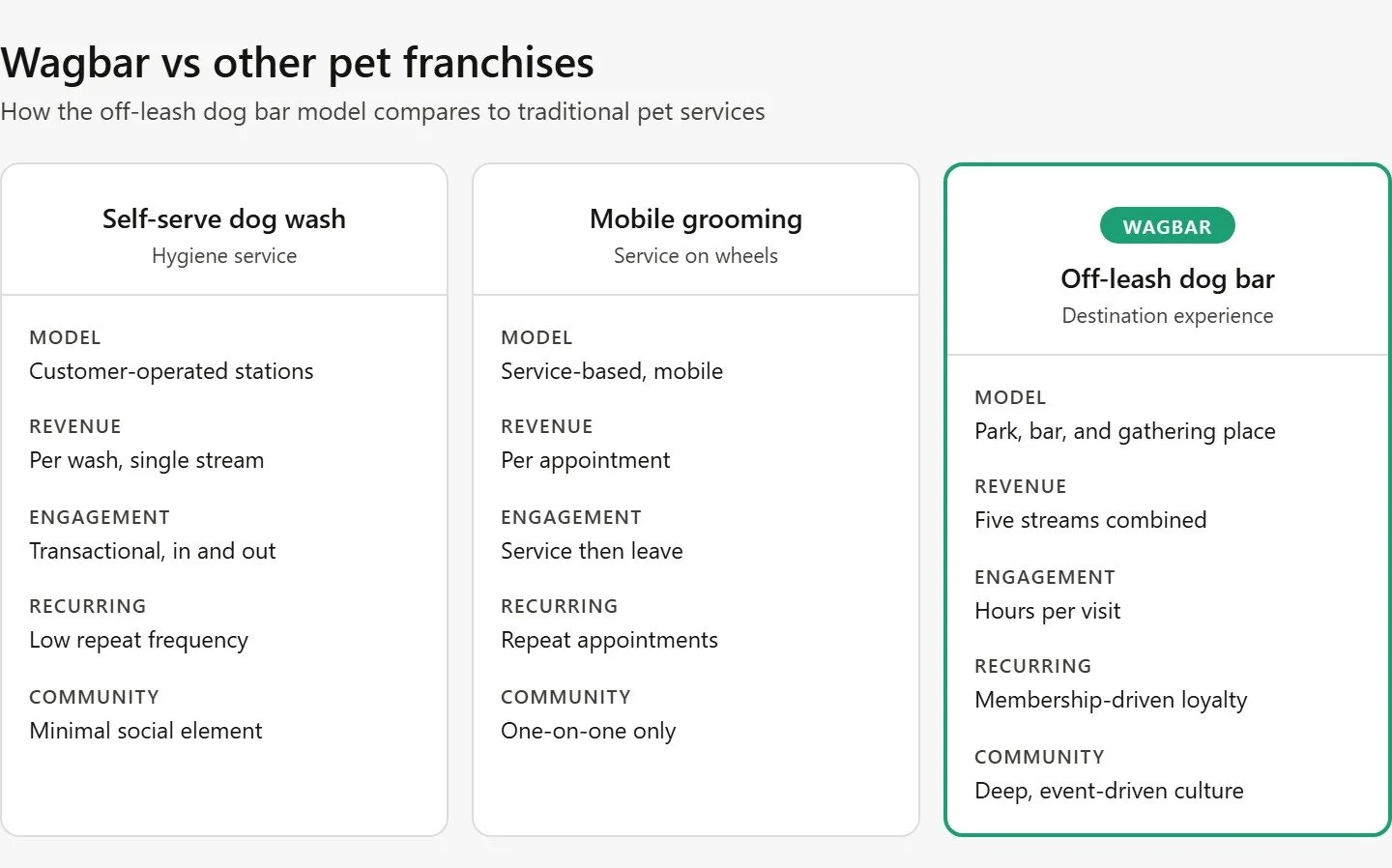
Wagbar's model builds on this foundation with a multi-stream revenue structure that no pure service or retail franchise can match. Dog park access fees and memberships establish the baseline. Beverage sales from draft beer, craft brews, wine, cocktails, seltzers, and non-alcoholic options layer on top of attendance. Private event bookings add advance-scheduled revenue. Food truck partnerships and seasonal programming create additional visit occasions throughout the calendar year.
Each stream runs independently and concurrently. On a busy Saturday, the business earns from memberships, day-pass fees, beverages sold to every visitor, and possibly event revenue, all during the same operating hours with the same staffing floor.
Learn how revenue streams in an off-leash dog bar stack across a typical operating week to create a more resilient income structure.
Comparing the Three Models on Key Investor Metrics
Customer acquisition cost. Service and retail franchises must continuously acquire new customers to replace those who don't return. Experience franchises with strong community and events programming generate meaningful referral traffic from satisfied customers, which reduces the cost of acquiring new ones over time.
Customer retention. Service franchises retain customers primarily through convenience and habit. Retail franchises retain through product availability and price. Experience franchises retain through emotional connection, social community, and the accumulated switching costs of belonging. Retention quality is meaningfully higher in experience franchises that execute community building well.
Revenue predictability. Service franchises earn what they can actively deliver and have no revenue floor without service contracts. Retail franchises depend on foot traffic and purchase frequency. Experience franchises with membership models build a committed revenue baseline before the month begins. Wagbar's membership structure, offering monthly, annual, and 10-visit punch pass options, creates this floor directly.
Labor scaling. Service franchises are labor-constrained because revenue requires active service delivery. Retail franchises need floor staff but don't require one-to-one labor for each transaction. Experience franchises can serve dozens of customers simultaneously with the same staffing floor, which is why beverage revenue per hour can be generated across the entire customer base at once.
Competitive moat. Service franchise differentiation is primarily on quality and price, both of which can be matched by a well-resourced competitor. Retail differentiation faces permanent pressure from e-commerce. Experience franchise moats deepen as the community grows, because accumulated social capital, the relationships, routines, and memories customers have built at a specific venue, are not replicable by a new entrant.
Recession resilience. Service franchises in non-essential categories face discretionary cuts during downturns. Retail franchises face structural competition from online alternatives in addition to cyclical demand pressure. Experience franchises serving genuine behavioral needs, like dog recreation, benefit from the underlying resilience of pet spending, which has grown every year for over three decades according to the American Pet Products Association.
Explore the pet industry market analysis that underpins the long-term investment case for pet-focused experience franchises.
Matching Model Type to Investor Profile
The right franchise model depends partly on capital availability, partly on operating preferences, and partly on what kind of business you want to be running three years from opening.
If you want lower initial investment, faster time to revenue, and a simpler operational profile, a service franchise may be the right fit. The trade-off is a lower ceiling, a more competitive market, and a business that earns nothing when it isn't actively working.
If you want to move physical product at scale and have strong supply chain instincts, retail franchises offer that path. The trade-off is inventory risk, e-commerce pressure, and a customer relationship that tends toward transactional.
If you want to build a community, generate recurring revenue, and own a business that gets stronger as it matures, an experience franchise is structurally better suited to those goals. The trade-off is higher initial investment and a longer ramp to community depth. Wagbar's estimated total initial investment ranges from $470,300 to $1,145,900, with a $50,000 franchise fee, 6% royalty on adjusted gross sales, and 1% marketing fund contribution. These figures are informational; prospective investors should review the Franchise Disclosure Document for complete details.
The investors who tend to perform best with Wagbar are the ones who came specifically because of the experience model and the community it produces. AJ Sanborn, who spent 20 years in financial services before opening his Richmond, Virginia franchise, chose Wagbar over a traditional bar concept specifically because of the community dynamic. Dianna in Phoenix, with a background in IT sales and the restaurant industry, described it similarly: a business model that creates something rather than just completing transactions.
See what to look for when evaluating an off-leash dog bar franchise against these model-type criteria before making any investment decision.
Frequently Asked Questions
What are the three main types of franchise business models?
The three main franchise model types are service franchises, which earn revenue by performing tasks for customers; retail franchises, which earn by selling physical products; and experience franchises, which earn by providing an environment and experience that customers pay to be part of. Each type has distinct revenue mechanics, customer retention dynamics, and competitive positioning that affect long-term performance.
Which franchise model generates the most recurring revenue?
Experience franchises with membership components generate the most reliable recurring revenue because customers pre-commit to access before any given visit occurs. Service franchise recurring revenue requires service contracts that are not standard in all categories. Retail franchises earn per purchase with no advance commitment from customers. The membership layer in experience franchises like an off-leash dog bar creates a known revenue baseline before the operating month begins.
How does an experience franchise compete differently than a service franchise?
A service franchise competes primarily on quality, speed, and price, all of which can be matched by a competitor with similar resources. An experience franchise competes on community, emotional connection, and the accumulated social capital that customers build over time at a specific venue. That social capital raises switching costs and deepens the competitive moat as the customer base grows, in a way that a service franchise's quality advantages simply cannot replicate.
Why do experience franchises tend to retain customers longer than service franchises?
Customers of experience franchises develop emotional connections with the venue, the staff, and other regulars that are not present in most service franchise relationships. Those connections increase the perceived cost of switching to a competitor, even when the competitor offers a comparable experience. Customers who have formed social habits around a venue are not making a neutral comparison when they consider leaving. They're weighing a new option against an existing community.
What makes the dog bar model different from other experience franchises?
Most experience franchises serve discretionary leisure preferences. The dog bar model serves a genuine behavioral need: dogs require regular exercise and socialization, and owners must provide it. That obligatory dimension makes visit frequency more durable than in experience franchises where the customer visits only when they feel like it. The experience is embedded inside a routine that exists independently of whether the customer wants to go out.
How should I use this comparison when evaluating franchise opportunities?
Use the model-type framework as a first filter before evaluating specific brands. Determine which model type aligns with your capital position, operating preferences, and long-term goals. If recurring revenue, community building, and a deepening competitive position over time are priorities, focus your evaluation on experience franchises. Then evaluate specific brands, including their training, support infrastructure, and franchise network, against those criteria.
Summary
Franchise business models differ fundamentally in how they generate revenue, retain customers, and build competitive advantage over time. Service franchises earn per transaction and face a labor ceiling. Retail franchises earn per purchase and face structural pressure from e-commerce. Experience franchises earn from multiple concurrent streams, build emotional customer relationships, and develop a deeper competitive moat as the community grows. The off-leash dog bar sits within the experience category with an additional behavioral foundation: dogs genuinely need what the venue provides. For investors who want a business that compounds in strength as it matures, experience franchise models are worth evaluating seriously. Explore Wagbar's franchise opportunity to see how the experience model works in practice across a growing national network.
Bottom TLDR: Franchise business models compared across service, experience, and retail show that experience franchises generate more durable revenue because they build emotional customer relationships rather than completing isolated transactions. Wagbar's off-leash dog bar operates in the experience category with a behavioral foundation: dogs need regular exercise regardless of economic conditions. Review the Franchise Disclosure Document and use this model-type framework as a first filter before evaluating specific brands.
All investment figures are for informational purposes only. Wagbar's total estimated initial investment ranges from $470,300 to $1,145,900. $50,000 franchise fee. 6% royalty on adjusted gross sales. 1% marketing fund contribution. 50% multi-unit fee discount for three or more units. Consult the Franchise Disclosure Document before making any investment decision.