
Franchise Business for Sale in Houston, TX: Metro-Wide Opportunity in America's Fourth-Largest City

Top TLDR: A franchise business for sale in Houston, TX means evaluating scale differently. The Houston metro hit 7.9 million residents in 2025, ranking first nationally for population growth. The real opportunity lies in the high-income suburbs, Fort Bend County at a $113,409 median income and The Woodlands corridor, where Wagbar's membership model performs best. Start at wagbar.com/franchising.
Houston is the fourth-largest city in the United States and the largest in Texas, with a city population of 2.33 million and a metro population that crossed 7.9 million as of July 2025. The Houston-Pasadena-The Woodlands-Sugar Land metropolitan statistical area added 126,720 residents between July 2024 and July 2025, more numerical growth than any other metro in the country, according to U.S. Census Bureau estimates reported by InnovationMap.
That scale creates something important for a franchise investor evaluating a franchise business for sale in Houston, TX: options. Houston is not one market. It's a collection of distinct submarkets, each with its own demographic profile, income concentration, and community culture. Picking the right one is the most consequential decision a Houston-area franchisee will make, and it's exactly where Wagbar's site selection support provides real value.
The Metro Picture: Why Houston's Scale Changes the Franchise Calculus
Most franchise opportunity pages for cities lead with city-level income data. For Houston, that creates a misleading picture. Houston's city-wide median household income sits at $64,813 in 2024 per U.S. Census ACS data, which is below national averages. That number is real but incomplete, because it averages across an extraordinarily diverse city that includes some of the country's wealthiest suburban communities alongside dense urban neighborhoods with lower household incomes.
The relevant income numbers for a Wagbar franchise evaluation are at the county and suburban level. Fort Bend County, which encompasses Sugar Land, Fulshear, and Missouri City, carries a median household income of $113,409. Montgomery County, home to The Woodlands and Conroe, sits at $97,266. These are not outliers. They are large, established communities within easy driving distance of Houston's employment centers, and they have the income profile, dog ownership rates, and community orientation that Wagbar locations depend on.
Harris County itself, which includes Houston proper plus surrounding communities, has a median income of $73,104 and added 48,695 residents in a single year to push past five million people, ranking first among all U.S. counties for numeric population growth according to Texas Demographics Center data. That county-level number is closer to the relevant benchmark for inner-ring Houston neighborhoods where a Wagbar location could serve a dense, young-professional population.
The metro also hosts the headquarters of 24 Fortune 500 companies, ranks second to New York City in Fortune 500 headquarters, and has a gross metro product that places it among the largest urban economies in the United States. These aren't abstract indicators. They describe a concentration of professional employment that produces the household income and discretionary spending that sustain a membership-based social venue.
Where Dog Ownership and Community Culture Overlap in the Houston Metro
The case for a franchise business for sale in Houston, TX goes beyond population size. Texas as a whole sees more than 43% of households owning at least one dog per Dogster's 2026 Texas pet ownership analysis, and the French Bulldog is Houston's most popular breed, followed by Bulldogs, Labrador Retrievers, Golden Retrievers, and Poodles. These are the same breeds that fill Wagbar locations across the Southeast and Mid-Atlantic every weekend.
The suburban ring around Houston has been growing its dog-friendly hospitality infrastructure in parallel with its residential growth. The western suburbs, particularly Katy, Fulshear, Sugar Land, and Missouri City, have developed a cluster of community-oriented craft breweries that have become neighborhood gathering spots for the same demographic that drives Wagbar's membership base. Project Halo Brewing in Fulshear, Talyard Brewing in Sugar Land, and No Label Brewery in Katy represent a growing pattern of family- and dog-friendly taprooms that position themselves explicitly as community gathering places, not just bars.

That existing craft brewery culture matters for a Wagbar franchise because it confirms consumer appetite for social venues that welcome dogs as part of the experience. The difference Wagbar offers is a fully managed, off-leash environment rather than a dog-tolerant patio, a structured membership model, and a dedicated dog park alongside the bar. In markets where dog-friendly breweries have already normalized the concept, Wagbar's differentiation is immediately legible to potential members.
The off-leash dog bar model explains in detail what makes a supervised off-leash environment distinct from a standard dog-friendly venue. That distinction resonates most clearly in markets where consumers already understand and seek out dog-welcoming social venues.
The Suburban Opportunity: Where Wagbar's Model Works Hardest
Wagbar's strongest markets share a specific set of conditions: high dog ownership density, recurring social venue culture, household incomes that support membership spending, and a residential pattern where people actually live in the community they're patronizing. Houston's suburbs check each of those boxes more consistently than the city's urban core.
The Woodlands is a master-planned community approximately 30 miles north of downtown Houston with 150-plus miles of trails, 151 parks, and major corporate employers including ExxonMobil's campus, Huntsman Corporation, and Baker Hughes. The community's design prioritizes walkable outdoor activity and local business patronage in ways that map directly onto a Wagbar location's target customer. Residents are active, professionally employed, and oriented toward community gathering. Dog ownership fits naturally into a lifestyle built around trails and green space.
Sugar Land and Fort Bend County represent perhaps the clearest suburban opportunity in the Houston metro for a Wagbar investor. Fort Bend County's $113,409 median household income is among the highest of any Texas county and reflects a concentration of energy-sector, healthcare, and technology professionals living in family-oriented master-planned communities. The area has the spending power for membership-based social venues and a family culture that extends to pets. Talyard Brewing, Sugar Land's first major brewery, opened in late 2024 and immediately positioned itself as a community gathering spot, signaling that the local hospitality market is actively maturing.
Katy and Cypress represent the western suburban corridor, one of the fastest-growing areas in the entire Houston metro. These communities have developed a self-contained retail and entertainment ecosystem that allows residents to live most of their social lives without driving into Houston proper. That self-containment creates loyalty to local businesses and strong repeat-visit patterns, which is exactly what a Wagbar membership model depends on.
Pearland and the southern suburbs offer a similar suburban profile south of the city, with growing residential density, a community-oriented culture, and proximity to the Texas Medical Center employment hub that anchors significant professional household formation in that part of the metro.
The best cities for dog franchise success page covers the demographic indicators that consistently predict strong performance for dog-focused franchise concepts. Houston's suburban ring matches those indicators in multiple areas simultaneously.
Why the Multi-Unit Angle Makes Sense in a Market This Large
Most franchise business opportunities are evaluated on the assumption of a single location. Houston's metro size introduces a different consideration: the same operator who builds a successful Wagbar in The Woodlands could logically expand into Katy or Sugar Land without creating geographic overlap, because the communities are physically distinct, self-contained, and separated by enough distance that a resident of one rarely drives to the other for weekly social activities.
Wagbar offers a 50% multi-unit discount on the franchise fee for operators committing to three or more locations.* In a market the size of Houston, that discount creates real economic incentive for an investor who wants to build a regional presence rather than a single neighborhood business. The metro's scale supports that kind of territorial strategy in ways that smaller markets don't.
The Wagbar franchising page covers multi-unit eligibility, and the pet industry franchise opportunities page provides context on why multi-unit ownership is an increasingly common entry strategy for experienced franchise investors in large metro markets.
Texas Market Validation: What Dallas Tells Houston Investors
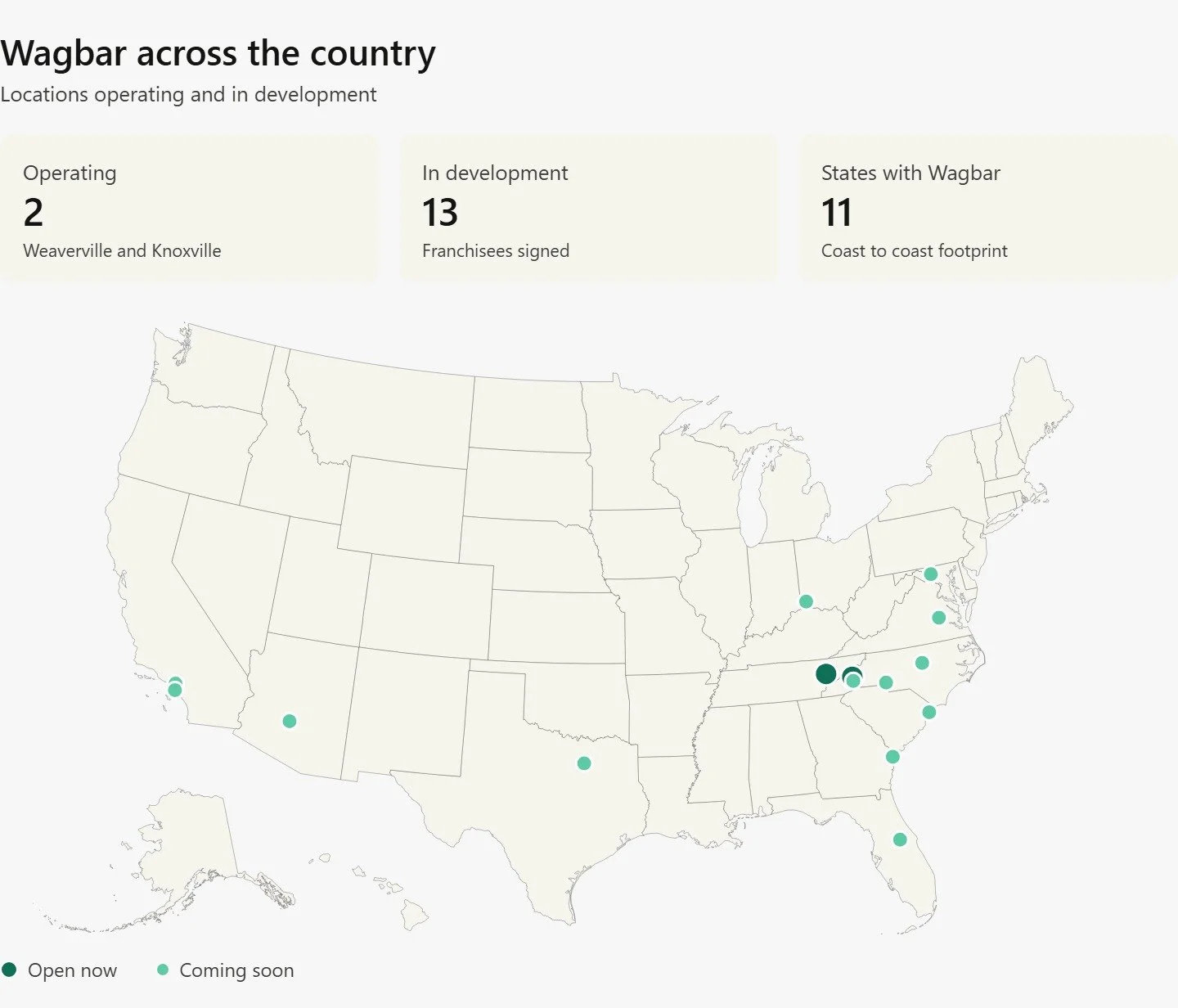
Wagbar's Dallas, TX franchise location is the most relevant reference point for a Houston-area investor. Dallas and Houston share the same state regulatory environment, the same summer heat management challenges, and the same broad cultural orientation toward dogs as central to family and social life.
The Dallas franchise confirms that the Wagbar operational model works in Texas: the container bar build-out performs in the climate, the vaccination check-in and off-leash management protocols translate to Texas customer behavior, and the beverage-plus-membership revenue model generates a viable business in a Southern metro market. For a Houston investor, the Dallas validation removes one of the more significant unknowns in franchise due diligence.
Wagbar's training program, which includes a week-long intensive at headquarters in Asheville, NC, covers dog behavior management, bar operations, staff training, and marketing. The format is designed to give franchisees the operational confidence to open and run the location regardless of prior food and beverage experience. That's important in a market like Houston, where the best-positioned owners are often professionals changing careers rather than industry veterans.
The Wagbar Franchise Investment
The initial franchise fee is $50,000. Total estimated investment ranges from $470,300 to $1,145,900 depending on site selection, local build-out requirements, and market-specific factors. The royalty fee is 6% of adjusted gross sales, with 1% directed to the Wagbar marketing fund. A 50% multi-unit discount on the franchise fee applies for commitments of three or more locations.*
Revenue comes from day passes, memberships, and bar sales. The membership model creates predictable recurring income from a base of regular customers, which is a meaningful advantage in a large metro where building a steady local customer base takes time. The revenue structure for off-leash dog bars covers how these streams work together across the typical membership lifecycle.
This information is provided for general reference only and does not constitute an offer to sell a franchise. Investment figures are estimates. Full details are in the Wagbar Franchise Disclosure Document (FDD). Wagbar Franchising LLC, 7 Kent Place, Asheville, NC 28804.
Frequently Asked Questions
Is Wagbar currently franchising in the Houston, TX market?
Houston is an open territory for Wagbar franchise development. Prospective franchisees can begin the inquiry process at wagbar.com/franchising. Wagbar's team reviews all inquiries and follows up to discuss territory availability, qualification, and next steps.
Which Houston-area submarkets best fit the Wagbar concept?
Wagbar's model performs best in communities with high dog ownership density, strong household incomes, and a recurring social venue culture. In the Houston metro, The Woodlands, Sugar Land and Fort Bend County, and the Katy/Cypress corridor consistently fit those conditions based on income data and community demographics. The site selection process works in partnership with Wagbar's support team.
How does the investment figure break down?
The initial franchise fee is $50,000. Total estimated investment ranges from $470,300 to $1,145,900. Royalties are 6% of adjusted gross sales plus 1% to the Wagbar marketing fund. A 50% multi-unit discount applies for commitments of three or more locations.* Full details are in the FDD.
Not an offer to sell a franchise. Offer made only by FDD.
Is there an existing Wagbar location in Texas?
Yes. The Wagbar Dallas, TX location is an active franchise in the Texas market, providing operational reference for anyone evaluating Houston. The Dallas franchise gives Wagbar direct experience with Texas regulatory requirements, climate management, and the regional customer profile.
What dog entry requirements apply at Wagbar?
All dogs must be current on rabies, Bordetella, and distemper vaccinations, at least six months old, and spayed or neutered. Human guests 18 and older enter free. These requirements are consistent across all Wagbar locations. Full details are at the Wagbar FAQ.
Does Wagbar work in markets with hot summers?
Yes. Wagbar's container bar build-out includes climate management as part of the standard system, and the Dallas, TX franchise has demonstrated the model's viability in a Texas summer climate. Shaded and covered outdoor space, ventilation, and operational scheduling around heat are part of the operational framework that Wagbar's training program addresses.
What makes Houston different from other Texas markets for this franchise?
Scale is the primary differentiator. Houston's 7.9 million metro population supports multiple Wagbar locations without creating geographic overlap, which creates a multi-unit development opportunity that smaller Texas markets don't. The suburban ring also contains high-income communities with household incomes significantly above the city average, providing a different customer profile than the city-wide numbers suggest.
Bottom TLDR: A franchise business for sale in Houston, TX means one metro, multiple viable markets. Fort Bend County carries a median household income of $113,409, Montgomery County $97,266, and the metro overall added 126,720 residents in one year. Wagbar's multi-unit discount rewards investors who build across submarkets. Explore the Houston territory at wagbar.com/franchising.