
Franchise Business for Sale in Dallas-Fort Worth, TX: Franchise Investment in the DFW Metroplex
Top TLDR: A franchise business for sale in Dallas-Fort Worth, TX starts from a strong position: Wagbar already operates in the Dallas market, proving the concept works in North Texas. With the DFW Metroplex holding 8.3 million residents and suburbs like Frisco carrying a $145,444 median household income, the available territory across Fort Worth, Collin County, and the northern suburbs represents one of the largest untapped franchise opportunities in the Wagbar network. Start at wagbar.com/franchising.
The DFW Metroplex is America's fourth-largest metropolitan area, home to 8,344,032 residents as of July 2024, and it grew by nearly 178,000 people in a single year. That makes it the third-fastest growing major metro in the country, behind only New York and Houston, according to U.S. Census Bureau data. It employs 4.1 million people. It is home to more Fortune 500 headquarters than any U.S. metro except New York City.
And Wagbar is already here.
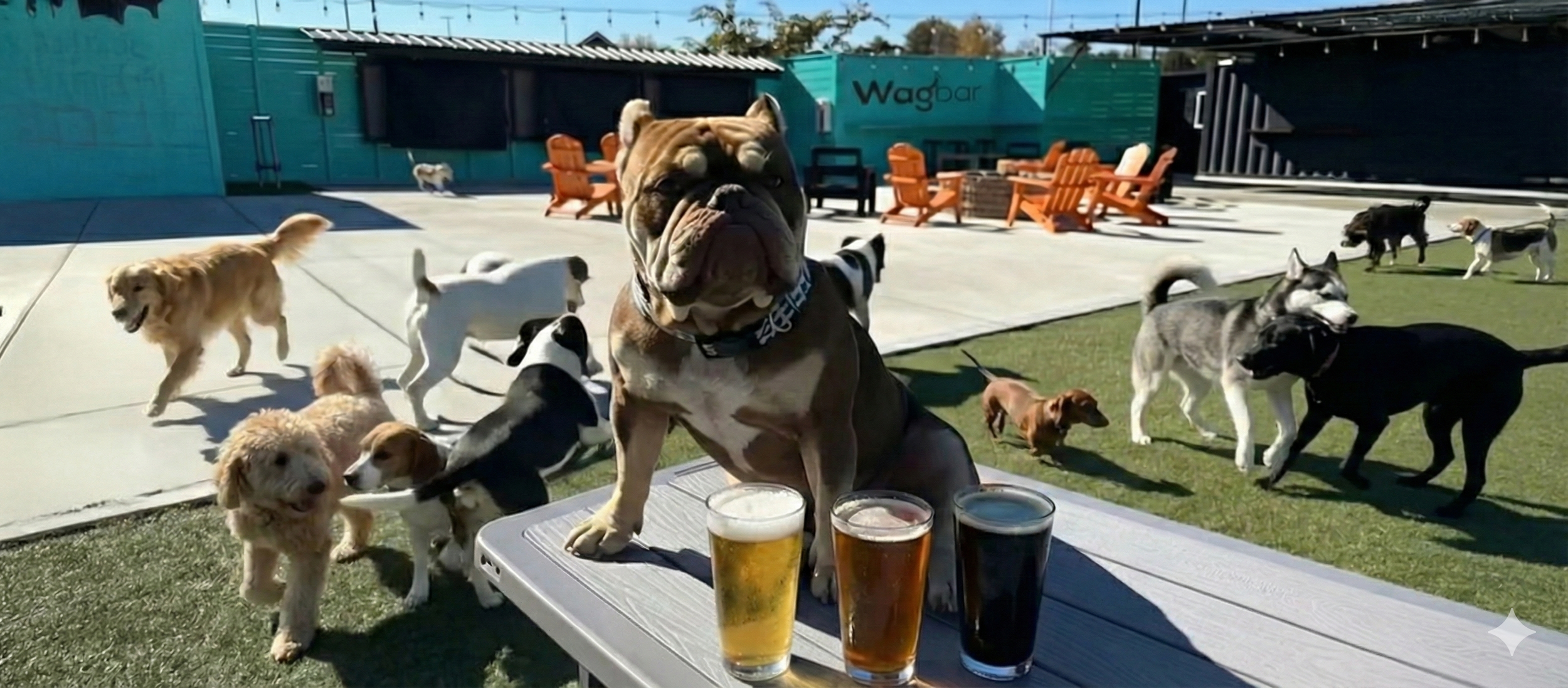
The Dallas franchise location represents more than a foothold in Texas. It's operating proof that the off-leash dog park and bar concept translates to a major Sun Belt metro, that customers in North Texas will pay for memberships and day passes, and that the Wagbar operational model works in the summer heat and the community rhythms of a sprawling Southern city. For anyone evaluating a franchise business for sale in Dallas-Fort Worth, TX, that's a meaningful head start.
What the DFW Metroplex Actually Represents for a Franchise Investor
Scale and variety. The DFW Metroplex is not one city. It's a collection of distinct markets sharing infrastructure: Dallas and its urban neighborhoods, Fort Worth and the Tarrant County communities to the west, and a northern suburban corridor stretching through Plano, Frisco, McKinney, Allen, and Collin County that has become one of the highest-income population belts in the country.

The MSA added 177,922 residents between July 2023 and July 2024, a 2.18% growth rate that outpaced the national average of 0.98%, according to Grokipedia's analysis of Census Bureau data. That growth is concentrated in the northern suburbs. Collin County led the entire Metroplex in total population gains during the 2012-2022 period, adding 323,900 residents, according to the Texas Comptroller's Metroplex regional analysis. Employment across the MSA grew 2.43% year-over-year in 2024, from 4.0 million to 4.1 million workers.
The income distribution within the Metroplex is the factor that matters most for a Wagbar franchise evaluation. Dallas city's median household income sits at $74,323 in 2024 per U.S. Census ACS data. That's a workable baseline. But it's not where the most compelling Wagbar markets sit. Frisco's median household income is $145,444, ranking it among the highest of any major city in the country according to SmartAsset's 2024 report. McKinney's median comes in at $124,177. Plano's middle-class threshold runs as high as $207,832. These are communities where residents have the discretionary income and lifestyle orientation to sustain a membership-based social venue week after week.
The existing Wagbar Dallas, TX location serves that market, but one location in a metro of 8.3 million people is a starting point, not saturation.
The Northern Suburbs: Where Wagbar's Membership Model Has Room to Grow
The northern DFW corridor, anchored by Frisco, Plano, McKinney, and Allen in Collin County, represents the clearest expansion opportunity within the Metroplex for an additional Wagbar franchise. These communities share characteristics that align directly with what makes Wagbar locations succeed.
Frisco was the fastest-growing city in the United States in both 2017 and the 2000-2009 decade, and its growth has continued since. With a population of more than 200,000 and a median household income of $145,444, it hosts major corporate campuses, the Dallas Cowboys' headquarters and practice facilities, and a density of young professional families that consistently demand premium experiential venues. Homes in Frisco typically range from $450,000 to $900,000, with some neighborhoods exceeding $1 million in median value. The community's orientation toward outdoor activity, active families, and dog-friendly parks creates natural demand for a Wagbar concept.
McKinney has developed a reputation as one of the most livable suburbs in the country, combining historic downtown charm with rapid growth in master-planned communities like Trinity Falls and Painted Tree. Its $124,177 median household income, highly rated schools, and community-driven culture mirror the profile of other markets where Wagbar has built strong membership bases. McKinney's downtown area and walkable commercial corridors already support independent food and beverage businesses with loyal local followings.
Plano is one of the largest DFW suburbs and a significant corporate hub, home to major employers in financial services, technology, and healthcare. Its income profile and professional density make it a viable Wagbar market, particularly given the popularity of dog-friendly destinations throughout the city.
Cities like Frisco, Plano, and Flower Mound are specifically noted for their dog-friendly environments, with dog parks, trails, and pet-welcoming restaurants embedded into community life, according to DFW suburb guides. That existing infrastructure signals a customer base that is already active, already dog-oriented, and already looking for social venues that welcome their animals.
The best cities for dog franchise success page covers the demographic markers that consistently predict strong performance for dog-focused concepts. The northern DFW corridor checks those markers consistently across multiple communities.
The Fort Worth Side: An Underserved Market in Its Own Right
The western half of the Metroplex is a different market from Dallas, and often treated as an afterthought in franchise development conversations that focus on the northern suburban growth story. That's an opportunity.
Fort Worth has a distinct identity: western heritage, a growing downtown cultural district, a significant professional population driven by the aerospace, healthcare, and defense industries anchored at Naval Air Station Fort Worth and the corporate campuses along Alliance Corridor and in Westlake. Tarrant County has its own strong suburban communities, including Southlake, Colleyville, and Keller, all of which carry household income profiles and community orientations well-suited to a Wagbar location.
Southlake in particular is frequently cited as one of the wealthiest communities in North Texas, with highly educated residents, a walkable town center, and a family culture that extends to pet ownership. The western suburbs have developed their own dog-friendly bar and restaurant scene alongside a craft beverage culture, but the specific off-leash, membership-based model that Wagbar offers has not yet established a presence on this side of the Metroplex.
For a franchise investor based in Fort Worth or the western suburbs, this represents clean territory in a market that already understands dog-friendly social venues and has the household income to support recurring membership spending.
What the Dallas Location Proves
Every Wagbar franchise investor in the DFW Metroplex benefits from something no other market in the Wagbar network provides to the same degree: a neighboring, active franchise that proves the model works locally.
The Dallas Wagbar location announcement marked Wagbar's second franchise and its first in Texas. The fact that it has reached the operations stage means the container bar build-out works in North Texas, the vaccination check-in and off-leash management protocols function with Texas customers, the membership model has converted to paying members, and the regional regulatory environment is understood by the Wagbar support team.
For a prospective franchisee in Fort Worth, Frisco, or McKinney, that active reference point matters. It means site selection conversations can be informed by the Dallas team's experience, marketing can reference an existing local presence, and the regional brand recognition that comes from an established Wagbar in the same metro carries over into neighboring markets.

The off-leash dog bar model explains what this concept delivers to customers that standard dog-friendly patios and parks don't. In a market like DFW where dog-friendly venues exist but true off-leash, supervised park environments with a full bar are still rare, that distinction is commercially significant.
How the Wagbar Franchise Model Works in DFW
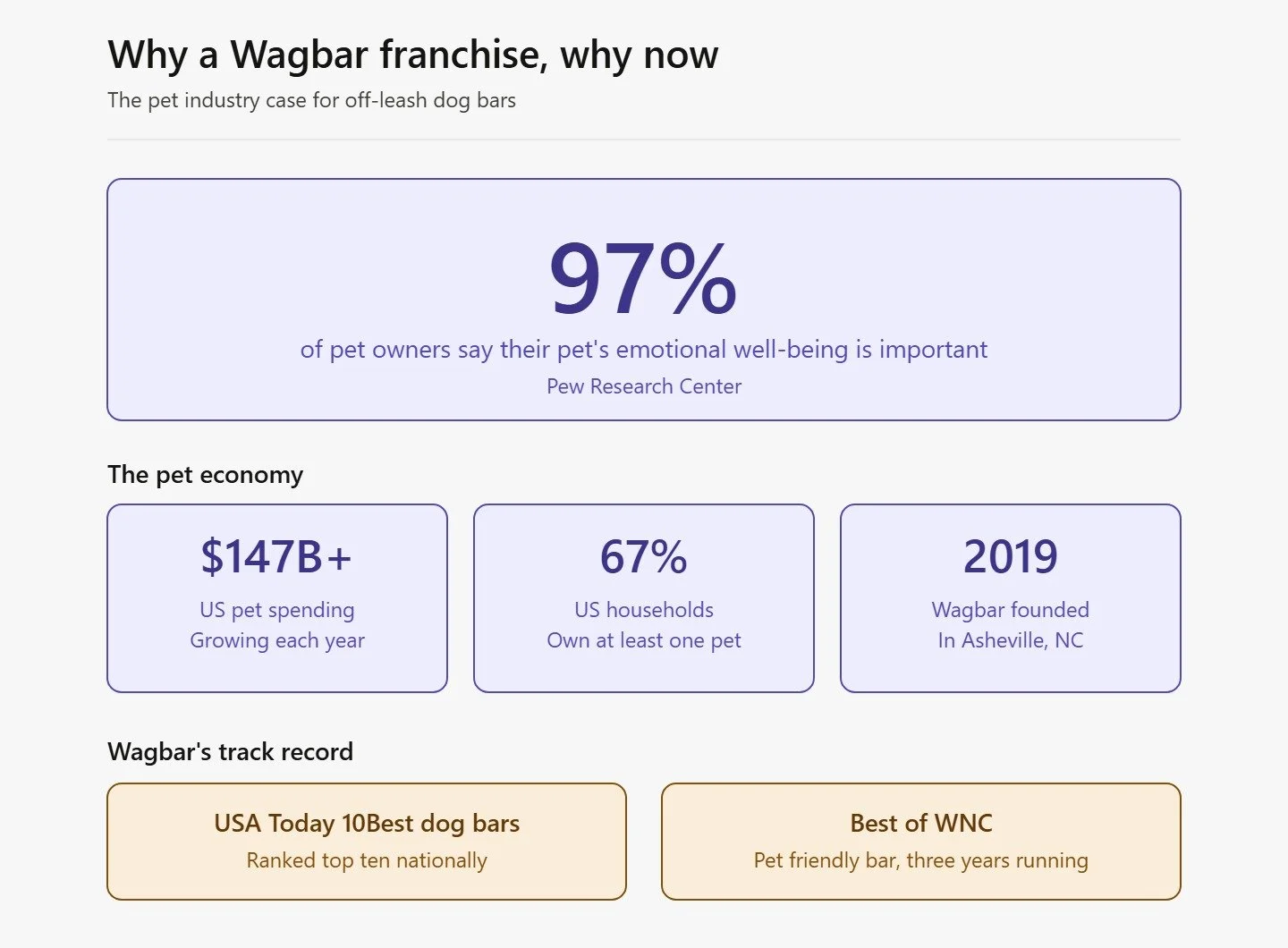
Wagbar is an off-leash dog park and bar franchise founded in Weaverville, North Carolina by Kendal and Kajur Kulp in 2019. The franchise model is built for owner-operators who want to be actively involved in their community, not passive investors collecting royalties from a distance.
Franchisees receive site selection support, a container bar build-out system that simplifies the physical construction process, and a week-long intensive training program at Wagbar headquarters in Asheville, NC. The training program covers dog behavior management, bar operations, staff training, and local marketing, so franchisees are operationally ready before their doors open.
Revenue comes from three streams: day passes, memberships, and bar sales. The membership model creates predictable recurring income. In a market like DFW's northern suburbs, where families establish routines around their communities and their dogs, that recurring dynamic is a real business advantage. The full revenue model for off-leash dog bars covers how these streams work across the customer lifecycle.
The initial franchise fee is $50,000. Total estimated investment ranges from $470,300 to $1,145,900 depending on site selection, local build-out requirements, and market-specific factors. The royalty fee is 6% of adjusted gross sales, with 1% directed to the Wagbar marketing fund. For franchisees committing to three or more locations, a 50% multi-unit fee discount applies. Given the number of distinct, non-overlapping communities across DFW, a multi-unit strategy within the Metroplex is a realistic path for the right investor.*
This information is provided for general reference only and does not constitute an offer to sell a franchise. Investment figures are estimates. Full details are in the Wagbar Franchise Disclosure Document (FDD). Wagbar Franchising LLC, 7 Kent Place, Asheville, NC 28804.
Frequently Asked Questions
Is there already a Wagbar in Dallas-Fort Worth?
Yes. The Wagbar Dallas, TX location is an active franchise in the Metroplex, representing Wagbar's second franchisee and its first Texas market entry. The Dallas franchise serves the Dallas proper and surrounding areas. The broader DFW Metroplex, particularly the northern suburbs and the Fort Worth/Tarrant County side, remains available territory for additional franchise development.
Which DFW Metroplex submarkets are available for Wagbar franchise development?
Wagbar's team works with qualified candidates on territory identification. The northern Collin County corridor (Frisco, McKinney, Plano, Allen) and the Fort Worth/Tarrant County side of the Metroplex represent the areas with the most available room for additional locations. Inquiries can be submitted at wagbar.com/franchising.
What is the investment required?
The initial franchise fee is $50,000. Total estimated investment ranges from $470,300 to $1,145,900 depending on site and build-out. Royalties are 6% of adjusted gross sales plus 1% to the marketing fund. A 50% multi-unit discount applies at three or more locations.* Full details are in the FDD.
Not an offer to sell a franchise. Offer made only by FDD.
Why do Frisco and McKinney's income levels matter for this franchise?
Wagbar generates revenue through memberships, day passes, and bar sales. Membership-based recurring revenue depends on customers who have discretionary income, a social lifestyle, and a pattern of returning to the same venue regularly. Frisco's $145,444 median household income and McKinney's $124,177 median put both communities well above the national average, supporting the spending behavior that membership models depend on.
Do I need prior restaurant or bar experience to open a Wagbar?
No. Wagbar's training program is designed to prepare franchisees to operate the full business regardless of prior food and beverage experience. The week-long intensive in Asheville covers all operational areas. Most Wagbar franchisees come from professional backgrounds rather than the hospitality industry.
What dog entry requirements apply at Wagbar locations?
All dogs must be current on rabies, Bordetella, and distemper vaccinations, at least six months old, and spayed or neutered. Human guests 18 and older enter free. These requirements are consistent across all locations and are documented at the Wagbar FAQ.
How does the multi-unit opportunity work in a market like DFW?
Because DFW communities are geographically distinct, self-contained neighborhoods separated by significant distances, multiple Wagbar locations across the Metroplex can operate without meaningful geographic overlap. Frisco, McKinney, and a Fort Worth-side location, for example, serve completely different customer populations. Wagbar's 50% multi-unit fee discount at three or more units creates a real financial incentive for investors who want to build a regional presence across the Metroplex rather than a single neighborhood business.
Bottom TLDR: A franchise business for sale in Dallas-Fort Worth, TX benefits from an existing Wagbar in Dallas that proves the concept works in North Texas. The DFW Metroplex at 8.3 million residents and Frisco's $145,444 median household income make the northern suburbs and Fort Worth side compelling expansion opportunities. Wagbar's multi-unit discount rewards investors building across multiple communities. Explore territory availability at wagbar.com/franchising.