

First Visit to an Off-Leash Dog Bar: Complete Preparation Guide

Top TLDR: A first visit to an off-leash dog bar goes smoothly when you handle three things in advance: current Rabies, Bordetella, and Distemper records, an honest read on whether your dog is ready for off-leash group play, and a calm arrival on a slower weekday hour. Bring vaccination paperwork, a flat collar with ID, and a leash for the entry zone. Skip toys and treats inside the play area.
Why the First Visit Sets the Tone for Every Visit After
A first visit to an off-leash dog bar is part vaccination prep, part behavior check, and part reading the room once you walk in. Most dogs do well when their owner shows up calm, the dog is socially ready, and the timing matches what the dog can handle. The other half is knowing what's normal during those first ten minutes inside the gate, so you don't panic over behavior that's just your dog working out the new environment.
This article walks through every step. Vaccination prep, readiness checks, what to pack, what the check-in actually looks like at a Wagbar location, what your dog will likely feel during those first minutes, behaviors you'll see and how to read them, and how to take care of your dog after you head home.
Dogs remember experiences. A good first visit becomes a positive association your dog draws on for years, the same way a stressful first visit becomes something your dog flinches at later. That's why preparation matters more than people realize. The goal isn't just to get through the door, it's to give your dog a calm, manageable introduction to a new environment full of sounds, smells, and other dogs.

Wagbar parks were designed by a founder who'd had a bad dog park experience and wanted something different. Kendal Kulp opened the first Wagbar in Weaverville, North Carolina in 2019 with that exact intention: a fully fenced off-leash space with trained staff who watch dog behavior in real time, screen vaccinations at entry, and step in when something needs to be redirected. That structure exists so first-time visitors and their dogs don't have to figure everything out alone.
A successful first visit usually leads to a second, then a third. By the fourth or fifth visit, most dogs have stopped reading the place as new and started reading it as theirs.
Pre-Visit Vaccination Prep: The Non-Negotiable Step
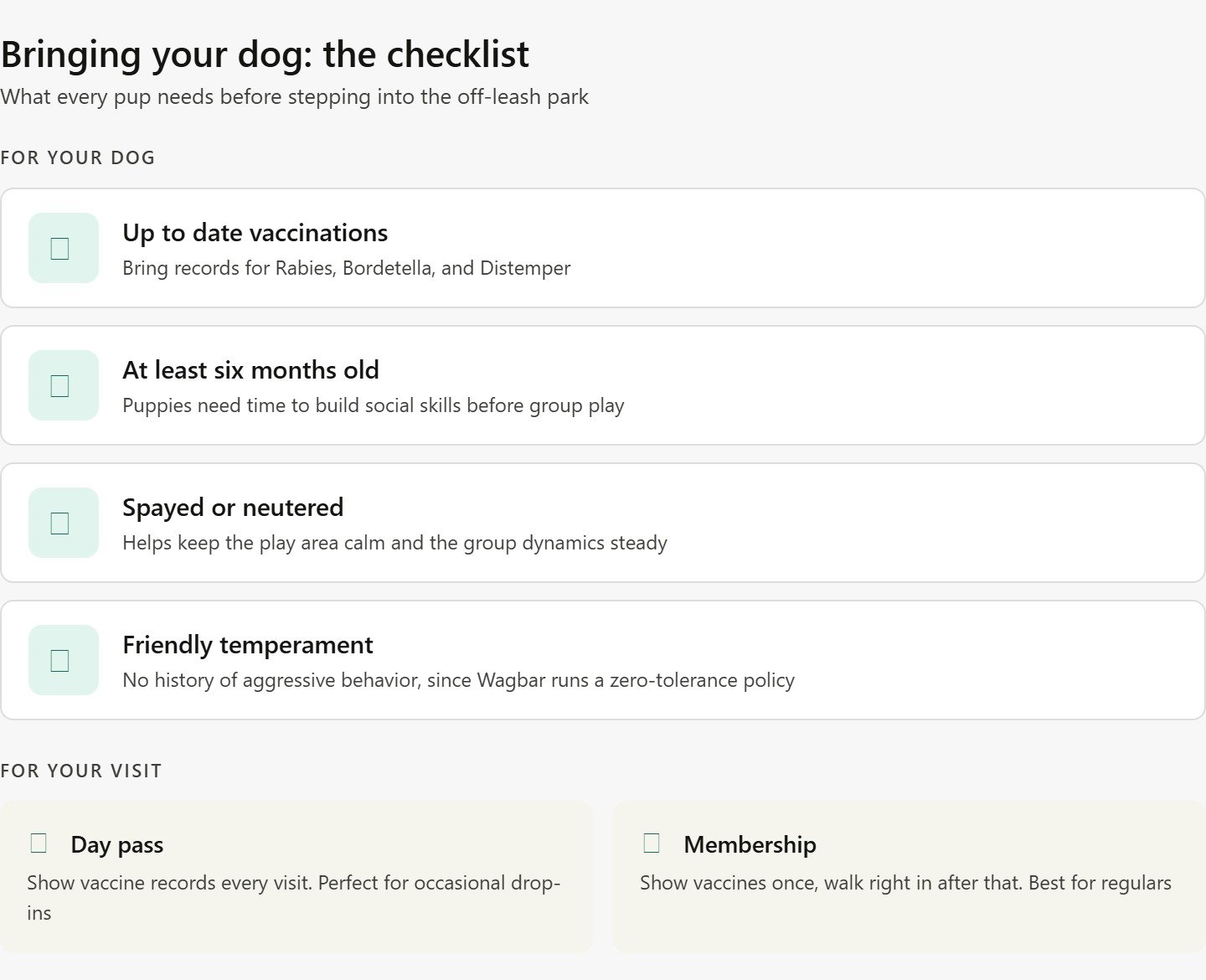
Before anything else, get your dog's vaccinations sorted and the paperwork accessible. This is the one piece you can't skip and can't fake your way through. Wagbar requires proof of three specific vaccinations for every dog entering the off-leash area: Rabies, Bordetella, and Distemper.
Rabies is the legal baseline almost everywhere in the country. Most states require it for any dog over four months old, and it's the first thing any park, boarding facility, or groomer will ask to see. Your vet provides a certificate at vaccination, and most clinics will email or text a copy on request.
Bordetella protects against the bacterial respiratory infection commonly called kennel cough. It's especially important in any setting where dogs share air and surfaces. The vaccine is given either as an injection, a nasal spray, or an oral dose, and immunity builds within a week or two of administration.
Distemper is a serious viral disease that affects respiratory, gastrointestinal, and nervous systems. It's almost always given as part of the standard puppy vaccination series, with adult boosters every one to three years depending on the protocol your vet uses.
Beyond those three, your dog needs to be at least six months old and spayed or neutered. The age requirement gives the dog's immune system and behavioral development a chance to mature. The spay/neuter requirement reduces hormone-driven conflict between unfamiliar dogs.
Get the paperwork before you leave the house. Either print copies, save photos of the vaccination certificates on your phone, or have your vet's office email them in advance. Wagbar's health and safety standards are checked at every first visit, and they don't make exceptions. If you arrive without proof, you'll have to reschedule, which is a frustrating way to start.
If your dog is due for a booster within the next month, it's worth getting it done before you visit rather than after. Vaccinations need a few days to a couple of weeks to provide full protection depending on the type, and you want that protection in place when your dog enters a shared space for the first time.
Evaluating Whether Your Dog Is Ready for Off-Leash Group Play
Vaccination handles the medical side. Readiness handles the behavioral side, and it's the part owners most often get wrong because it's easier to assume your dog is ready than to honestly check.
A dog ready for an off-leash bar setting usually shows several specific behaviors. They have reliable recall in low-distraction settings. They've had positive interactions with other dogs outside the home, whether at a friend's house, on group walks, or at puppy classes. They can be near other dogs without lunging, freezing, or excessive barking. They recover from minor startles within a minute or two rather than spiraling.
A dog that isn't quite ready also shows specific signs. Heavy resource guarding around food, toys, or people. A history of fights or repeated tense encounters. Strong fear responses to strangers or new environments. A pattern of getting stuck in arousal states they can't come down from. None of these mean your dog can never visit, but they mean the off-leash bar setting may not be the right next step yet.
If you're not sure where your dog falls, run through an off-leash readiness checklist honestly. Recall in a quiet space, behavior on neutral walks, response to other dogs across a street or parking lot. The dog who can handle those situations calmly is usually the dog who handles a first visit well.
A few additional things worth weighing. Puppies who just hit six months old are often physically eligible but emotionally still working through socialization, and a high-stimulation environment can backfire. Older dogs who've been mostly solo for years sometimes do better in low-traffic hours rather than busy weekend afternoons. Dogs recovering from injury or illness should wait until they're at full strength before adding a new physical demand.
What to Bring on Your First Visit
Pack light, but pack the right things. The list is shorter than people expect.
Vaccination records. Either physical printouts or photos on your phone, both work. Wagbar checks these at the first visit, and once you sign up for a Wagbar membership you won't need to show them at every subsequent visit, just keep them updated.
A flat collar with current ID tags. Even though play is off-leash inside the park, your dog should have visible ID. Tags should include a phone number that gets answered.
A standard leash. You'll need one to walk through the entry zone and back to your car. Skip the retractable leash, since it's harder to control in a tight space with multiple dogs around.
Poop bags. Most parks supply them, but bring a few of your own anyway. Picking up after your dog is a hard rule, not a suggestion.
Water and a collapsible bowl, optional. Wagbar locations have water stations throughout the park, but some owners prefer their own. Useful in summer.
Cash or a card for drinks. The bar accepts standard payment. Your dog drinks free from the water stations, you'll be paying for yours.
A change of clothes in the car, optional. First visits sometimes involve muddy paws, jumping greetings from friendly strangers' dogs, and the occasional drink spill. Having backup clothes in the trunk is a small thing that pays off.
That's the whole list. Resist the urge to bring a backpack full of supplies. The goal is a manageable, calm arrival, not gear management at the gate.
What to Leave at Home
The list of what not to bring is just as important.
Toys. Wagbar's policy is no toys inside the off-leash area, and the reason is simple: a toy your dog loves becomes a resource other dogs may want, and resource guarding is one of the most common triggers for first-visit conflict. Leave the favorite ball, the rope tug, and the squeaky duck in the car or at home.
Treats and food. Same logic. Treats in your pocket become a focal point for every dog within nose-range, which puts your dog in the awkward position of being mobbed. The rule against feeding dogs in the park applies to other people's dogs and your own. If you want to reward calm behavior, do it in the parking lot before you go in or after you leave.
Children under 18. Wagbar is an 18+ venue. The bar service plus the off-leash environment makes it a venue for adults. Plan childcare in advance.
Other family pets. Stick to one dog for the first visit, even if you have two or three at home. Multiple unfamiliar dogs introduced at once turns into more variables than you can read at the same time.
Stress. This one's harder, but real. Dogs read your tension through the leash and your body language. If you walk in tight and worried, your dog walks in tight and worried. The Wagbar FAQ page covers most of the entry questions people stress about, so reading it ahead of time is worth fifteen minutes if it cuts the day-of anxiety in half.
Walking Through the Check-In Process at Wagbar
The check-in process at Wagbar is straightforward, but knowing what to expect makes it feel less like a test and more like a routine.
Step one: arrive at the entrance. You'll walk in with your dog on a leash. Most Wagbar locations have a clear entry pathway leading to a check-in area where staff greet you.
Step two: present your vaccination records. A staff member will check your dog's Rabies, Bordetella, and Distemper records against the date and your dog's name. They're verifying the dog at the gate matches the records you brought, which is a routine but real check.
Step three: choose your pass. You can buy a quick day pass for one visit, or sign up for a membership at that location for ongoing access. Memberships come in daily, monthly, annual, and 10-visit punch pass formats, with the upside that members don't have to show vaccination records on every visit, just keep them current. If your local Wagbar isn't yet open, the locations page lists what's active and what's in development.
Step four: enter through the double-gate system. Wagbar parks use a two-gate entry, which means one gate closes behind you before the next one opens. This is a small detail but a big safety feature, since it prevents dogs from slipping past the entrance and prevents new arrivals from getting rushed by the existing pack at the gate.
Step five: unclip the leash inside the park, not in the entry zone. Once you're fully inside the off-leash area, you can drop the leash. Don't unclip in the entry zone or before the inner gate closes. Staff will usually direct you if you're new.
Step six: settle in and order at the bar when ready. The bar is integrated into the park space. Once your dog is engaged and you've watched the first few interactions, you can order a drink and grab seating. Some locations have covered patios, some have container bar setups with bathrooms, and most rotate food trucks on a published schedule.
The whole process from arrival to first drink usually takes ten to fifteen minutes for a first visit, less once you're a member.
What a First Visit Typically Feels Like for Your Dog
Once your dog is off-leash inside the park, the first ten minutes will look like one of three patterns.
The bouncer. Some dogs explode into play within seconds. They sprint, sniff, target the nearest playmate, and start a chase. This is great if their play style matches the other dog's, less great if they overwhelm a quieter dog. Watch the other dog's body language as much as your own. If your dog is the bouncer, your job in the first few minutes is to keep an eye on intensity and step in before play crosses into rude.
The scanner. Some dogs walk the perimeter slowly, sniffing everything, taking in the smell of every dog who's been there in the last week. This is normal and healthy. They're building a mental map. Don't rush them. Scanners often play later, after they've satisfied themselves about the layout. A solid grasp of canine socialization patterns helps you read what your dog is actually telling you in those first few minutes.
The shadower. Some dogs stick to your leg, watch the other dogs from a distance, and aren't sure what to make of any of it. This is also normal, especially for dogs who haven't been in group settings recently. Don't force interaction. Pick a bench, sit calmly, let them watch. Many shadowers will start engaging within thirty minutes once they've decided the place is safe.
There's no right pattern. There's only what your specific dog does, and what that tells you about how to support them. Most dogs settle in within fifteen to thirty minutes. Some take longer. A small number need to leave and come back another day, and that's also fine.
Inside the park, expect movement everywhere. Dogs running, drinking from water stations, lying in shaded spots, getting attention from owners at picnic tables. A typical Wagbar afternoon has eight to twenty dogs in play at any given moment, with people scattered around the bar and seating areas. The ambient sound is dogs barking now and then, music from the bar, conversation, occasionally a food truck running its generator.
It's busier than a regular dog park because of the bar layer, but also better-supervised because staff are present rather than just signage on a fence.
Common First-Visit Behaviors and What They Actually Mean
Reading dog behavior is what separates a calm first visit from a chaotic one. Here's what you'll likely see and what it usually means.
Heavy panting. Often it's just heat or exercise. Sometimes it's stress. Look at the rest of the body. A panting dog with a relaxed face, soft eyes, and easy posture is hot. A panting dog with a tight mouth, hard stare, or stiff body is stressed.
Tail wagging. Wagging doesn't always mean happy. A high, fast, stiff wag is often arousal or warning, not friendliness. A loose, mid-height, sweeping wag with a wiggly body is a dog who's actually relaxed and inviting interaction. Learning to read tails accurately is one of the most useful skills a dog owner picks up. The body language decoder breaks down these signals at a level that genuinely helps in real time.
Play bows. Front legs down, butt up, tail wagging. This is one of the clearest invitations to play, and it's a great sign. Dogs use play bows to reset interactions during intense chases too. If your dog is play-bowing, they're communicating they're having fun and want it to keep going.
Air sniffing and ground sniffing. Sniffing is information gathering, and it's calming. A dog who pauses to sniff is regulating themselves. Don't pull them away mid-sniff just to get them to engage with another dog.
Lip licking and yawning at odd moments. A dog who licks their lips when there's no food around or yawns when they're not tired is showing low-level stress. It's a calming signal. They're trying to defuse a situation. If you see this repeatedly, give your dog a break, walk them to a quieter area, sit with them.
Mounting. Common in new environments and not always sexual. Often it's overstimulation or a clumsy attempt to interact. Interrupt it calmly. Most dogs don't appreciate being mounted, and your dog picking up that mounting gets interrupted every time is part of how they figure out appropriate play.
Hard staring. A dog locked onto another dog with stiff body and unblinking eyes is not relaxed. This is one of the clearer warning signs. Step in, redirect your dog, walk them away.
Hiding behind you. A nervous dog seeking your protection is communicating clearly. Don't push them out. Sit with them, let them watch from your space, give them time. Some dogs need three or four visits before they really engage.
Reading the Difference Between Healthy Play and Trouble
Healthy dog play looks like reciprocal chasing where dogs swap roles, loose body posture, frequent pauses, play bows, and bodies that bounce rather than slam. Both dogs come back for more after a break.
Trouble looks different. One dog pinning another and not letting up. Stiff bodies that don't loosen. Hackles up that stay up. Vocalizations that are guttural rather than happy. One dog visibly trying to escape and the other not reading the signal. A pause that lasts more than a few seconds with stiff staring.

Wagbar staff are trained to spot these patterns and intervene, but you should be too. You know your dog better than anyone. Trust your gut. If something looks off to you, call your dog out and take a thirty-second break. Most "almost a fight" situations defuse with a brief separation. Resources like the park fight prevention article walk through the early warning signs in detail, and reading them once before your first visit makes you a better observer in real time.
The good news is that most off-leash bar visits go well. Dogs play, dogs rest, dogs play again, owners chat, drinks get refilled. Conflict is the exception, not the rule, and the structure of a screened, supervised, fully fenced environment cuts the conflict rate way down compared to an unsupervised dog park.
Follow-Up Care After Your Dog's First Visit
The visit doesn't end when you walk to your car. The first hour and the first day after a first visit matter.
Check your dog physically before leaving the parking lot. Quick once-over. Any limping, any cuts on paws, any small bites you didn't notice during play. Most first visits produce nothing, but a quick check is worth the thirty seconds.
Hydrate. Dogs who've been running for an hour are often more dehydrated than they show. Offer water in the car or at home before settling in.
Expect a long nap. Mental and physical exhaustion from a new environment hits hard. Many dogs sleep for three to six hours after their first visit. This is normal and good.
Watch for signs of soreness the next morning. Dogs who haven't run hard in a while may be stiff the day after a heavy play session. Light walking is fine. Skip another high-intensity outing for a day or two.
Watch for stress signs over the next 24 to 48 hours. Some dogs process new experiences with a delay. Decreased appetite, restlessness, clinginess, or unusual nighttime waking can all show up. Most resolve on their own within a day or two. Persistent changes are worth a vet visit, and the broader dog health and wellness fundamentals cover what to monitor and when.
Watch for kennel cough symptoms over the next week. Even with Bordetella, no vaccine is 100% effective. Dry hacking cough, especially after exercise, is the most common sign. Mention it to your vet if it appears.
Note what worked and what didn't. Did your dog do better in the first half hour or after they'd settled? Did they get along with certain dog types and not others? Was the time of day right? These notes shape your next visit.
Setting Up the Second Visit for Even Better Results
The second visit is usually easier than the first. Your dog has a memory of the place, knows the layout, and starts at a calmer baseline.
A few things help.
Go at a similar time to the first visit. Familiarity layers on familiarity. If your first visit was a Tuesday afternoon at three, a Tuesday afternoon at three for visit two reuses the same routine.
Stay roughly the same length. A dog who handled forty-five minutes well will probably handle forty-five again. Don't push to two hours just because they did fine the first time.
Try to engage with a few of the same dogs if you see them. Dogs build pack memory, and a familiar playmate from visit one becomes an instant friend on visit two.
Consider switching to a membership if you plan to come back regularly. Skipping the vaccination check at every visit speeds up arrival, and the cost-per-visit drops fast if you use a 10-visit punch pass or monthly option.
For dogs who needed extra time on the first visit, a second visit during a quieter slow hour often unlocks the play they didn't show before. Mid-mornings on weekdays tend to be the calmest. Looking through a beginner's primer on dog play at Wagbar gives you specific things to try when your dog is ready to engage more actively.
By the third or fourth visit, most dogs have fully settled into the routine. They walk through the entry gate without hesitation, they greet a few familiar dogs, they pick a play partner or two, they take breaks at your feet, and they leave tired and content. That's the rhythm Wagbar was built around.
Frequently Asked Questions
How long should my dog's first visit to an off-leash dog bar last?
Most first visits should run thirty to sixty minutes. That's enough time for your dog to take in the environment, engage in some play or observation, and leave on a positive note before they get overstimulated or exhausted. You can extend on later visits once you know how your dog handles the energy load.
What if my dog has never been around other dogs before?
A first off-leash bar visit isn't ideal as a true first introduction to other dogs. Try a few smaller, controlled meetups first, like a friend's calm dog or a structured group walk. Once your dog can handle one or two unfamiliar dogs without spiraling, the off-leash bar becomes a reasonable next step. Reading reactive dog training fundamentals is also useful if your dog tends to overreact in new situations.
Is the first visit free at Wagbar?
Human entry is free for guests 18 and over, regardless of whether you bring a dog. Dog entry has a small fee, either a quick day pass or any of the membership options. The fee covers staff supervision, park upkeep, and the vaccination screening process at entry.
Can I bring my puppy under six months old?
No. Wagbar requires dogs to be at least six months old, spayed or neutered, and up to date on Rabies, Bordetella, and Distemper. The age requirement gives puppies time to mature physically and behaviorally before entering a busy off-leash space. You can still visit Wagbar yourself without your puppy if you want to scope it out first.
What happens if my dog gets into a scuffle on the first visit?
Wagbar staff are trained to step in. Most scuffles defuse within seconds and don't lead to lasting issues. After any incident, staff will check both dogs and check in with the owners. If your dog repeatedly shows aggression, they may be asked to leave, but a single rough interaction usually isn't a problem. The complete dog park etiquette and safety reference covers how staff and owners typically handle these moments.
Do I have to drink alcohol while I'm there?
No. Wagbar serves craft and domestic beer, wine, cider, hard seltzer, plus non-alcoholic beverages and hot drinks. Plenty of visitors come for coffee, soda, or water. The bar is part of the experience, not a requirement.
Can I bring outside food?
Yes. Wagbar allows outside food, and most locations also rotate food trucks on a published schedule. You can grab something from a truck, bring your own, or pick up snacks at the bar.
What if my dog needs to leave early?
That's fine and often the right call. If your dog is overwhelmed, exhausted, or just done, head out. There's no rule that says you have to stay a certain length. Leaving on a calm note is better than pushing through to the point of stress. You can always come back another day.
Bottom TLDR
A first visit to an off-leash dog bar works best when you've handled vaccination records ahead of time, checked your dog's readiness, packed light, and arrived during a slower hour. Watch your dog's body language for the first ten minutes, give them time to settle, and keep the visit short. Plan the second visit at a similar time once you know what your dog needs.