

Failure Rates: Independent Dog Businesses vs. Franchise Dog Businesses in the First Five Years

Top TLDR: Failure rates for independent dog businesses vs. franchise dog businesses are frequently cited but rarely explained accurately. SBA data shows roughly 50% of small businesses survive five years — an average that doesn't predict any specific outcome. Franchise systems reduce specific risk factors through structure and training, but capitalization, market selection, and execution matter more. Evaluate both models on their specific terms, not aggregate statistics.
The question of whether franchise dog businesses fail less often than independent dog businesses sounds straightforward. The honest answer is more complicated than the numbers most people cite.
The commonly repeated claim — that franchise businesses succeed at dramatically higher rates than independents — is real, but the data behind it is often oversimplified. And the commonly repeated claim that most small businesses fail within five years is also overstated. Understanding what the research actually shows, what drives failure in each model, and what it means for someone evaluating a dog business investment requires stepping past the headline numbers.
This page covers the real data on business survival rates, what specifically makes dog-sector businesses more or less durable, and what the structural differences between franchise and independent models mean for risk in practice.

What the Survival Rate Data Actually Shows
The U.S. Small Business Administration tracks business survival rates across industries. According to SBA data, approximately 50% of small businesses survive past five years and approximately one-third survive ten years. These numbers are often misquoted — the frequently cited claim that 90% of businesses fail in the first year has no basis in SBA data or any other major research body.
The five-year survival rate of roughly 50% is an average across all industries, all sizes, and all levels of capitalization and preparation. It includes businesses that were undercapitalized from day one, businesses in structurally declining industries, and businesses run by owners with no prior relevant experience. It is not a prediction for any specific business.
For franchise businesses, the Federal Trade Commission and the International Franchise Association (IFA) have both noted that franchisee survival rates tend to be higher than comparable independent business survival rates, though the gap varies significantly by industry and franchise system quality. A 2006 study by researchers Timothy Bates and Alicia Robb found that franchise units fail at rates comparable to independent businesses when controlling for initial investment and industry — suggesting that the franchise premium is partly an artifact of higher capitalization, not the franchise system itself. Other research, including work by Franchise Business Review and the IFA, suggests franchisee satisfaction and business continuation rates are meaningfully higher across well-run systems.
The honest conclusion: franchise systems from established brands with strong support infrastructure and financial disclosure requirements produce better-documented outcomes than independent startups. But the franchise badge alone doesn't guarantee survival — the quality of the system, the franchisee's execution, and the capitalization level all matter significantly.
Why Pet Industry Dog Businesses Are Structurally Different
One of the most relevant factors for evaluating failure rates is industry selection, and the pet sector has genuine durability advantages over many categories.
According to the American Pet Products Association, U.S. pet industry spending has grown every year for more than three decades, including through recessions. Pet spending held up during the 2008 financial crisis and accelerated after the pandemic-driven increase in dog ownership that began in 2020. The sector's consistent growth is driven by a cultural shift toward treating pets as family members — a pattern that has proven more durable than discretionary spending in categories like restaurants or retail.
An off-leash dog bar sits at the intersection of pet services and experiential hospitality — two categories that have both shown structural growth. The membership model compounds this advantage. A business with 200 active monthly members has recurring revenue that doesn't disappear if the owner takes a week off or if one slow weekend happens in January. That predictability reduces the cash flow volatility that kills many independent small businesses in their early years.
The pet industry market dynamics that support this type of business are real — but they don't protect a specific location from the local-level execution failures that account for most closures.
The Real Reasons Dog Businesses Fail in Year One Through Five
Looking at why businesses in the pet service category fail is more useful than looking at aggregate survival statistics, because the causes are often identifiable and addressable before they become fatal.
Undercapitalization
The single most common cause of small business failure across all categories is running out of money before reaching sustainable revenue. This is particularly acute for businesses with significant startup costs — like dog park bars — because the gap between opening day and stable membership revenue can be six to twelve months, and every month of that gap requires working capital.
Undercapitalized businesses compromise: they hire less experienced staff to save money, defer maintenance that eventually becomes a larger cost, and can't invest in marketing when the membership ramp stalls. The businesses that survive the first two years are almost always adequately capitalized — either because the owner raised enough upfront or because they had realistic working capital estimates that reflected the actual ramp.
Franchise systems address this directly by disclosing the working capital range in the FDD, requiring franchisees to demonstrate financial qualifications before approval, and providing experienced-based guidance on realistic ramp timelines. Independent operators have to estimate this on their own, often without the benefit of comparable examples.
Operational Inexperience in Key Areas
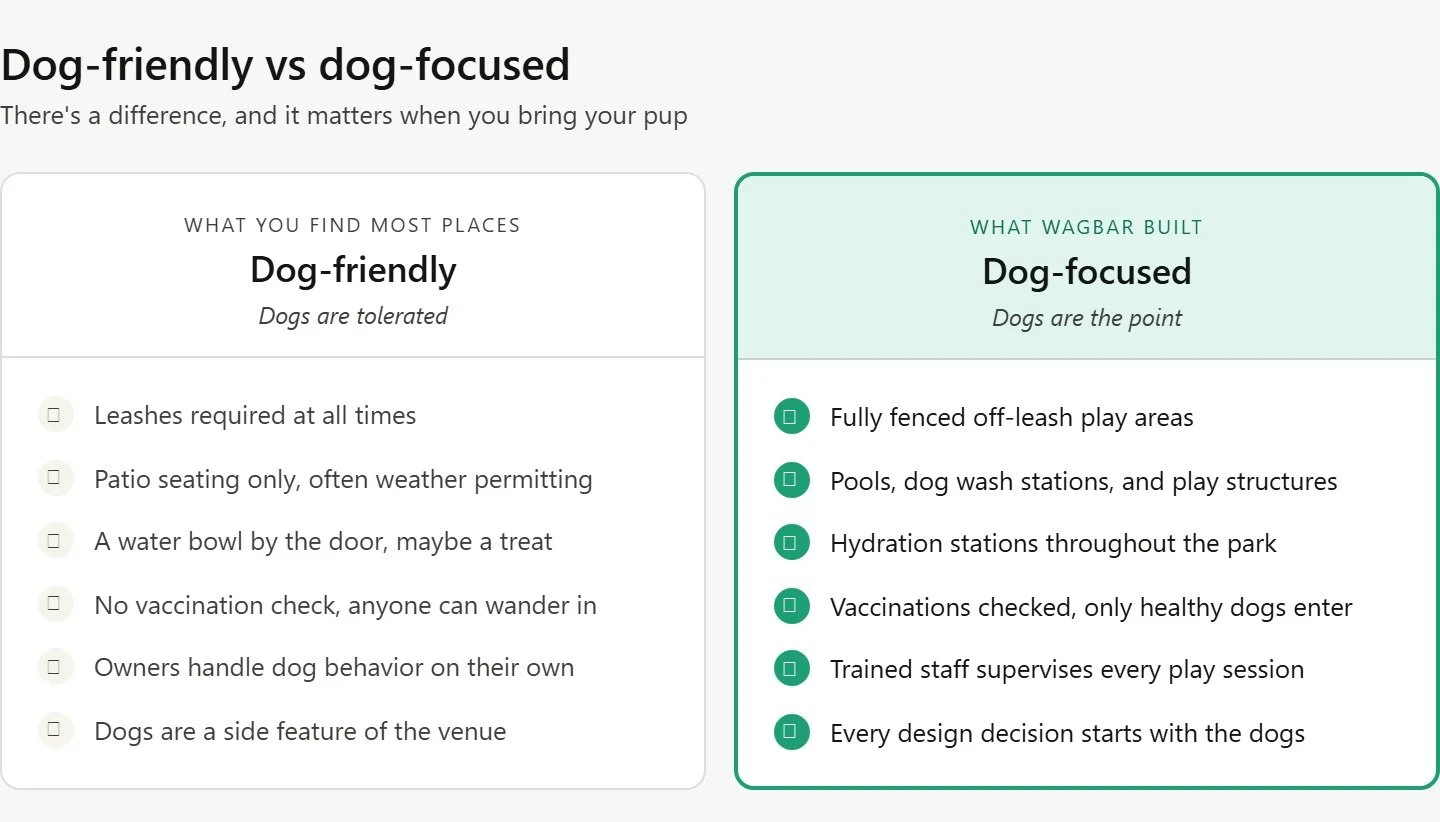
An off-leash dog park bar requires competence in two domains simultaneously: pet management and hospitality. Running a safe, well-supervised off-leash environment requires staff training in dog behavior, entry screening, incident management, and the judgment to intervene before a situation escalates. Running a bar operation requires licensing compliance, inventory management, staffing for fluctuating demand, and adherence to liquor regulations.
Most entrepreneurs entering this category have experience in one of these domains, not both. The ones who have neither are in the highest-risk category. The ones who have one are typically surprised by the demands of the other.
Franchise systems train franchisees in both — the Wagbar training program specifically covers dog behavior management alongside bar operations. Independent operators hire the expertise they lack, which works when they make good hires and fails when they don't.
Market Misjudgment
A dog bar concept that works in one market doesn't automatically work in another. The demographic profile matters: household income, pet ownership rates, the culture around social spending, and the density of potential members within a reasonable drive radius all affect whether a location can build a sustainable membership base.
Independent operators who select sites based on gut feel rather than demographic analysis often find that a market they believed would support the concept simply doesn't have the customer density or spending behavior to get to profitability. Franchise systems support market selection with structured criteria and sometimes demographic tools — not because the franchisor knows better than the local owner, but because the system has tested what market characteristics correlate with location success. The demographic criteria behind successful dog franchise market selection reflect real patterns from operating experience.
Owner Burnout and Team Instability
A significant number of small business closures in years two through five are not financial failures — they're owner decisions. The owner simply decides the business is not worth the effort relative to what it's producing. This happens when the business is marginally profitable but the owner is working 70-hour weeks and has no relief.
Building a team that can operate the location without the owner present is what makes a business sustainable rather than just a job the owner has created for themselves. Both franchise and independent operators face this challenge. The franchise system provides some structural help — the Opener app, training, operational support — but it doesn't create a team for you.
Independent operators who didn't budget for management overhead often find themselves at a decision point in year two: keep grinding or close. Ones who built systems and teams from the beginning have options.
The Franchise-Specific Risk Factors
It's worth being clear that franchises introduce specific risk factors that independent businesses don't carry.
Royalty obligations during slow periods. A franchisee paying 6% of adjusted gross sales during a slow first year or a challenging season has a fixed cost that an independent doesn't have. The royalty is valuable when the system is providing support worth more than its cost and when revenue is healthy. It's a burden when revenue is low and the owner is already stretched.
Franchisor business health. A franchisee's business is affected by the health of the franchisor itself. Franchisors who exit the market, sell the brand, or face financial difficulties create disruption for franchisees that independent operators don't face. Evaluating the financial health and stability of the franchisor is a required part of FDD due diligence.
System changes and compliance demands. Franchisors update their systems, change requirements, and require compliance with new standards. These changes can be genuinely valuable or they can add cost and operational burden. Franchisees who didn't read the agreement carefully before signing sometimes find that they have less flexibility than they expected when changes occur.
Territory and competition from the network. A franchisee in a growing system may eventually face a new Wagbar location closer to their existing territory than they expected. Franchise agreements define territory protections, but those protections have limits. Understanding exactly what territory protection exists — and what doesn't — before signing is critical.
The FDD review process addresses most of these risks by disclosing them. Franchisees who do thorough due diligence going in are rarely surprised by these factors. Those who don't are.
What the Comparison Actually Tells a Prospective Owner
Both independent dog businesses and franchise dog businesses fail for similar underlying reasons: undercapitalization, operational inexperience, market misjudgment, and owner burnout. The franchise system addresses several of these risk factors through structure, disclosure, and support. It introduces a few of its own through royalties, franchisor dependency, and compliance obligations.
The choice between them is not primarily a bet on which model has a better survival rate in aggregate. It's a question of which model fits the specific owner's experience, capital, risk tolerance, and goals.
An independent dog business with an experienced operator, adequate capitalization, a well-selected market, and a realistic operational plan has a reasonable chance of reaching year five. A franchise location with an undercapitalized franchisee who didn't read the FDD and expected the brand to do most of the work does not.
Understanding the specific factors that drive performance for dog franchise owners — not the aggregate statistics — is what actually prepares someone to make a well-informed investment decision.
Frequently Asked Questions
Do franchise businesses really fail less often than independent businesses?
The research is mixed and context-dependent. Studies controlling for initial investment and industry find smaller differences than the headline franchise marketing statistics suggest. In well-run franchise systems with adequate capitalization requirements and strong support infrastructure, franchisees tend to have better outcomes than comparable undercapitalized independents. The franchise system itself is not the primary driver — capitalization, experience, and execution are.
What is the actual five-year survival rate for small businesses?
According to SBA data, approximately 50% of small businesses survive five years. This is a wide average that includes businesses in all industries and at all capital levels. It does not mean any specific business has a 50/50 chance of failing — the survival rate for well-capitalized businesses in growing industries with experienced operators is significantly higher.
Is the pet industry recession-resistant?
Pet spending has grown every year for more than 30 years according to the American Pet Products Association, including through the 2008 recession. This doesn't mean every pet business is recession-resistant — it means the category has structural tailwinds that reduce the industry-level failure risk compared to more cyclical categories. Individual business outcomes still depend on local execution.
What kills most dog businesses in the first two years specifically?
The most common culprits are undercapitalization (running out of money during the revenue ramp), poor site selection (market doesn't have the customer density to support a membership base), and operational failures in either the pet management or hospitality side of the business. The businesses that survive past year two have typically solved for capitalization and hired at least one person who has real competence in the area the owner lacks.
Does having a franchise agreement protect against failure?
No. A franchise agreement provides a system, brand recognition, training, and support — all of which reduce specific risk factors. It doesn't insulate a franchisee from the consequences of their own execution mistakes, an undercapitalized launch, or a poor site selection. The FDD provides transparency about what the system offers; it's the owner's responsibility to use it.
What should I look for in an FDD to assess business viability?
Item 19 (Financial Performance Representations) is the most useful item for assessing what established locations actually earn — though not all franchisors publish it. Item 20 covers the number of franchised units opened and closed, which is a direct measure of system viability. Item 21 covers audited financial statements for the franchisor. Looking at the trend in unit count — is the system growing or contracting? — is one of the clearest indicators of franchisor health. The complete guide to understanding franchise structures explains the FDD review process in more detail.
How does the membership model affect failure rates?
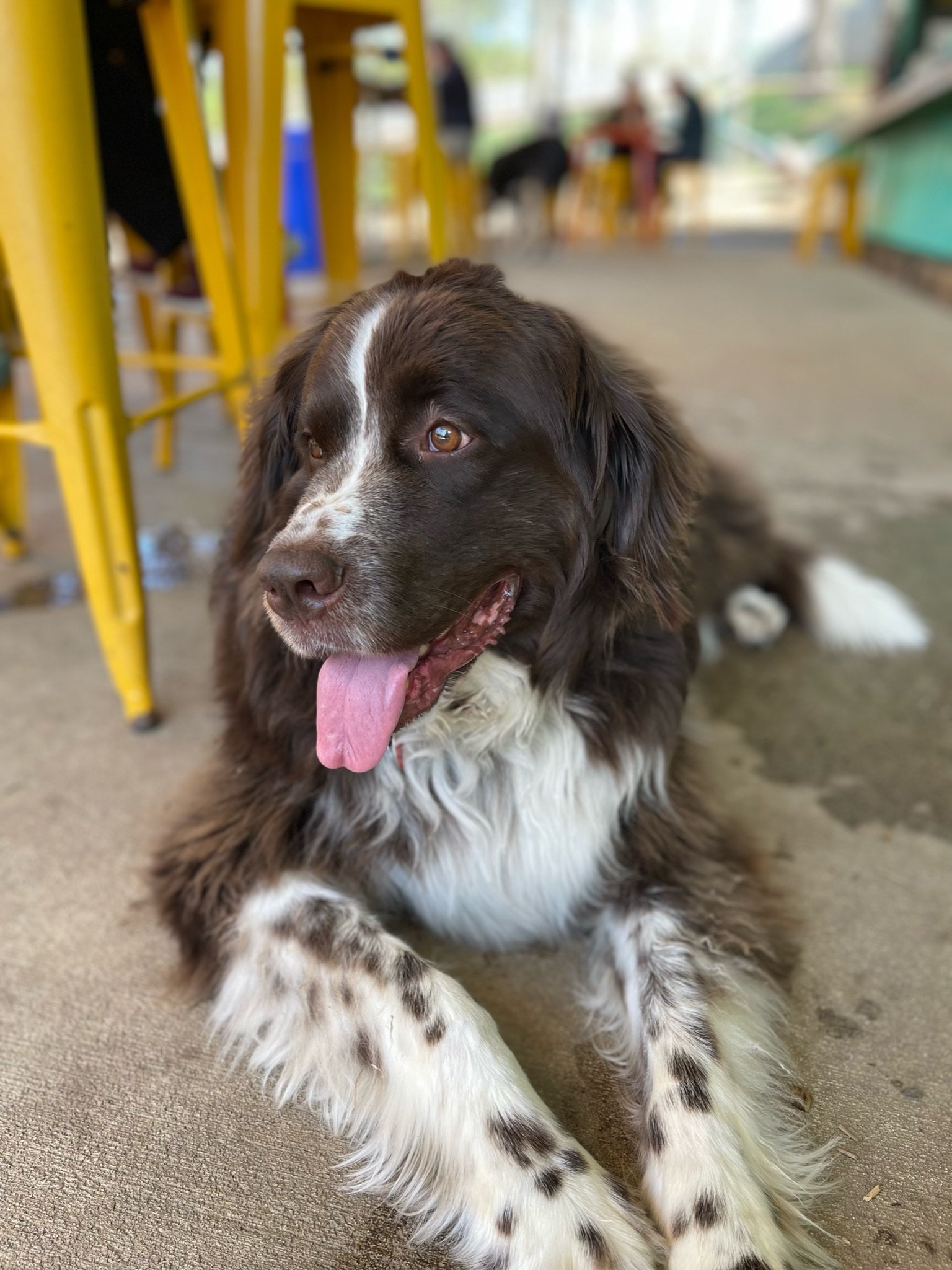
Recurring membership revenue directly reduces the cash flow volatility that causes most early-stage closures. A location with 150 active members has a revenue floor that carries it through slow weeks, bad weather, and off-season periods. A location that depends entirely on daily foot traffic has no floor — every slow week is a cash flow stress. For off-leash dog park businesses, building the membership base early is the single most important determinant of whether the business reaches stable operations.
Bottom TLDR
Failure rates for independent vs. franchise dog businesses depend more on capitalization, market selection, and execution than on the model itself. Franchise systems address specific early-stage risks through training, support, and financial disclosure. Independent operators take on more of that risk alone. The businesses that survive five years in this category start adequately funded, select a viable market, and build operations that can run without the owner present every day.
This page cites general industry data for informational purposes. Statistical claims about business survival rates reference SBA and APPA data as of the knowledge cutoff. This page is not investment or financial advice and is not an offer to sell a franchise. Investment in any business involves risk. Wagbar Franchising LLC, (828) 554-1021, 7 Kent Place, Asheville, NC, 28804.