

Experience Economy Franchises: Why Outdoor Recreation Businesses Are Outpacing Service Models

Top TLDR: Experience economy franchises in outdoor recreation outperform service models because they generate revenue from park access, beverages, memberships, and events simultaneously while building repeat community behavior. Dog bar franchises like Wagbar sit at the intersection of pet spending growth and the outdoor social venue trend. If you are evaluating an experience franchise opportunity, compare how the model builds recurring community loyalty versus single-transaction relationships.
Key Takeaways
Experience economy franchises in outdoor recreation generate revenue from multiple sources simultaneously: park access fees, beverage sales, memberships, and private events, while service franchises typically collect payment for a single transaction.
According to Eventbrite research, 78% of millennials prefer spending money on experiences over products, making experience-based businesses a structurally stronger investment for the decade ahead.
Dog bar franchises like Wagbar sit at the convergence of pet spending growth and the outdoor social experience trend, two of the fastest-moving segments in consumer behavior.
If you're evaluating an experience franchise opportunity, ask whether the business creates recurring community relationships or one-time transactions.
Franchise investors in 2025 are looking at two very different kinds of businesses. On one side: service models built around doing something for a customer and getting paid once. On the other: experience franchises built around creating a place people return to, linger in, and tell their friends about.
The numbers increasingly favor the second category. Outdoor recreation and social experience venues are posting growth rates that pure-service models struggle to match, and the structural reasons why are worth understanding before you commit capital to any franchise investment.
This page walks through what the experience economy actually means for franchise investors, why outdoor recreation has become the fastest-growing segment within it, and how the dog bar concept specifically captures two of the most durable consumer trends running simultaneously.
What the Experience Economy Means for Franchise Investors
The term "experience economy" was first articulated by Joseph Pine and James Gilmore in 1998. Their core argument was that economic value had progressed from commodities to goods to services, and the next stage was experiences: time well spent that customers pay a premium for and remember long after.
That framework, originally theoretical, has since been validated by 25 years of consumer data.
According to the U.S. Travel Association, experiential spending in the United States grew at roughly twice the rate of goods spending for most of the 2010s. The pandemic compressed that trend dramatically in 2020, then released it with force. Consumer spending on experiences rebounded faster and harder than any analyst predicted, and the recovery wasn't simply people returning to old habits. Research from McKinsey found that consumers who shifted to experience spending during the post-pandemic rebound were significantly less likely to revert to product-heavy spending than pre-pandemic models suggested.
For franchise investors, this shift has a direct implication. A service franchise delivers a result: a clean car, a trimmed lawn, a groomed dog. Customers pay for the outcome and leave. An experience franchise delivers a feeling: belonging, relaxation, social connection. Customers pay to be in the environment, and they return because of how it made them feel.

That distinction drives wildly different unit economics, customer retention curves, and word-of-mouth growth rates. It also changes the competitive landscape. You can undercut a service business on price. It's much harder to undercut a place that makes someone feel like they belong.
Explore how these dynamics play out across the pet franchise industry and what they mean for investors evaluating the next decade.
Why Consumers Pay More for Experiences Than Services
The behavioral economics underlying experience spending have been studied extensively, and the pattern is consistent across age groups, income levels, and geographies: people adapt to possessions quickly and stop deriving satisfaction from them, but they continue to draw satisfaction from experiences long after the experience ends.
This is sometimes called the "experience advantage" in consumer psychology research. Cornell psychologist Thomas Gilovich has studied it for decades. His research consistently shows that experiential purchases produce more lasting happiness than material purchases of equivalent cost, largely because experiences become part of personal identity in a way that products rarely do.
What this means practically for franchise investors: customers at experience-based businesses are not price-shopping in the same way they shop for services. A dog owner comparing membership at an off-leash dog bar to a pet grooming visit is comparing two entirely different categories of value. The grooming visit solves a problem. The dog bar membership feeds a lifestyle.
Lifestyle businesses command higher margins, lower churn, and stronger advocacy. According to Bain & Company, businesses that generate strong emotional connections with customers see 3x the revenue growth of businesses with weaker customer relationships. That emotional connection is structurally easier to build in an experience franchise than in a service franchise.
The outdoor recreation category adds another dimension. When the experience happens outdoors, customers also associate it with wellbeing, health, and community in ways that indoor service environments rarely achieve. An off-leash outdoor venue isn't just a place to take your dog. It becomes a ritual, a weekly social event, a source of relationships.
That's the retention engine that service models simply don't have access to.
Outdoor Social Venues as the Fastest-Growing Recreation Segment
Within the broader experience economy, outdoor social venues have pulled ahead of almost every other recreation subcategory since 2020.
The data here comes from several directions. The Outdoor Industry Association reported that outdoor recreation participation in the U.S. hit record levels in 2020 and has held most of those gains through 2024, with the most durable growth coming from social outdoor activities: paddleboarding groups, outdoor fitness classes, dog parks, and gathering venues with outdoor components.
Separately, IBISWorld's tracking of the bar and nightlife sector shows that venues with outdoor seating and non-alcohol-centered activities have significantly outperformed traditional indoor bar formats on customer retention and return visit frequency.
The convergence makes sense. Consumers came out of the pandemic with a heightened appreciation for outdoor space, a diminished appetite for crowded indoor venues, and a strengthened desire for community connection that remote work had frayed. Outdoor social venues checked all three boxes simultaneously.
For franchise investors, this creates an opening that didn't exist five years ago. The category is established enough to have a consumer base and cultural legitimacy. It's still early enough that franchise saturation in most markets is minimal. And the consumer behaviors driving it, preference for outdoors, desire for community, willingness to pay for genuine social experience, appear to be structural rather than cyclical.
Understand more about pet industry trends and the growth projections shaping investment decisions through 2030.
The Dog Bar at the Intersection of Pet Spending and Social Experience
The off-leash dog bar concept is not simply a pet business. It sits precisely at the intersection of two independent growth curves: the expansion of pet spending and the growth of outdoor social venues.
Both trends are well-documented individually. The American Pet Products Association reports that U.S. pet spending has grown every year for three decades without interruption, reaching over $147 billion annually. Dog owners specifically have shifted toward premium experiences for their animals: better food, more veterinary care, and increasingly, dedicated social and recreational environments.
At the same time, consumers are actively seeking third places: social environments that are neither home nor work, where they can build community. The decline of traditional third places (bowling alleys, civic clubs, neighborhood bars) has created genuine demand for new gathering spaces, and outdoor pet venues have organically filled that gap in many markets.
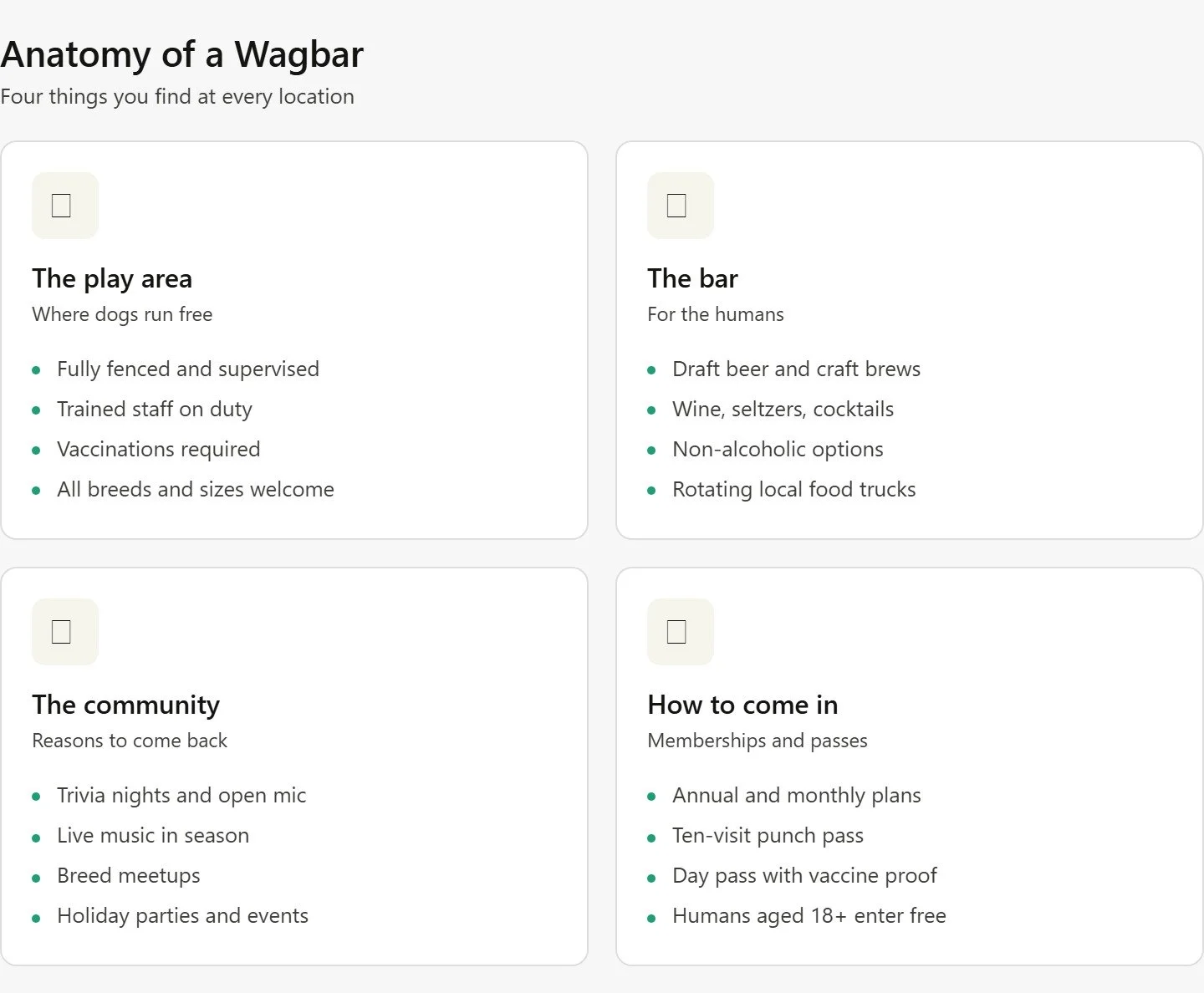
When you put a fully fenced off-leash play area together with a licensed bar serving draft beer, cocktails, wine, and non-alcoholic options, you're not just combining two businesses. You're creating a category where the dog's needs and the owner's desires are addressed simultaneously. That pairing drives visit frequency, session length, and social sharing at rates that neither a dog park nor a bar would generate independently.
Wagbar, founded in Asheville, North Carolina in 2019, built this model from the ground up. The flagship Weaverville location proved that the combination creates genuine community loyalty. Customers don't just visit when it's convenient. They build social schedules around it. They bring friends who become regulars. They buy memberships because the dog bar has become a regular part of their week.
Read more about why the dog bar model outpaces traditional dog parks as a business and community concept.
Revenue Comparison: Experience Franchise vs. Service Franchise
The structural difference between experience and service franchise unit economics comes into sharper focus when you look at revenue streams side by side.
A dog grooming franchise, as a representative service model, generates revenue primarily from individual appointments. Each visit is a discrete transaction. The customer arrives, receives a service, pays, and leaves. There's no inherent reason to stay, socialize, or spend beyond the core service. Upselling is possible but constrained. Revenue per visit is largely fixed.
A dog grooming franchise also requires that every revenue dollar be earned through active labor. No customers means no revenue, with fixed costs continuing regardless.
An experience franchise like an off-leash dog bar generates revenue from several simultaneous sources during any given operating hour. Membership and day-pass fees cover park access for dogs. Beverage sales run continuously throughout the visit. Private event bookings layer on top of normal operating revenue. Merchandise, food truck partnerships, and branded experiences add further diversification.
Critically, revenue doesn't require discrete labor-per-transaction. Forty people can be in the venue simultaneously, all generating beverage revenue, without any additional per-person labor cost beyond the standard staffing floor. That's fundamentally different from a service model, where forty customers would require forty service transactions.
Session length also matters. When customers enjoy an experience, they stay longer. A dog grooming visit is over in 45 minutes. A dog bar visit may last two hours or more. Longer sessions mean higher average spend per visit and a stronger habituation effect that drives return frequency.
Wagbar's model supports investment of $470,300 to $1,145,900 total, with a $50,000 franchise fee, 6% royalty on adjusted gross sales, and 1% toward the marketing fund. Investors who commit to three or more units receive a 50% multi-unit discount on the franchise fee. These figures are for informational purposes; all prospective franchisees should consult the Franchise Disclosure Document for complete details.
Review the full guide to revenue streams for off-leash dog bars to understand how the model diversifies income across a typical week.
Community Moat and Customer Loyalty Dynamics
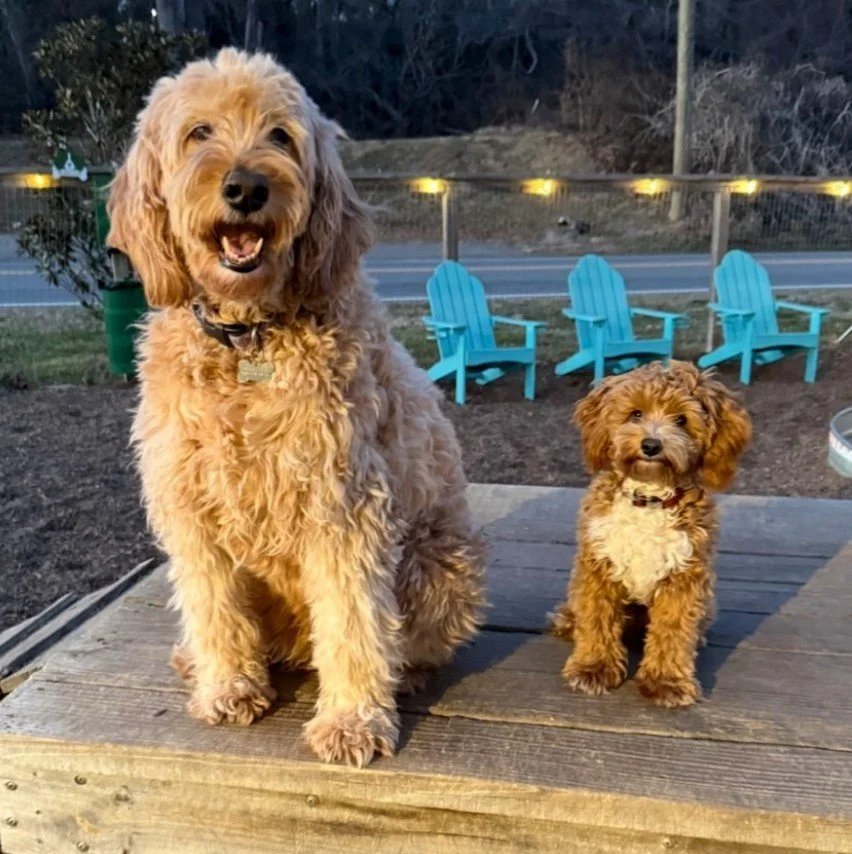
Service businesses compete primarily on price, quality, and convenience. Any of those advantages can be matched by a competitor with similar resources. An experience business builds something harder to replicate: community.
The concept of a "community moat" in franchise investing refers to the accumulated social relationships and identity that form around a venue over time. When a customer has met their friends at a particular dog bar every Saturday for two years, when their dog has a pack of regulars it recognizes, when the staff knows their name, the competitive threat from a new entrant is dramatically lower than it would be in a service category.
This dynamic shows up clearly in Wagbar's operational history. The Weaverville flagship location has earned recognition including a top-10 ranking in USA Today's 10Best Dog Bars list and multiple Best of WNC awards. That recognition reflects customer relationships deep enough that the community advocates publicly for the business.
Wagbar franchisees across its growing network, including locations in Richmond, Virginia; Phoenix, Arizona; and Los Angeles, California, bring this same community-building orientation. AJ Sanborn, the Richmond franchisee who came from a 20-year financial services career, specifically chose the dog bar model over a traditional bar because of the community it creates. Dianna in Phoenix, coming from IT sales and a restaurant background, described it the same way: not a traditional business transaction but a space where connections form.
That community moat is what service franchises struggle to build. The customer relationship is transactional by definition. The experience franchise, when executed well, becomes part of how its customers define their social life.
Explore the community building principles behind dog-focused businesses and how they translate into customer retention metrics.
How Market Selection Amplifies Experience Franchise Performance
Not every market supports an experience franchise equally. Service businesses can operate in nearly any location with sufficient population density. Experience franchises perform best in markets with specific demographic and cultural characteristics.
For outdoor recreation and dog-focused social venues specifically, the highest-performing markets share several traits. College towns and university corridors bring a younger demographic that spends heavily on experiences and adopts community venues quickly. Tech corridors and professional hubs have high household incomes, high dog ownership rates, and a population that actively seeks authentic gathering places. Outdoor recreation markets, cities with strong hiking, cycling, and outdoor lifestyle cultures, have residents who are already predisposed to spending time in outdoor social venues.
Markets that over-index on these characteristics generate faster membership adoption, higher average spend per visit, and stronger organic word-of-mouth. Wagbar's expansion targets markets with these profiles specifically: Richmond, Denver, Phoenix, Atlanta, and others where the demographic fit supports the experience-driven model.
The best cities for dog franchise success breaks down the specific market demographics that predict strong performance for off-leash outdoor concepts.
What Franchise Investors Should Ask About Any Experience Concept
Experience economy franchises are not uniformly well-positioned. The category has genuine advantages over service models, but those advantages only materialize if the underlying concept actually creates the community and repeat behavior that drives the economics.
Before committing to any experience franchise, investors should ask five questions.
Does the visit generate social sharing? Experience venues that prompt customers to post, share, and tell friends have a built-in marketing engine. Dog bars generate this naturally. A dog playing freely while its owner has a drink is an inherently shareable moment.
What drives repeat visits? A single novel experience doesn't build a business. The retention mechanics matter. Wagbar's membership model, weekly events calendar, and the habitual nature of dog owners' routines create the repeat pattern.
Is the revenue multi-stream or single-stream? Single-stream revenue creates fragility. Multi-stream models create resilience. Dog bar revenue from memberships, day passes, beverages, and events distributes risk across customer behaviors.
Does the community compound over time? The best experience franchises get stronger as their community grows. New members meet existing members and integrate into the social network, raising switching costs for everyone.
How recession-resistant is the core behavior? Pet ownership and spending have proven recession-resistant through multiple economic cycles. Dog owners who have built a social routine around a dog bar are unlikely to eliminate it during a downturn. The behavioral economics of community attachment are genuinely sticky.
Review what to look for specifically in an off-leash dog bar franchise investment before moving forward with any decision.
Frequently Asked Questions
What is an experience economy franchise?
An experience economy franchise is a business built around delivering a memorable, repeatable social experience rather than completing a discrete service transaction. Instead of charging customers for a single outcome, experience franchises charge for time spent in an environment, which typically results in multiple simultaneous revenue streams: access fees, food and beverage sales, memberships, and private events. Examples include escape rooms, entertainment complexes, and off-leash dog bars.
Why are outdoor recreation franchises growing faster than service franchises?
Consumer behavior shifted significantly after 2020 toward outdoor activities, social connection, and experience-based spending. Outdoor social venues benefit from all three of those shifts simultaneously. They also carry lower perceived health-and-safety anxiety than indoor venues and align with broader wellness trends. Service franchises have not seen comparable tailwinds because the behavioral drivers of their growth, convenience and time savings, are largely unchanged rather than accelerating.
How does a dog bar franchise generate more revenue than a dog service business?
A dog bar operates multiple revenue streams simultaneously: park access fees or memberships for dogs, beverage sales for humans, private event rentals, and ancillary revenue from food trucks and merchandise. All of these revenue streams run concurrently during operating hours, and longer average visit lengths mean higher per-customer spend. A service business like grooming or training generates revenue only when a service is being actively delivered.
What investment is required to open a Wagbar franchise?
The total estimated initial investment ranges from $470,300 to $1,145,900, with a $50,000 franchise fee. The royalty rate is 6% of adjusted gross sales, plus 1% to the Wagbar marketing fund. Investors committing to three or more units receive a 50% discount on the franchise fee for additional units. These figures are informational; prospective investors should review the Franchise Disclosure Document for complete details before making any investment decision.
Do experience franchises perform better in certain markets?
Yes. Outdoor experience franchises and dog-focused social venues specifically perform best in markets with high household incomes, high dog ownership rates, strong outdoor recreation cultures, and an active social scene. College towns, tech corridors, and cities with established craft beverage cultures consistently produce faster customer adoption and stronger membership retention.
What makes the dog bar experience sticky for customers?
Several behavioral dynamics reinforce retention. Dog owners already have a habitual routine around their dogs' exercise and social needs, and a dog bar fits naturally into that rhythm. The social relationships customers form, both among owners and among dogs, create a genuine switching cost. Membership pricing encourages regular attendance. And the experience itself is inherently positive: a relaxed outdoor setting, social interaction, and a pet that's visibly happy create a strong associative reward that drives return behavior.
Summary
Experience economy franchises in outdoor recreation are outpacing service models for clear structural reasons. Consumers pay more, stay longer, return more frequently, and advocate more loudly for businesses that create genuine community rather than complete isolated transactions. The dog bar concept, by combining the pet spending growth curve with the outdoor social venue trend, sits at an unusually strong intersection for franchise investors. Wagbar's model across its growing national footprint demonstrates what that intersection produces: loyal membership communities, diversified revenue, and a competitive position that compounds as the local customer base grows. If you're evaluating experience franchise opportunities, the off-leash dog bar category deserves serious consideration alongside your FDD review.
Bottom TLDR: Experience economy franchises in outdoor recreation generate stronger retention, higher average spend, and more durable customer loyalty than service models because they create community rather than completing transactions. Wagbar's off-leash dog bar concept captures both the pet spending growth curve and the outdoor social experience trend. To evaluate this as a franchise investment, review the Franchise Disclosure Document and compare revenue stream diversity against service alternatives.
Explore Wagbar franchise opportunities
Investment figures referenced throughout this page are for informational purposes only. Prospective franchisees should consult Wagbar's Franchise Disclosure Document for complete financial details before making any investment decision.