

Dog Training Franchise vs. Dog Park Bar: Comparing Two Growing Pet Business Models

Top TLDR: A dog training franchise and a dog park bar franchise serve dog owners through entirely different business models. Training generates session-based revenue limited by trainer capacity, while a dog park bar like Wagbar builds recurring membership income and multi-stream revenue that compounds over time. If you're comparing these two growing pet business models, request each franchisor's FDD and review Item 19 before deciding.
Dog training franchises and dog park bar franchises both tap into one of the most resilient spending categories in the US economy. Both serve dog owners. Both benefit from the ongoing humanization of pets that has pushed annual US pet spending past $147 billion. And both offer investors a pet business model with a real market behind it.
What they don't share is much else. The operational requirements, revenue structures, staffing demands, investment profiles, and long-term competitive trajectories are meaningfully different. If you're trying to figure out which one is the better fit for your situation, this comparison covers what actually matters.
For context on the full investment spectrum across all pet franchise categories, the pet franchise investment overview covers the range from mobile concepts through full build-outs.
What Each Business Model Actually Does
Understanding the comparison requires being precise about what you're actually comparing.
Dog training franchises are skill-and-service businesses. Revenue comes from training sessions, group classes, behavioral consultations, and in some concepts, online or hybrid training programs. The business depends on certified trainers, curriculum development, and consistent client throughput. Some concepts are mobile or in-home. Others operate from a dedicated training facility. A few offer a hybrid model with both facility-based group classes and in-home private sessions.

Dog park bar franchises like Wagbar are experience and hospitality businesses. Revenue comes from dog park memberships, day passes, and food and beverage sales. Human guests visit with their dogs, the dogs play off-leash in a fenced environment, and the humans enjoy a bar experience alongside them. The concept creates a social gathering place that functions simultaneously as a pet amenity and a community venue.
Neither is a variation of the other. They share a customer segment, but they're different businesses built around different customer needs and different operator skills.
Investment Cost Comparison
Dog training franchise investment:
Dog training franchise investment ranges vary more than almost any other pet category because the concept types vary so much. Mobile or in-home training concepts can be started for $80,000 to $150,000 total. Facility-based training programs with dedicated space typically run $200,000 to $400,000. Hybrid concepts with both facility and mobile operations fall somewhere in the middle.
Franchise fees for training concepts generally run from $20,000 to $50,000. Royalties typically range from 6% to 12% of gross sales, with some concepts charging higher royalties to reflect lower build-out requirements. The labor cost structure is different from retail or hospitality: the primary ongoing cost is trainer compensation, which is tied directly to revenue production.
Dog park bar franchise (Wagbar) investment:
Wagbar's total investment range is $470,300 to $1,145,900, with a $50,000 franchise fee, 6% royalty on adjusted gross sales, and a 1% marketing fund contribution. Operators opening three or more units receive a 50% discount on franchise fees starting at the third location.
The investment spread reflects real estate variability. Markets with accessible outdoor space and lower build-out costs sit toward the lower end. High-cost urban and suburban markets with premium real estate push the range upward.
(All figures are illustrative. Prospective franchisees must review the current Franchise Disclosure Document for complete and verified investment information.)
The gap between the two investment ranges is real, and for investors with a capital constraint, it matters. But the cost comparison needs to be evaluated alongside the revenue model, because how much you can earn relative to what you spend determines whether the investment makes sense.
The pet store franchise cost breakdown covers all five major pet business models in one place if you want to see the full category side by side.
Revenue Models: How Each Business Earns
This is where the two models diverge most clearly.
Dog training revenue:
Training revenue is session-based. A client books a private lesson or signs up for a group class, pays per session or per package, and returns when they're ready for more. Average session rates for private training typically run $75 to $150 per hour depending on market and trainer credentials. Group classes run lower per session but higher in throughput since multiple dogs participate simultaneously.
The recurring revenue story in dog training is limited. Some concepts sell prepaid session packages that create short-term revenue certainty, but there's no equivalent to a monthly membership that generates income regardless of visit frequency. Once a dog completes a training program, the relationship often pauses until the owner has a new need. Retention requires deliberate programming, new curriculum, and consistent outreach.
Revenue capacity at a single location is constrained by how many sessions trainers can deliver per day and how many dogs can safely participate in group classes. Adding revenue requires adding trainers or adding hours, each of which adds cost and complexity.
Dog park bar revenue:
Wagbar generates revenue from three simultaneous streams: memberships, day passes, and food and beverage.
The membership layer is the critical differentiator. Members pay recurring monthly or annual fees for unlimited access. That revenue continues whether a member visits once a week or once a month. A location with a strong membership base collects predictable recurring income before a single day pass is sold or a single drink is poured. The compounding effect of membership growth over 12 to 24 months transforms the financial character of the business.
Day passes capture visitors who haven't yet converted to membership, first-time guests, and occasional users. Food and beverage serves human guests at the bar, with margins more typical of hospitality than pet services. No skilled labor cost attaches to each beverage transaction the way it does to each training session.
The multi-stream structure means Wagbar's revenue model is more layered and more resistant to disruption. A day where no day passes are sold doesn't erase the membership revenue already collected. There's no appointment cancellation problem because revenue doesn't depend on each individual transaction.
For a full breakdown of how these revenue streams work together, Wagbar's revenue model overview is worth reviewing before you finalize any investment comparison.
Gross Margins and Profitability Profile
Dog training margins:
Dog training is a high-skill service business. Gross margins for facility-based training typically run 45% to 60%. The primary cost is trainer compensation, which is necessary for every unit of revenue generated. Supply costs (treats, equipment, curriculum materials) are relatively minor. After fixed costs including rent (for facility-based concepts), royalties, insurance, and overhead, net operating margins for well-run training franchises generally run 15% to 25%.
That's a solid profitability profile. The constraint is that growth requires proportional increases in trainer capacity, which means growth is linear rather than leveraged. Adding 20% more revenue means adding roughly 20% more trainer hours.
Dog park bar margins:
Wagbar's blended margin structure reflects the three-revenue-stream model. Membership revenue has very low marginal cost once the facility is operational. Each new member added to an existing base generates revenue with minimal incremental expense. Beverage revenue carries margins typical of a well-run bar. Day pass revenue adds minimal variable cost as well.
The membership component specifically creates the potential for increasing margin efficiency over time. As the member base grows, fixed costs are spread across a larger recurring revenue base, improving the operating margin profile. That dynamic doesn't exist in the same way in a session-based service business.
Staffing: Who You're Actually Managing
Staffing requirements are a practical reality that financial models tend to understate.
Dog training staffing:
Certified dog trainers with recognized credentials (CPDT-KA, KPA-CTP, or equivalent) are the core requirement for any quality training franchise. This is a specialized skill set with a limited labor pool. Qualified trainers take significant time to develop and are in demand across multiple employment contexts including veterinary clinics, shelters, and independent practice.
Turnover among training staff disrupts client relationships directly. A client who has built a rapport with a particular trainer may follow that trainer when they leave, which is a revenue loss that isn't always easy to quantify in advance. Franchise training concepts address this with systems and curriculum ownership, but the underlying labor market reality is that good trainers have options.
Dog park bar staffing:
Wagbar's staffing model centers on park monitors who maintain safety and enforce vaccination and entry standards, and bar staff who handle beverage service. These roles draw from a broader and more accessible labor pool than certified dog trainers. Hospitality and customer service experience is common and widely available.
The community dynamic of a dog park bar creates a different retention incentive for staff as well. Employees who become known to regular members and their dogs build relationships that make the workplace more engaging. That's harder to replicate in a session-based service environment where each appointment is relatively transactional.
Wagbar requires all dogs entering the park to be current on rabies, Bordetella, and distemper vaccinations, to be at least six months old, and to be spayed or neutered. Enforcing those standards is a daily operational task handled by park monitors.
Competitive Environment for Each Model
Dog training competition:
Dog training is a fragmented market. Independent trainers operate across every US market with minimal barriers to entry. Certification improves quality but isn't legally required in most states. Online training platforms have expanded access to behavioral guidance at lower price points, creating some downward pressure on the in-person training market for basic obedience needs.
Franchise training concepts compete on brand consistency, proven methodology, and the credibility that comes with a recognizable system. The competitive case for a franchise over an independent trainer centers on the customer's desire for a structured, accountable program rather than one person's approach.
The broader pet services category, of which training is a part, has shown strong resilience. According to the American Pet Products Association, pet services spending has been one of the fastest-growing segments of the $147 billion US pet industry. Training participates in that growth.
Dog park bar competition:
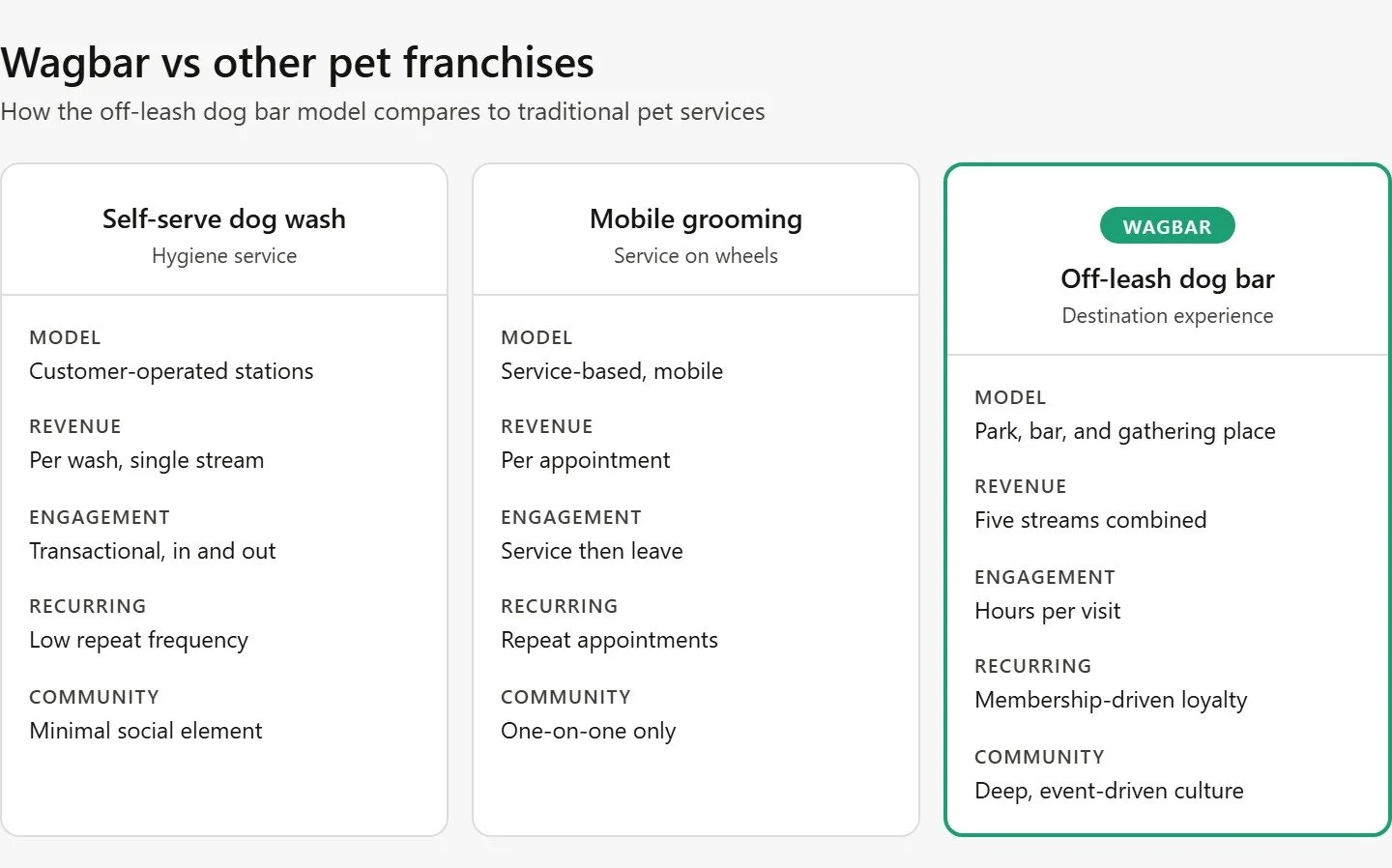
The branded off-leash dog bar category is newer and less crowded than training. Public dog parks exist in most markets but offer a different product: no bar, no vaccination standards, no trained monitors, no membership community. They're a related amenity, not a direct substitute.
Independent dog bars exist in some markets. Wagbar operates as a branded franchise system with consistent standards, training, and operational infrastructure that independent operators typically don't have. Being an earlier entrant in a market with an established brand provides real advantages in community recognition and membership growth.
The experience-based pet concept benefits from a structural immunity to online competition that service businesses partially share. You can't take a dog training course entirely online and get the same result you'd get in person with a skilled trainer in a controlled environment. You absolutely cannot replicate an off-leash play session with a beer in hand through any digital channel. Both categories have some protection here, but the dog park bar has a complete immunity that training concepts don't fully share.
The dog park market guide covers what the competitive picture looks like across different US markets.
Which Business Fits Which Investor
Neither model is universally better. The right choice depends on the investor.
Dog training franchise investors tend to have backgrounds in education, coaching, behavioral science, or animal care. Some are trainers themselves who want to build a business around their expertise. Others manage the business operationally and hire certified staff. The business suits someone who wants to build a professional services operation, is comfortable managing specialized labor, and finds fulfillment in measurable behavioral outcomes.
Dog park bar investors tend to come from finance, sales, hospitality, or corporate management backgrounds. They're drawn to the community dimension, the recurring revenue structure, and a business that creates a gathering place rather than delivering a service. Wagbar's confirmed franchise owners reflect this profile clearly.
AJ Sanborn in Richmond spent 20 years in financial services before evaluating the recurring membership model and deciding it was the right fit. Liz and Shelby in Knoxville brought finance and sales backgrounds to a partnership that's building one of the brand's newest locations. Dianna in Phoenix came from IT sales and restaurant experience, recognizing the hospitality side of the model as a natural extension of what she already knew.
If you're working through what kind of franchise fits your background and goals, the types of animal franchise opportunities guide covers the full range of pet franchise categories with context on which investor profiles tend to succeed in each.
Frequently Asked Questions

Is a dog training franchise a good investment?
Dog training franchises offer solid gross margins, a skill-based service model, and a market that has shown consistent growth. The labor market for qualified trainers is tight, and revenue is session-based rather than recurring. For investors with relevant background or genuine interest in the training process, they can be a strong investment. Review Item 19 of the specific franchisor's FDD for available earnings data.
How does a dog park bar franchise generate recurring revenue?
Wagbar generates recurring revenue through memberships: monthly or annual fees that members pay for unlimited access. Once a dog owner becomes a member, that revenue continues regardless of visit frequency. A growing membership base creates a predictable income floor that session-based service models don't have. Day pass and food and beverage revenue add to that base on a transactional basis.
What does Wagbar require for dogs entering the park?
All dogs entering a Wagbar must be current on rabies, Bordetella, and distemper vaccinations, be at least six months old, and be spayed or neutered. Human entry is free for guests 18 and older. Wagbar is a day-use concept and does not offer boarding. The dog health and safety standards page covers these protocols in full.
Can I own a dog training franchise without being a certified trainer?
Many dog training franchise concepts are designed for owner-operators who manage the business and hire certified trainers rather than performing training themselves. Operational understanding of the service is still important for managing quality and staff effectively. Check the specific franchisor's requirements, since some concepts require franchisee certification and others do not.
How do I compare dog training franchises to dog park bar franchises financially?
The most reliable way to compare any two franchises financially is to review the Franchise Disclosure Document for each. Item 7 covers the estimated initial investment. Item 19 covers any earnings disclosures the franchisor chooses to include. Beyond the FDD, call existing franchisees from both systems and ask about actual costs versus projections, ramp-up timelines, and what they would do differently. The franchise investment due diligence guide walks through what to look for at each step.
Bottom TLDR: Dog training franchises offer strong gross margins and a skill-based service model with lower startup costs. Dog park bar franchises like Wagbar require a higher investment but generate recurring membership revenue, layered income streams, and a community that drives long-term retention. To compare them accurately, review Item 7 and Item 19 of each franchisor's FDD and speak directly with existing franchise owners.
FDD Disclaimer: All Wagbar investment figures cited on this page are illustrative estimates only. Prospective franchisees must receive and review the current Franchise Disclosure Document before making any investment decisions. Nothing on this page constitutes an offer to sell a franchise.