

Dog Park Franchise vs. Dog Boarding Franchise: Which Business Model Fits Your Goals

A dog park franchise and a dog boarding franchise are both pet businesses, but they operate with fundamentally different economics, staffing structures, and customer relationships. Dog park concepts run on day-use access with membership revenue and low overnight obligations; boarding depends on nightly capacity and round-the-clock care. Understanding those differences is the first step toward choosing the model that actually matches how you want to run a business.
Two Pet Businesses, Two Very Different Days
On any given Tuesday, a dog boarding franchise operator might arrive before 6 a.m. to start morning feeding rounds, coordinate a dozen staff handoffs across daycare, boarding, and grooming, and stay on call in case of a late-night emergency. A dog park franchise operator might open at 10, check vaccination records at the gate, serve cold drinks to regulars, and close up at 9 that evening.
Neither description is better. They're just genuinely different businesses with different demands on your time, your team, and your capital. If you're seriously comparing these two models, the question isn't which one is more profitable in theory. It's which one fits the way you want to spend your days and the financial goals you're trying to reach.
This comparison breaks down the key differences across day-use vs. overnight operations, membership vs. per-visit revenue, and what staffing actually looks like at each type of location.

Day-Use vs. Overnight: What Each Model Actually Requires
The most fundamental difference between a dog park franchise and a dog boarding franchise is what happens after closing time.
Dog boarding is a 24-hour business whether you want it to be or not. Dogs in overnight care need feeding, monitoring, and emergency coverage around the clock. That means staffing overnight shifts, building protocols for medical situations, and maintaining facilities to a standard that holds up through continuous use. Most boarding operations handle some combination of boarding, daycare, and grooming under one roof, which compounds the operational complexity. Regulatory requirements in most states also reflect that complexity, with specific kennel licensing, health inspections, and animal welfare standards that vary by jurisdiction.
Dog park franchises are day-use businesses. At a Wagbar location, dogs and their owners visit during posted hours, play off-leash in a fenced park, and go home. There's no overnight boarding component. Staff manage guest check-in, verify vaccination records, monitor the park for safety, and run the bar operation. When the location closes, so does the operational responsibility.
That structural difference shapes almost everything else: investment requirements, staffing needs, insurance exposure, and how you think about growth.
Revenue Model: Memberships vs. Per-Visit Fees
How a business earns money determines how predictable that income is and how hard you have to work to maintain it.
Dog boarding revenue is transactional by nature. A customer pays per night or per day. If they don't board their dog, you don't earn revenue from them that week. Revenue is closely tied to travel patterns, seasonal demand, and local competition. During slower travel periods, occupancy drops. During peak holidays, demand spikes and capacity becomes the limiting factor. It's a model that can generate strong weekly revenue at full occupancy but carries real variability across the calendar.
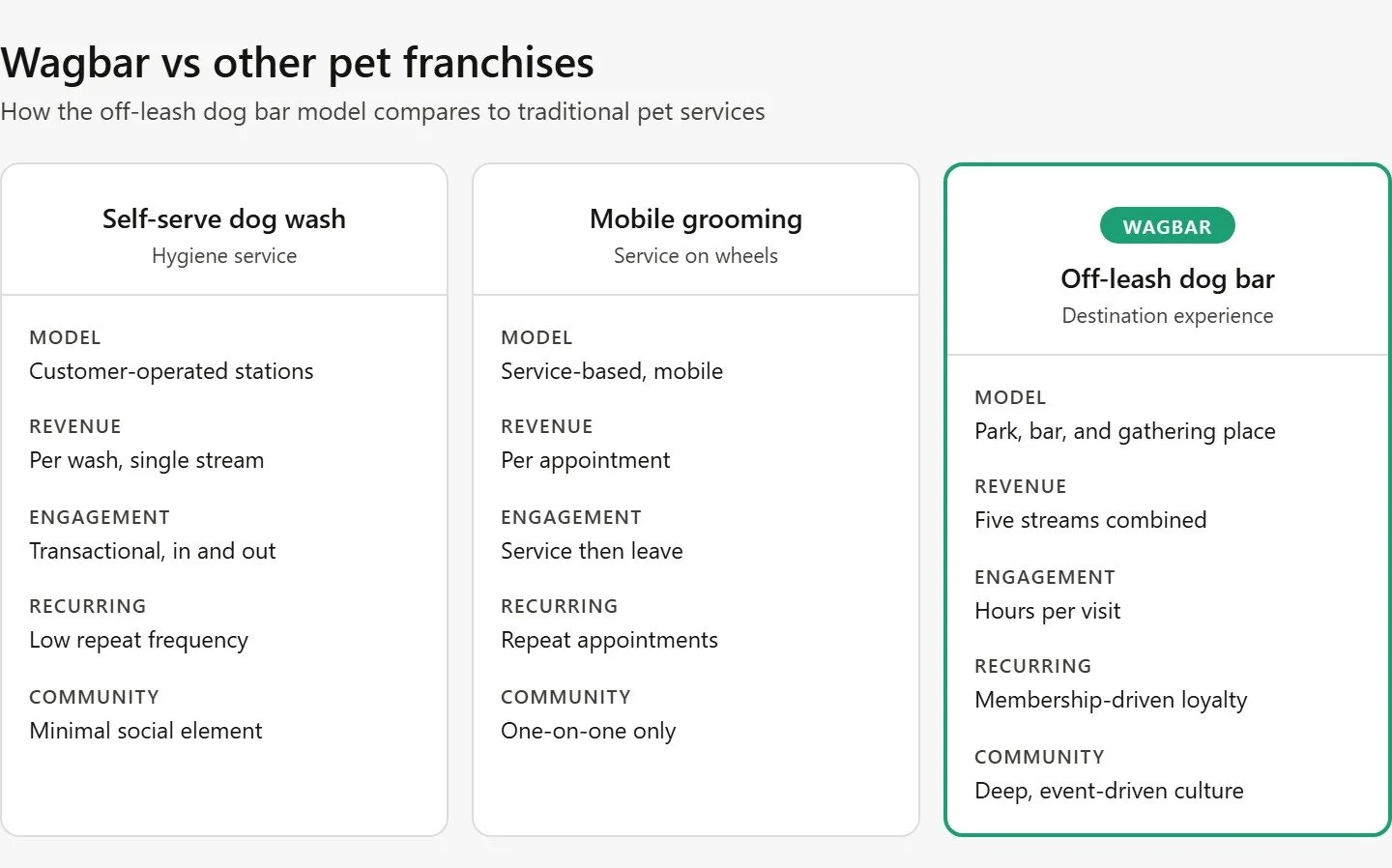
Dog park franchise revenue is structured differently. At Wagbar, membership options include daily, monthly, annual, and multi-visit punch passes. A member who pays monthly generates predictable revenue whether they visit once a week or every day. That recurring base provides stability that per-visit boarding revenue doesn't. On top of memberships, each visit generates bar and beverage revenue, which extends both the length of visits and the revenue per customer through a channel that boarding facilities simply don't have.
Day passes serve customers who aren't ready to commit to a membership, functioning as a lower-friction entry point. Over time, day-pass visitors often convert to members as the location becomes a routine part of their week.
This combination of membership revenue, day passes, and bar sales creates multiple income streams within a single visit rather than one flat nightly fee per dog. For investors who value predictability and multiple revenue channels, that structure is worth examining carefully.
Staff Complexity: What You're Actually Managing
Staffing is where the operational reality of each model becomes most apparent.
Boarding operations require a larger, more complex team. Overnight coverage means you either schedule staff around the clock or carry real personal responsibility for after-hours incidents. Dog behavior in group boarding settings requires trained staff who can recognize stress signals, manage introductions between unfamiliar dogs, and respond to fights or health emergencies at any hour. Grooming staff, daycare monitors, kennel cleaners, and customer-facing reception often represent four or five distinct roles that must be scheduled and managed simultaneously.
Staff turnover is a well-documented challenge in the pet care industry, particularly at boarding facilities where the hours are demanding and the pay at entry level tends to be modest. Managing that turnover while maintaining consistent care standards is one of the persistent operational challenges in the boarding model.
Dog park franchises require a smaller, more focused team. Staff at a Wagbar location handle gate check-in, park monitoring, and bar service. The role combines dog awareness with hospitality, which is a learnable combination. Wagbar's one-week intensive training in Asheville covers dog behavior management, bar operations, and staff training protocols so franchisees can set consistent standards from day one. The proprietary Opener app also provides structured pre-opening guidance so teams are prepared before the first guest walks through the gate.
There are no overnight shifts. There are no after-hours kennel emergencies. The operational window is defined and predictable in a way that boarding is not.
Capital Investment: What You're Paying For
Investment differences between the two models reflect the physical and operational requirements of each.
Dog boarding facilities require substantial real estate, indoor and outdoor kennel runs, climate control systems, sanitation infrastructure, and safety systems that meet state licensing requirements. Total investment for a mid-sized boarding facility typically runs from $750,000 to over $2 million depending on market, size, and build-out approach. Ongoing operational costs are high because of staffing, utilities, and facility maintenance.
Wagbar's total initial investment ranges from $470,300 to $1,145,900, with a $50,000 franchise fee. The model includes a near-turnkey bar build-out using converted shipping containers, which simplifies the construction process and reduces both timeline and complexity. Royalties are 6% of adjusted gross sales, with 1% contributed to the Wagbar marketing fund. Franchisees who commit to three or more units receive a 50% multi-unit discount on the franchise fee.
These figures are informational. Prospective franchisees should review the current Franchise Disclosure Document for complete details before making any investment decisions.
The physical footprint differences matter too. Boarding facilities need significant indoor space for kennels, play areas, and grooming. Dog park franchises need outdoor acreage for off-leash play with a more modest indoor or covered bar structure. Site selection criteria differ accordingly, and zoning requirements for a licensed bar alongside a dog park are distinct from kennel licensing requirements for boarding. The pet business legal guide covers how licensing and compliance differ across pet business types.
Target Customer and Location Fit
Understanding who your customer is and what motivates them determines where you should open and how you market.
Boarding customers are primarily dual-income households with dogs and regular travel needs. They need reliable care for their dog when they're away. The relationship is transactional but can be loyal if trust is established. Location matters: easy access from residential neighborhoods and proximity to highways or airports influences choice. Once a customer finds a boarding facility they trust, switching costs are meaningful, which creates decent retention.
Dog park customers span a wider behavioral profile. Some are dog owners who want regular socialization for their dog in a safe, monitored environment. Some are social people who want a place to meet other dog owners over a drink. Many are both. The community dynamic is a real differentiator. Regular visitors become familiar faces, staff know regulars by name, and the experience accumulates social value that a boarding drop-off simply doesn't.
Markets with strong outdoor and social culture tend to perform well for dog park bar concepts. Understanding what demographics and markets make the most sense for this model is part of Wagbar's site selection support.
Which Model Fits Which Investor?
Neither model is universally better. The right fit depends on your background, your capital, and what you actually want to be doing every day.
A boarding franchise might make sense if you have experience managing complex operations, you're comfortable with 24-hour business obligations, you have access to substantial capital, and you're drawn to the care-focused relationship of overnight pet supervision.
A dog park franchise is worth serious consideration if you want defined operating hours without overnight obligations, you're energized by community building and social environments, you prefer a recurring membership revenue model over purely transactional income, and you want a business with genuine market differentiation rather than competing in an already-crowded category.
Wagbar's franchisees reflect that second profile. AJ Sanborn spent 20 years in financial services before choosing Wagbar specifically because the model offered a business structure with community at its core. Dianna in Phoenix came from IT sales and was drawn to combining her love of people and dogs in something that felt more like community building than traditional operations management. Their paths into this model were different, but the appeal of a defined, relationship-driven business with a social atmosphere was consistent.
The complete guide to different pet franchise types offers a broader look at where each category fits within the overall pet industry landscape.
Frequently Asked Questions
Is a dog park franchise less expensive than a dog boarding franchise?
Generally, yes. Boarding facilities require significant real estate, indoor kennel infrastructure, and staffing for round-the-clock operations, which pushes total investment well past $1 million in most cases. Wagbar's investment range of $470,300 to $1,145,900 reflects a model with lower physical infrastructure requirements and no overnight operations. Consult current FDD documents for both categories before making any financial comparisons.
Does a dog park franchise require less staff than a boarding facility?
Typically, yes. Dog boarding requires staff for overnight shifts, daycare supervision, grooming, and kennel maintenance simultaneously. A dog park franchise operates during defined hours with a smaller team covering park monitoring, gate check-in, and bar service. There are no overnight shifts.
Which model produces more predictable revenue?
Dog park franchises with a strong membership base produce more predictable recurring revenue than per-night boarding, which fluctuates with travel demand and seasonality. Membership revenue arrives monthly regardless of visit frequency, while boarding revenue depends on occupancy.
Can a dog park franchise compete in a market that already has multiple boarding facilities?
Yes. They serve overlapping but meaningfully different customer needs. A dog owner might use boarding for travel and a dog park for regular social outings. The two models aren't direct substitutes, and a dog park bar concept with a membership community competes on different dimensions than a boarding facility.
What zoning is required for a dog park franchise?
Zoning requirements vary by municipality, but dog park franchises typically need to satisfy regulations for outdoor dog areas and, if serving alcohol, local liquor licensing. This is distinct from kennel licensing required for boarding. Wagbar provides legal and compliance support as part of franchisee onboarding. The zoning and regulations guide covers this across pet business types.
Where can I learn more about the Wagbar franchise model specifically?
Start at the Wagbar franchising page for investment details, training overview, and inquiry information. You can also review what to look for when evaluating an off-leash dog bar franchise to understand the specific questions worth asking before committing.
Investment figures for Wagbar are provided for informational purposes only. Prospective franchisees should review the current Franchise Disclosure Document for verified financial details.